

Most merchants still treat bitcoin as an asset they need an opinion about. Will it go up? Is it a bubble? Should we hold any? Those are fair questions, and none of them is the one that matters for your business. The question that matters is simpler: who are the customers asking whether you accept it, and what are they worth to you?
I spent more than ten years building merchant loyalty and rewards programs at Mastercard. For the past year I’ve studied the Bitcoin economy from the merchant’s side of the counter. Here is the case in seven ideas. Each one has its own piece in this library.
1. Bitcoin-friendly is a posture toward a customer, not a belief about an asset
Tens of millions of Americans own some bitcoin (if indirectly). Security.org’s 2026 survey implies roughly one adult in five. Inside that group is a much smaller committed core, which we conservatively estimate at around one million people, and growing, for whom bitcoin is not just an asset they hold but a cause or mission.
Bitcoin-friendly is a posture toward a customer, not a belief about an asset.
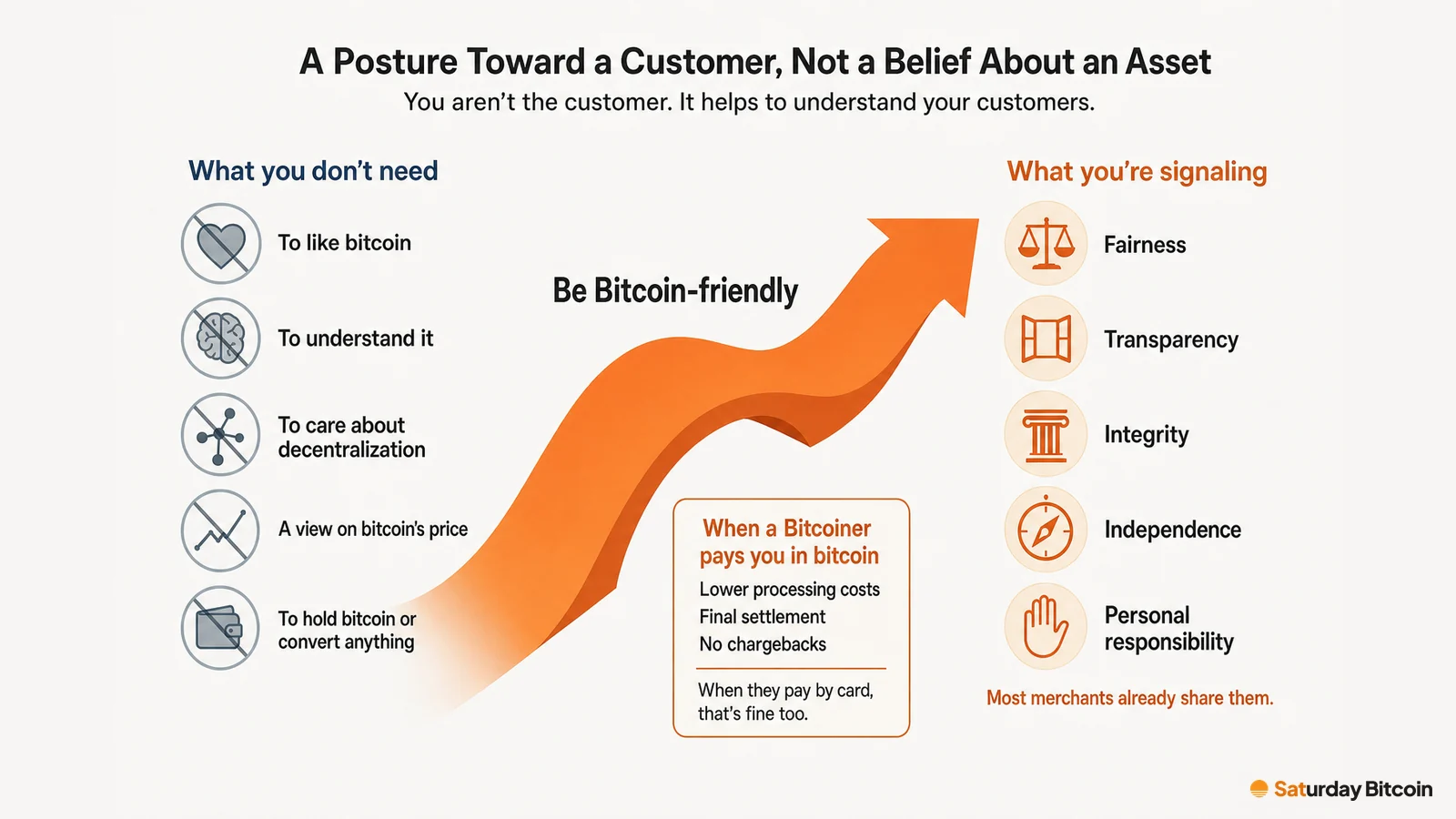
Many of them shop based on a single leading criterion: which merchants are Bitcoin-friendly? They tend to be patient, often affluent, and vocal. No ad platform lets you target them. Irrespective of what you think about bitcoin, the customer segment is real, invaluable, and very likely unclaimed by any merchant in your category so far.
2. Accepting bitcoin isn’t enough
Thousands of businesses already accept bitcoin and see little volume from it. A payment option sitting quietly at checkout tells nobody anything.
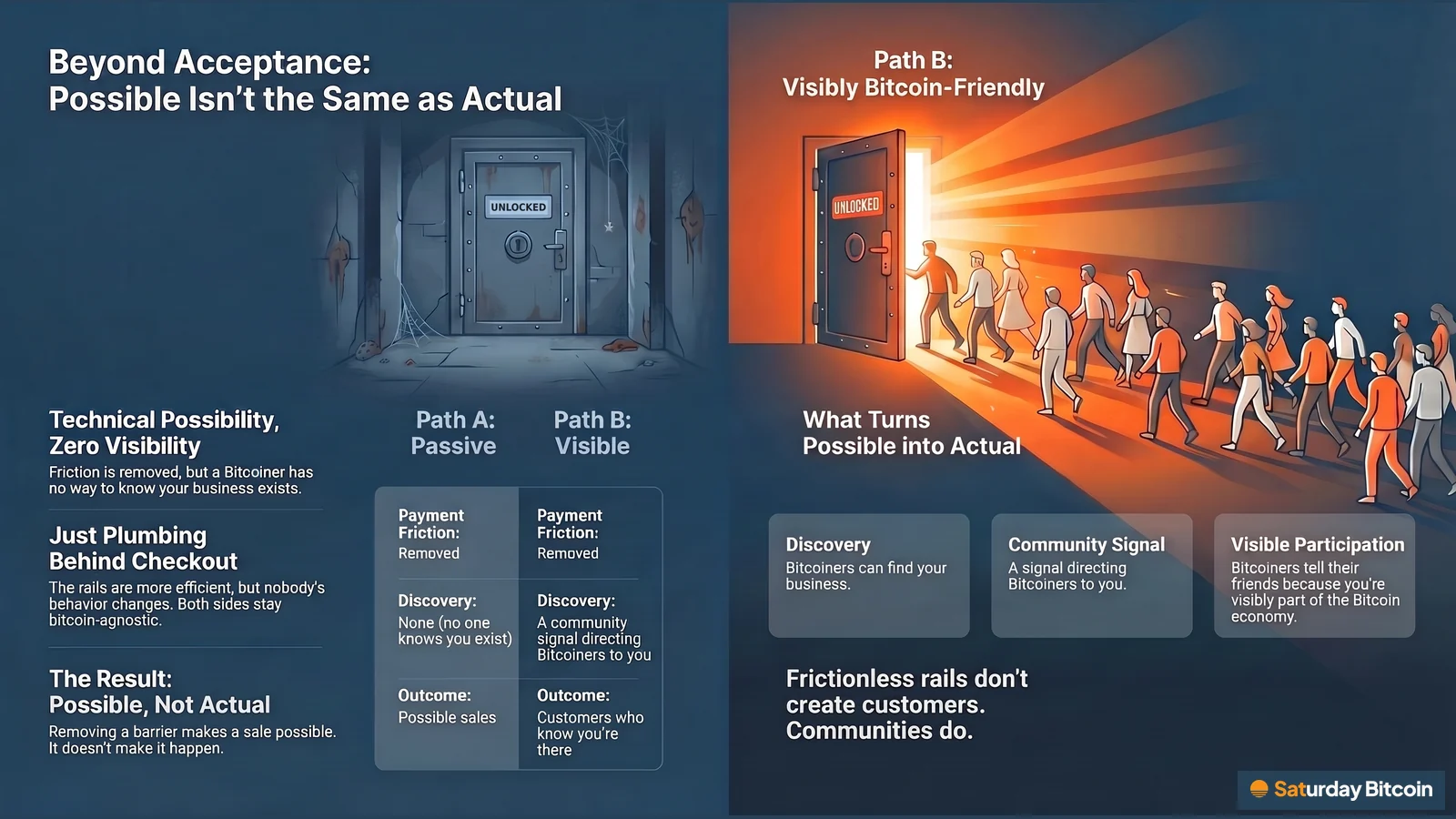
Bitcoin commerce has a coordination problem. Merchants wait for customers, customers can’t find merchants, and nothing moves until someone gathers one side. Acceptance without discovery is passive. Bitcoiners have to find you.
3. First visible wins
In most markets, first-mover advantage fades as followers copy you. With single-issue shoppers it can compound, because the advantage isn’t a feature. It’s the memory of which merchant welcomed the community first, and a follower merchant can’t claim that position later.
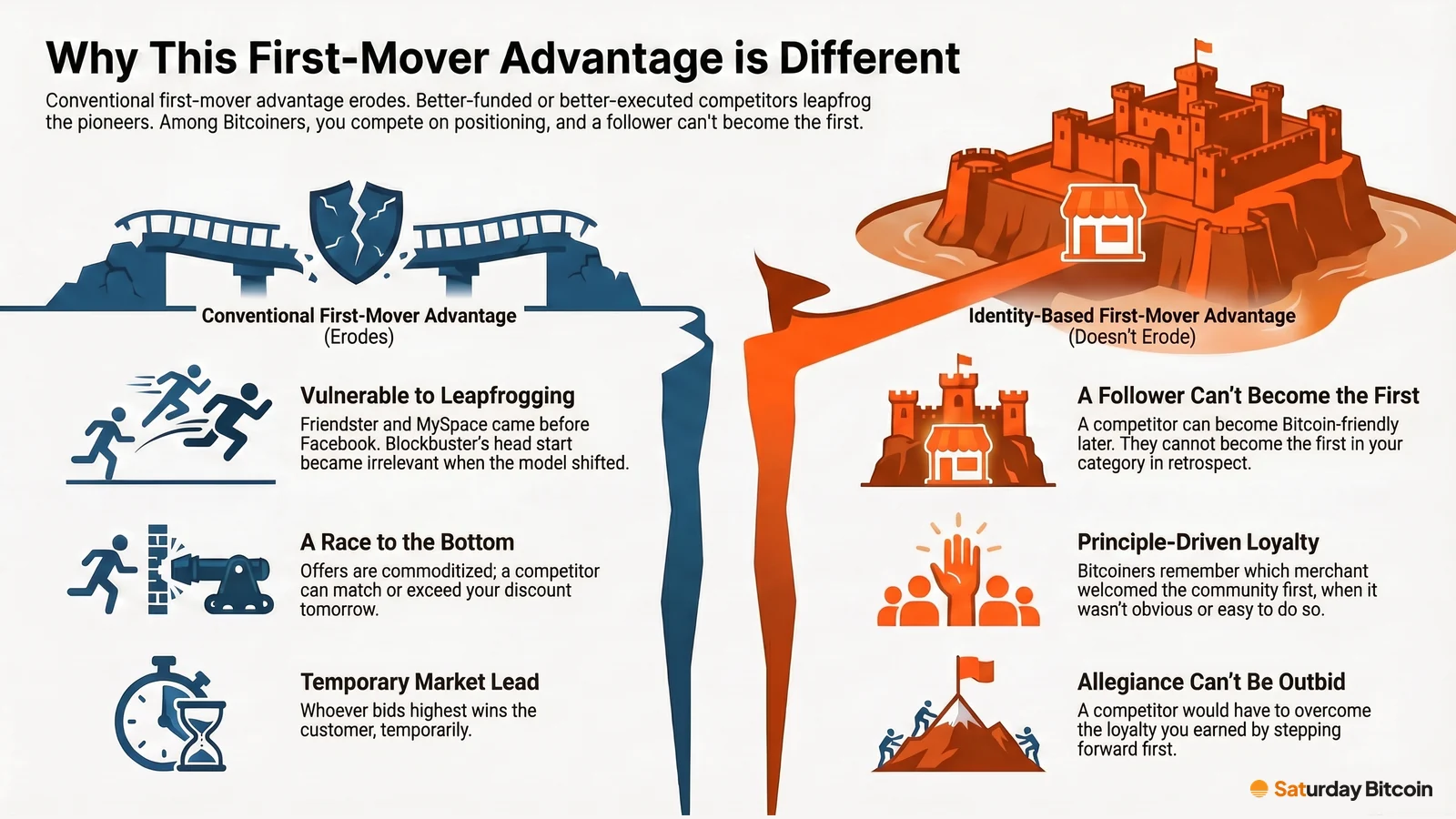
Most categories are still open, especially specific ones. Be first if you can, second if you must. Don’t be last.
4. You can match a price. You can’t match an identity.
Your channels choose your customers. Discount channels attract discount-led shoppers who came for a discount and leave for the next discount, from a different merchant; Thomas Jones and Earl Sasser called these shoppers Mercenaries. In contrast, identity-led channels find Apostles: customers who stay, recommend you, and even forgive the occasional slip. Bitcoiners are one of the very best examples of Apostle customers ever to have existed, and they are looking for Bitcoin-friendly merchants to shop at.
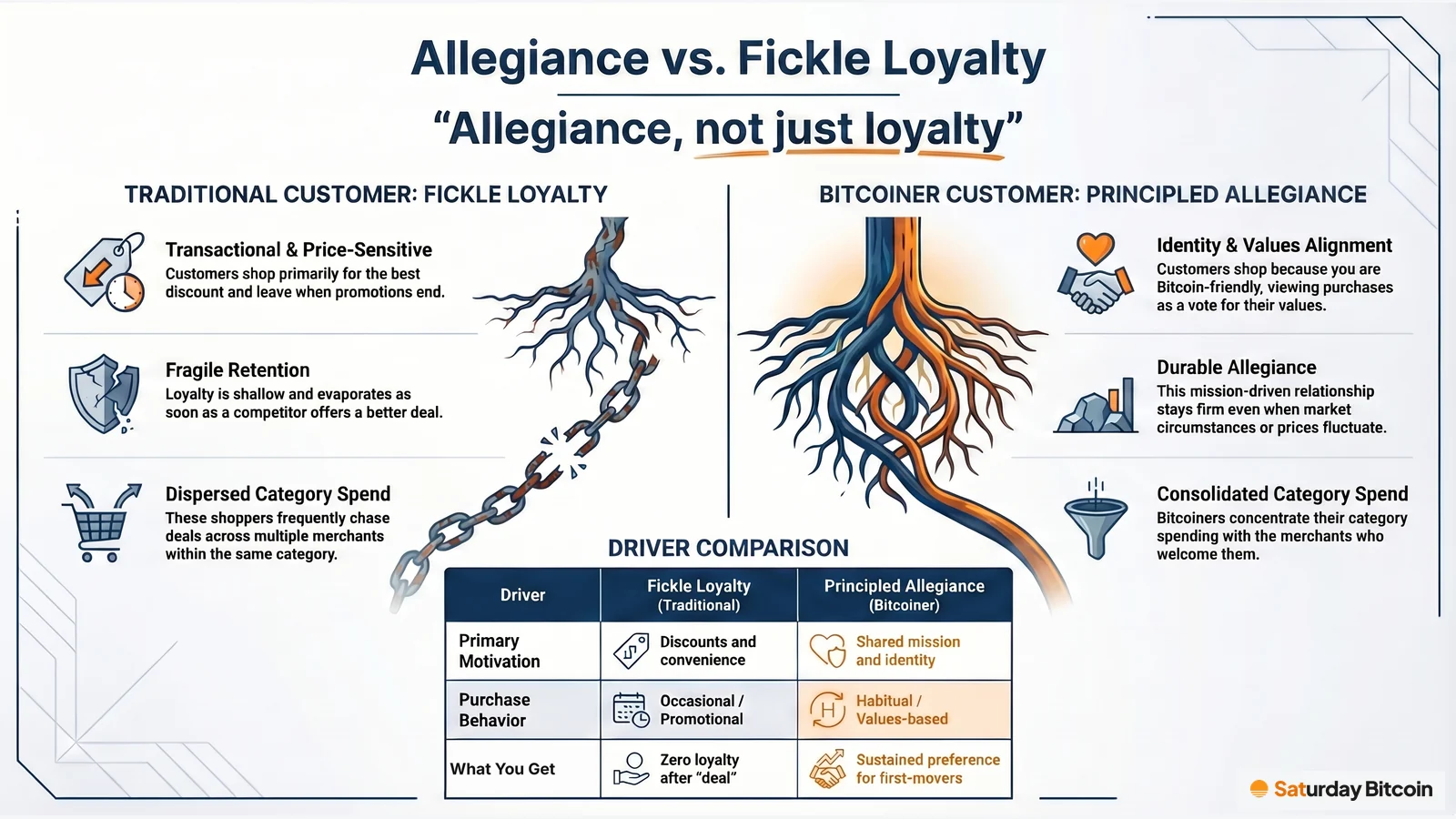
When a Bitcoiner switches to you because of what you stand for, they don’t arrive as a deal-seeker. They arrive as an advocate. A competitor can copy your discount tomorrow. It can’t occupy the Bitcoin-friendly position if you have already occupied it first.
5. Every merchant added makes the others, in other categories, more valuable
Bitcoiners are filling in a jigsaw of everyday spending, one category at a time: coffee, then software, then clothing, then travel. Each new piece, in each new category, makes the whole picture more useful, which makes it easier to keep choosing Bitcoin-friendly businesses. Bitcoiners are looking to migrate their existing shopping, in the categories where they already shop, to Bitcoin-friendly merchants.
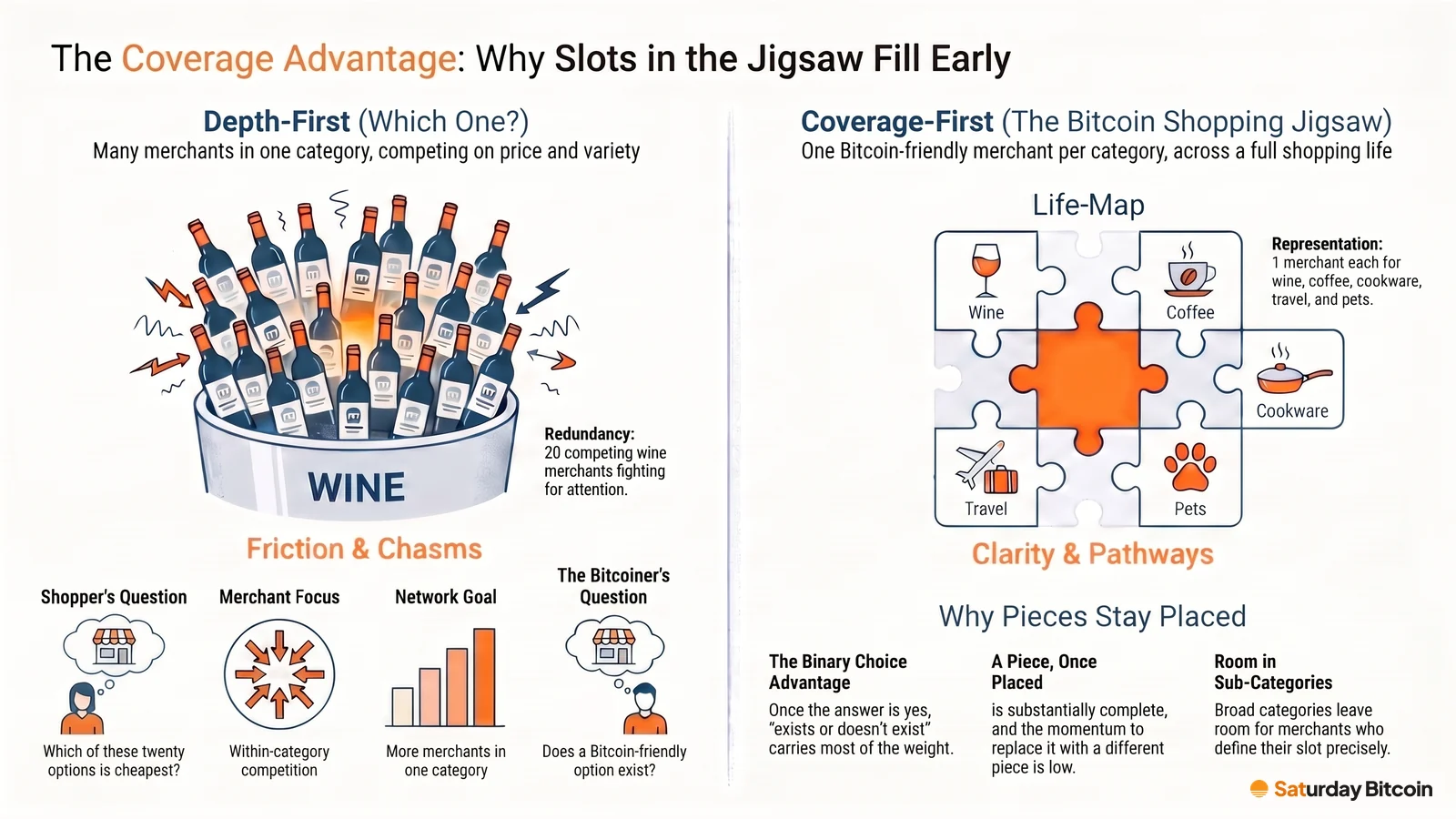
One category is a vote. Every category is a movement. Early participating merchants take the primary slot in their category.
6. When they pay in bitcoin, they arrive on your cheapest rail
Online card payments cost U.S. merchants about 2.3% plus 25 cents per transaction on average, and closer to 3% on American Express. Bitcoin payments (via Bitcoin’s Lightning Network) typically cost just a fraction of a penny, and they settle with finality, immediately: no chargebacks, and you alone decide your refund policy.
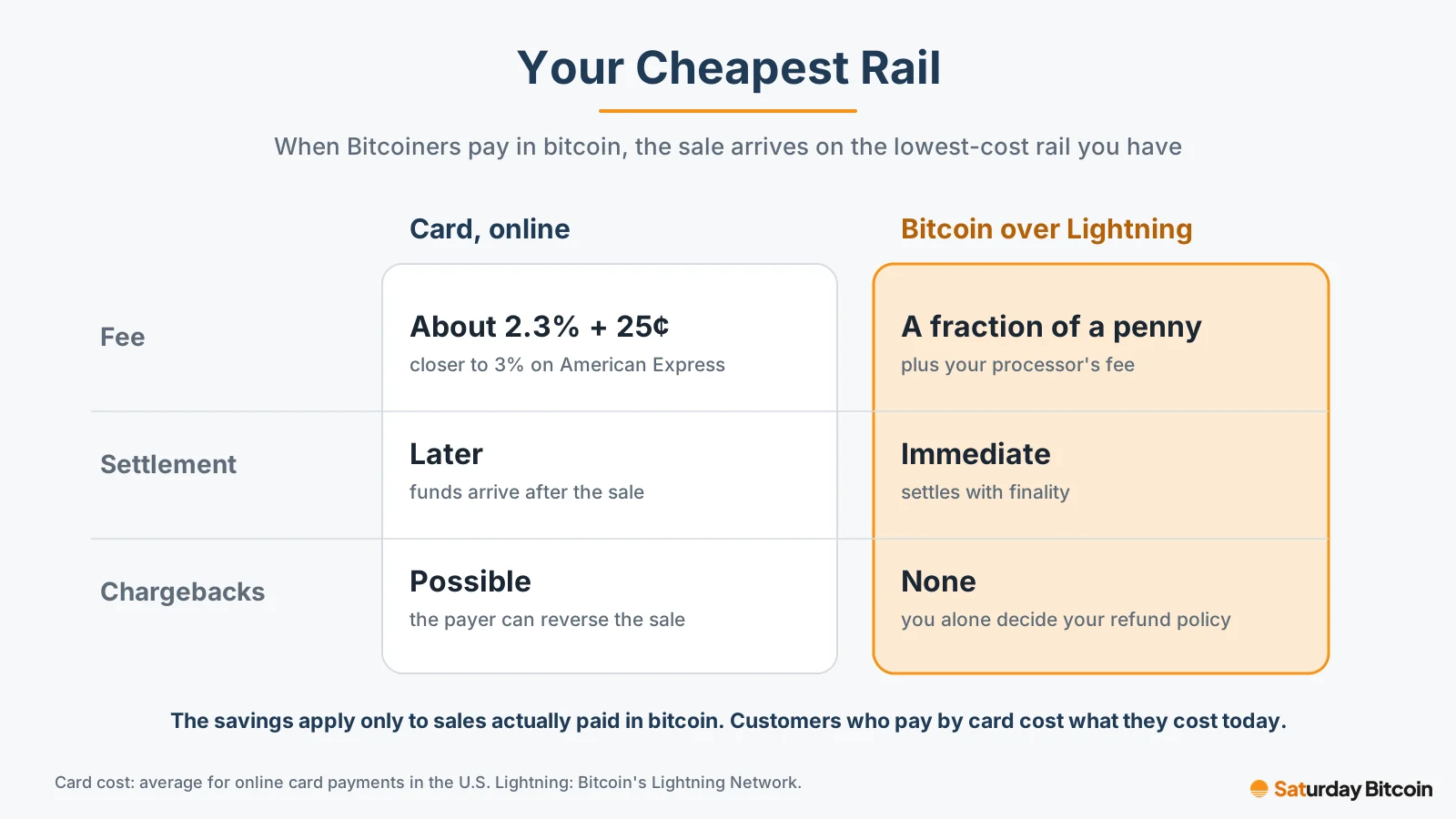
Be precise about this. The savings apply only to sales actually paid in bitcoin, and some Bitcoiners will still pay by card (supporting Bitcoin-friendly merchants on principle, even when they pay through conventional channels). The customer is the first half of the value you can expect. The low-cost payment rail is the second.
7. Waiting has a cost; acting costs little
Wait-and-see feels safe. As the strategy proves itself in the marketplace, it gets easier to defend adopting it, but by then you are following merchants who have already claimed the high ground in your category. The early bird catches the worm. Acting early in your category wins the attention of Bitcoiners, and their allegiance. The merchant bitcoin strategy doesn’t touch your pricing, your brand for other customers, or your existing marketing, and you can drop it at will.
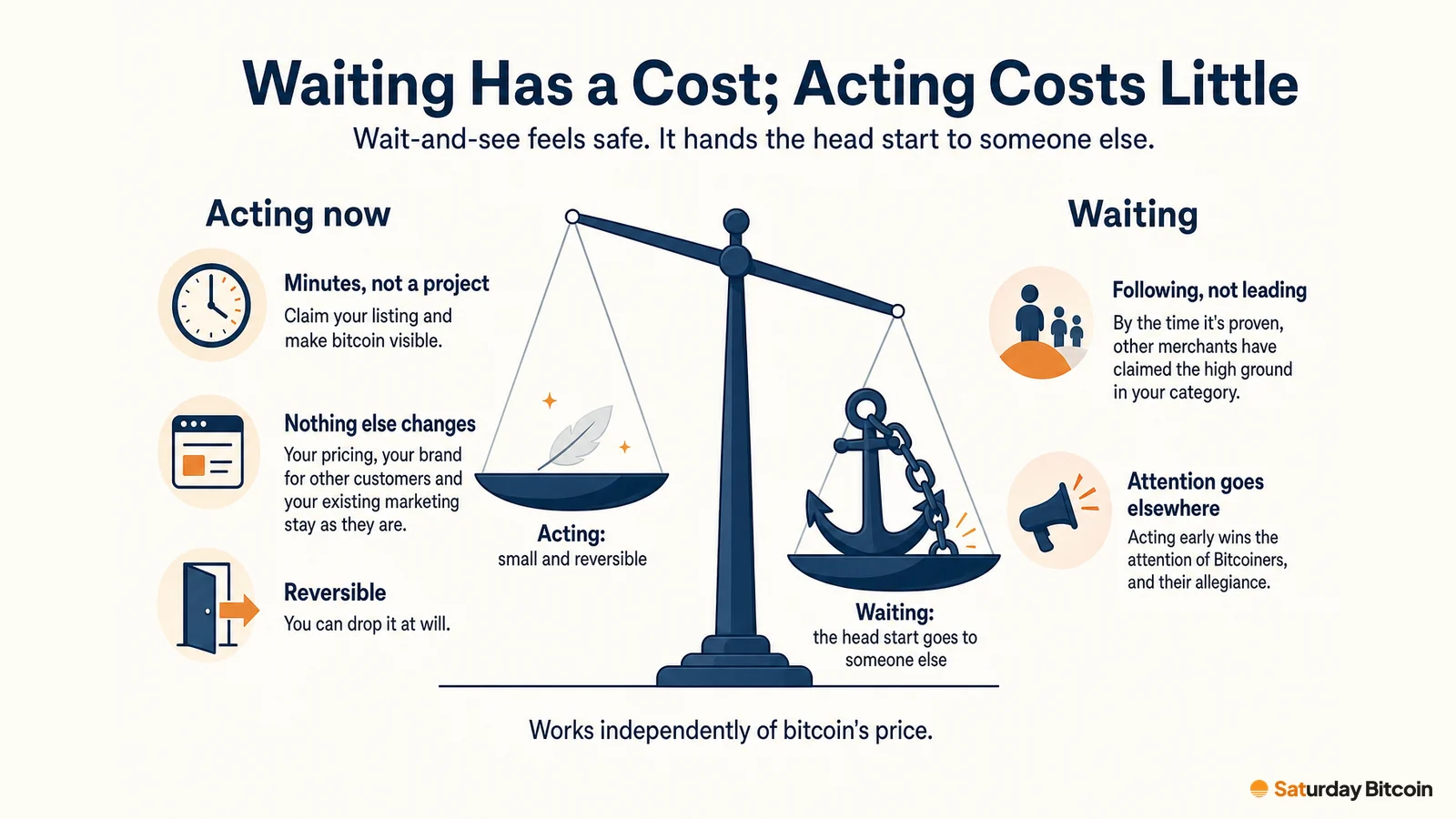
The merchant bitcoin strategy works completely independently of bitcoin’s price. One day, having a bitcoin strategy will be table stakes for merchants. Today it is still a differentiator, potentially delivering significant, sustainable business impact.
What this is not
This isn’t a promise of category dominance or a specific sales lift. The committed segment is small (for now), and it rewards sincerity more than slogans. If your product isn’t right, no customer segment will save it.
What it offers is a segment of invaluable customers that your competitors aren’t courting, reached through a channel they can’t see.
Where to start
Our companion guide, The Bitcoin-Friendly Merchant Playbook, sets out seven practical moves. The first is the simplest: make sure Bitcoiners can find you. If you already accept bitcoin, claim your free listing at saturdaybitcoin.com/business.