

One national chain, one visible move, and an energy that had been hiding in plain sight
One visible move
On May 16, 2025, Steak ’n Shake began accepting bitcoin as payment in its U.S. restaurants, wherever the law allowed. It announced the date a week ahead and posted about it constantly. On launch day, Bitcoiners showed up, ordered, photographed their receipts and posted them.
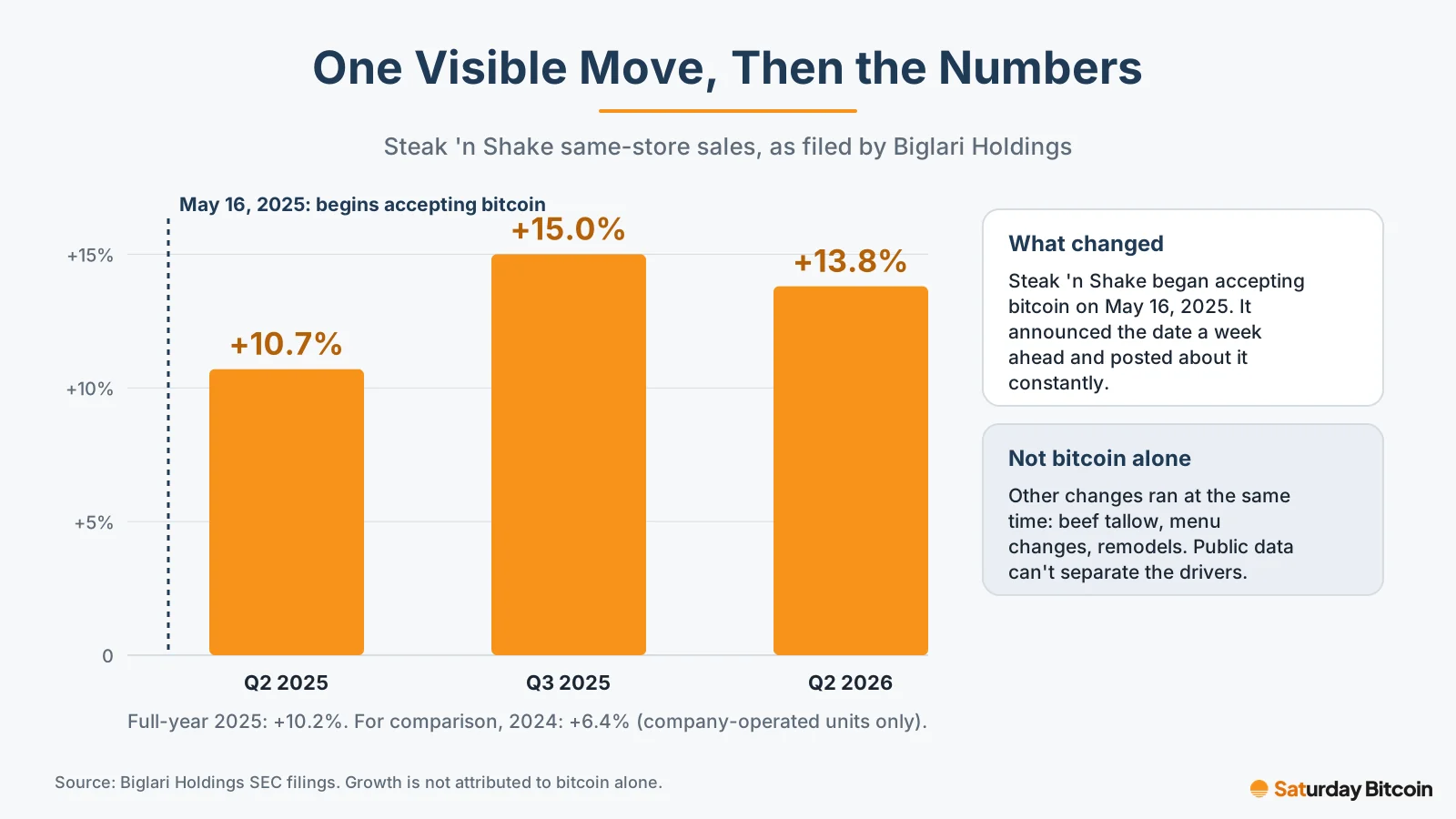
Then the numbers came in. Here’s what the company’s parent, Biglari Holdings, reported in its SEC filings for Steak ’n Shake same-store sales:
A fraction of this segment did that. Imagine the whole of it.
- Q2 2025: up 10.7% (company-operated and franchise-partner restaurants)
- Q3 2025: up 15.0% (domestic company-operated and franchise-partner restaurants)
- Full year 2025: up 10.2% (company-operated and franchise-partner restaurants combined)
- Q2 2026: up 13.8% (domestic company-operated and franchise-partner restaurants)
For comparison, the 2024 figure was 6.4%, at company-operated units only. A long-established national chain in a hard year for fast food had put together its strongest same-store run in years. Over the same 2025 quarters, the largest burger chains reported low-single-digit gains or outright declines, which puts Steak ’n Shake’s figures among the strongest same-store results in fast food that year. Eleven days after launch, a company executive told the Bitcoin 2025 conference, “We’ve seen a sustained spike since adding Bitcoin.”
What actually changed, and what didn’t
It would be easy to tell this as a story about bitcoin and nothing else. That would be wrong. Bitcoin wasn’t the only change at Steak ’n Shake in 2025. Earlier that year the chain switched to frying in beef tallow. It made a series of ingredient and menu changes it publicly tied to the “Make America Healthy Again” movement. It also kept investing in remodeling its restaurants. The company itself credited both groups, MAHA supporters and Bitcoiners.
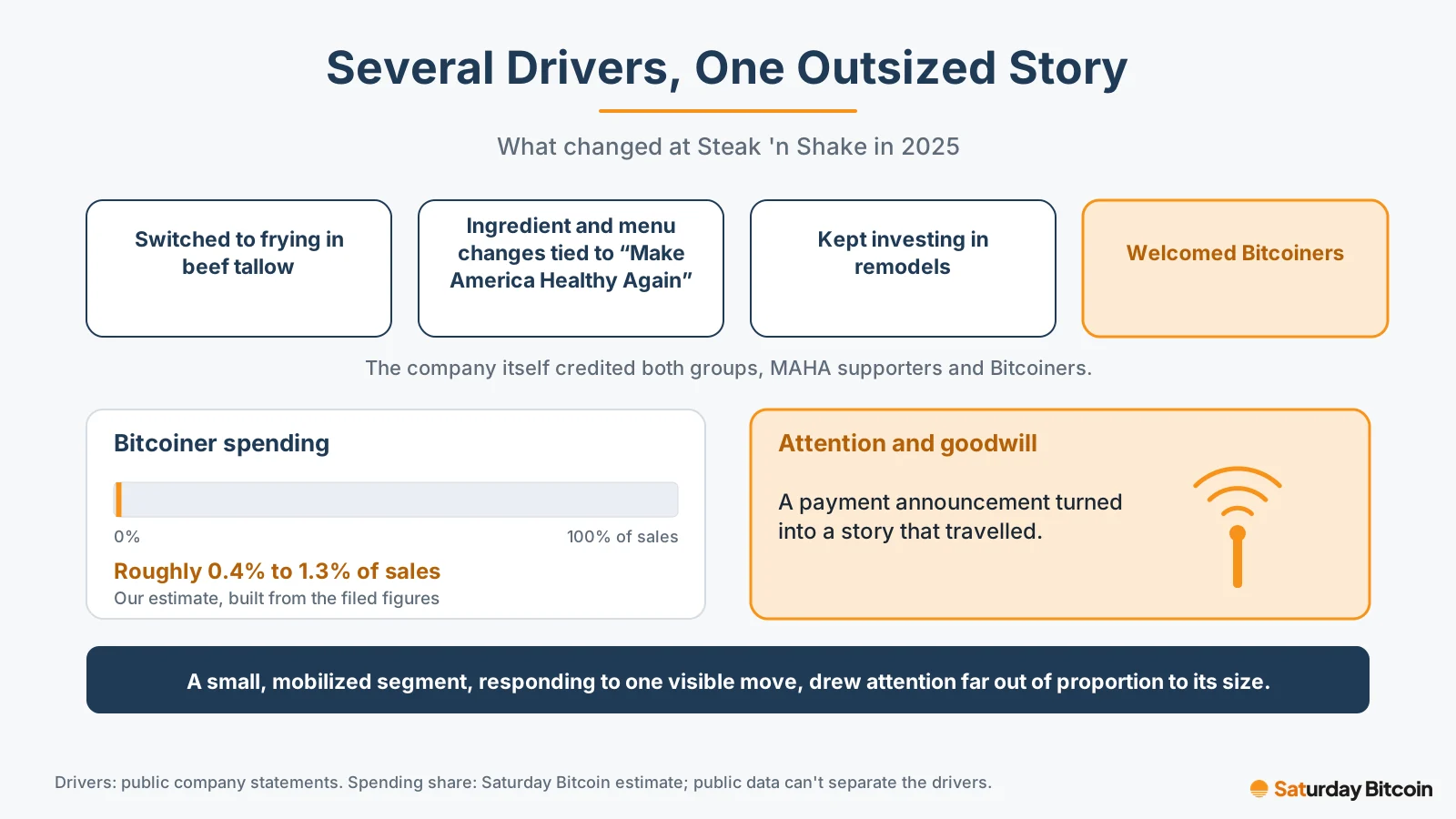
So the honest version is this. Steak ’n Shake’s dramatic, immediate positive results had several drivers, but the visibility of welcoming Bitcoiners played a large role.
How large? From public data, we can’t separate the drivers. Our own estimate, built from the filed figures, is that spending by Bitcoiners was likely a small share of sales, roughly 0.4% to 1.3%. What probably mattered most was attention and goodwill. Bitcoiners turned a burger chain’s payment announcement into a story that travelled, and the company leaned into that story at every turn.
That’s the lesson worth taking away. Bitcoiners didn’t spend the chain back to growth by themselves. A small, mobilized segment, responding to one visible move, produced attention far out of proportion to its size.
Why this segment behaves this way
Bitcoiners don’t just own bitcoin. They identify as Bitcoiners. Traditional marketing segments are defined by demographics or purchase history. Bitcoiners are defined by identity, and that identity drives behavior that demographic targeting can’t replicate. Using bitcoin is an active expression of who they are and what they believe. They aren’t just passively hoping bitcoin succeeds. They’re actively looking for ways to help it succeed.
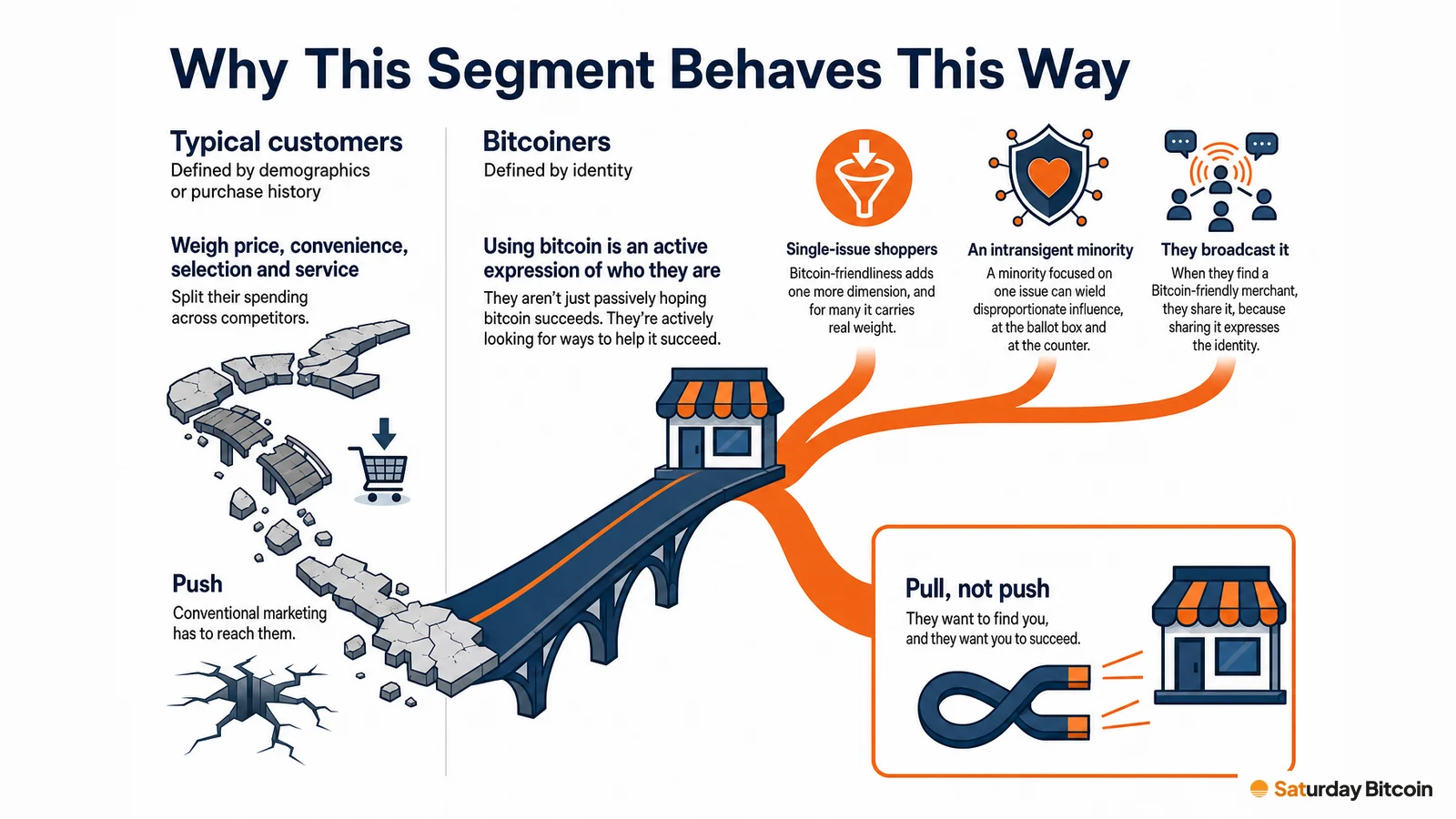
That makes them single-issue shoppers. Most customers weigh price, convenience, selection and service, and split their spending across competitors. Bitcoiners add one more dimension, Bitcoin-friendliness, and for many it carries real weight. An intransigent minority focused on one issue can wield disproportionate influence. That’s true at the ballot box, and Steak ’n Shake showed it’s true at the counter.
It also explains the attention effect. Virtually any other consumer group would have no interest in posting their purchases online. Bitcoiners are different. When they find a Bitcoin-friendly merchant, they broadcast it, because sharing it expresses the identity. This is a pull dynamic rather than the push of conventional marketing. They want to find you, and they want you to succeed.
“But one million seems small”
Merchants used to thinking about population share will underestimate this segment. Millions of Americans own some bitcoin, directly or through funds. Within that group is a much smaller core, conservatively around one million people and growing, who see themselves as part of a movement. They go to local meetups, talk about bitcoin online and look for merchants who welcome them.
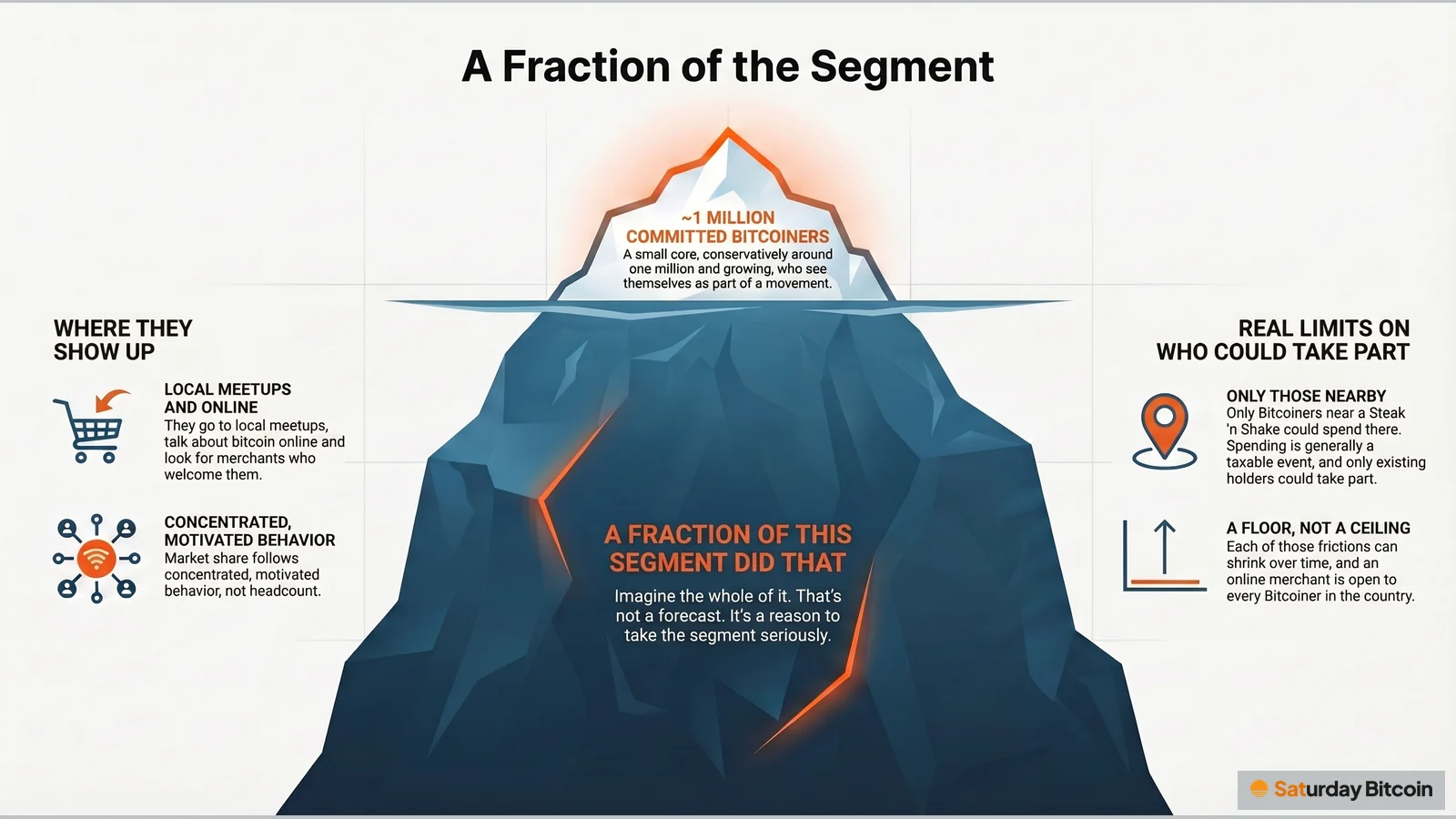
On paper that is a small share of the country. Steak ’n Shake is the reminder that a segment which looks small by conventional standards can deliver outsized, visible impact. Market share follows concentrated, motivated behavior, not headcount.
And it did this with real limits on who could take part. Only Bitcoiners near a Steak ’n Shake could spend there. Spending bitcoin is generally a taxable event, which makes many holders hesitate. For most of that period there were no rewards for paying in bitcoin. And the effect was confined to people who already held bitcoin. Each of those frictions can shrink over time, and an online merchant is open to every Bitcoiner in the country, not only those within driving distance. What the segment has shown so far is a floor, not a ceiling.
A fraction of this segment did that. Imagine the whole of it. That’s not a forecast. It’s a reason to take the segment seriously.
The public moves any merchant can learn from
None of what follows requires a national footprint. These are things Steak ’n Shake did in public, in the open:
- Announced a launch date. It gave the community something to show up for.
- Posted often. The company’s own account carried the story, so Bitcoiners had something to share and amplify.
- Credited Bitcoiners publicly. When results came in, it thanked them by name. Being recognized is part of what this segment responds to.
- Kept committing. On October 31, 2025 it announced a Strategic Bitcoin Reserve, saying all bitcoin payments would be placed in it, and pledged 210 sats from every Bitcoin meal to OpenSats, a nonprofit that funds open-source Bitcoin developers.
Steak ’n Shake’s approach was comprehensive and public: a full, visible commitment. Not every merchant wants that, and they don’t need to. In a concentrated market, every competitive advantage is announced by the very act of deploying it. Some merchants will prefer a quieter posture. They can accept bitcoin, be easy to find where Bitcoiners look, and let the community do the talking, without a press release. You have options. Loud works. Quiet works too. Being invisible to the people already looking for you is the only posture that doesn’t work.
The honest limits
There were several drivers, and public data can’t separate them. A same-store sales run that coincides with a bitcoin launch is correlation, not proof. Steak ’n Shake is a national chain with a famous brand and a launch that got heavy media coverage, so its results won’t transfer one-for-one to a single restaurant, a regional retailer or an online shop. Your mileage will depend on your category, how visible you are and whether you’re the first Bitcoin-friendly option your customers can find.
What does transfer is the underlying behavior: a segment that is actively looking, rewards merchants who step forward when it isn’t yet obvious or easy, and talks about them in public. Steak ’n Shake proved there is an energy here that had been hiding in plain sight.
Where to start
If you already accept bitcoin, the first step is making sure Bitcoiners can find you. Saturday Bitcoin is a live directory that helps Bitcoiners discover merchants that accept bitcoin. You can claim and verify your listing for free and add a welcome offer. For the full set of moves, read The Bitcoin-Friendly Merchant Playbook, then claim your free listing at saturdaybitcoin.com/business.