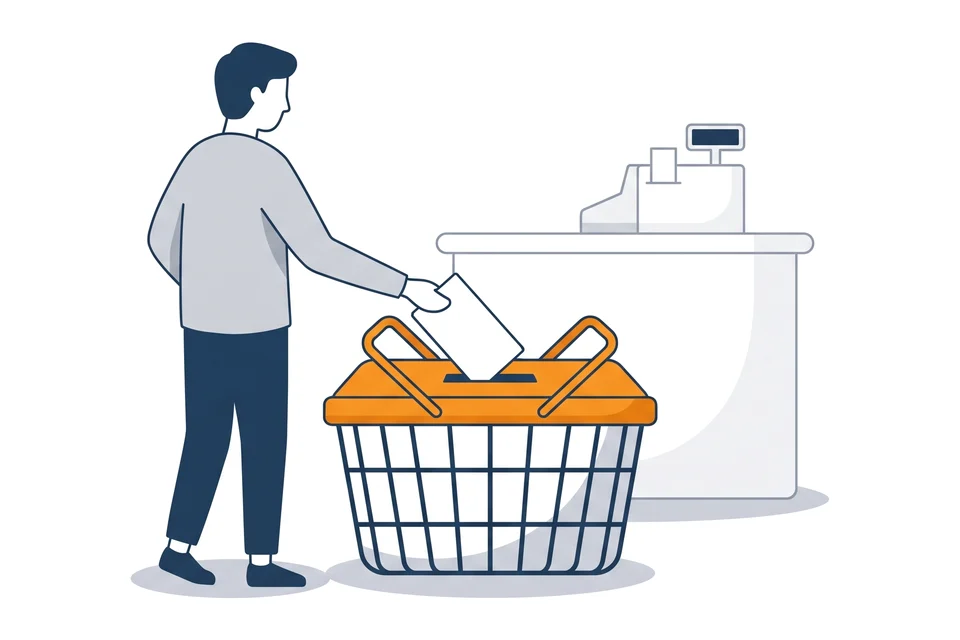
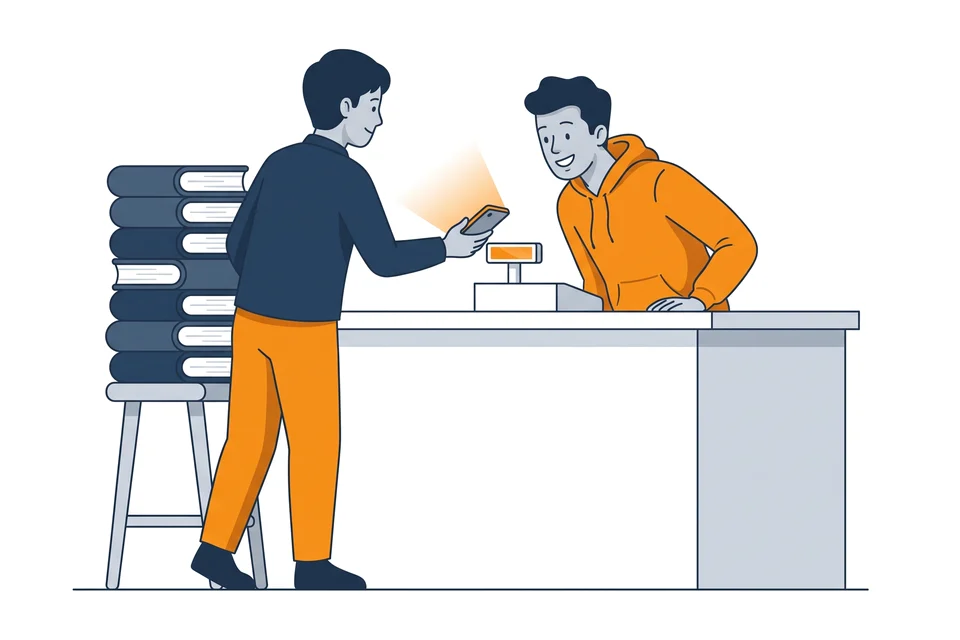

Every Bitcoiner has been there. You understand why bitcoin matters. You want to share it with friends, family and colleagues. You try to explain it.
And it goes nowhere.
Maybe they aren’t interested in monetary theory, or they think bitcoin is too risky, or they mean to look into it and never do. The conversation ends politely, and nothing changes.
Nobody was ever orange-pilled by a lecture on monetary history.
There’s a better way to start, and it doesn’t involve a single word about fiat debasement. Take them somewhere that accepts bitcoin.
Nobody was ever orange-pilled by a lecture on monetary history
Most orange-pilling follows a familiar script. There’s the educational approach: “Read The Bitcoin Standard.” “Let me explain proof-of-work and the difficulty adjustment.” There’s the investment pitch: “Look at the long-term chart.” And there’s the ideological appeal: “Bitcoin is freedom money.”
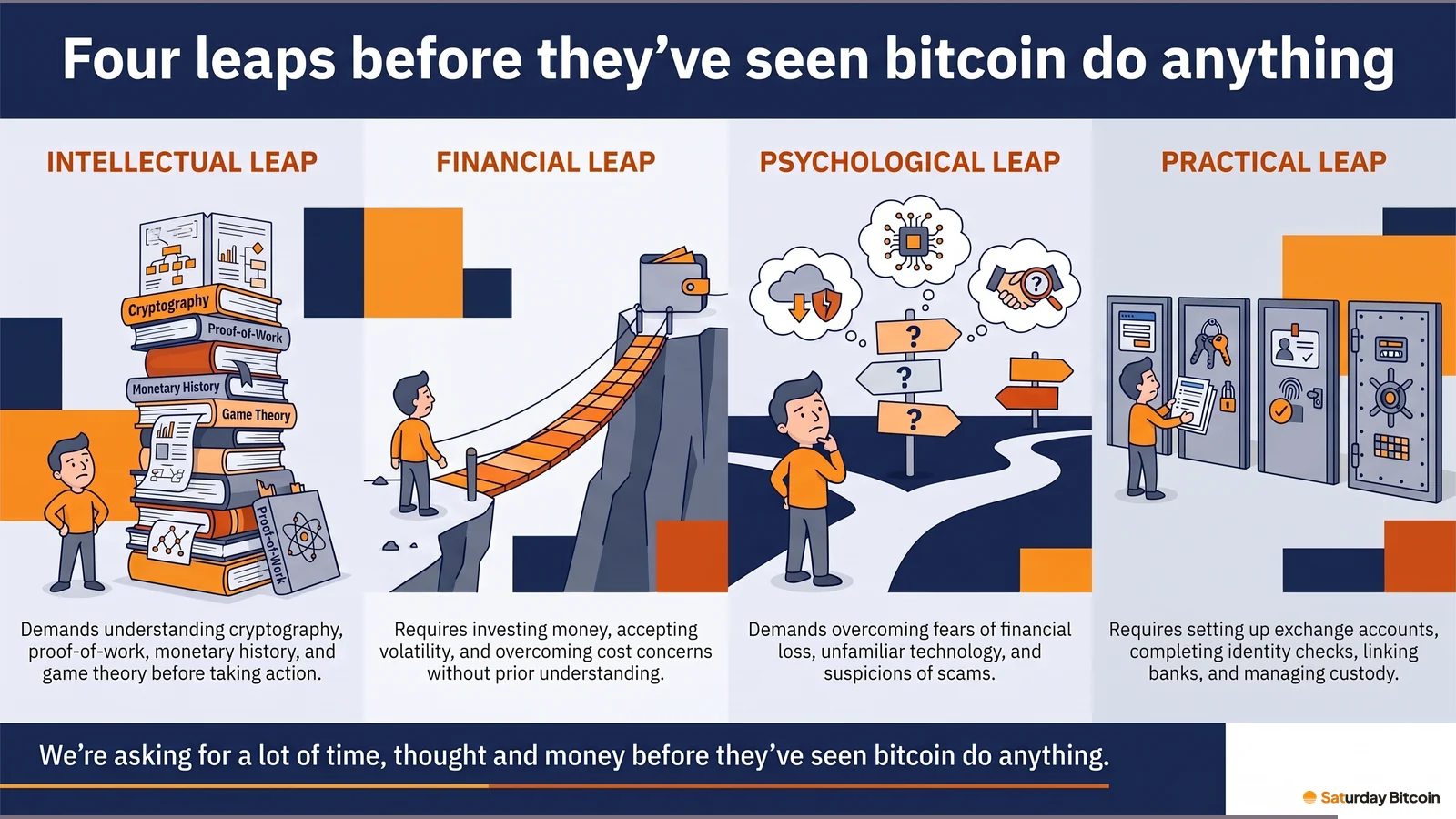
These approaches work for some people. Someone who is already intellectually curious, financially comfortable and philosophically aligned may dive right in. For most people they fail, and it’s worth being honest about why. Look at what we’re actually asking for:
- An intellectual leap. Cryptography, proof-of-work, monetary history and game theory, plus enough conviction to act, all ahead of everything else competing for their attention.
- A financial leap. Putting money into something they don’t fully understand, accepting real volatility, and getting past “I’m too late” and “it’s too expensive.” All that before deciding how much to put in, when many people have little or nothing set aside to invest.
- A psychological leap. “What if I lose money?” “I don’t understand the technology.” “Sounds like a scam.”
- A practical leap. Exchange accounts, identity checks, bank links, custody decisions, security.
You can’t blame them. We’re asking for a lot of time, thought and money before they’ve seen bitcoin do anything at all. So they nod, say they’ll look into it, and never do.
Experience beats explanation
Telling someone about bitcoin and letting them see it work are two very different things.
When you tell someone, you’re asking them to imagine future benefits, trust your explanation and set aside their skepticism. That invites resistance: “Sounds too good to be true.”
When you show them, nobody has to take your word for anything because they watch it happen. And it creates something a lecture rarely does: curiosity. “Wait, how did that work?”
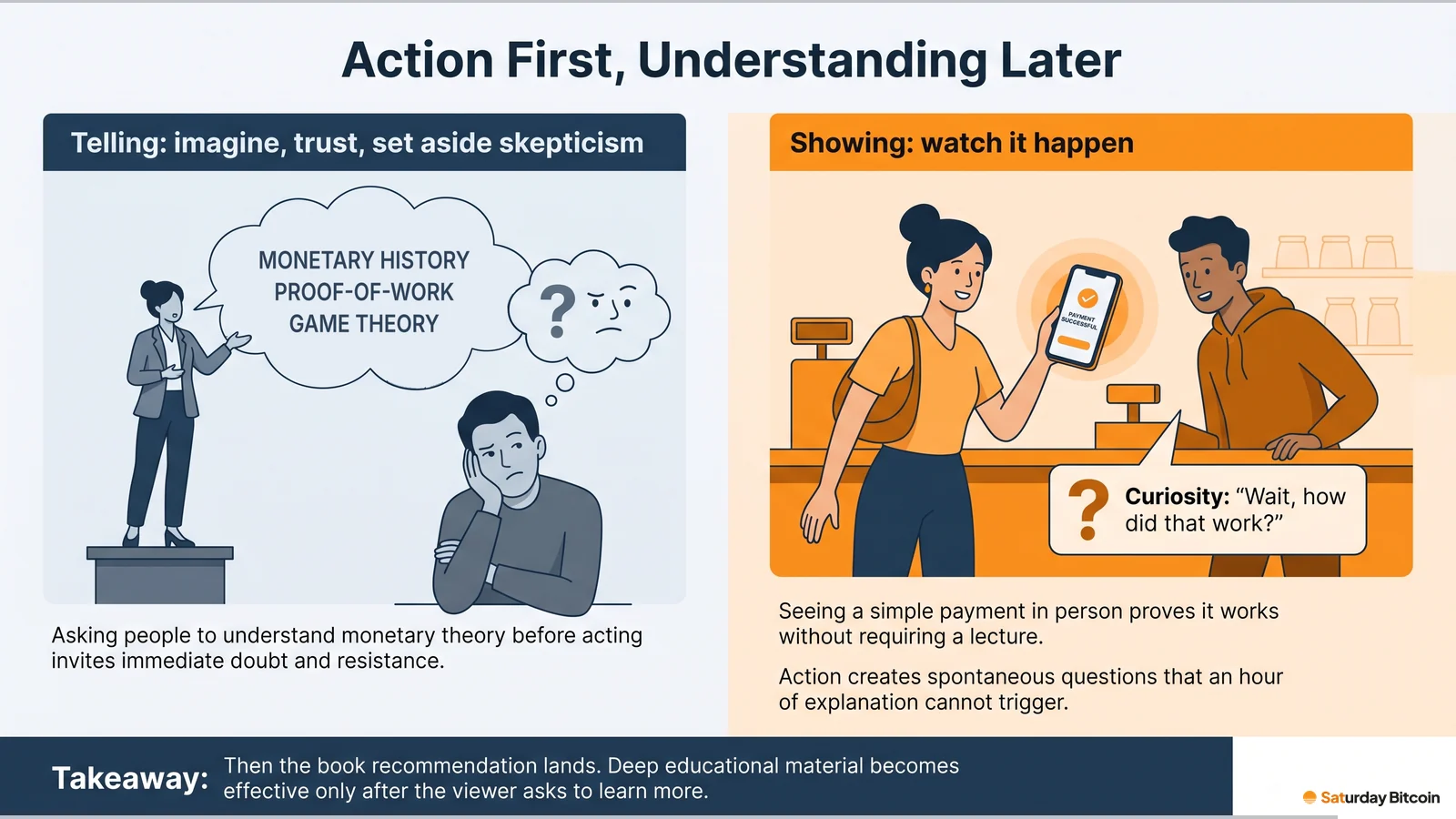
Traditional orange-pilling assumes people need to understand before they act. For most people that gets the order backwards. Let them do something with bitcoin, or watch you do it, before you explain it. Action first, understanding later.
When the questions come (“How does this actually work?” “Where would I even get some?” “Where can I learn more?”), that’s when they’re ready for the deeper material. And they came to you, rather than you pushing it on them. That’s when the book recommendation finally lands.
Show a friend a merchant that takes bitcoin. That’s the whole lesson.
Imagine family dinner. Someone asks what you’ve been up to.
The old way: “I’ve been reading about bitcoin. Did you know there will only ever be 21 million? Let me explain why that matters…” Eyes glaze over. Someone changes the subject.
The new way: “There’s a taco place across town that takes bitcoin. Let’s go Friday. I’ll show you how it works.”
Then you go. You order, you pay from your phone, and it’s done in moments. Your friend pays however they like. Nobody gets a lesson in monetary theory, an investment pitch or an account to open. They see a real business, a real meal and a payment that worked.
That small moment does what an hour of explanation can’t. It makes bitcoin ordinary: something people use to buy dinner, not just a price chart. It works online too. Pull up a shop that accepts bitcoin and check out together. Either way, you’re showing instead of telling. You’re offering an experience instead of making demands, and you’re removing barriers instead of adding them.
Bitcoiners bring people to the businesses they love
This is already how Bitcoiners behave. When we find a Bitcoin-friendly merchant, we tell people on X and Nostr, at meetups and in group chats. We post the receipt. Recommending a merchant is more than a favor to friends. It advances bitcoin adoption and backs a business that stepped forward.
That same instinct works offline, with the people closest to you. Bitcoiners drag friends and family to the businesses they love. The friend arrives on a trusted recommendation, not because of an ad.
Here’s the part that’s easy to miss: your friend doesn’t need to own bitcoin, and they don’t need to pay with it. If they pay by card, it’s still a win. The merchant gained a customer because it welcomed Bitcoiners, and your friend saw bitcoin used for something ordinary. The same goes for you. Plenty of committed Bitcoiners still pay by card some of the time, out of habit, for rewards, to avoid tax paperwork or simply to support the merchant. The visit still counts.
Orange-pilling compounds
This is where it gets interesting. Your friend tells their spouse about the place that takes bitcoin. The spouse mentions it to a coworker. Somewhere along that chain, someone gets curious enough to buy their first sats, and one day they take their own friends to dinner.
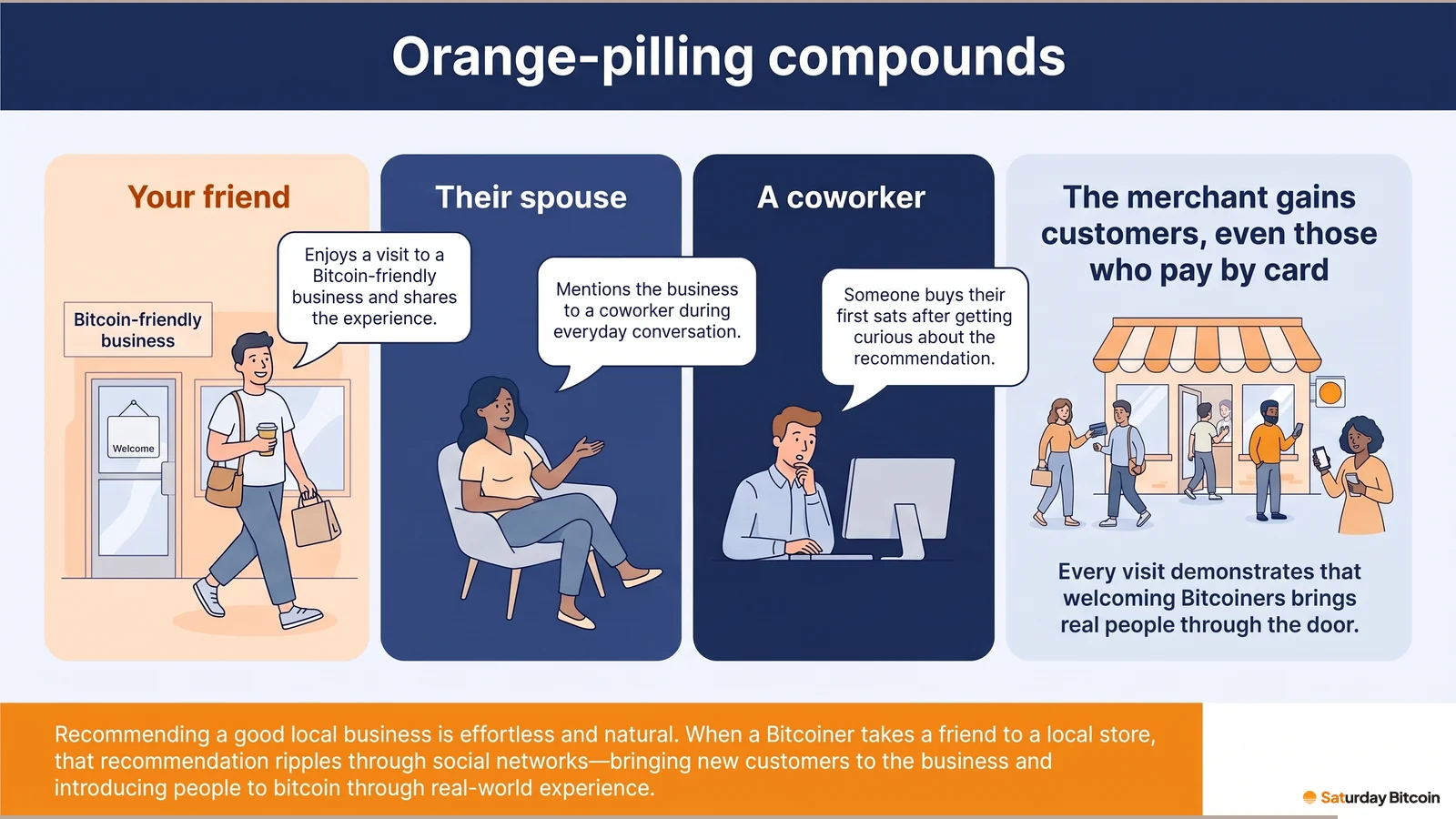
Traditional orange-pilling rarely spreads this way, because explaining monetary theory is hard work and few people want to repeat the lecture. Taking someone to a good restaurant is easy. People share good places naturally.
It compounds on the merchant side too. Every visit tells a business that being Bitcoin-friendly brings people through the door, including people who don’t hold bitcoin yet. That gives the merchant a reason to keep welcoming Bitcoiners, and the business next door a reason to notice. One category is a vote. Every category is a movement.
The honest part
Not everyone you show will become a Bitcoiner. Some will enjoy the meal and never think about it again. Some will pay by card forever. Some will get curious, buy a little and stop there.
That’s okay. Perfect is the enemy of good. A friend who has watched bitcoin buy dinner is further along than one who politely ignored your book recommendation. And the merchant still gained a customer.
A directory listing is also a starting point, not a guarantee. How a merchant accepts bitcoin can change, and staff turn over. For the first visit, pick a place where you’ve paid in bitcoin yourself, or check with the merchant before you go.
Where Saturday Bitcoin fits
The hardest part of the new conversation used to be the first line: where? Saturday Bitcoin is a free directory of merchants that already accept bitcoin, online and nearby, with tens of thousands of places listed. You can browse by category or location, save the places you like and share a listing with a friend. Merchants can claim and verify their listings, so more of them now say plainly that Bitcoiners are welcome.
We don’t process payments, and we can’t see what anyone buys. We help you find the places. The showing is up to you.
Start this week
You don’t need to be an expert, and you don’t need anyone’s permission.
- Find one Bitcoin-friendly merchant you’d genuinely recommend, like a café, a restaurant or a shop you already like.
- Share it with one friend who has never seen bitcoin used.
- Go together. Pay in bitcoin. Let them watch.
Don’t explain bitcoin, and don’t launch into monetary theory. Just show them, and answer the questions when they come.
Find a Bitcoin-friendly merchant and share it with a friend at saturdaybitcoin.com.