

Bitcoin as a medium of exchange has been stuck in a catch-22 for years.
Ask a Bitcoiner why they don’t spend at bitcoin-accepting merchants more often, and you hear some version of this: “Why would I spend my bitcoin on things I can buy with dollars?” “The tax tracking is a headache.” “And most of the places I shop don’t take it anyway.”
Ask a merchant why they don’t lean into bitcoin, and you hear the mirror image: “Why bother if no customers show up to pay with it?” “The few who tried saw very little volume.” “Our card processor works fine. Why add complexity?”
Bitcoin commerce is a coordination problem. Someone has to gather one side first.
Neither side moves first without confidence that the other side will show up. That is not a technology problem. Lightning works. Merchant tools exist. It’s a coordination problem, and coordination problems don’t solve themselves. Someone has to gather one side first.
Why “just accept bitcoin” stalled
Over the years, plenty of merchants tried simply accepting bitcoin. Some even offered a small discount for paying with it. Most saw almost no volume, and many quietly turned it off. “We accept bitcoin” sounds innovative, but if it brings in a sliver of revenue, it looks like a failed experiment.
The reasons are worth naming, because they’re about demand, not the merchant:
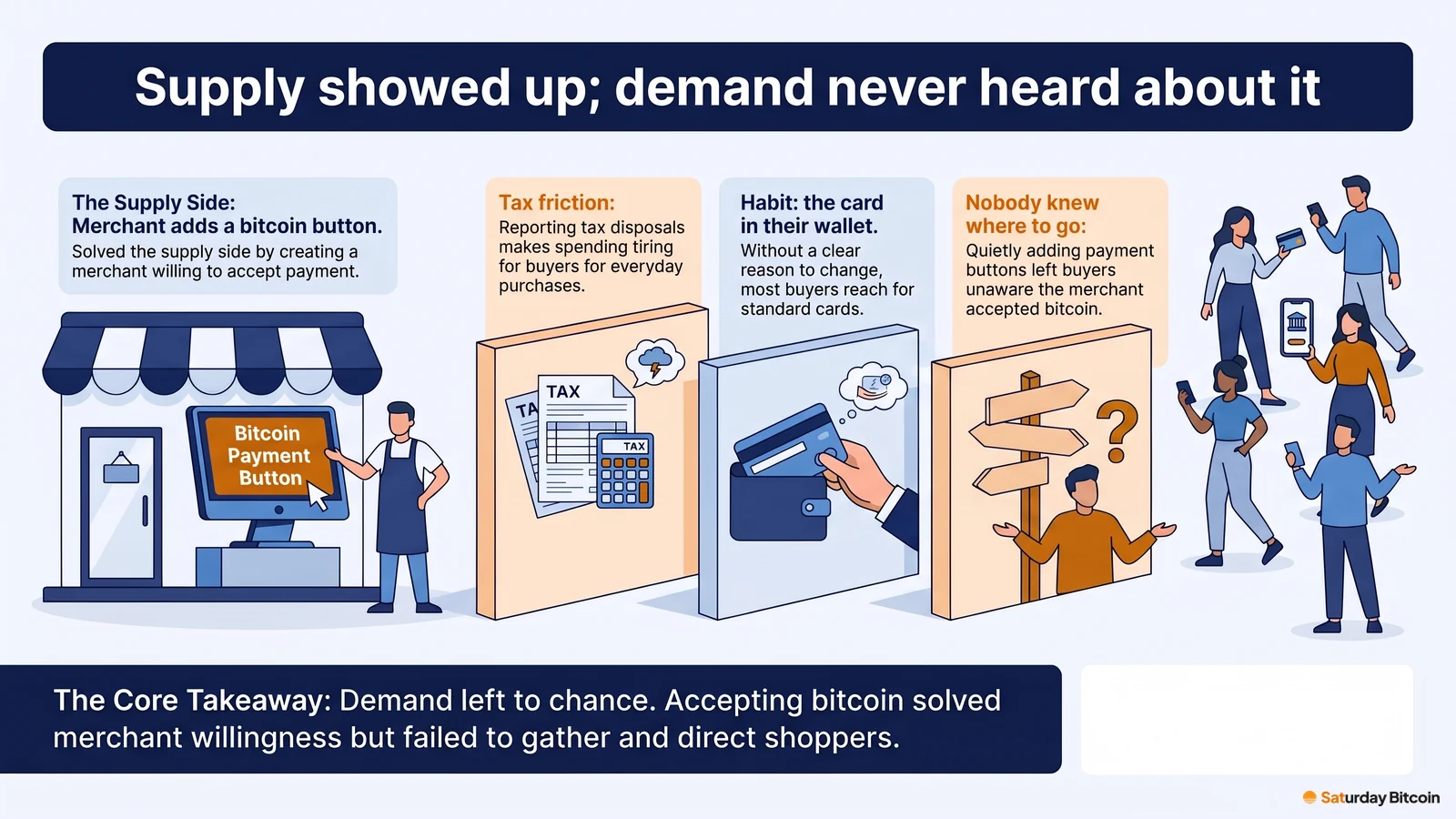
- Tax friction. For U.S. tax purposes, bitcoin is property, and spending it is a disposal that has to be reported, with a gain or loss to work out. Even committed Bitcoiners find that tiring for everyday purchases.
- Habit and card rewards. Without a reason to change, most people reach for the card in their wallet.
- Nobody knew where to go. A merchant that quietly adds a bitcoin button is on a channel Bitcoiners aren’t watching. Supply showed up; demand never heard about it.
Accepting bitcoin solved the supply side, a merchant willing to receive bitcoin, and left the demand side to chance.
The other common half-measure came from the opposite end: bitcoin-denominated rewards on ordinary card purchases. A sliver of the reward turned into bitcoin somewhere downstream, but the merchant never knew a Bitcoiner had walked in. Nothing about the merchant’s incentives changed.
There is a well-known exception. Steak ’n Shake began accepting bitcoin on May 16, 2025, and told the whole world about it. That was a big, public, all-in move, made alongside other changes to the business, and most merchants can’t or won’t make it. (We cover it in A Fraction of the Segment: What Steak ’n Shake Proved About Bitcoiners.)
Start with the demand side
Bitcoin commerce failed when only one side showed up. The lesson is to start with the demand side.
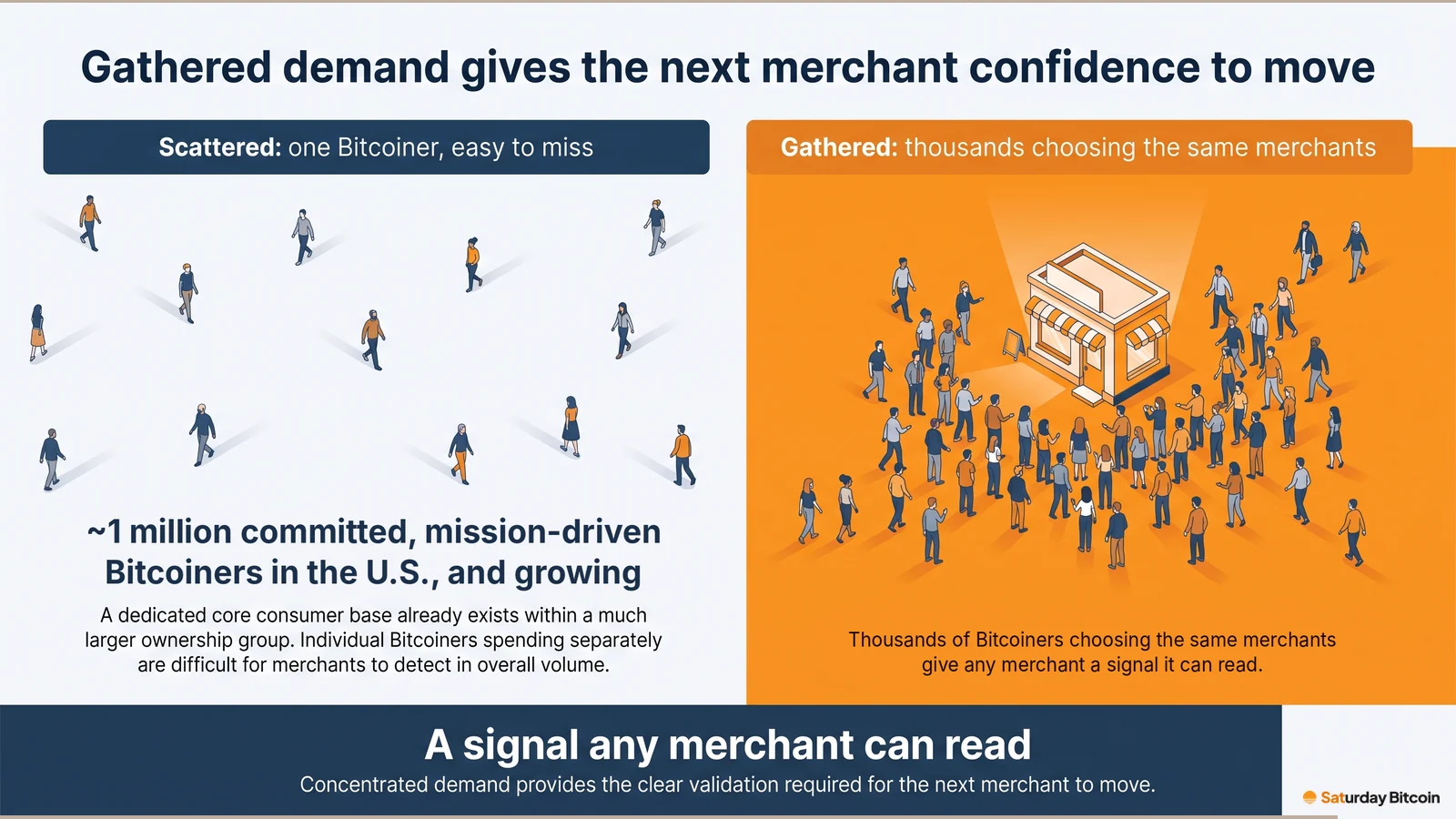
That side is real. There are an estimated ~1 million committed, mission-driven Bitcoiners in the U.S., and growing, inside a much larger group: tens of millions of Americans own some bitcoin.
The problem has never been that we don’t exist. It’s that we’re scattered. One Bitcoiner choosing a merchant is invisible. Thousands of Bitcoiners choosing the same merchants, in the same categories, is a signal any merchant can read. Gathered demand is what gives the next merchant the confidence to move.
The game theory: when enough of us shop on one issue
Think about how payment competition works today. Every merchant accepts the same cards. Payment methods are a given, not differentiators. Merchants compete on product, price, service and brand.
Bitcoiners change that, because many of us are single-issue shoppers. When enough of us shop on one issue, merchants compete on that issue.
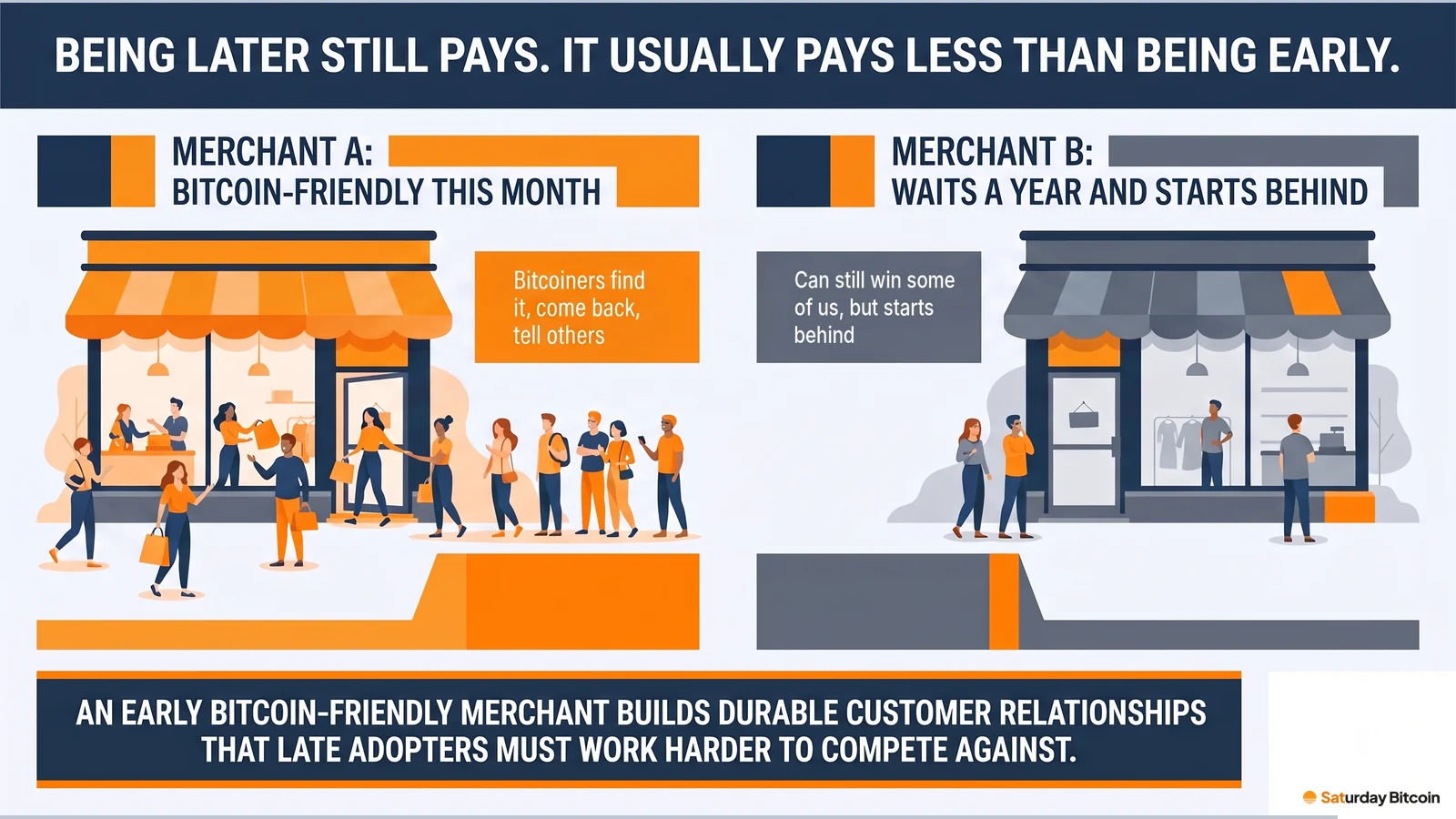
Picture two supplement merchants of similar quality and price. Merchant A becomes visibly Bitcoin-friendly this month. Merchant B waits a year. In that year, Bitcoiners find Merchant A, try it, come back, and tell other Bitcoiners about it. It becomes “my Bitcoin-friendly supplement brand.” When Merchant B finally moves, it can still win some of us, but Merchant A’s relationships are durable, and Merchant B starts behind.
Being later still pays. It just usually pays less than being early. That creates pressure on every merchant in the category to move. Today, being Bitcoin-friendly is a differentiator. One day it will be table stakes.
One honest caveat: this only works when the merchant is otherwise competitive. If the Bitcoin-friendly option is clearly worse, rational Bitcoiners will shop elsewhere. Identity breaks ties; it doesn’t rescue a bad product.
Every visible purchase is a data point
Network effects start slowly and then get easier. Early on, credibility comes from personal relationships: “my friend shops there.” As more people join, credibility comes from visible adoption: “lots of Bitcoiners shop there.” Eventually, being Bitcoin-friendly becomes expected in some categories. Each stage unlocks the next.
The catch is that merchants usually can’t see us in their data. Most of what a Bitcoiner buys looks like any other card sale. So the job is to make the demand visible:
- Pay in bitcoin where you can. On those sales the merchant gets lower processing costs and final settlement, with no chargebacks; they decide refunds under their own policy.
- If you pay by card, that’s still a win. Plenty of Bitcoiners do, for habit, card rewards, tax friction, or to support the merchant on principle. Tell them how you found them.
- Save it, share it, post it. A public recommendation reaches other Bitcoiners and the merchant’s competitors.
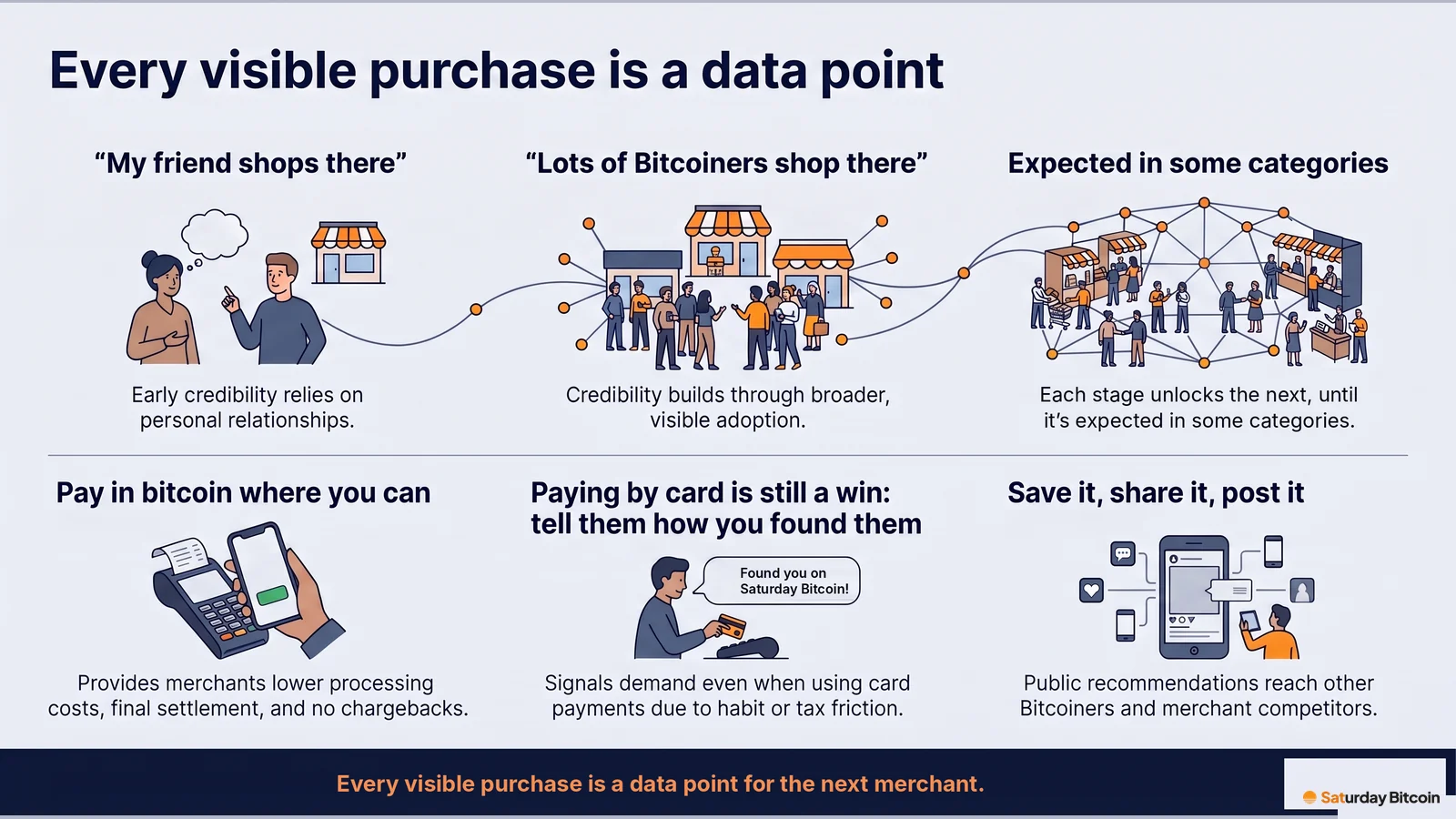
Every visible purchase is a data point for the next merchant. One category is a vote. Every category is a movement.
What Saturday Bitcoin does now
Saturday Bitcoin is a discovery directory. It gathers the demand side around merchants that already accept bitcoin, online and nearby, with tens of thousands of places listed.
Open saturdaybitcoin.com, pick a category (apparel, tech, health and wellness, pantry and groceries, and more), and find a merchant that welcomes you. Online merchants are the focus; local places are on the map too. Save the ones you like so you can come back, and share them with other Bitcoiners.
On the other side, merchants can claim and verify their listing for free, add a welcome offer or promo code for Bitcoiners, and get featured. Our job is to make the meeting point obvious to both sides.
We’re building out categories and coverage. There’s much more we can build around merchants and spending over time, but we’ll talk about those products when they’re ready to use.
The honest limit
This is early. Coverage is incomplete: some categories are thin, and local coverage varies a lot by city. A listing is discovery, not a guarantee that a merchant will see volume. And Saturday Bitcoin is not a payment processor, so we can’t see what you buy. That’s exactly why your shares matter. Shares are the part of the demand side merchants and their competitors can see.
Your move
Coordination problems get solved by people who go first. You don’t have to change how much you spend. You only have to change where some of it goes, and let it show.
Pick one category you already spend in every month, find a Bitcoin-friendly merchant on saturdaybitcoin.com, and save it. Then share it with one other Bitcoiner. That’s how one side gets gathered.