

Volatility isn’t the biggest thing stopping Bitcoin holders from spending their bitcoin. Neither is merchant acceptance or the technology. It’s taxes.
We won’t pretend otherwise. This piece covers what the rules say today, what committed Bitcoiners do about it, the one policy change that would matter most, and a fact about your credit card that most people never think about. None of it is tax advice, and your situation is your own, so talk to a tax advisor before you change how you spend.
Yes, spending bitcoin is a taxable event
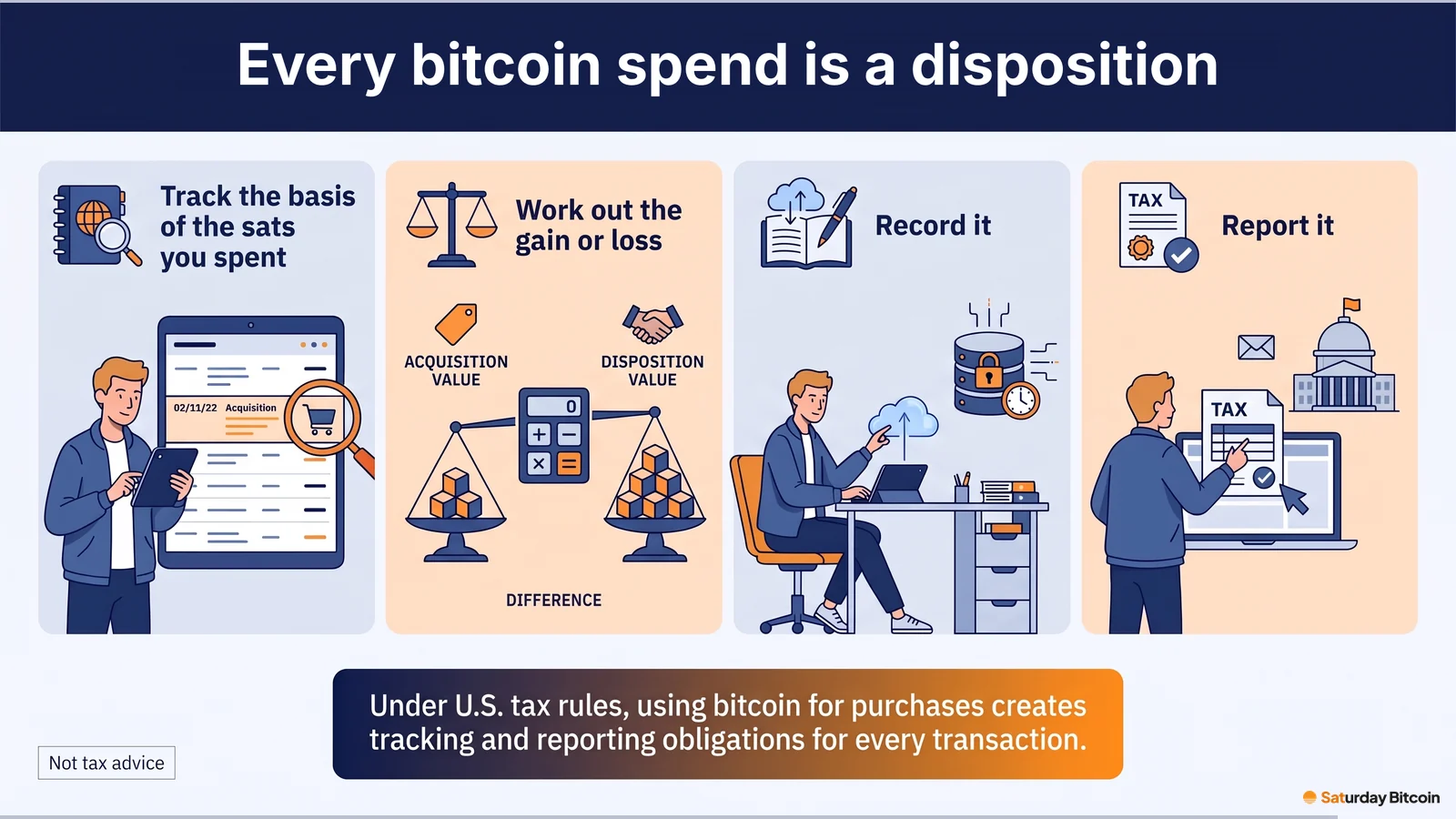
The IRS position is plain: “For U.S. tax purposes, digital assets are considered property, not currency.” Using bitcoin to pay “for property, goods or services in any amount” counts as a disposition. That means you have to work out a gain or loss every time you spend, even on a coffee.
Yes, spending bitcoin is a taxable event today. We won’t pretend otherwise.
Here’s how that plays out. (This is an illustration, not data.) You bought some bitcoin when it was $30,000. It’s now $60,000, and you spend about 0.00167 BTC on a $100 item.
- Your cost basis for those sats is about $50.
- Your “sale price” is $100.
- Your capital gain is $50.
- If you’ve held for more than a year and fall in the 15% long-term bracket, you owe about $7.50. If you’ve held for a year or less, the gain is taxed as ordinary income, which is usually more.
So the $100 purchase really costs you more than $100. And every purchase means tracking the basis of the specific sats you spent, calculating the gain or loss, recording it, and reporting it. Reporting is getting more formal, too. Brokers now file Form 1099-DA, which covers gross proceeds for transactions from January 1, 2025 and adds basis for certain transactions from January 1, 2026.
That’s why so many “We now accept bitcoin!” announcements were followed by very little bitcoin volume. Even Bitcoiners who want bitcoin to work as a medium of exchange face real friction. For most everyday purchases, the rational move is still to spend dollars and hold bitcoin. The barrier is regulatory, not technical, and no amount of merchant acceptance fixes it by itself.
Spend-and-replace: keep your stack, support the merchant
Many committed Bitcoiners spend anyway, and they handle it with a simple discipline. They spend bitcoin at a merchant who accepts it, then buy back the same amount so their position doesn’t shrink. Spend, replace, keep your stack, support the merchant.
Some people flip the order and call it “replace and spend”: they buy fresh sats first, then spend them. The idea is that sats bought at today’s price carry little or no gain, though the result depends on how your lots are identified. That’s a question for your tax advisor, not a rule of thumb.
Spend-and-replace is a noble practice, and it’s worth being honest about what it doesn’t do:
- It doesn’t remove the tax event. Each spend is still a disposition you track and report. Replacing your sats restores your position, but it doesn’t undo the gain.
- It takes discipline. You have to actually rebuy, close to the time you spend, every time.
- It has small costs. Fees on the replacement purchases add up.
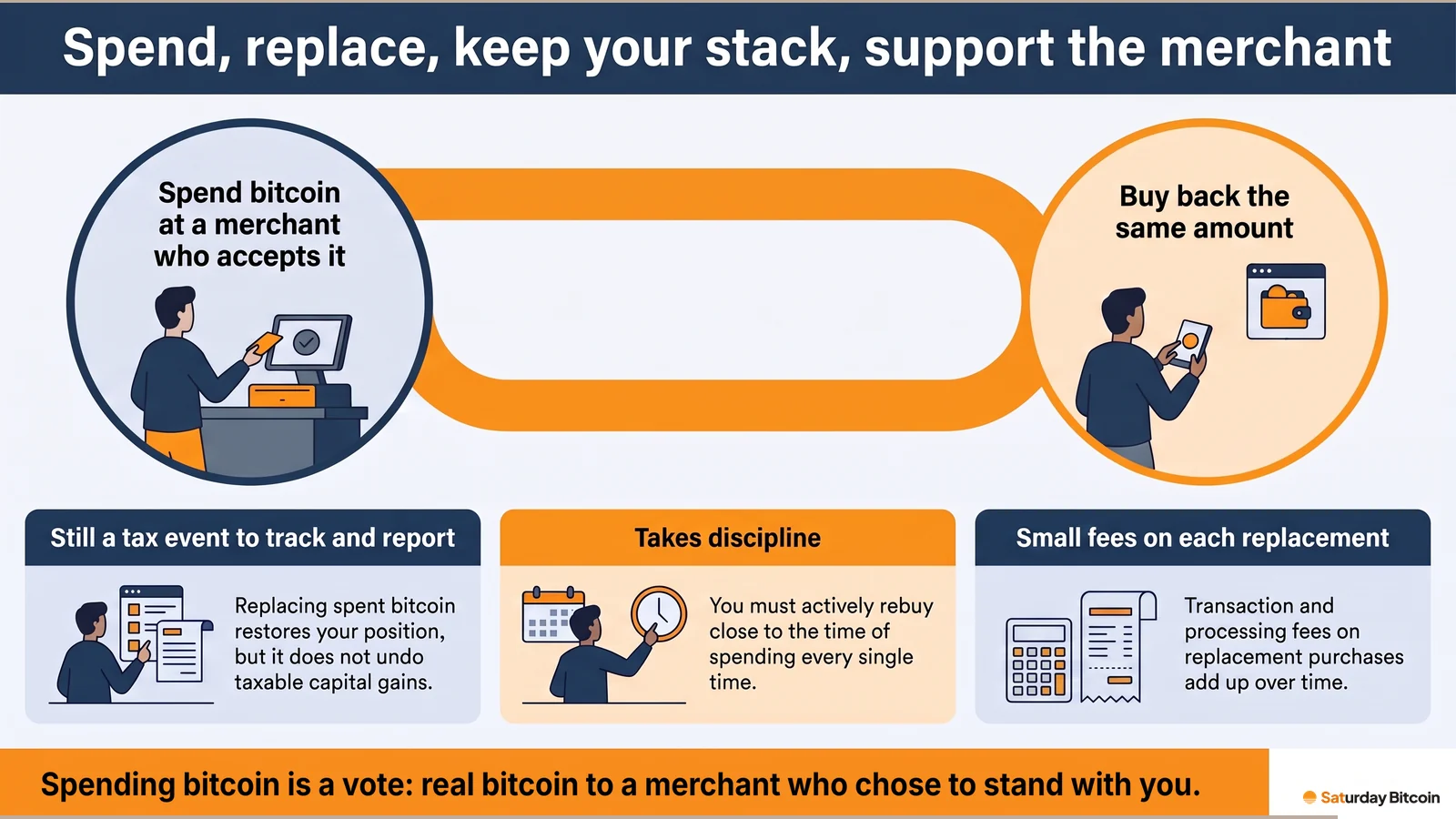
So why do it? Because spending bitcoin is a vote. Your payment moves real bitcoin to a merchant who chose to stand with you. It shows that merchant and their competitors that the channel is real, and it’s the habit that makes bitcoin a working currency rather than only a savings asset.
The policy unlock: a de minimis exemption
The fix isn’t a product. It’s a law. A de minimis exemption would let everyday purchases below a set threshold go untaxed and unreported, the way foreign-currency transactions under $200 are treated today. That’s the policy unlock worth advocating for.
As of this writing, no such exemption for everyday bitcoin purchases has become law. Proposals exist. In July 2025, Sen. Cynthia Lummis introduced a bill that would exempt transactions of $300 or less, with exempt gains capped at $5,000 a year. In September 2026, the House Ways and Means Committee approved a bill with a de minimis rule for small network fees and dollar-pegged stablecoins, but not for everyday bitcoin purchases; it still needs the full House and the Senate. Witnesses at hearings have broadly supported a de minimis rule, but they disagree on whether it should reach bitcoin. It may pass this Congress or it may not.
The case for it gets stronger as more people actually spend bitcoin. When ordinary people pay with bitcoin at ordinary merchants, taxing every coffee as a property sale looks less like policy and more like paperwork for its own sake. Merchants who accept bitcoin and the customers who use them become a constituency that lawmakers can see. If this matters to you, tell your representatives.
Where your card rewards really come from
Now the other side of the ledger. Plenty of Bitcoiners pay by card, even at Bitcoin-friendly merchants, because of habit, tax friction, or the rewards. That’s fine, and the merchant still wins your business. But it helps to know what those rewards are.
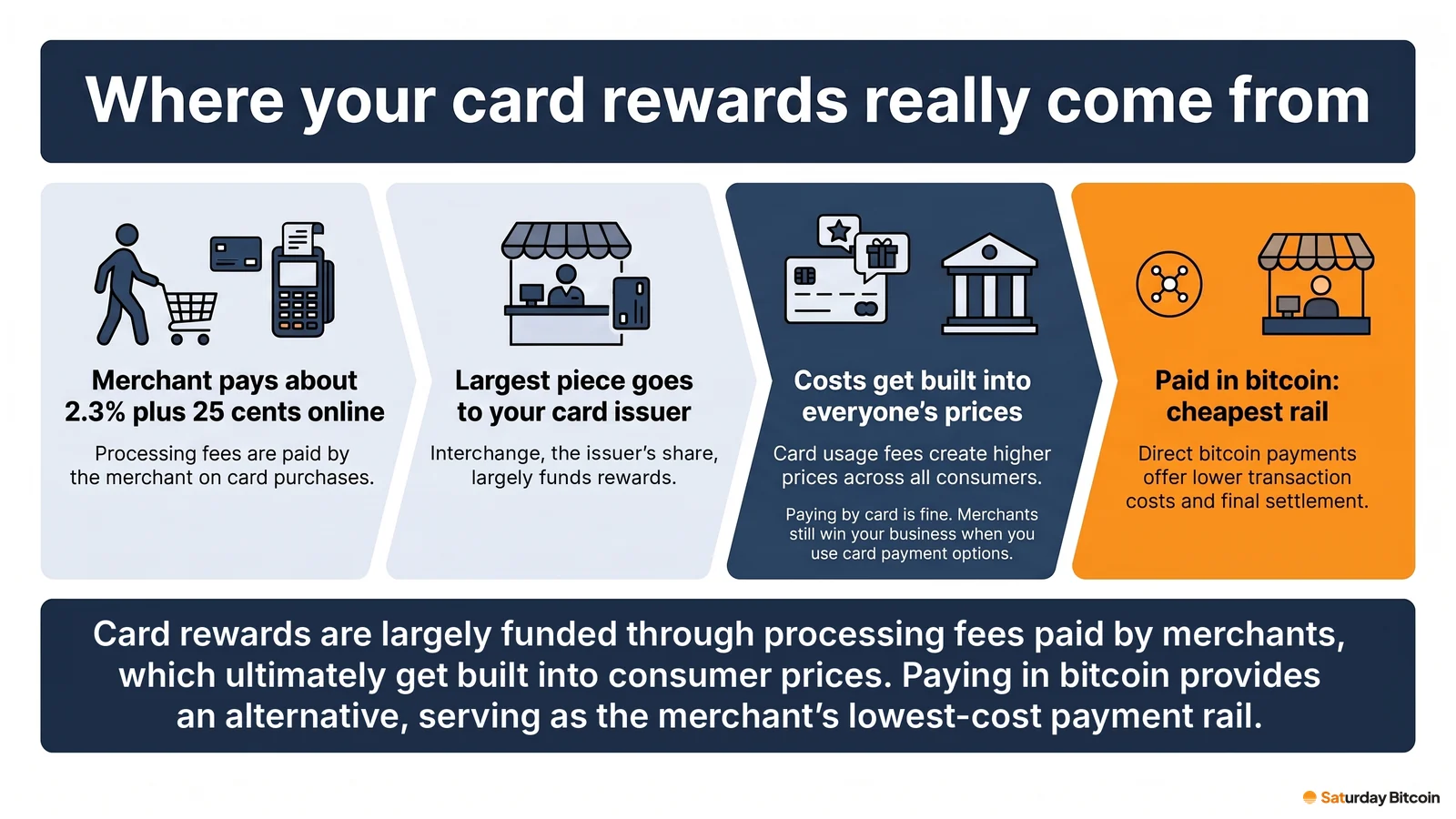
When you pay by card, the merchant pays a processing fee. Online, that averages about 2.3% plus $0.25 on Visa, Mastercard and Discover, and about 3% plus $0.25 on Amex. Interchange, the part that goes to your card issuer, is the largest piece. Rewards cards carry higher interchange than standard cards.
Your 1-2% cash back is largely a slice of what the merchant paid. Interest, annual fees and other revenue cover the rest, and the issuer and the networks take their share along the way. Merchants generally don’t charge card users more, so those costs get built into everyone’s prices. Federal Reserve economists have described this as an implicit transfer from people who pay cash to people who pay by card.
None of this makes you wrong for using a rewards card. It just reframes the “free” 2%. You’re getting back part of a toll your favorite merchant already paid, and some of that toll is in the price you paid.
When you do pay in bitcoin, the sale arrives on the merchant’s cheapest rail. On sales actually paid in bitcoin, they get lower processing costs, final settlement and no chargebacks, and they decide refunds themselves. Lightning network fees are typically a fraction of a cent, and even with a processor’s fee, the total is typically well below card costs. That’s real value to a merchant who took a stand, even if it never shows up as points on your statement.
What you can do this week
You don’t need a perfect tax setup to support Bitcoin-friendly merchants. You just need to find them and pick how you pay.
- Pay in bitcoin when it works for you, and consider spend-and-replace so your stack stays whole. Keep records, and talk to a tax advisor.
- Pay by card when it doesn’t. Your loyalty still counts. A Bitcoiner who pays by card at a Bitcoin-friendly merchant is still a customer that merchant earned.
- Make the case for de minimis. The more of us who spend, the louder that case gets.
Saturday Bitcoin is a free directory of tens of thousands of merchants that already accept bitcoin, online and near you. We’re not a payment processor, and we can’t see your purchases, so what you buy and how you pay stays between you and the merchant. Some merchants add a welcome offer for Bitcoiners. All of them made a choice that deserves to be found.
Find a Bitcoin-friendly merchant, save it, and spend there this week at saturdaybitcoin.com.