


Most discretionary initiatives that reach a CFO’s desk come with the same tradeoffs. There’s a budget ask up front. The attribution is modeled rather than observed. The payback is measured in quarters or years. The accounting brings estimates and audit questions. And someone has to run governance across several functions. Most get rejected, more because of how they’re built than because CFOs are conservative.
Becoming a visible, Bitcoin-friendly merchant is unusual because it clears most of those filters at once. This piece looks at it through the finance seat. That means no enthusiasm for bitcoin is required. Irrespective of what you think about bitcoin, the customer segment is real, and the merchant bitcoin strategy works independently of bitcoin’s price.
The transformation paradox
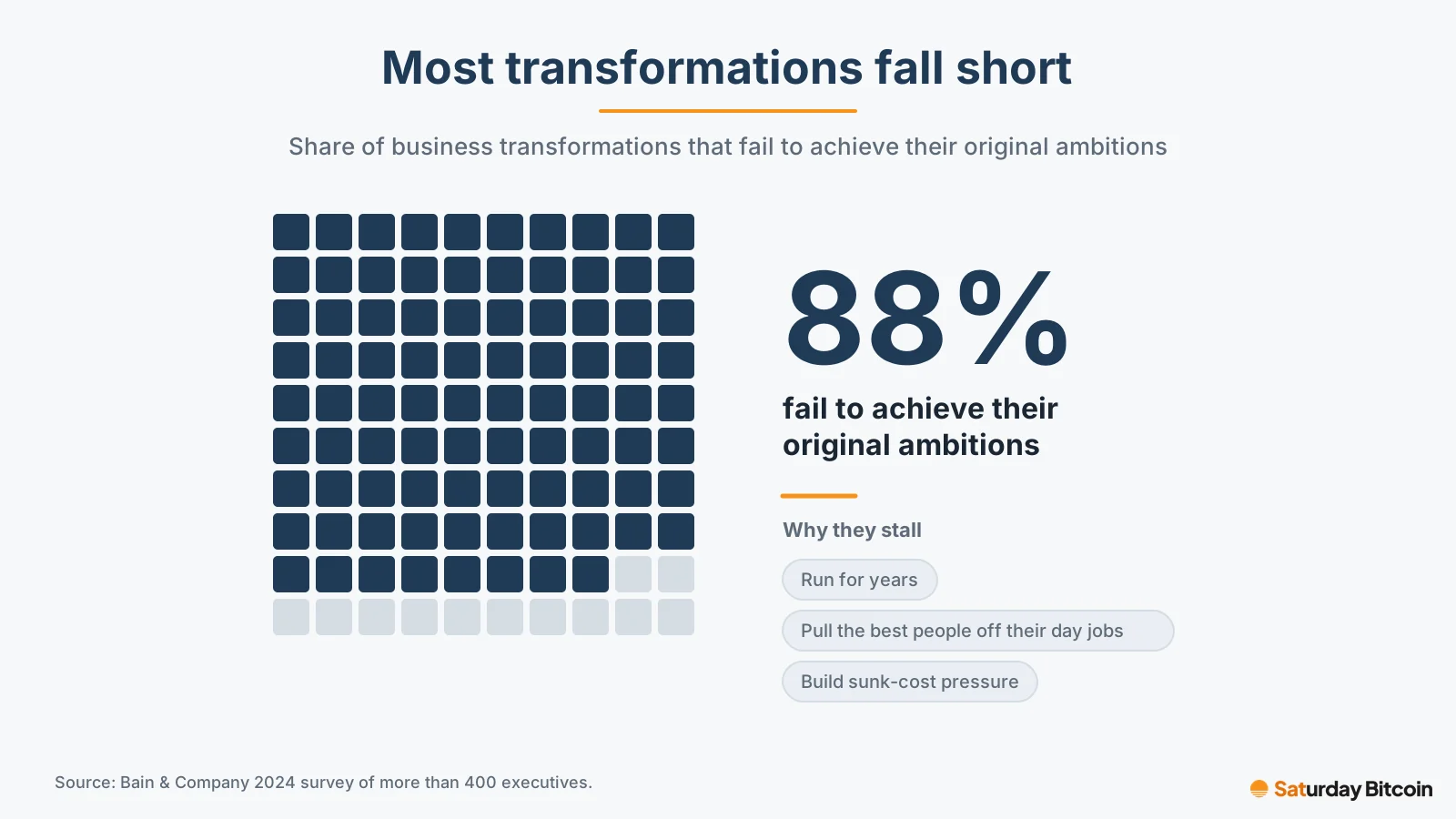
Most executives have a complicated relationship with the phrase “digital transformation.” They know it can matter, and they’ve seen it cost too much and fail. Bain’s 2024 survey of more than 400 executives found that 88% of business transformations fail to achieve their original ambitions. Programs often run for years, pull the best people off their day jobs, and build up sunk-cost pressure that keeps a failing program alive long after a clear-eyed review would have stopped it.
This is an opt-in, not a transformation. Claiming your listing takes minutes, not a project.
So most transformation programs fail expensively. The executives who do well in that environment find ways to signal forward-looking leadership without taking on that cost and risk. Being an early Bitcoin-friendly brand is one of the rare low-cost ways to send that innovation signal, as long as there’s real substance behind it.
An opt-in, not a transformation
When merchants hear “bitcoin,” many think of complexity, volatility, retraining and some kind of ideological commitment. That’s the framing problem. The right mental model is an opt-in.
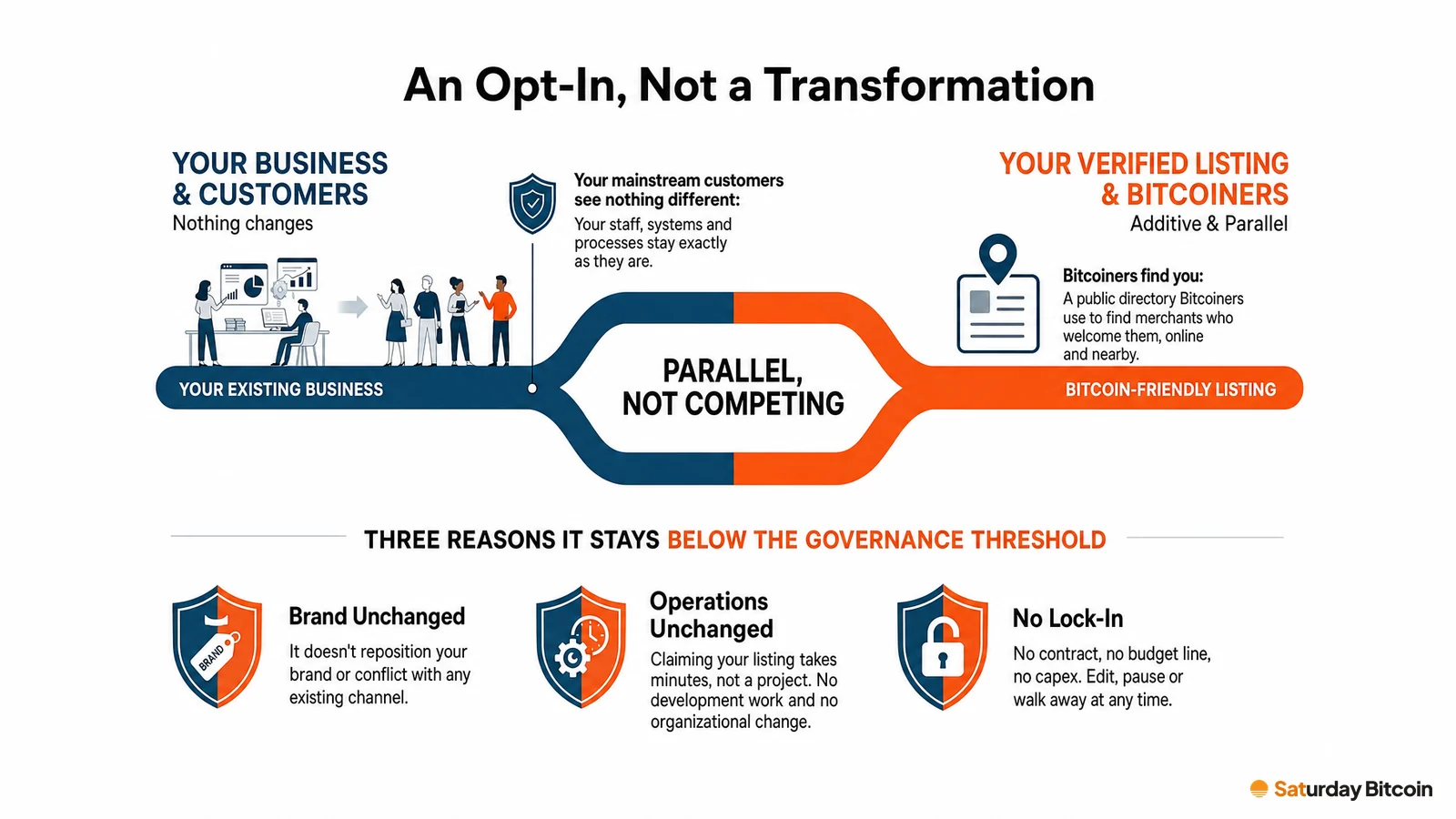
If your business already accepts bitcoin, Saturday Bitcoin may already list you in a public directory that Bitcoiners use to find merchants who welcome them, online and nearby. Claiming and verifying that listing is free. Claiming your listing takes minutes, not a project. You can add a welcome offer or promo code if you want one. A verified listing changes nothing about how you run your business. It doesn’t reposition your brand. It doesn’t conflict with any existing channel. Your mainstream customers see nothing different. Your staff, systems and processes stay exactly as they are. It’s additive, and it doesn’t compete with anything you already do.
There’s also no contract and no lock-in. You can edit the listing, pause the offer or walk away at any time. There’s no sunk cost to unwind because there was no upfront cost.
That puts it below the governance threshold. Steering committees and board reviews exist to stop overcommitment to unproven bets. Nothing here needs a steering committee. There’s no budget line, no capex, no development work and no organizational change. You can treat it as a pilot, judge it on what actually happens, and keep it or drop it.
One honest caveat: bitcoin is still a charged topic for some executives. Getting senior leaders aligned is sensible, as it would be for anything that carries your brand in public.
Initiatives that show up this fiscal year get approved
Finance leaders are under well-documented pressure to deliver results in the current period. In the landmark survey by Graham, Harvey and Rajgopal of 401 financial executives, 78% said they would give up economic value in exchange for smoother earnings. That isn’t a moral failing. It’s how initiatives actually get judged. Initiatives that show up this fiscal year get approved. Ones that pay back in three years get deferred.
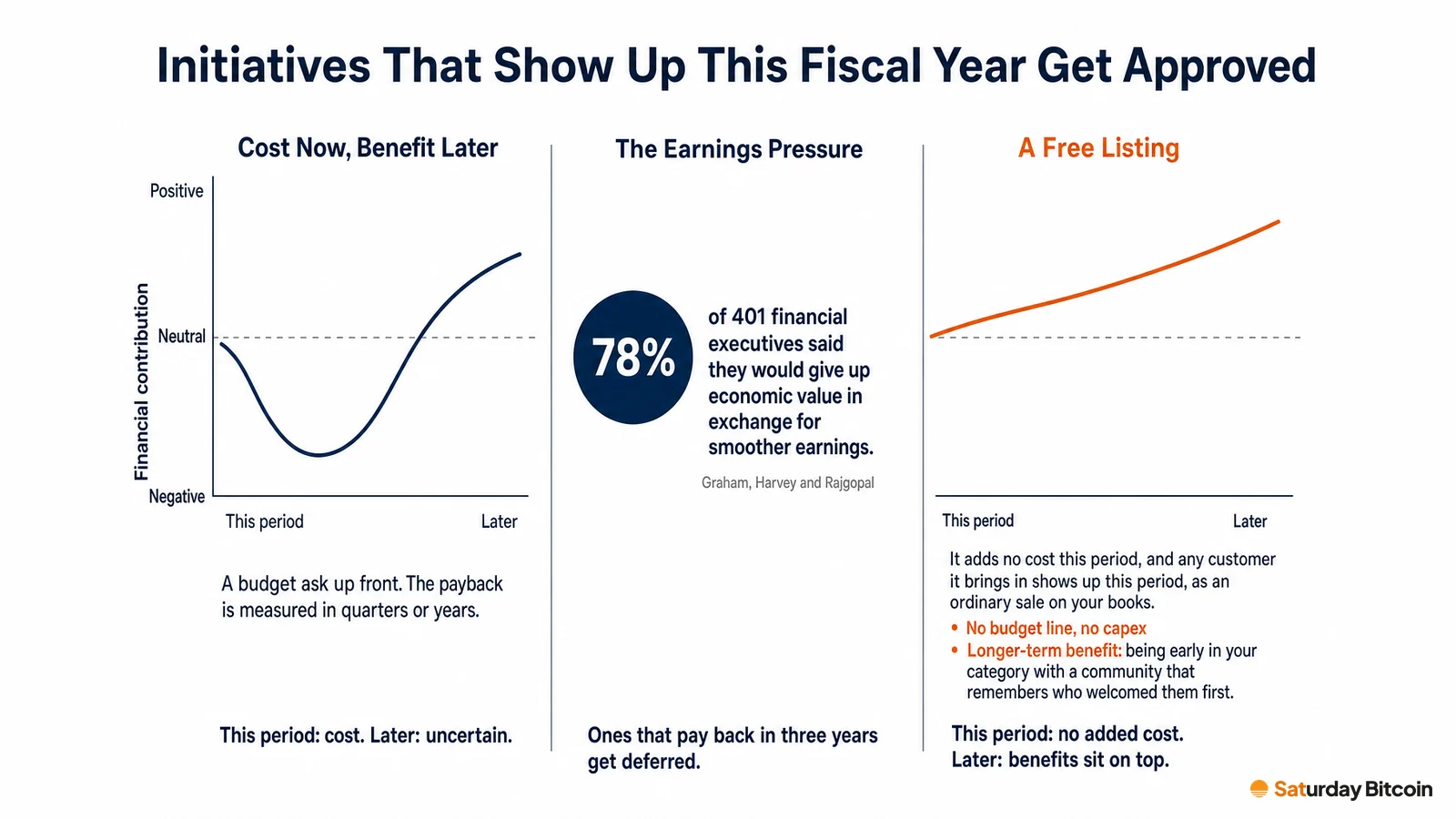
A free listing doesn’t fit the usual pattern of cost now and benefit later. It adds no cost this period, and any customer it brings in shows up this period, as an ordinary sale on your books. The longer-term benefits sit on top of that. One is being early in your category with a community that remembers who welcomed them first. That’s a differentiator today, and in time it will be expected of everyone.
On the sales customers actually pay in bitcoin, your existing bitcoin channel already has useful properties: lower processing costs, final settlement, no chargebacks, and you decide refunds. For context, online card payments average about 2.3% + $0.25 on Visa, Mastercard and Discover, and about 3% + $0.25 on Amex. Lightning network fees are typically well below card costs, though processors may add their own fee. Many Bitcoiners will still pay by card out of habit, for rewards, to avoid tax friction, or to support you on principle. That sale still lands on your books.
The confidence haircut
CFOs make a move in the approval discussion that others in the room often miss. Every marketing dollar you project gets a haircut for attribution uncertainty. When the attribution comes from modeling (marketing-mix models, multi-touch attribution, brand-lift surveys), the finance seat discounts the projected return. For initiatives on the edge of approval, which describes most of them, that haircut often decides the outcome.
So ask what any channel’s attribution actually is, including this one. Here’s the honest answer for a directory listing. Saturday Bitcoin is not a payment processor and can’t see your purchases, so it can’t hand you a revenue number. What you can do is give the listing a dedicated welcome code and ask new customers how they found you. That gives you a cleaner read than most channels, though not a perfect one. Because the listing costs nothing, even a heavy haircut leaves the case intact. That’s rarely true of a channel that needs budget.
The accounting you don’t take on
There’s a second reason conventional channels often underperform their projections: their costs don’t all show up on the incentive line. Points programs are an accounting liability as much as a marketing tool. Under ASC 606, loyalty points usually count as a “material right.” That means part of each sale is deferred as a liability until the points are redeemed or expire. Finance teams have to estimate a standalone selling price for each point and forecast breakage, the share of points that will never be redeemed. Both are volatile, audited estimates that add work to the close. This is industry context, not a reason to drop your program. Being Bitcoin-friendly sits alongside your loyalty program and doesn’t replace it.
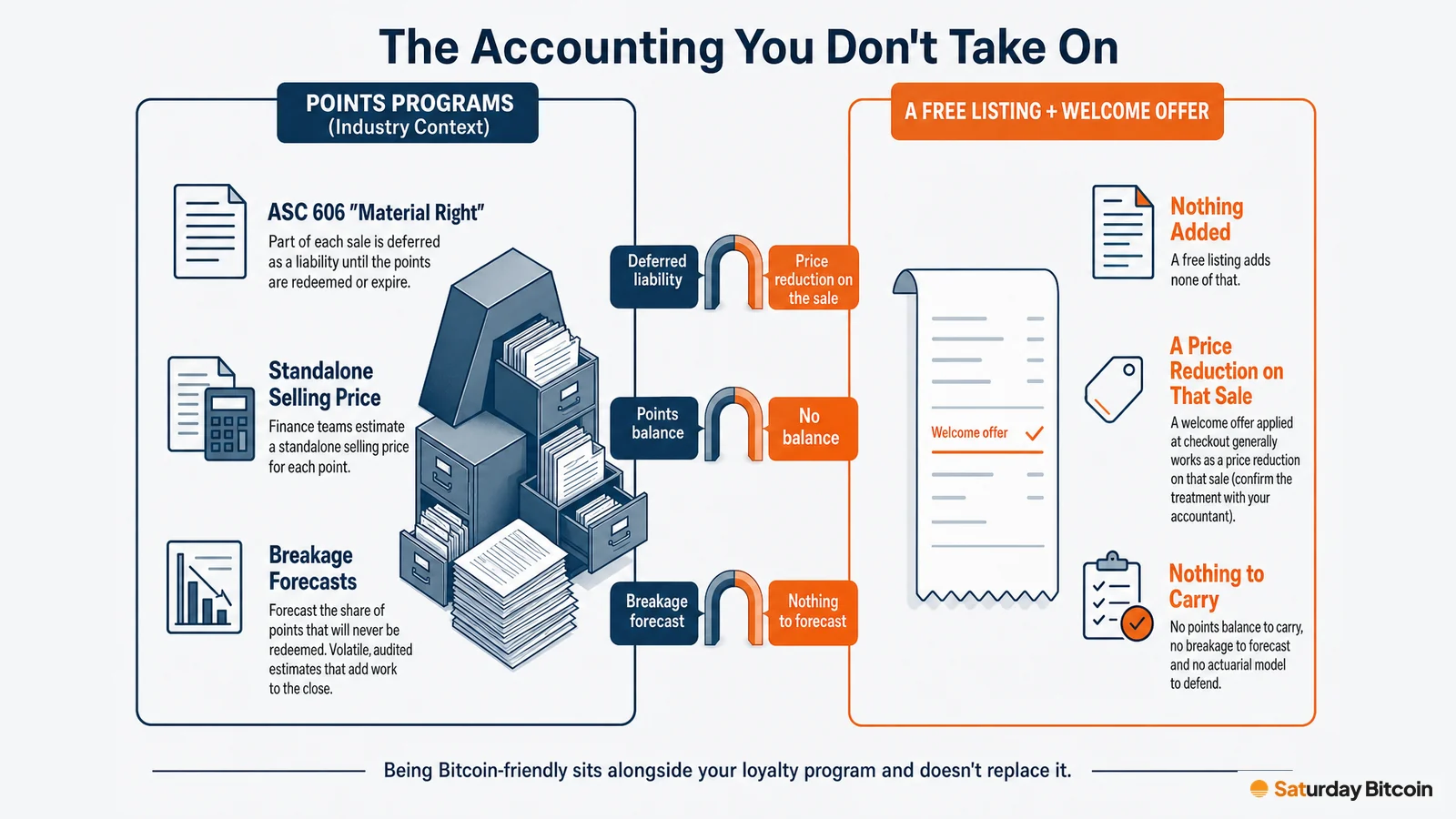
A free listing adds none of that. A welcome offer applied at checkout generally works as a price reduction on that sale (confirm the treatment with your accountant). It leaves no points balance to carry, no breakage to forecast and no actuarial model to defend.
Safe innovation from the finance seat
Championing innovation from the CFO’s chair is hard by design. The role pulls two ways: business partner to the CEO on growth, and steward of controls, costs and risk. Research on the CFO role, including a 2024 study funded by AICPA and CIMA, describes exactly that tension between controllership and business partnering. As a result, many finance leaders stick to a “safe innovation” repertoire: automation, efficiency and cost programs.
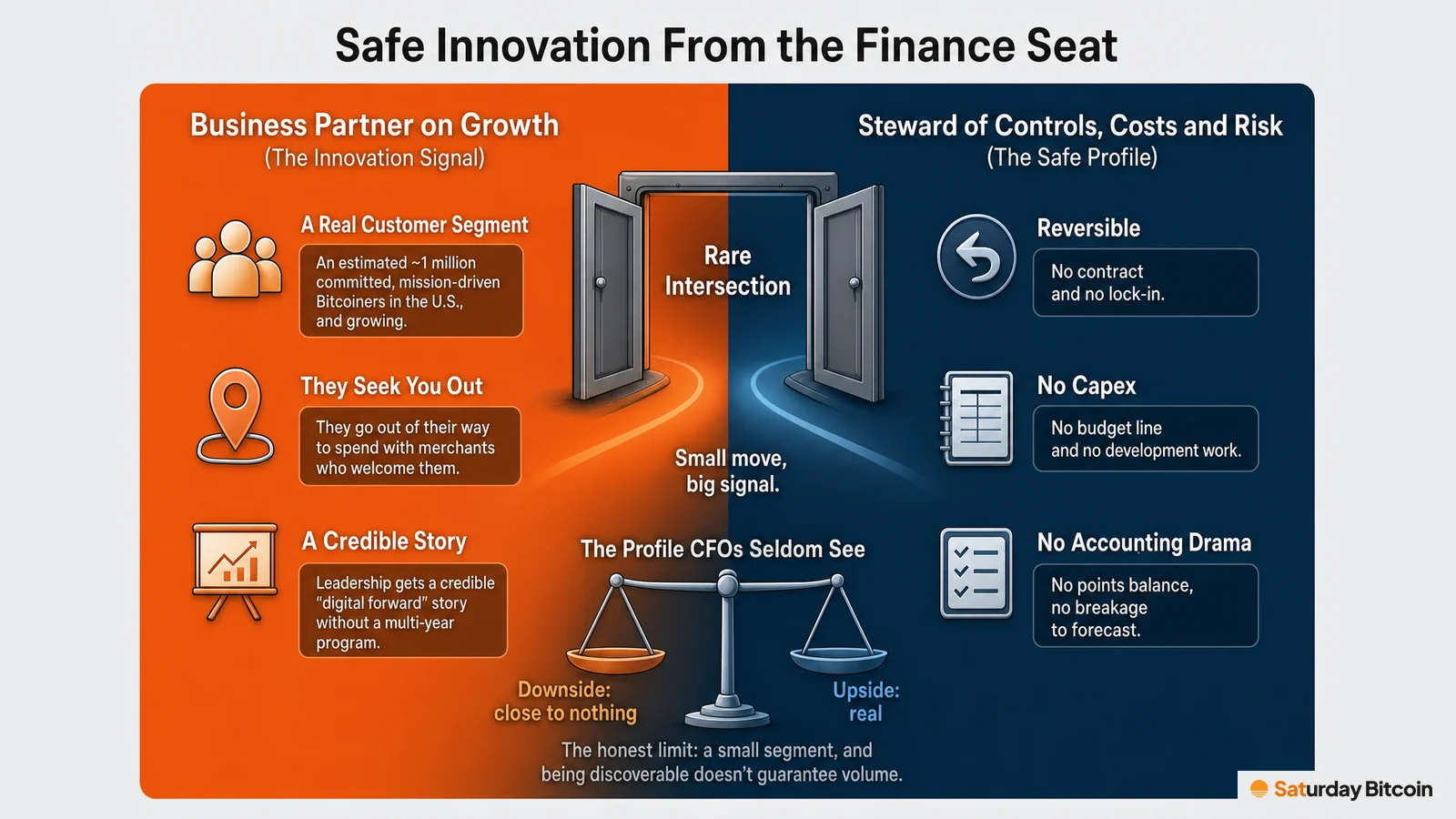
For a CFO, being Bitcoin-friendly is a rare safe innovation: reversible, no capex, no accounting drama. It also stands for something real. An estimated ~1 million committed, mission-driven Bitcoiners in the U.S., and growing, go out of their way to spend with merchants who welcome them. Tens of millions of Americans own some bitcoin. Small move, big signal. Leadership gets a credible “digital forward” story, and it doesn’t come at the cost of a multi-year program.
The honest limit: this is a small segment, and being discoverable doesn’t guarantee volume. Your product, price and service still have to be right. The case isn’t that a listing will transform your numbers. It’s that the downside is close to nothing and the upside is real, which is a profile CFOs seldom see.
What to do this week
Check whether your business is already in the Saturday Bitcoin directory, then claim and verify your free listing at saturdaybitcoin.com/business. Add a dedicated welcome code so you can see what it does. If you don’t accept bitcoin yet, see Accepting Bitcoin Isn’t Enough for why the welcome matters as much as the payment option. For the full strategy, start with The Bitcoin-Friendly Merchant Playbook.
It’s free, reversible and low effort, with real upside. We bring you the customer. When they pay in bitcoin, they arrive on your cheapest rail.