


Every marketing leader knows this meeting. It comes around every quarter, every year or both. It’s the budget review, and every channel is on the table. Paid search competes with paid social. Events compete with influencers. Loyalty competes with brand. Every channel needs a justification, every justification needs data, and someone in the room with different priorities will dispute that data.
Your shop already accepts bitcoin. If you’re wondering where that belongs in your marketing mix, start with the constraints a CMO actually works under. They explain why this channel works differently.
The constraints nobody puts on the org chart
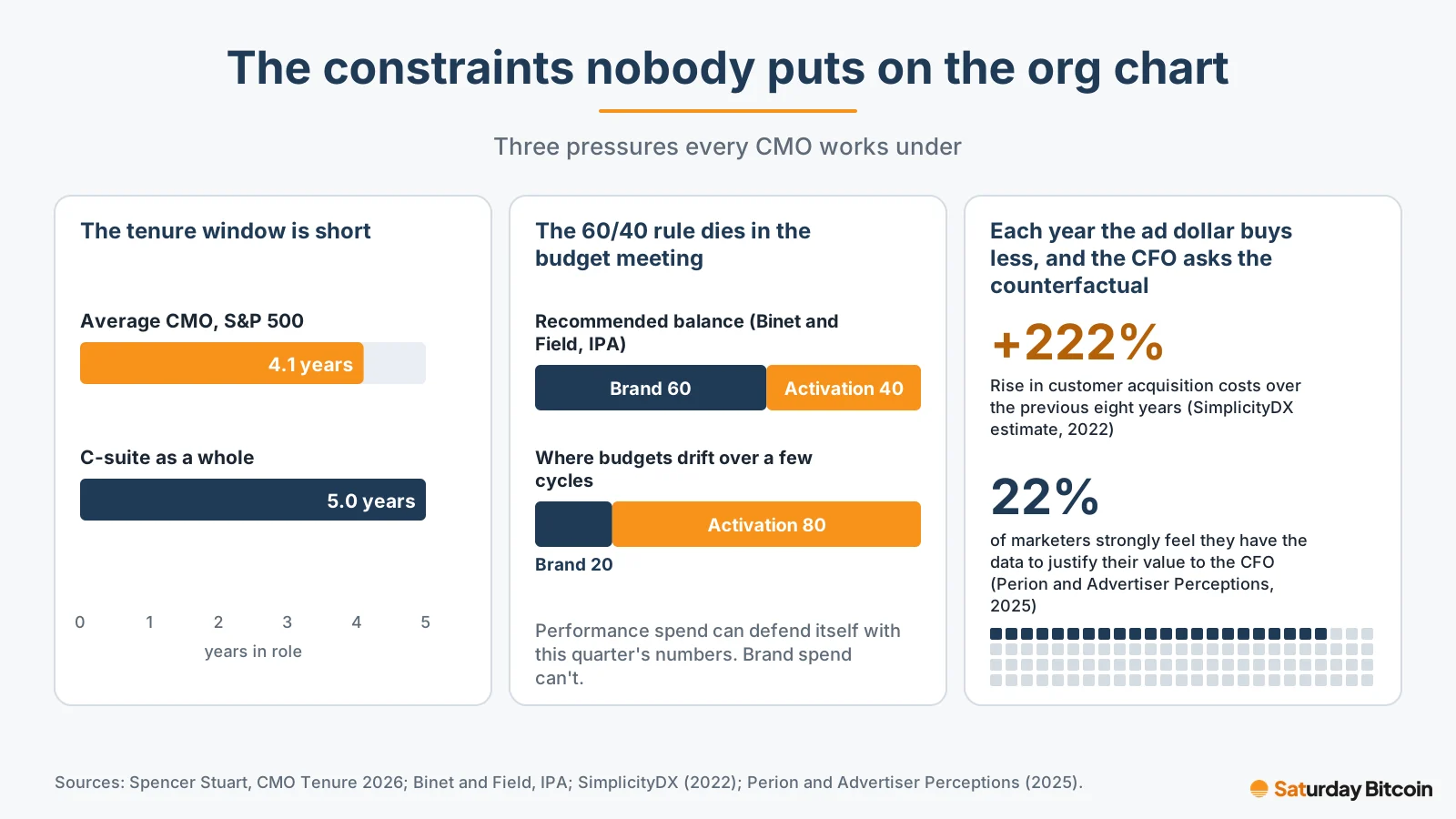
The tenure window is short. Spencer Stuart’s CMO Tenure 2026 study puts average CMO tenure at S&P 500 companies at 4.1 years, against 5.0 years for the C-suite as a whole. A CMO with three or four years in the seat needs channels that show defensible results inside that window. A brand investment with a long payback is a leap of faith for a leader who may not be there to collect.
Every channel you run is a program you have to defend.
The 60/40 rule dies in the budget meeting. Les Binet and Peter Field’s IPA research found the best balance between brand building and sales activation is roughly 60:40. Most CMOs know it. Most budgets drift away from it anyway, because performance spend can defend itself with this quarter’s numbers and brand spend can’t. Over a few budget cycles, 60/40 slides toward 80/20. Then the acquisition treadmill starts: more performance spend, exhausted buyer pools, rising costs. SimplicityDX estimated in 2022 that customer acquisition costs had risen 222% over the previous eight years. Every year the same ad dollar buys less.
The CFO asks the counterfactual question. The CFO doesn’t ask what marketing produced. The CFO asks what would have happened without the spend. A 2025 Perion and Advertiser Perceptions survey found that only 22% of marketers strongly feel they have the data to justify their value to the CFO. Most CMOs can’t answer the counterfactual cleanly, so pick channels where the answer is simpler.
Every channel you run is a program you have to defend
Every budget-funded channel lives on conditional approval. It needs budget, management, attribution, audit and renewal, and it runs only as long as someone with budget authority keeps believing in it. When the CMO changes or the quarter gets tight, programs that are clearly working can still be cut. Performance is necessary for survival, but it isn’t enough.
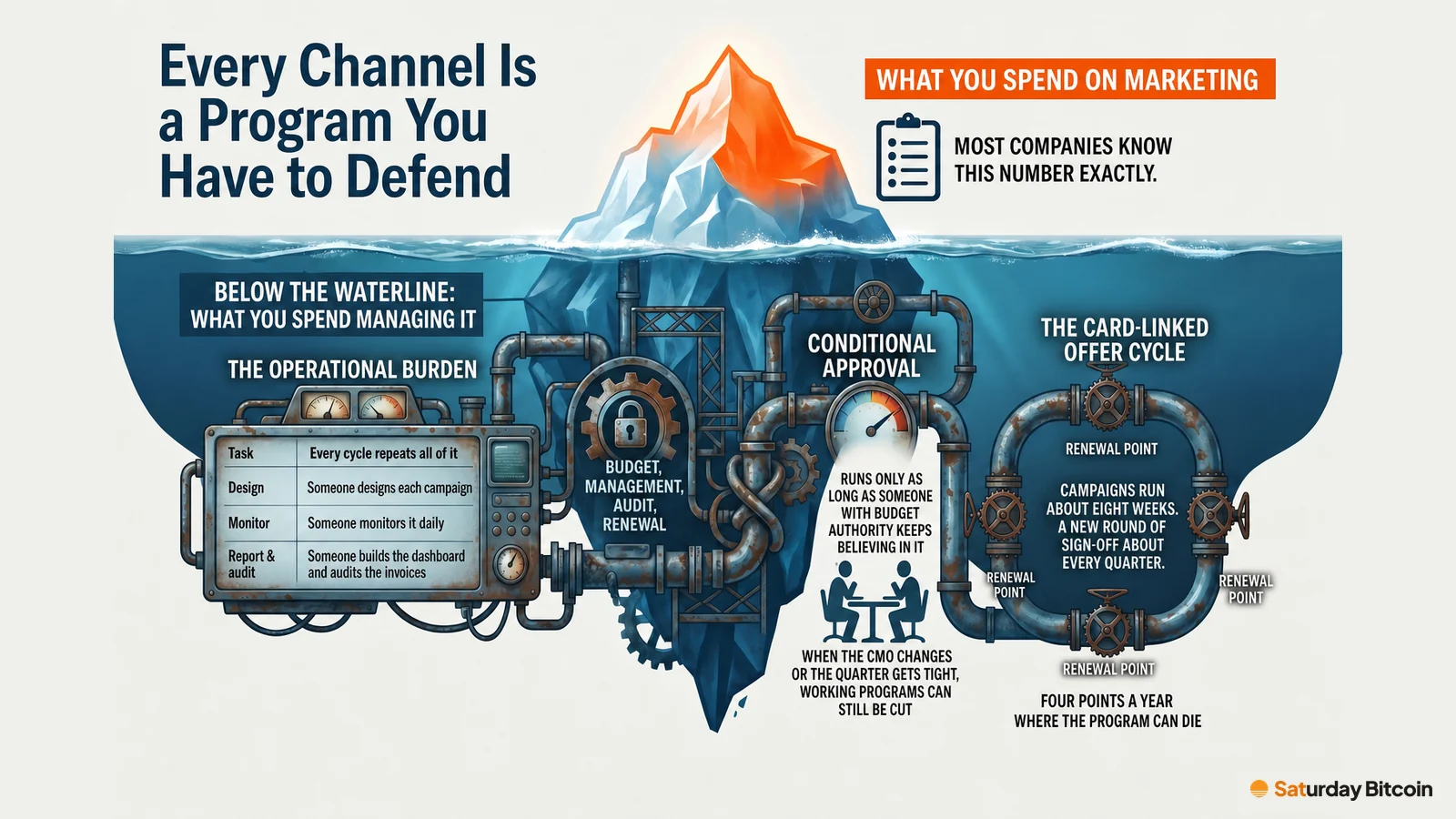
The cadence can be brutal. In card-linked offer programs, which I worked on for years, a campaign typically ran about eight weeks. A new round of budget, design, targeting and sign-off came up about every quarter. That’s four points a year where the program can die.
Count the hours, not just the dollars. Most companies know exactly what they spend on marketing. Few know what they spend managing it. Someone designs each campaign, someone monitors it daily, someone reconciles the attribution and builds the dashboard, and someone audits the invoices. Every cycle repeats all of it. That overhead is a real cost that rarely appears in any channel’s ROI.
Most channels decay
Look across the conventional mix and the same pattern repeats.
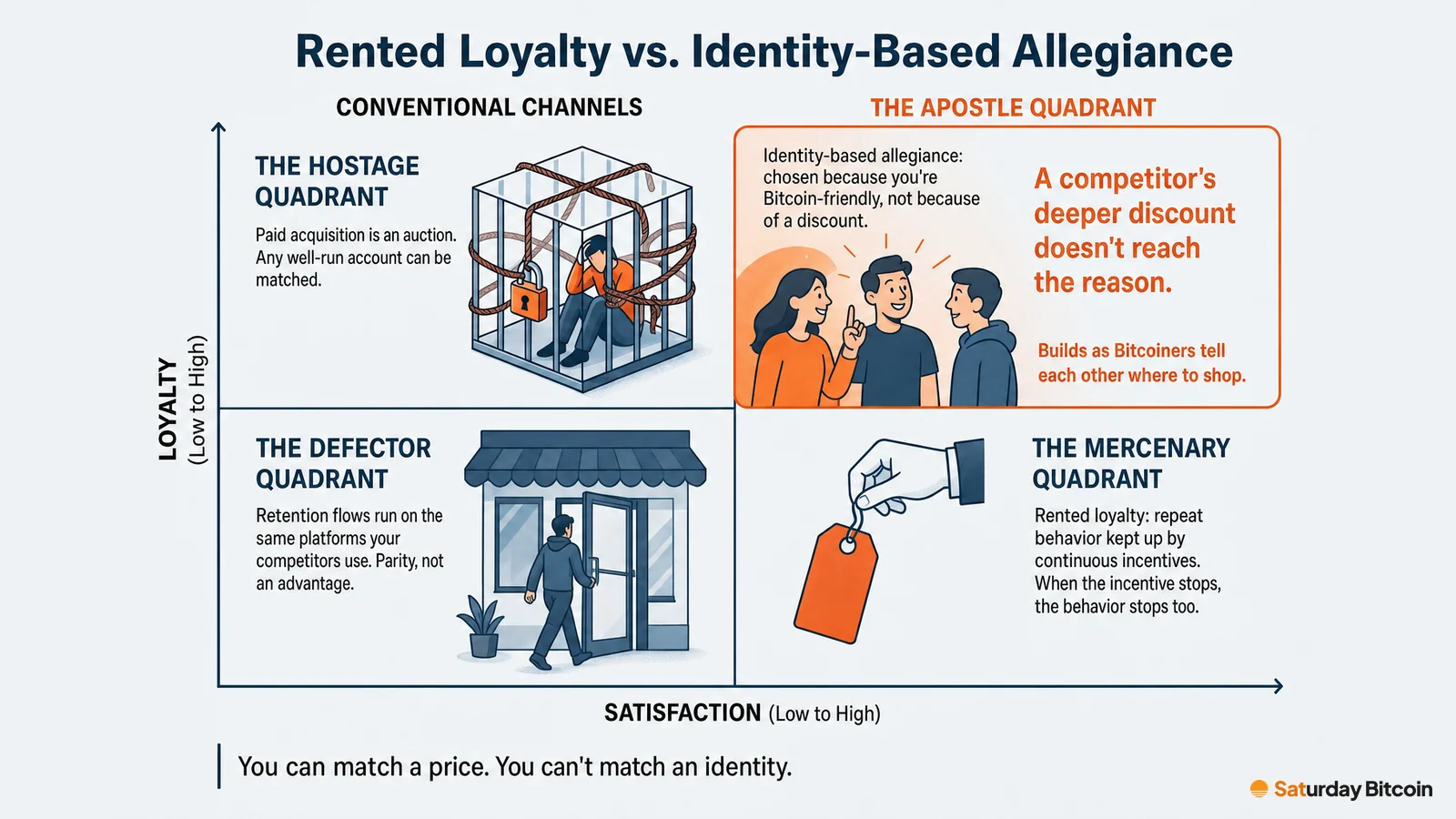
- Paid acquisition is an auction. You bid against competitors for the same audience, and any well-run account can be matched.
- Retention marketing (email, SMS, automated flows) is excellent, but it works only on customers you already have. Your competitors run the same flows on the same platforms, so it’s parity, not an advantage.
- Loyalty programs and card-linked offers produce what I call rented loyalty: repeat behavior kept up by continuous incentives. When the incentive stops, or a competitor offers a better one, the behavior stops too.
These aren’t failures of execution. They’re structural.
Identity-based allegiance works differently. A Bitcoiner who chooses you because you’re Bitcoin-friendly hasn’t chosen you because of a discount, so a competitor’s deeper discount doesn’t reach the reason. You can match a price. You can’t match an identity. Most channels decay. Allegiance based on identity tends to last, and it builds as Bitcoiners tell each other where to shop.
Think channel and context, not campaign
Being Bitcoin-friendly in a way Bitcoiners can see doesn’t work like a campaign. It works more like accepting Amex: you set it up once and it keeps running. Nothing has to be relaunched each quarter, and nothing expires.
It also changes the context in which a particular customer judges you. Bitcoiners are single-issue shoppers. Many deliberately look for merchants that accept bitcoin, and many consolidate their spend in a category with the ones they find. A Bitcoiner who already shops with you judges you like any other merchant, on price, service and convenience. Once they know you’re Bitcoin-friendly, you’re no longer one more option on the shelf. You’re the merchant they want to see win.
Irrespective of what you think about bitcoin, the customer segment is real. Tens of millions of Americans own some bitcoin. Within that group we estimate there are about 1 million committed, mission-driven Bitcoiners in the U.S., and the number is growing. That’s a conservative estimate, since no direct survey exists. This merchant bitcoin strategy works independently of bitcoin’s price.
A brand statement and a customer source in the same act
Analysts sometimes use the awkward term bothism for a channel that serves the brand ledger and the performance ledger in the same act. Such channels are rare.
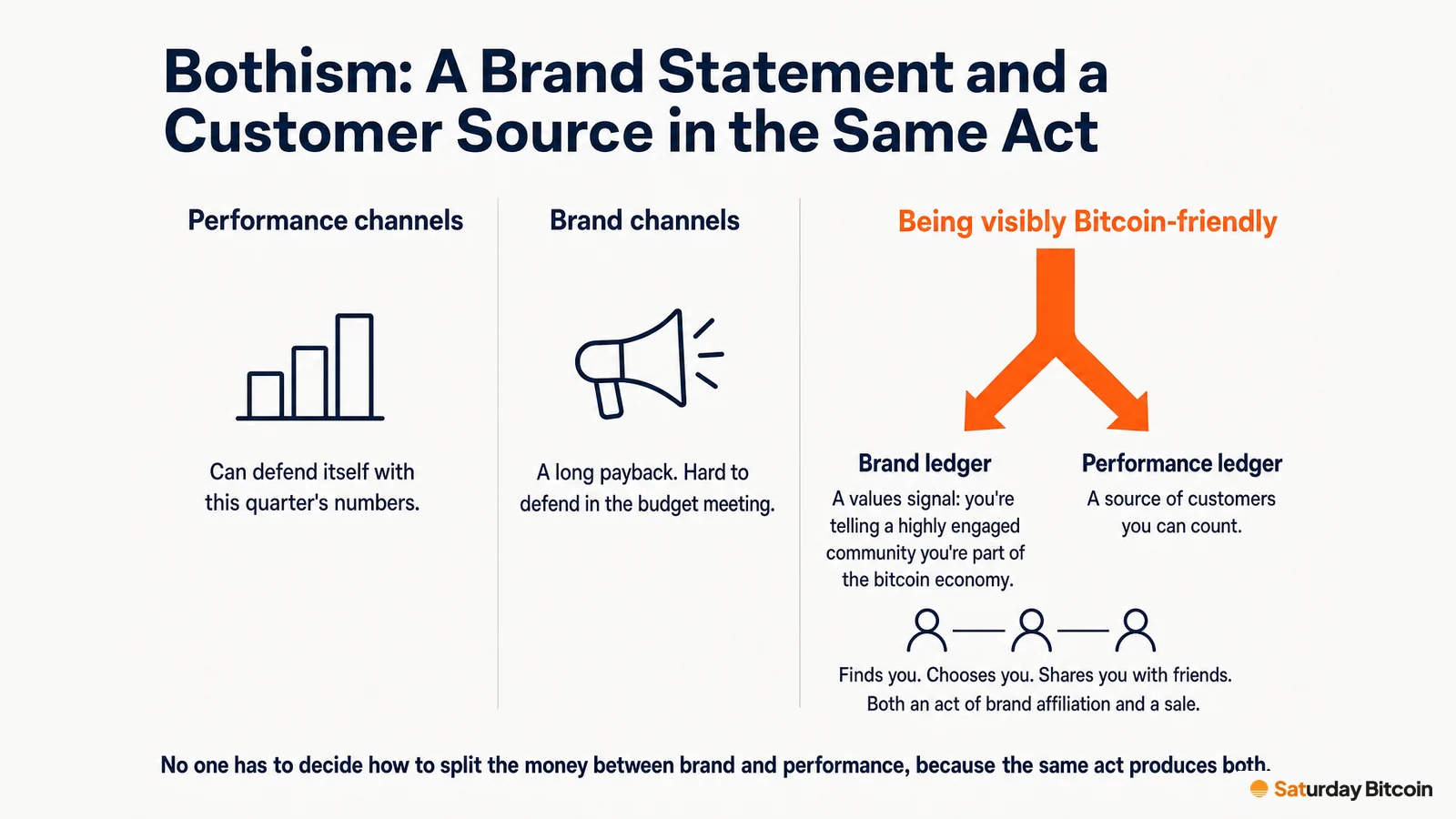
Being visibly Bitcoin-friendly is one of them. On the brand side, it’s a values signal: you’re telling a highly engaged community that you’re part of the bitcoin economy. On the performance side, it’s a source of customers you can count. A Bitcoiner who finds you, chooses you and shares you with friends is both an act of brand affiliation and a sale. No one has to decide how to split the money between brand and performance, because the same act produces both.
The payment side helps too. When a Bitcoiner pays in bitcoin, the sale settles on your lowest-cost rail: lower processing costs, final settlement and no chargebacks, and you decide refunds under your own policy. Many Bitcoiners still pay by card, out of habit, for card rewards, to avoid tax friction, or to support the merchant on principle. That sale still counts.
Where Saturday Bitcoin fits
Saturday Bitcoin is a directory that helps Bitcoiners find merchants that already accept bitcoin, online and nearby. It lists tens of thousands of places. Bitcoiners browse it, save the merchants they like and share them.
Here’s how it fits your mix:
- It’s always on, with no budget. You claim and verify your listing for free. We’ll direct Bitcoiners to your business even if you never do more than claim your listing.
- You can turn it up. If you want more engagement, add a welcome offer or promo code, or get featured.
- There’s no renewal meeting. It’s free, reversible and low effort, with real upside. No line item gets defended every quarter, and no campaign team has to run it.
- Measurement is simple, though not perfect. A dedicated welcome code tells you how many customers came through the directory. Your own bitcoin sales report tells you how many paid on that rail. Neither catches the Bitcoiner who found you here and paid by card. Still, it answers the CFO’s question more simply than most channels in your portfolio.
The honest limit
This doesn’t replace your paid search, your email flows or your loyalty program. Keep all of them. The segment is small next to your total market, and being found isn’t a guarantee of volume. Saturday Bitcoin isn’t a payment processor and can’t see your purchases. Your product, price and service still have to be right. Bitcoiners are unusually motivated, but they aren’t charity.
What it adds is something your current programs can’t do: an always-on route to a customer segment that chooses on identity, at no budget cost. Today it is a differentiator; one day it will be table stakes.
What to do this quarter
Claim your free listing at saturdaybitcoin.com/business. Add a welcome code so you can count what it brings in, then check the code and your bitcoin sales at 30, 60 and 90 days. That fits inside any tenure window.