


Why your channel picks your customer, and why Bitcoiners are a pool of Apostles that already exists
Your channel picks your customer
Every brand has a customer it would most like to have: one who buys consistently rather than opportunistically, concentrates category spending with you rather than spreading it across competitors, advocates for you organically and stays through competitive offers. Most marketing budgets don’t acquire that customer. The problem is that the acquisition channel itself largely determines the type of customer acquired.
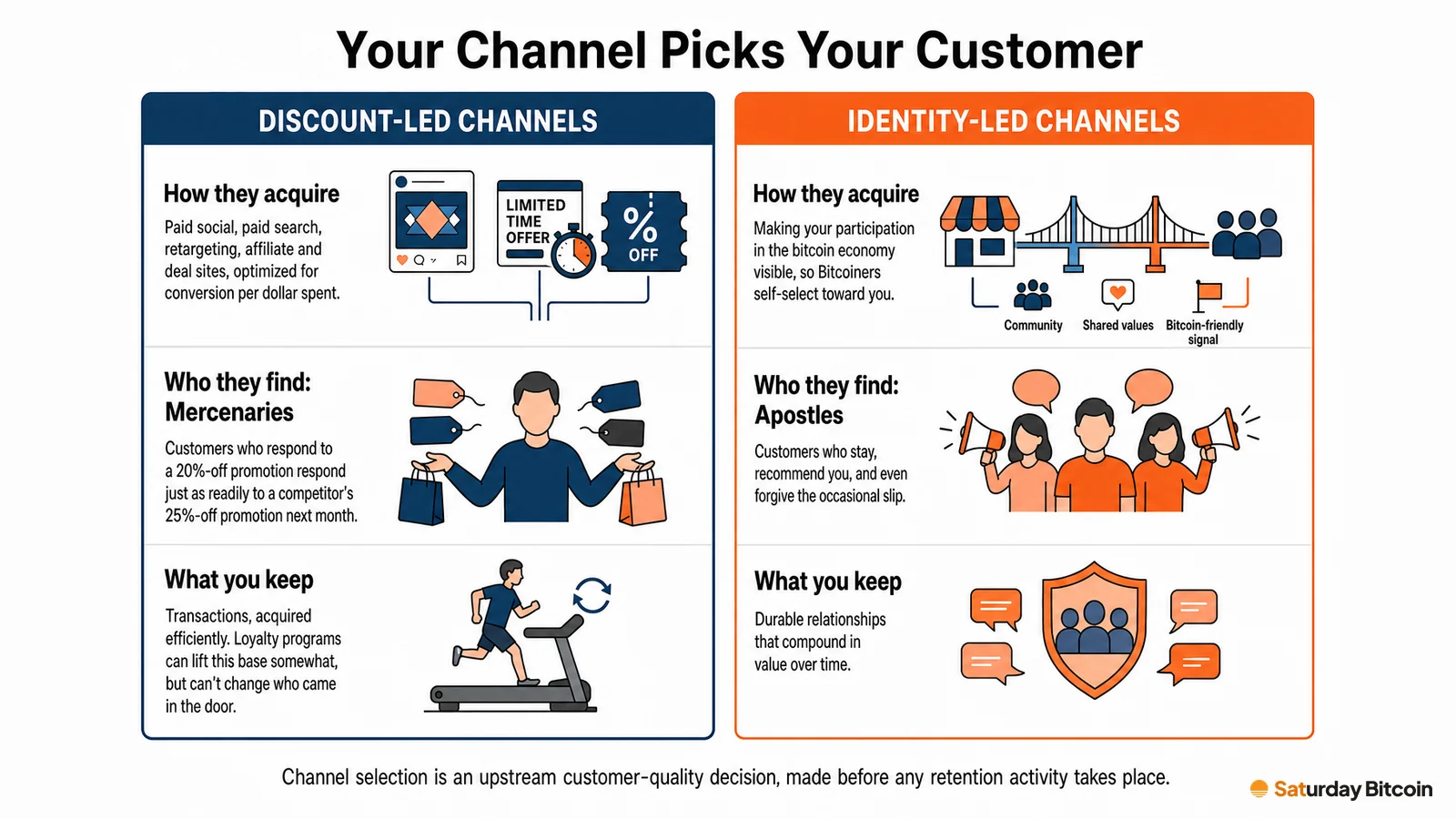
Paid social, paid search, retargeting, affiliate and deal sites all optimize for conversion per dollar spent. The optimization works exactly as designed: it finds the customers most likely to respond to the offer being shown. The unspoken consequence is that the customers acquired by a 20%-off promotion are, by definition, customers who respond to a 20%-off promotion. That means they are just as responsive to a competitor’s 25%-off promotion the following month.
You can match a price. You can’t match an identity.
This is not a failure of performance channels. They do exactly what they are designed to do: acquire transactions efficiently. What merchants ultimately need is durable relationships that compound in value over time. Loyalty programs then work on the customer base they inherit. They can lift it somewhat, but they can’t go back and change who came in the door. Channel selection is, in effect, an upstream customer-quality decision made before any retention activity takes place.
Mercenaries and Apostles
Discount channels attract discount-led shoppers who came for a discount and leave for the next discount, from a different merchant; Thomas Jones and Earl Sasser called these shoppers Mercenaries. In contrast, identity-led channels find Apostles: customers who stay, recommend you, and even forgive the occasional slip.
Jones and Sasser’s 1995 Harvard Business Review article, “Why Satisfied Customers Defect”, sorts customers along two axes, satisfaction and loyalty. Mercenaries are satisfied but not loyal: they buy when the offer is right and switch when a competitor offers better terms. Apostles are highly satisfied and highly loyal: emotionally connected to the brand and evangelistic in their recommendations. Its lasting insight is that satisfaction and loyalty are not the same thing. Your customer-satisfaction surveys count Mercenaries as “satisfied customers”. They aren’t unhappy, just unattached.
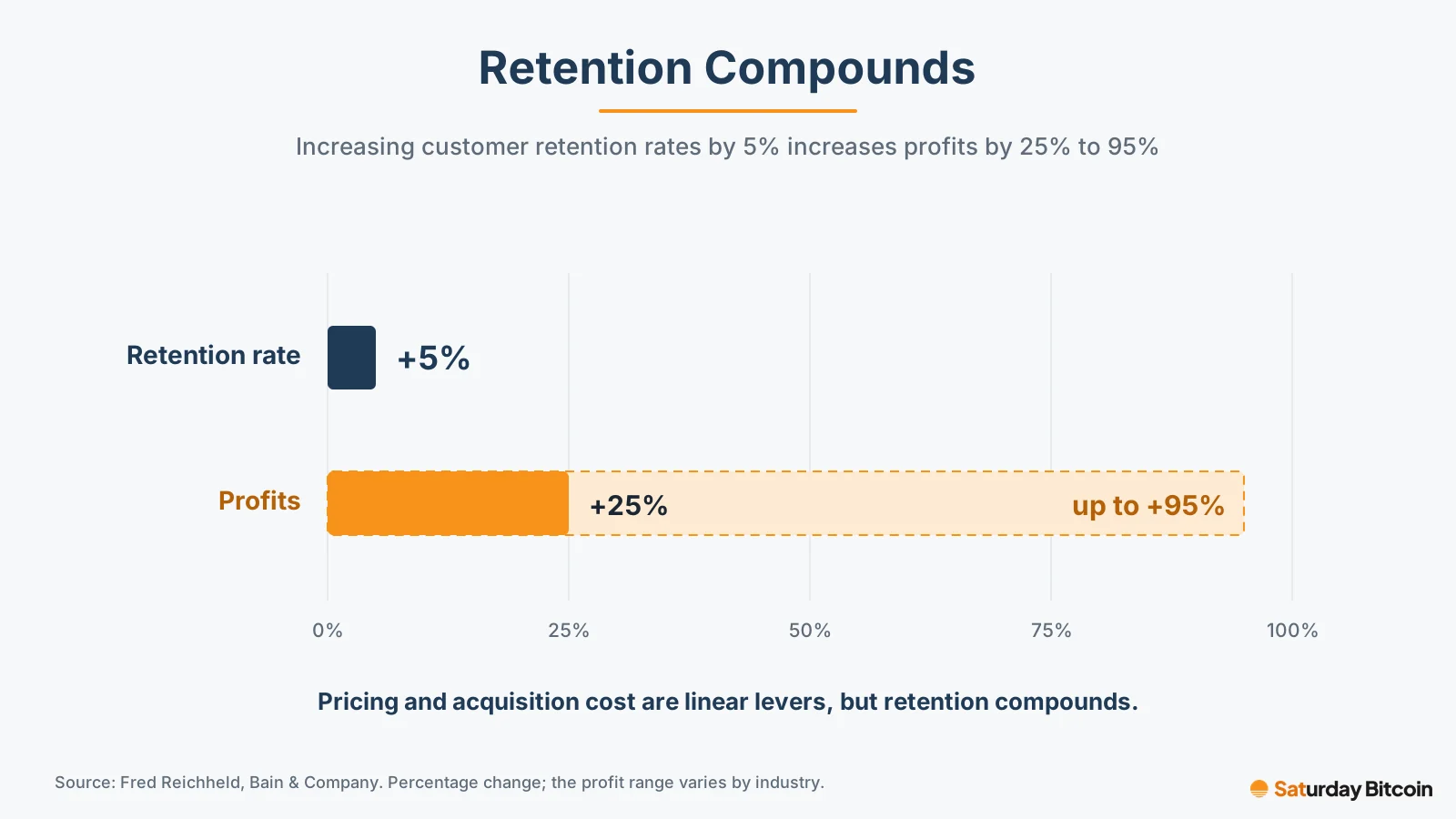
The commercial stakes are well documented. Research by Bain & Company’s Fred Reichheld found that increasing customer retention rates by 5% increases profits by 25% to 95%. Pricing and acquisition cost are linear levers, but retention compounds.
There’s an operating-margin side to this, too. Customers acquired on a discount tend to send back more of what they buy, and every return costs you shipping, handling and often part of the item’s value. Customers who chose you for who you are are more likely to keep what they buy, and that shows up in margin, not just revenue.
Not all retention is created equal
A useful way to rank retention is by how durable it is:
- Subsidy-driven. Customers stay because of discounts or points. The subsidy doesn’t create loyalty; it rents temporary preference. The moment a competitor offers a better incentive, the customer is gone. Points programs and card-linked offers sit in this tier: they rent loyalty, where identity earns it.
- Product-driven. Customers stay because the product delivers superior value. More durable, but even excellent products eventually face credible alternatives.
- Switching-cost-driven. Customers stay because leaving is costly. Durable, but mostly a B2B mechanism; for consumer merchants, switching costs are minimal.
- Identity-driven. Customers stay because the brand aligns with their values, identity or community. The customer is not making a transactional decision. They are expressing who they are.
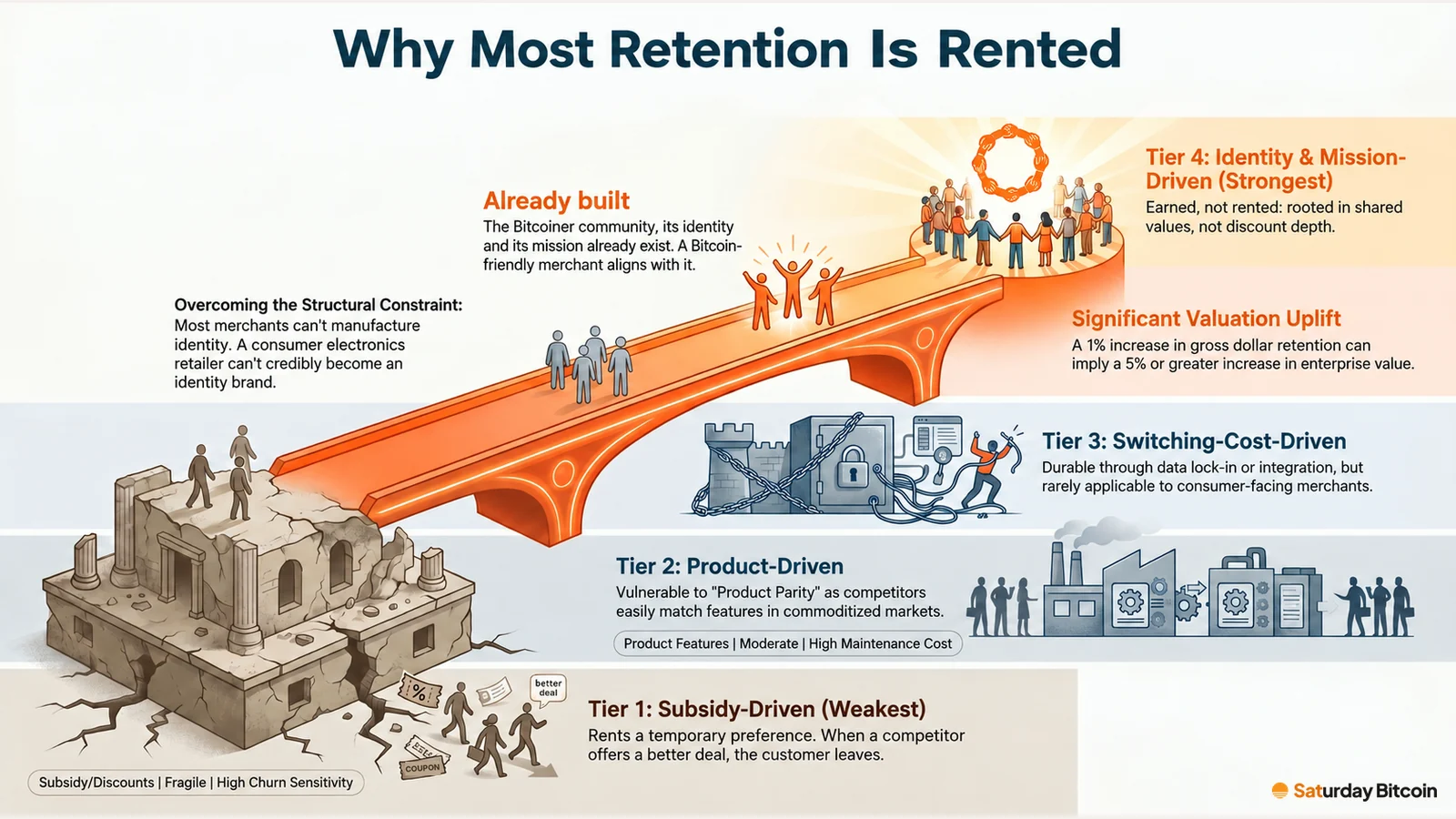
Subsidy is fragile, product is moderate, switching cost is contextual, and identity is durable. The problem is that most merchants don’t have access to identity-based retention. Patagonia and Liquid Death earned it through years of costly brand investment, but a consumer electronics retailer can’t credibly become an identity brand. Most are left with subsidy and product, the two least durable mechanisms.
You can match a price. You can’t match an identity.
Bitcoiners: an Apostle pool that already exists
This is where Bitcoiners change the picture. They already have a settled set of values that predates any particular merchant’s decision to accept bitcoin. They are looking for merchants who recognize and welcome their participation in the bitcoin economy, and they consolidate their spending with merchants who do. Bitcoiner allegiance is earned, not rented. It rests on identity and shared values rather than the size of a discount. A competitor can’t simply outbid you for it.
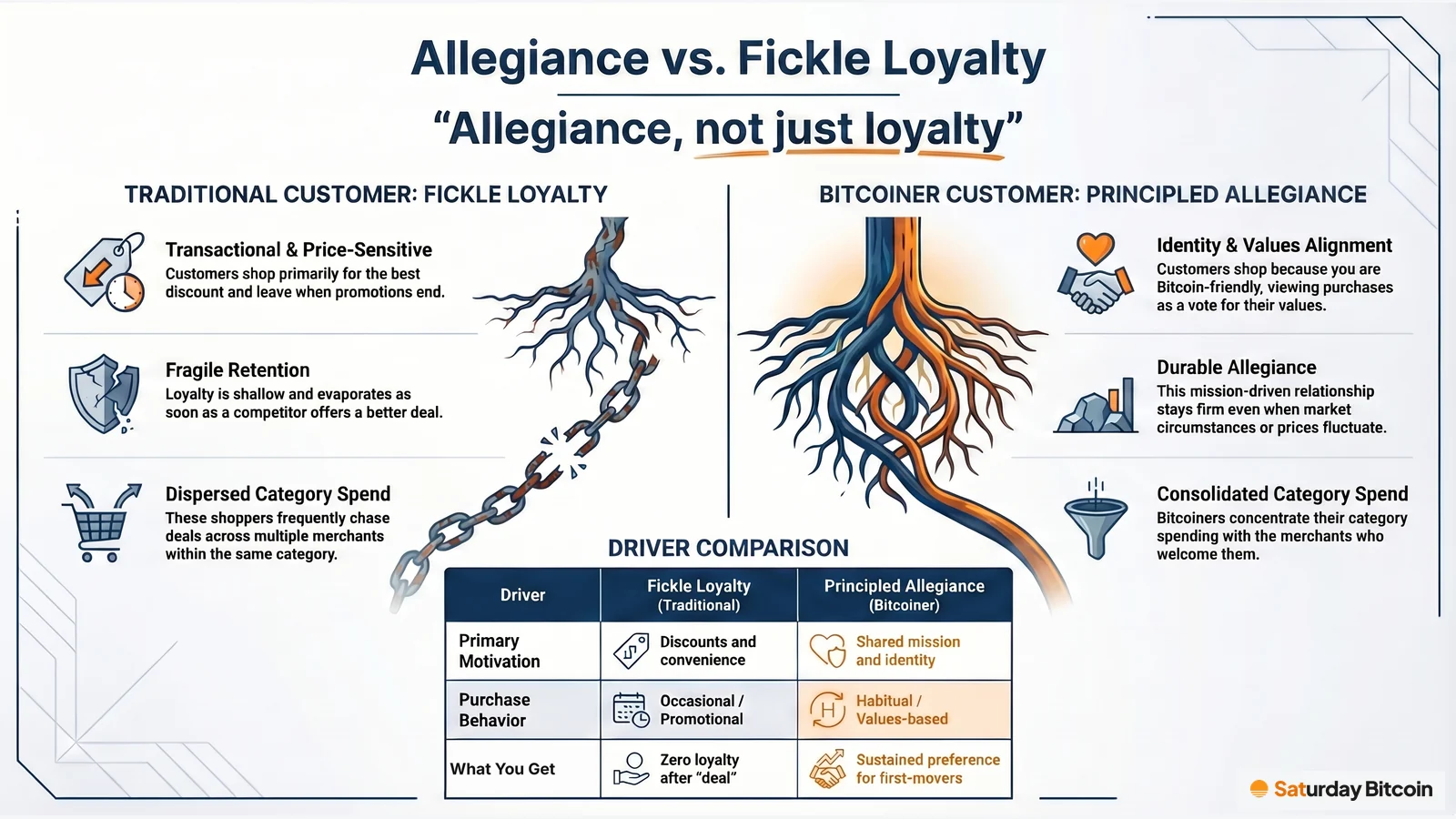
In this channel, the merchant’s job is not to design an offer that induces a purchase. It is to make their participation in the bitcoin economy visible, at which point Bitcoiners self-select toward the merchant. When a merchant becomes visibly Bitcoin-friendly, three things happen:
1. Net-new Bitcoiners arrive. These are Bitcoiners entering the category fresh, or whose previous category spending was spread across merchants they had no particular loyalty to. A specialty retailer with a few locations, or a niche merchant with a focused product line, becomes visible to Bitcoiners well beyond its usual reach.
2. Existing Bitcoiner customers step up. You almost certainly already have some. Before, you were one option among many. Telling them you welcome them can transform how they behave. You move from “one option” to “the obvious choice.” Expect them to consolidate their category spending with you and tell other Bitcoiners. Customers you already had become your best marketers, and you don’t pay for their recommendations. It’s the same person, but now a better customer. This doesn’t need a large share of your customer base. When a few percent of customers behave this differently, consolidating their spending, staying longer and recommending you, the effect on total sales can be out of proportion to their numbers.
3. Competitors’ Bitcoiners switch, and arrive as Apostles. This is the mechanism with no real precedent. When a competitor poaches a customer the conventional way, the customer’s loyalty character survives the switch. A Mercenary who left for a better offer stays a Mercenary. Bitcoiners who switch to a newly Bitcoin-friendly merchant are switching for shared values, not a lower price, and that changes the basis of the relationship. They were Mercenaries with the competitor; they become Apostles with the new merchant.
Steak ’n Shake is the most visible public example. The chain began accepting bitcoin in May 2025 and has publicly credited its Bitcoiner customers with a rise in same-store sales. The response included unusually motivated customers posting their purchases and recommending the chain to other Bitcoiners, much as the Apostle framework predicts. It is one company’s public account, not a controlled study, but it is among the clearest examples of Apostle customers in recent retail. The behavior itself isn’t unique to one chain: Bitcoiners post their purchases and name the merchants who welcomed them, so each Bitcoiner customer you win is also a likely source of referrals.
We also have a hypothesis, offered as a hypothesis, not a claim: a segment that prizes long-horizon thinking and honest accounting may bring those same traits to how it treats the merchants it supports.
Why being first counts
A competitor can copy your discount tomorrow. It can’t occupy the Bitcoin-friendly position if you have already occupied it first. When you are Bitcoin-friendly before your competitors, you hold a position, not a bid, and a position can’t be outspent. Bitcoiners tend to remember the merchant who stepped forward when it wasn’t obvious or easy. This is also why the advantage tends to stay quiet. Your rivals’ channel frameworks don’t have a row for it.
The honest limits
Identity can’t fix a product-market-fit problem. If customers leave because the product is bad, being Bitcoin-friendly is a band-aid, not a solution. Bitcoiners still care about price, convenience, service and selection. What identity does is break ties in your favor and make good relationships stickier. It helps most where products are commoditized, where loyalty is soft, and where acquisition costs keep rising. Results depend on your category, your execution and how many Bitcoiners you can reach. Treat the expected gains (deeper spending, longer retention and more referrals) as directional, not guaranteed.
Where Saturday Bitcoin fits
Saturday Bitcoin is a live directory that helps Bitcoiners find merchants that already accept bitcoin. It does one job in the Apostle dynamic: it makes your participation visible to the people looking for it. Saturday Bitcoin doesn’t process payments or touch your checkout. If you accept bitcoin, you can claim and verify your listing for free, add a welcome offer or promo code, and get featured.
What to do this week
Start with the Bitcoiners you already have. Claim your listing at saturdaybitcoin.com/business and add a welcome offer. A welcome offer isn’t a discount; it’s a signal: you’re welcome here. And when an existing customer uses it, don’t book that as leakage. Recognition moves the relationship onto shared values, which is often when a Bitcoiner you already had starts behaving like an Apostle. Then tell your existing customers that you accept bitcoin and that Bitcoiners are welcome, because some of your best future Apostles are probably already shopping with you.