


If you’re a merchant in 2026, you’re already feeling this. The way consumers discover and choose products is going through its biggest structural shift since the rise of e-commerce itself. The front door to shopping used to be a search box, a storefront or a homepage. Increasingly, it’s an AI agent, and the agent is choosing on the consumer’s behalf.
The front door has moved
Amazon’s Rufus, ChatGPT, Google and Perplexity all now put a shopping assistant between the consumer and the store. These aren’t experiments. Adobe measured generative-AI traffic to U.S. retail sites up 4,700% year over year in July 2025, and in its survey of about 5,000 U.S. consumers, 38% had already used generative AI for online shopping. OpenAI launched Instant Checkout in late 2025, letting U.S. shoppers buy some products without leaving the chat, then scaled it back in March 2026 in favor of checkout inside retailer apps and sites. The experiments are still settling; the shift in where shopping starts is not. McKinsey estimates that agentic commerce could orchestrate $3 trillion to $5 trillion in global retail revenue by 2030.
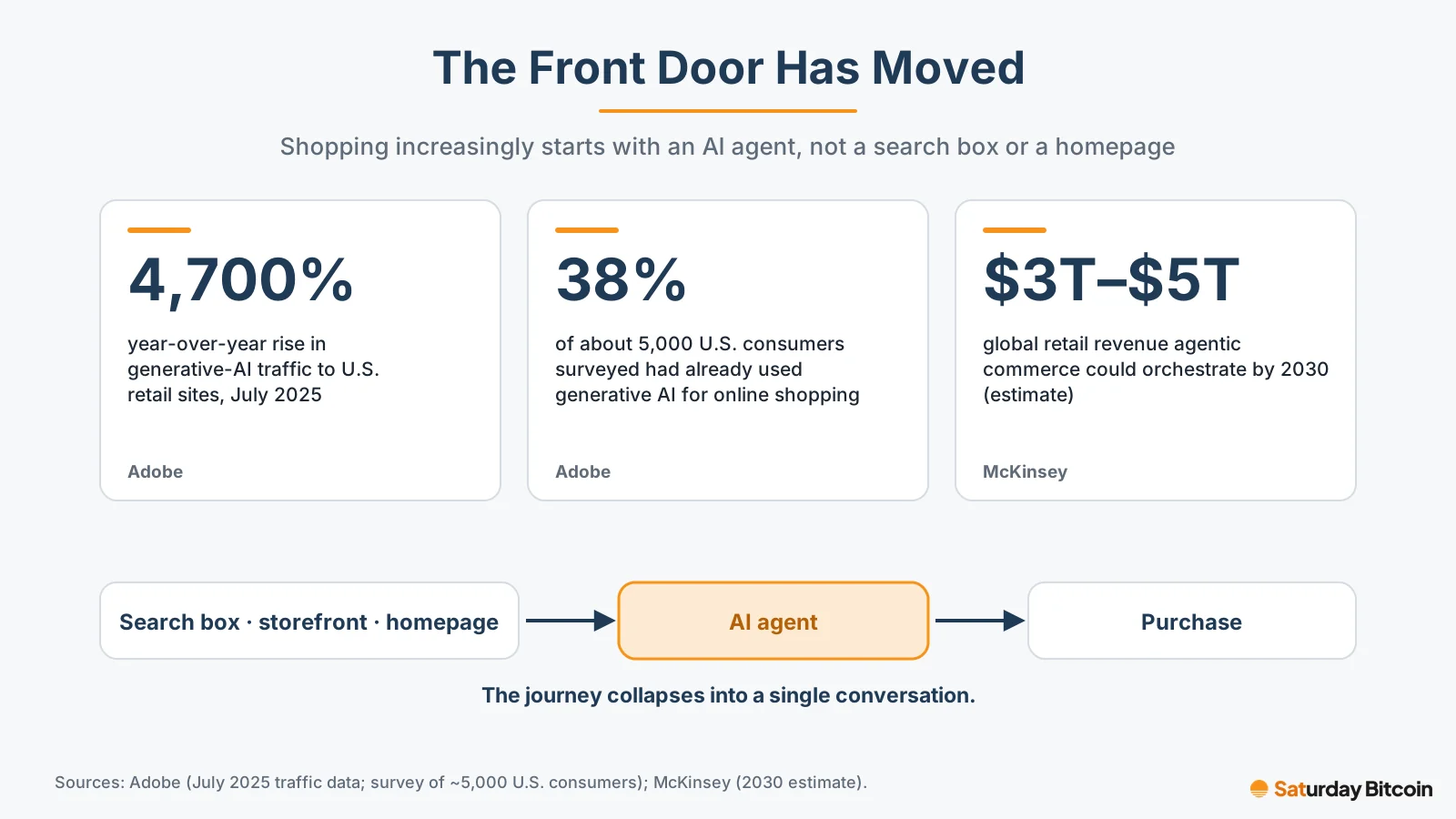
These agents don’t list options the way a search engine lists links. They synthesize, compare and increasingly complete the purchase. The journey from intent to purchase collapses into a single conversation between a consumer and a machine, and the consumer may never visit your website at all.
The front door has moved. Agents are choosing for consumers.
For merchants, this isn’t just a new marketing channel to optimize. It changes who controls the customer relationship.
How agents choose, and what they ignore
A shopping agent weighs functional and economic variables: price and price history, specifications, inventory, delivery speed, return policy and reviews. What it doesn’t optimize for is brand heritage, marketing narrative or emotional storytelling. When the agent finds functional parity, it defaults to the better price. Loyalty built over decades of brand spend can be bypassed in a single query.
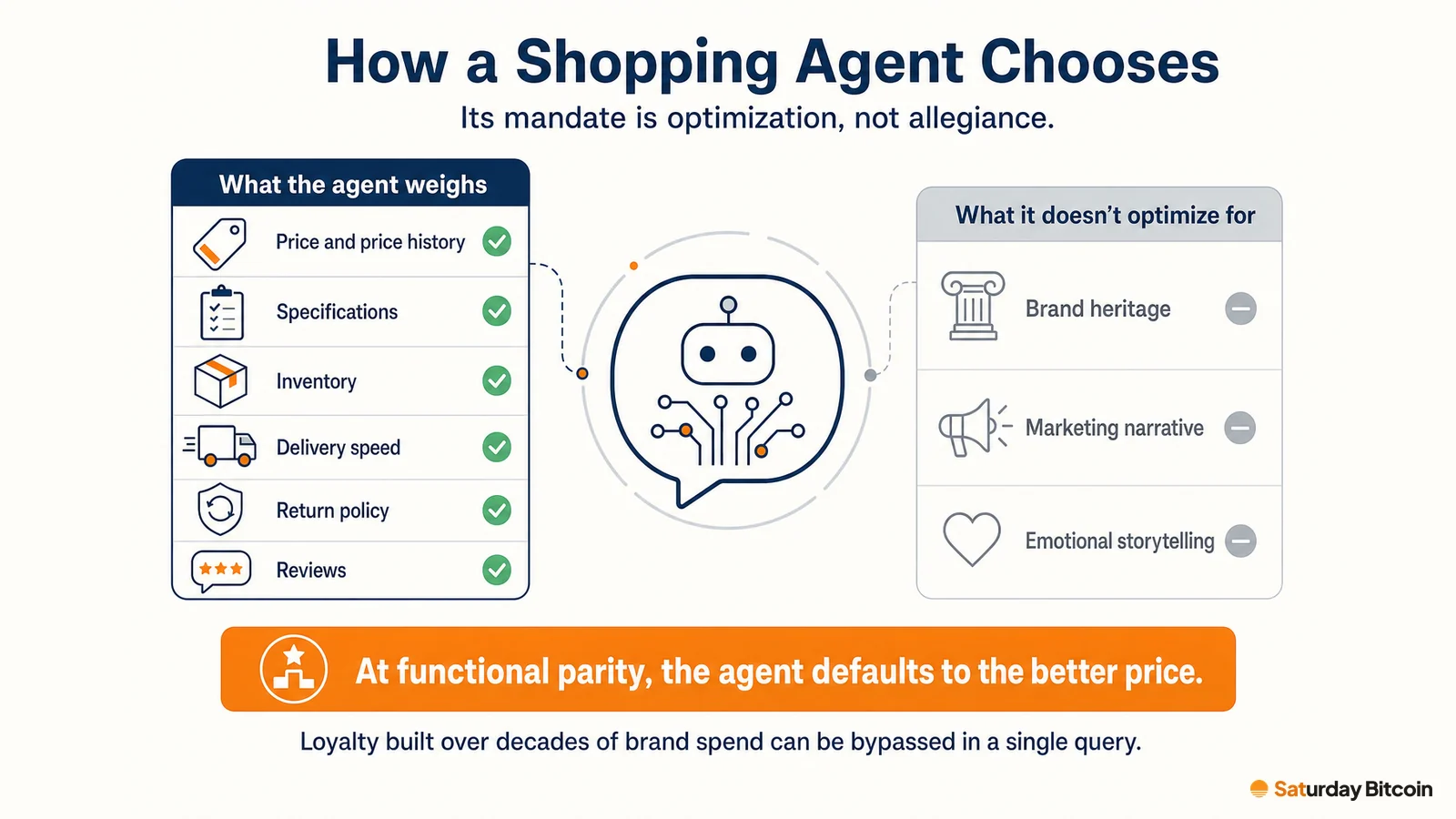
Consumers are learning to use agents as a kind of brand hack: send the agent past the marketing layer to find the product that performs. The agent doesn’t care what you’ve spent on brand awareness. It cares whether your specs, price and reviews beat the alternatives. The agent is the consumer’s trusted delegate, and its mandate is optimization, not allegiance.
Optimize for agents, yes. Don’t depend on it.
The industry’s response has been mostly defensive, and some of it is necessary. Answer engine optimization, which means clean product feeds, structured data and machine-readable policies, is now basic hygiene. If your product data isn’t structured for machines, you won’t surface where shopping increasingly begins. Do it.
But optimization gets you into the agent’s consideration set. It doesn’t stop the agent from picking your competitor on price. Visibility inside an algorithm that defaults to economic optimization is not the same thing as competitive advantage. Every merchant in your category is doing the same work, and the agent rewards whoever is cheapest that day.
So the strategic question isn’t only “How do I rank with agents?” It’s also “Which of my customers choose on something the agent doesn’t optimize for?”
The channel agents can’t route around
Consider how a Bitcoiner shops. They don’t start by asking an agent to “find me the best mattress under $1,000.” They ask a different question entirely: “Which mattress merchant is Bitcoin-friendly?” That decision runs on an axis the shopping agent doesn’t rank on. The Bitcoiner’s purchase criterion, alignment with the bitcoin economy, is orthogonal to price, specs and delivery speed. The agent can’t talk this customer into a cheaper competitor, because the decision was never made on the agent’s criteria.
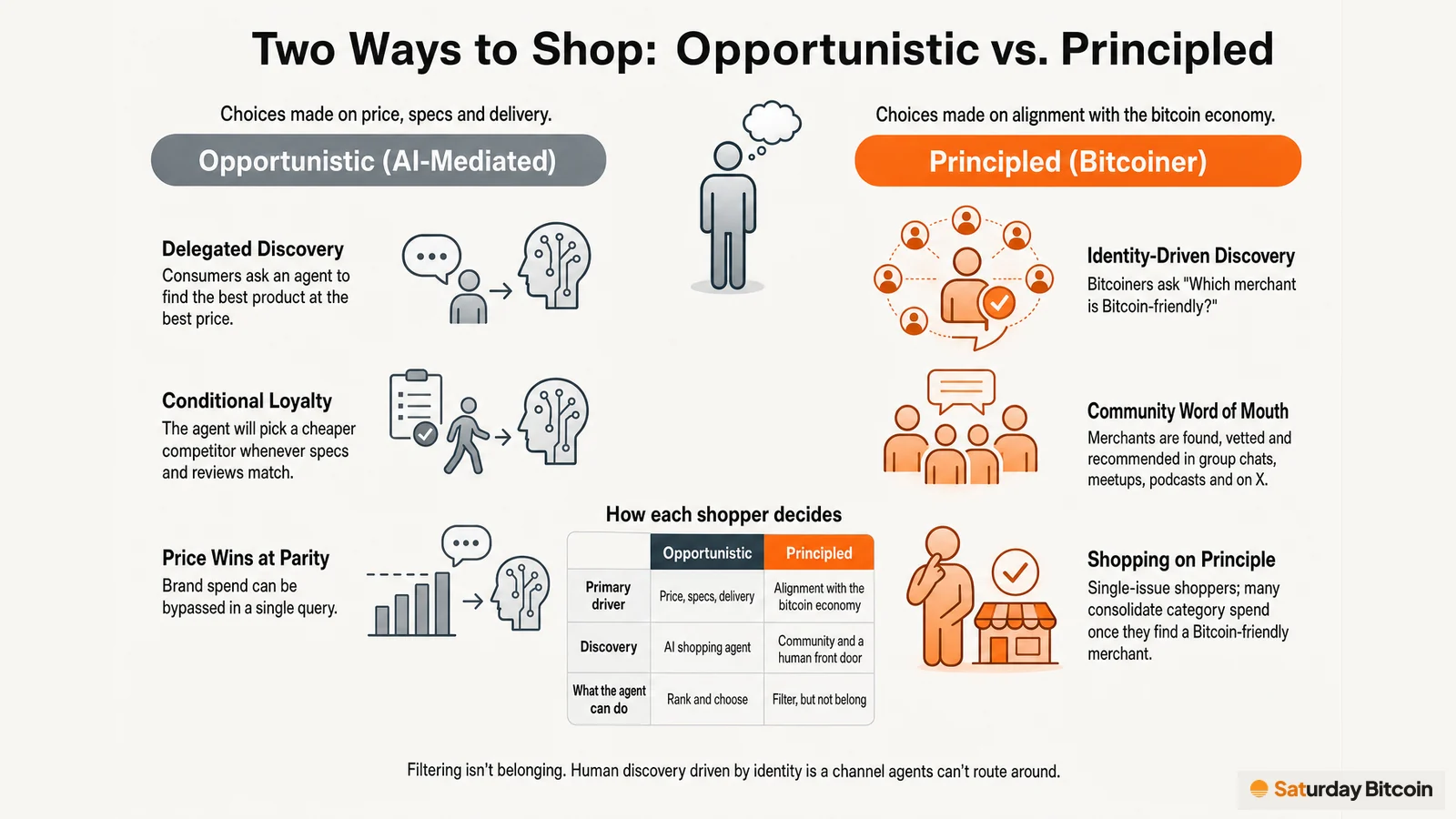
An agent can filter. Ask it for a veteran-owned business or a B Corp and it will try. But filtering isn’t belonging. Bitcoiners belong to a community that finds, vets and recommends Bitcoin-friendly merchants among themselves: in group chats and direct messages, at meetups, on podcasts and on X. A lot of that word of mouth happens in places agents don’t see and can’t join. Agents can’t infiltrate a community. Human discovery driven by identity is a channel they can’t route around.
One way to think about it: as AI-informed shopping spreads, most consumers will shop opportunistically. Bitcoiners will keep shopping on principle. They are single-issue shoppers, and many consolidate their category spend with the Bitcoin-friendly merchant once they’ve found one.
That’s what Saturday Bitcoin is for. It’s a discovery directory that helps Bitcoiners find merchants that already accept bitcoin, online and nearby, and then save and share them. It’s a human front door that sits alongside the agent’s. Our job is the introduction. When those customers pay in bitcoin, the sale lands on your cheapest rail: lower processing costs, final settlement, no chargebacks, and you decide refunds. Many Bitcoiners still pay by card out of habit, for card rewards, to avoid tax friction, or simply to support you. You won that customer all the same.
Machines and digitally native money
There’s a second, earlier-stage development worth watching. In early 2026, the Bitcoin Policy Institute gave 36 frontier AI models 9,072 open-ended monetary scenarios and asked what money they would use if they were acting as autonomous economic agents. Bitcoin was the single most-chosen instrument, at 48.3% of responses. About 91% of responses favored digitally native money over fiat, and no model ranked fiat first. The split is telling: bitcoin led for long-term store of value (79.1%), while stablecoins led for payments (53.2%, with bitcoin at 36%).
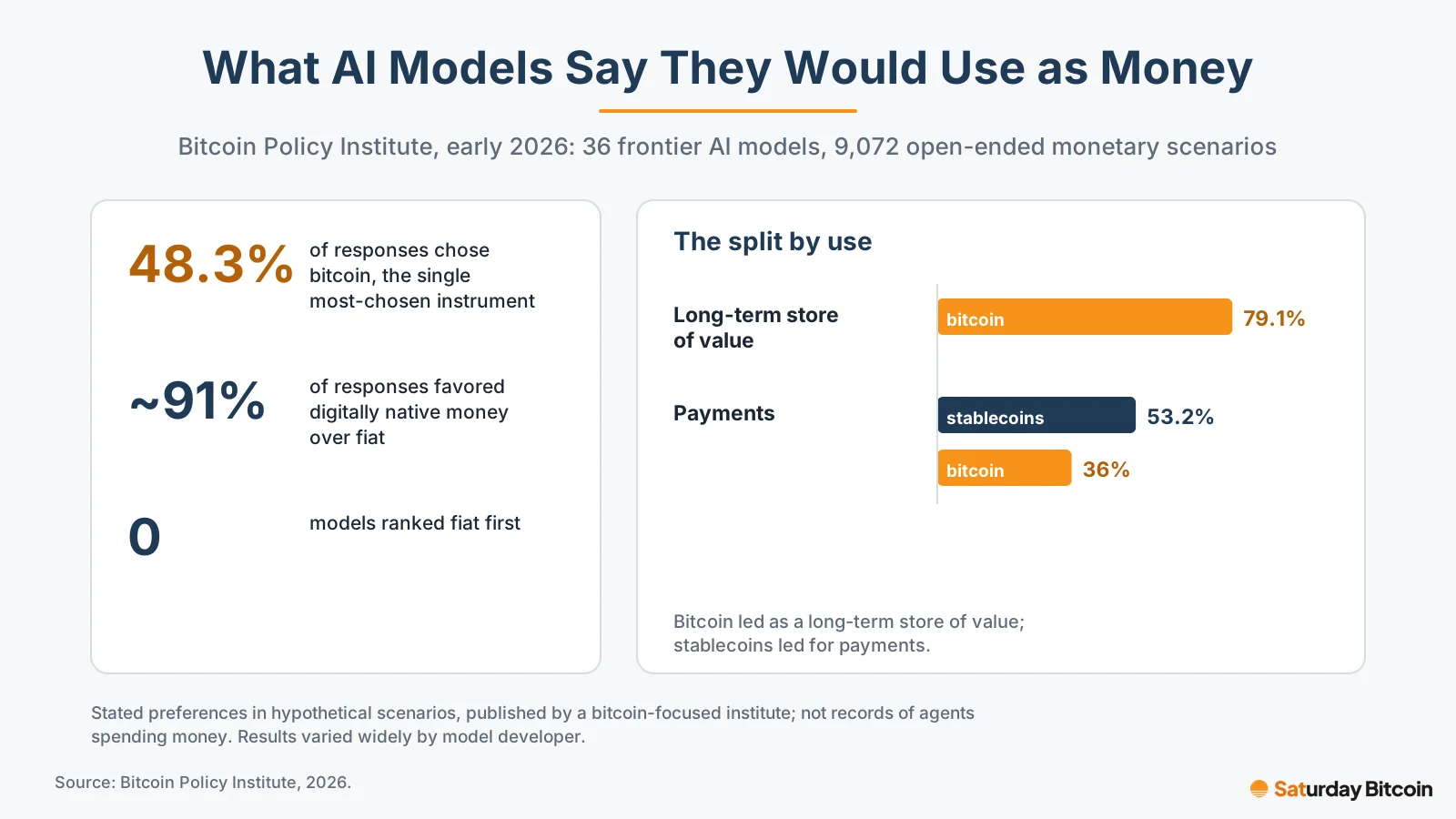
Read that carefully. These are stated preferences in hypothetical scenarios, published by a bitcoin-focused institute, not records of agents actually spending money. Results also varied widely by model developer. But the structural logic is easy to see. Software that runs around the clock and across borders fits awkwardly with money that keeps business hours, settles in days and depends on intermediaries’ approval. Machines appear to prefer money that is native to the internet.
Nobody knows yet how agent payments will settle. If they move toward digitally native money, a merchant who already accepts bitcoin has one less thing to learn. Treat that as optionality, not a forecast.
An honest framing
Being Bitcoin-friendly doesn’t solve AI disintermediation for your whole business. Most of your customers will keep finding you through channels that are increasingly mediated by AI, and you still have to compete there. The Bitcoiner segment is small, an estimated ~1 million committed, mission-driven Bitcoiners in the U.S., and growing, even though tens of millions of Americans own some bitcoin. Being listed is a discovery channel, not a guarantee of volume. The product still has to be right. And Saturday Bitcoin’s directory is a public website, so an agent could read it too. What an agent can’t do is supply the reason a Bitcoiner chose you.
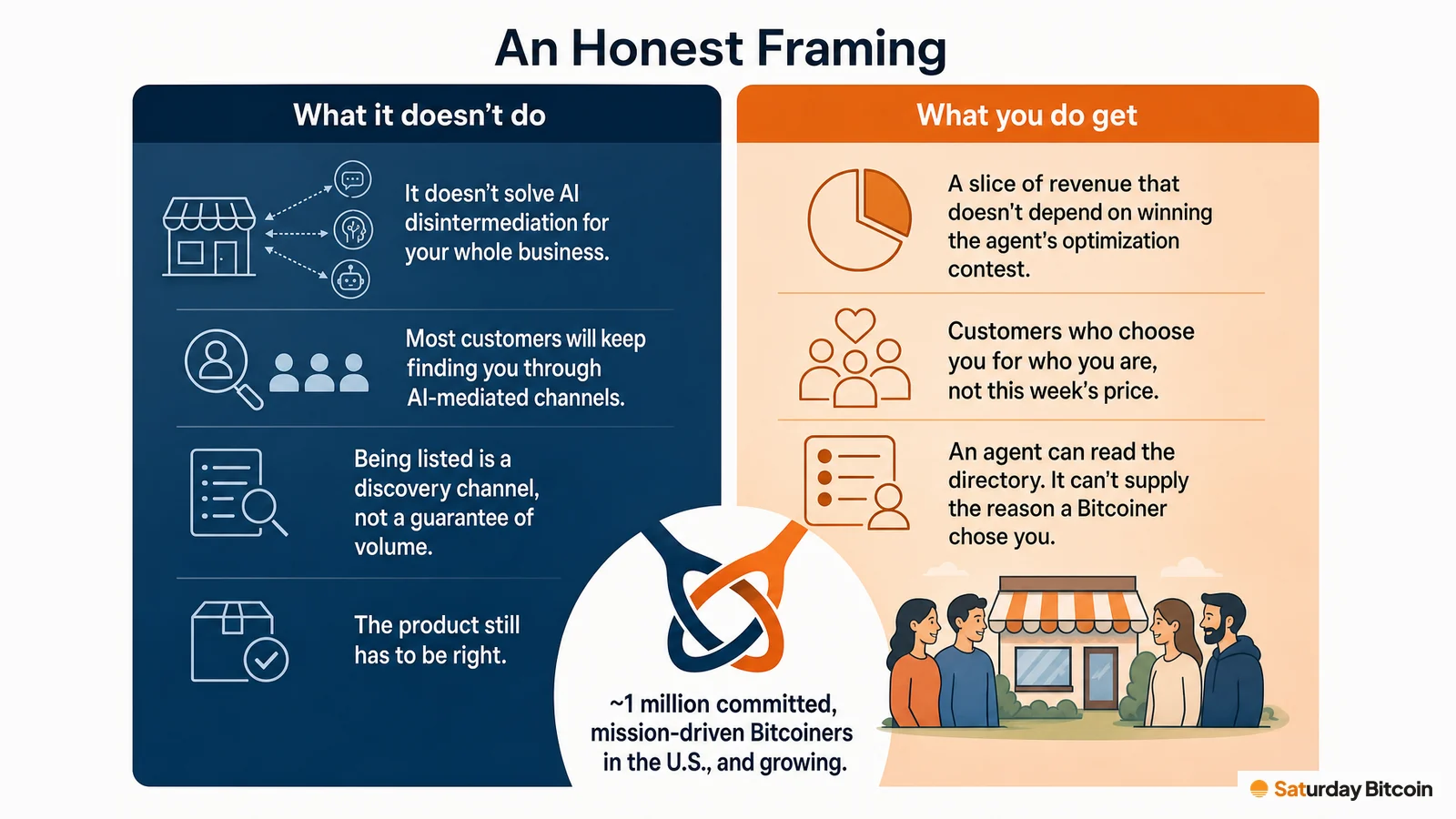
What you do get is a slice of revenue that doesn’t depend on winning the agent’s optimization contest. As agents handle a larger share of conventional shopping, a customer who chooses you for who you are rather than for this week’s price becomes more valuable, not less. Today it is a differentiator; in time it will simply be expected.
What to do now
Do both. Keep your product feeds and structured data clean for agents, and if your site uses schema.org markup, list bitcoin in the paymentAccepted field. Then open the human front door. If you already accept bitcoin, claim your free listing at saturdaybitcoin.com/business, verify it and add a welcome offer, so the Bitcoiners looking for your category can find you, save you and tell each other.