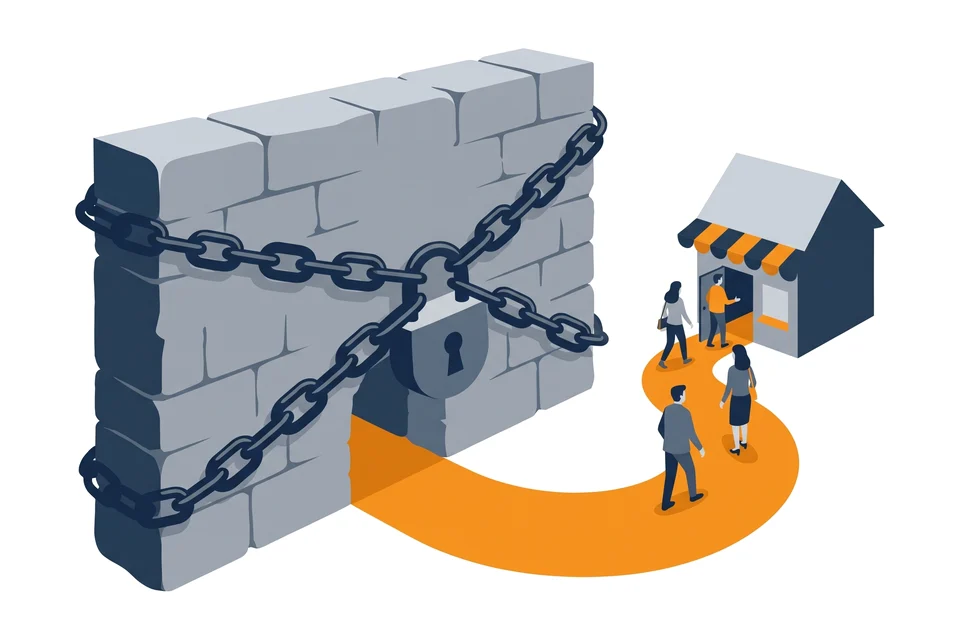


Bitcoiners don’t shop the way other consumers shop. An ordinary customer approaches each purchase more or less on its own: which coffee, which wine, which hotel, which software subscription, each judged on price, fit, quality and convenience.
A committed Bitcoiner approaches purchasing differently. Every purchase is a piece of a larger project: assembling a shopping life in which as many of the merchants they spend with as possible are Bitcoin-friendly. Coffee, wine, groceries, household goods, pet supplies, travel, dining, software, clothing. Each category is a piece of a personal jigsaw they are actively working to complete.
We call this the Bitcoin Shopping Jigsaw. If you already accept bitcoin, it changes how you should think about what that is worth.
For a Bitcoiner, every empty category is an open search, and every filled one is a piece of a growing whole.
From one purchase to every purchase
In Seven Ideas: Bitcoin as a Merchant Competitive Advantage we described Bitcoiners as single-issue shoppers: within a category, Bitcoin-friendliness becomes a dominant reason to choose one merchant over another. That describes what they do inside a single purchase. The jigsaw describes what they do across all of their purchases together.
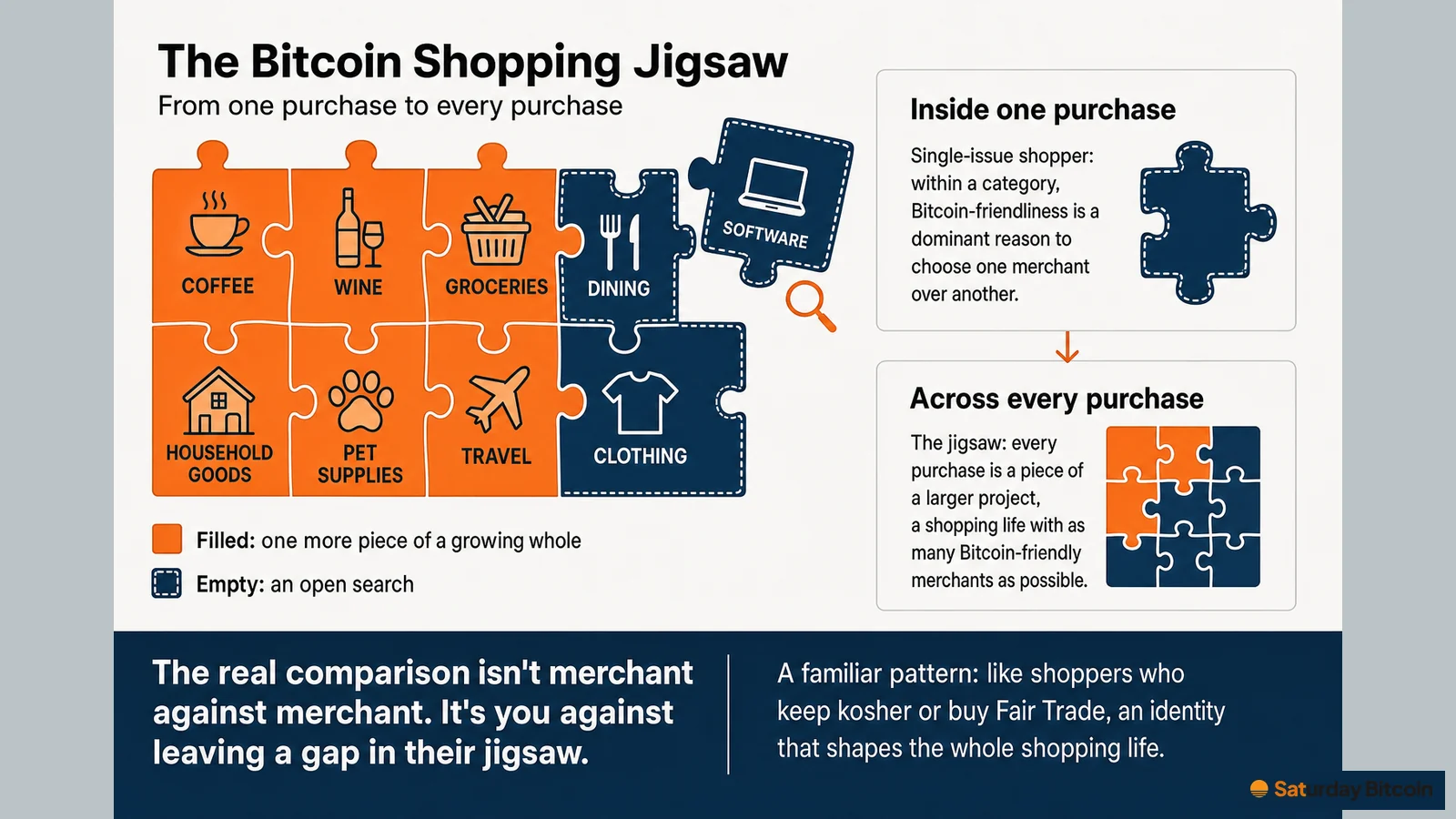
The difference matters. A single-issue shopper in one category is a customer who leans strongly toward you. A single-issue shopper across every category is something more consequential: someone for whom each empty category is an open search, and each filled category is one more piece of a growing whole.
So when a Bitcoiner finds you, you aren’t just meeting a customer for your category. You’re meeting someone who is already looking for the next piece. And when they weigh you against a conventional competitor, the comparison isn’t really merchant against merchant. It’s you against leaving a gap in their jigsaw.
This isn’t unique to Bitcoiners. People who keep kosher, or who buy Fair Trade on principle, carry that commitment across every aisle rather than applying it to one purchase. Bitcoiners are one more example of a familiar pattern: an identity that, once held, shapes the whole shopping life.
Coverage matters more than depth
Most marketplaces grow by depth: many sellers per category, so shoppers can compare price and selection. The jigsaw rewards coverage instead.
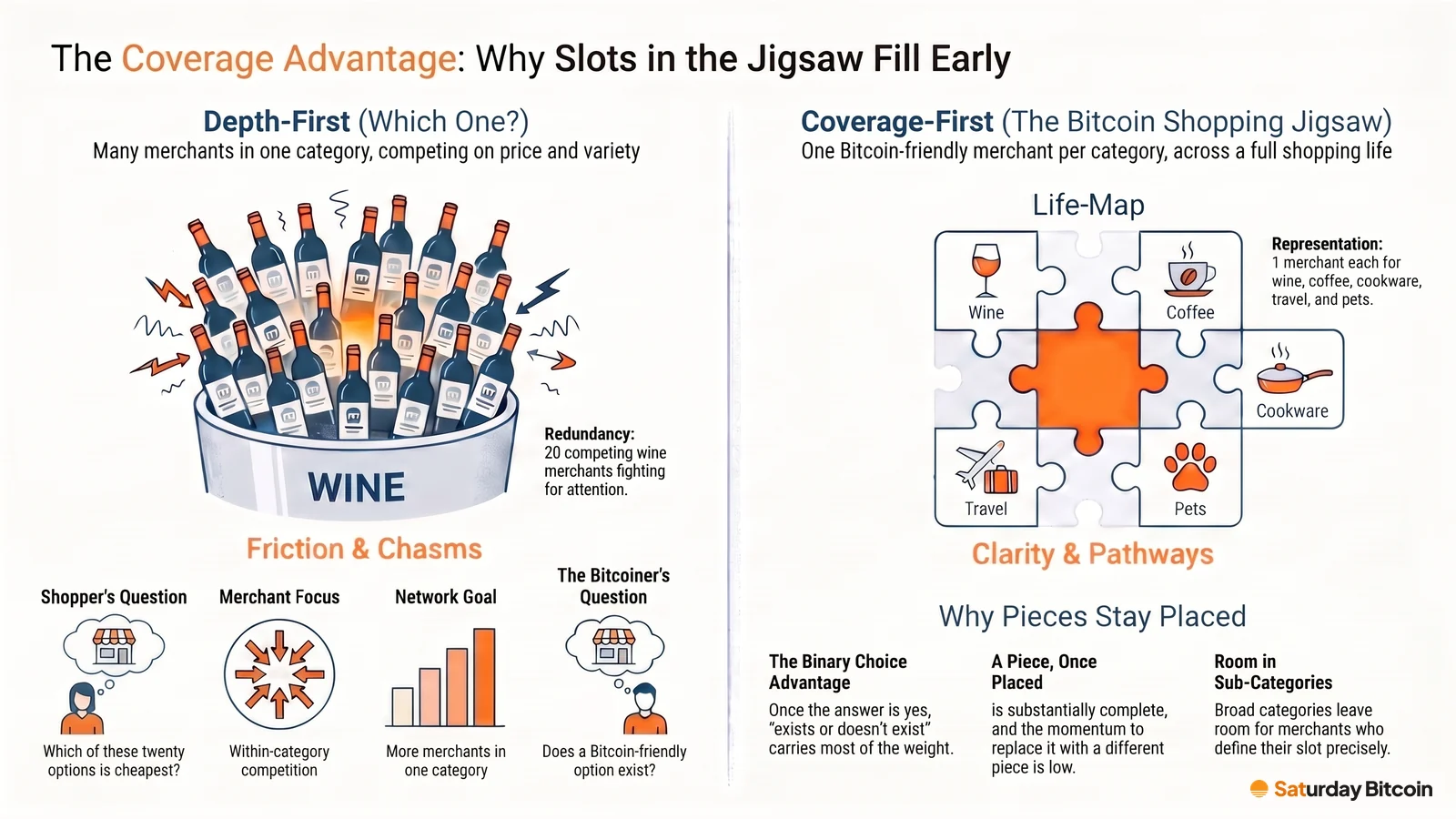
For a Bitcoiner, the first question in a category isn’t “which of twenty Bitcoin-friendly wine merchants suits my taste?” It’s “does a Bitcoin-friendly wine merchant exist that I can buy from?” Once the answer is yes, choosing between a first and a second becomes a secondary decision on ordinary criteria: price, selection, shipping. Exists-or-doesn’t carries most of the weight. A piece, once placed, is largely in place.
Categories aren’t all the same size, though. Wine, coffee or a neighborhood butcher can be covered by one or two strong merchants, because one good merchant can serve most of the need. Clothing breaks into activewear, workwear, footwear, outdoor, children’s and more, so the real pieces are sub-categories, and it takes more merchants to fill them.
The practical consequence for you: the first credible Bitcoin-friendly merchant in a category, or a sub-category, tends to become the piece the community slots into place. They become the default recommendation, and that position is durable, because once a piece is in, there is little reason to swap it out. Category consolidation is underway. Where your category sits right now (empty, partly filled or crowded) matters more than almost anything else about your bitcoin strategy.
Every piece makes every other piece more valuable
Here is the part most merchants miss. The value of being Bitcoin-friendly isn’t fixed by your own proposition alone. It is shaped by how well the rest of the jigsaw around you is filling in.
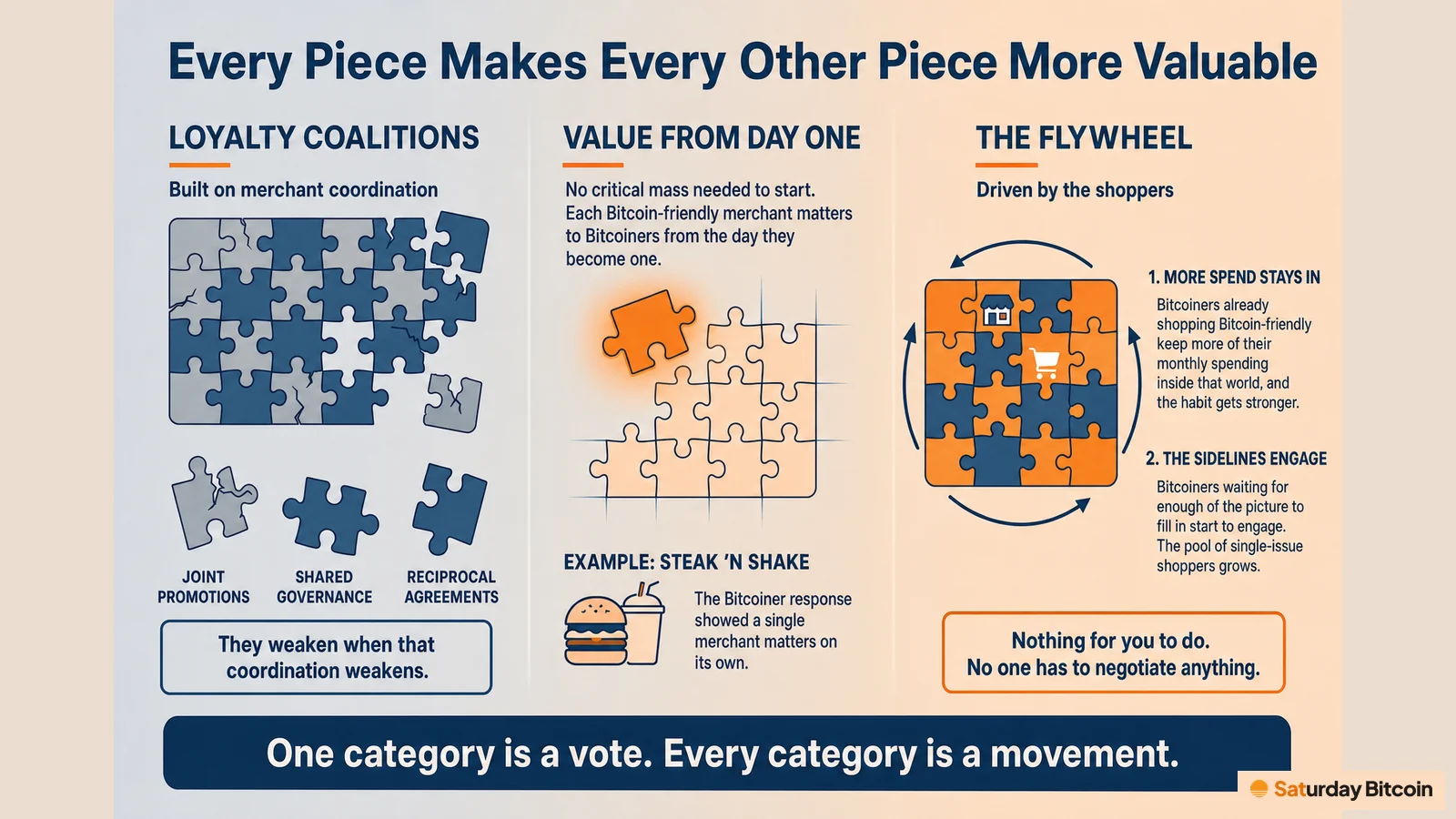
When a new Bitcoin-friendly merchant appears in a category that was empty, say the first one a Bitcoiner has found for household goods, two things happen.
First, Bitcoiners who were already shopping Bitcoin-friendly can now keep more of their monthly spending inside that world. Living on a bitcoin standard becomes a little more achievable, and the habit gets stronger. That habit is what brings them back to the coffee roaster, the wine merchant and the café they already use.
Second, Bitcoiners who were sitting on the sidelines, waiting for enough of the picture to be filled in before committing, start to engage. The pool of active single-issue shoppers grows.
Picture it as a flywheel. As an illustration, not a measurement: a Bitcoiner who can route 30%, then 50%, then 70% of their monthly spend through Bitcoin-friendly merchants is no longer cobbling together occasional purchases. They’re living on the bitcoin standard in a meaningful day-to-day sense, and they reward the merchants who make it possible. Every category that fills in makes the whole picture more valuable to every merchant in it.
Notice what you have to do for this to happen: nothing. Loyalty coalitions have historically needed merchant-to-merchant coordination, with joint promotions, shared governance and reciprocal agreements, and they weaken when that coordination weakens. The jigsaw is driven by the shoppers. Every merchant added makes every other merchant more valuable, and no one has to negotiate anything. One category is a vote. Every category is a movement.
It also doesn’t need critical mass to start. Each Bitcoin-friendly merchant matters to Bitcoiners from the day they become one, as the Bitcoiner response to Steak ’n Shake showed (see A Fraction of the Segment: What Steak ’n Shake Proved About Bitcoiners). The jigsaw is what compounds that starting value as more pieces arrive.
Somebody has to hold the whole picture
If Bitcoiners are filling in their jigsaw piece by piece, what connects one piece to the next? How does the Bitcoiner who buys from a Bitcoin-friendly coffee roaster find the Bitcoin-friendly wine merchant, or the café two blocks from their office?
Somebody has to hold the whole picture. That’s us. Saturday Bitcoin is a discovery directory of merchants that already accept bitcoin, online and nearby, with tens of thousands of places listed and browsable by category. Bitcoiners use it to find the next piece, save the merchants they like and share them with friends. The community does the rest, as it always has, by word of mouth.
There’s a twist worth noting. Ordinary online shoppers have learned to tune out “customers also bought” suggestions as clutter. For a Bitcoiner, a suggestion of another Bitcoin-friendly merchant in a category they haven’t filled yet isn’t noise. It’s the information they were looking for. There’s much more we can build around merchants and spending over time, but we’ll talk about those products when they’re ready to use.
The honest limits
The jigsaw is a direction, not a guarantee. The committed segment is real but small: an estimated ~1 million committed, mission-driven Bitcoiners in the U.S., and growing, inside a much larger group of tens of millions of Americans who own some bitcoin. Being discoverable doesn’t guarantee volume, and your product and price still have to be right. Many Bitcoiners will still pay you by card out of habit, for card rewards, to avoid tax friction, or simply to support you. They chose you all the same. When they do pay in bitcoin, they arrive on your cheapest rail: lower processing costs, final settlement, no chargebacks, and you decide refunds. And because we’re a directory, not a payment processor, we can’t see purchases. Your own records are the measure.
Make sure you’re on the map
Whatever your view of bitcoin, these customers are real, and they are assembling their jigsaw now. If you already accept bitcoin, the first step is to make sure Bitcoiners can find you as a piece of it, in the right category, online or nearby.
Claim your free listing at saturdaybitcoin.com/business. Verify your details and check your category, because that is how a Bitcoiner looking for that piece finds you. It’s free, reversible and takes a few minutes. From there you can add a welcome offer for first-time Bitcoiner customers if you want one.
Being Bitcoin-friendly sets you apart today; in time it will simply be expected. The question is whether you’re the piece Bitcoiners slot into your category.