


In May 2008, American Airlines became the first major legacy U.S. carrier to charge $15 for a first checked bag. Three weeks later, United matched it. Other carriers followed within months.
The airline industry had run a textbook case of competitive mimicry, in public and in real time. Every move was visible. Every move was matched. And no airline gained a lasting advantage, because every airline made the same move.
This is how competition works in concentrated markets. Whether your industry has three dominant players or thirty, the playbook is remarkably similar: you try something, your competitors see it, and they copy it. Price changes are matched within hours. Loyalty enhancements are studied and replicated within a quarter. Ad campaigns trigger a response within weeks. Everyone runs faster, spends more, and goes nowhere. Strategists call it the Red Queen effect: all the running is just to stay in place.
Every advantage you announce gets copied. Quiet advantages last longer.
In that environment, the most valuable advantage isn’t a lower price or a bigger budget. It’s one your rivals aren’t looking for.
Every advantage you announce gets copied
Look at how share is fought for in a concentrated category. Algorithms monitor competitor rates and launch counter-offers within hours. Multi-brand portfolios (premium, mid-tier, value) create a “price shield,” so a customer who trades down often stays inside the same parent company. National ad campaigns drive awareness, then rivals answer with campaigns of their own.
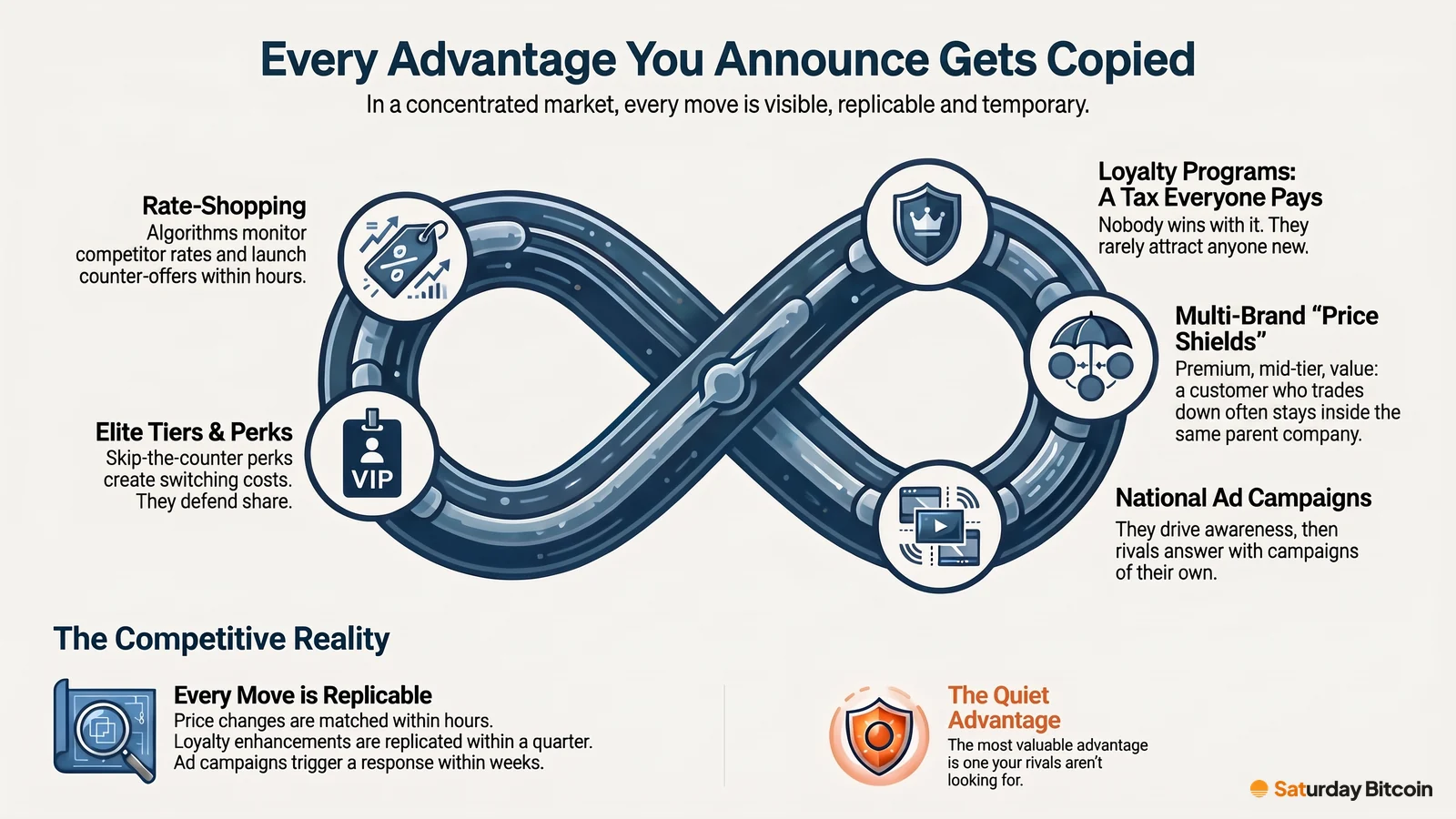
And then there’s loyalty. In a three-player market, loyalty programs are a tax everyone pays and nobody wins with. McKinsey found that companies spending more on loyalty grew at about the same rate as those that didn’t, or slightly slower (4.4% vs. 5.5% a year), and had EBITDA margins about 10% lower. Elite tiers and skip-the-counter perks create switching costs. They defend share. They rarely attract anyone new.
The common thread: every one of these moves is visible, replicable and temporary.
The convergence trap
This isn’t a failure of creativity. It’s structural. Organizational researchers call it institutional isomorphism: companies in the same field converge on the same practices. Under uncertainty, they copy whoever looks most successful, until “best practice” becomes universal practice, which is to say no practice at all. Executives and consultants move between competitors and carry the same playbook with them. And in many industries the convergence is now automated: rate-shopping software watches rivals’ prices and matches them without a human in the loop.
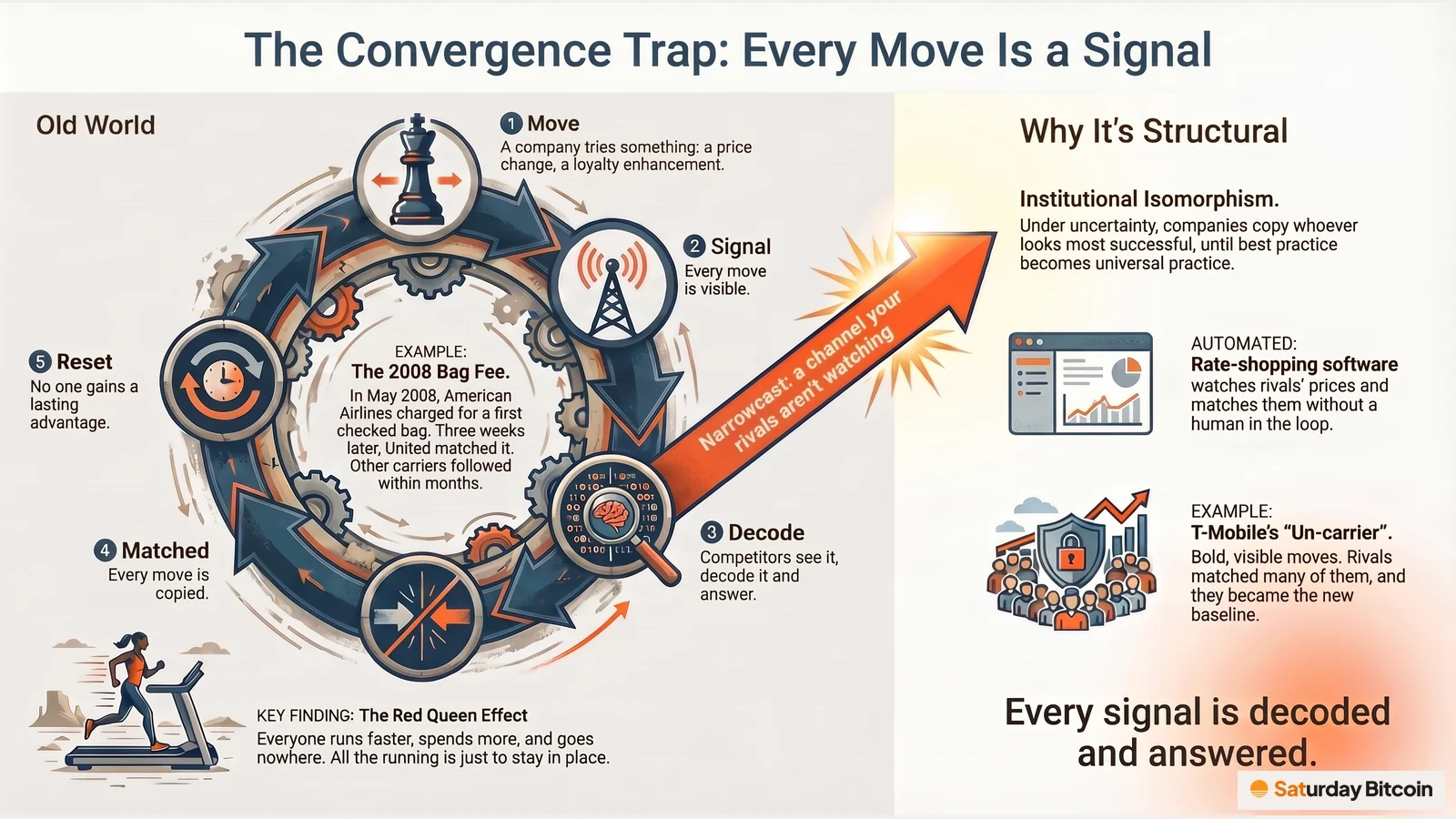
T-Mobile’s “Un-carrier” strategy shows both the possibility and the limit of breaking out. Dropping contracts and paying off rivals’ termination fees were bold, visible and effective moves. But Verizon and AT&T matched many of them, and they became the new baseline. The strategy only worked because it was loudly announced, and it was copied because it was loudly announced.
That’s the trap. In a concentrated market, every advantage is announced by the very act of deploying it. Every move is a signal, and every signal is decoded and answered.
What is 1% of share worth to you?
Take U.S. car rental. Auto Rental News estimates the market at about $40.6 billion in 2025, and three corporate groups (Enterprise, Hertz and Avis Budget) hold the great majority of it. Each runs rate-shopping systems that track rivals daily. Each has airline, hotel and card partnerships and a loyalty program designed to keep frequent renters.
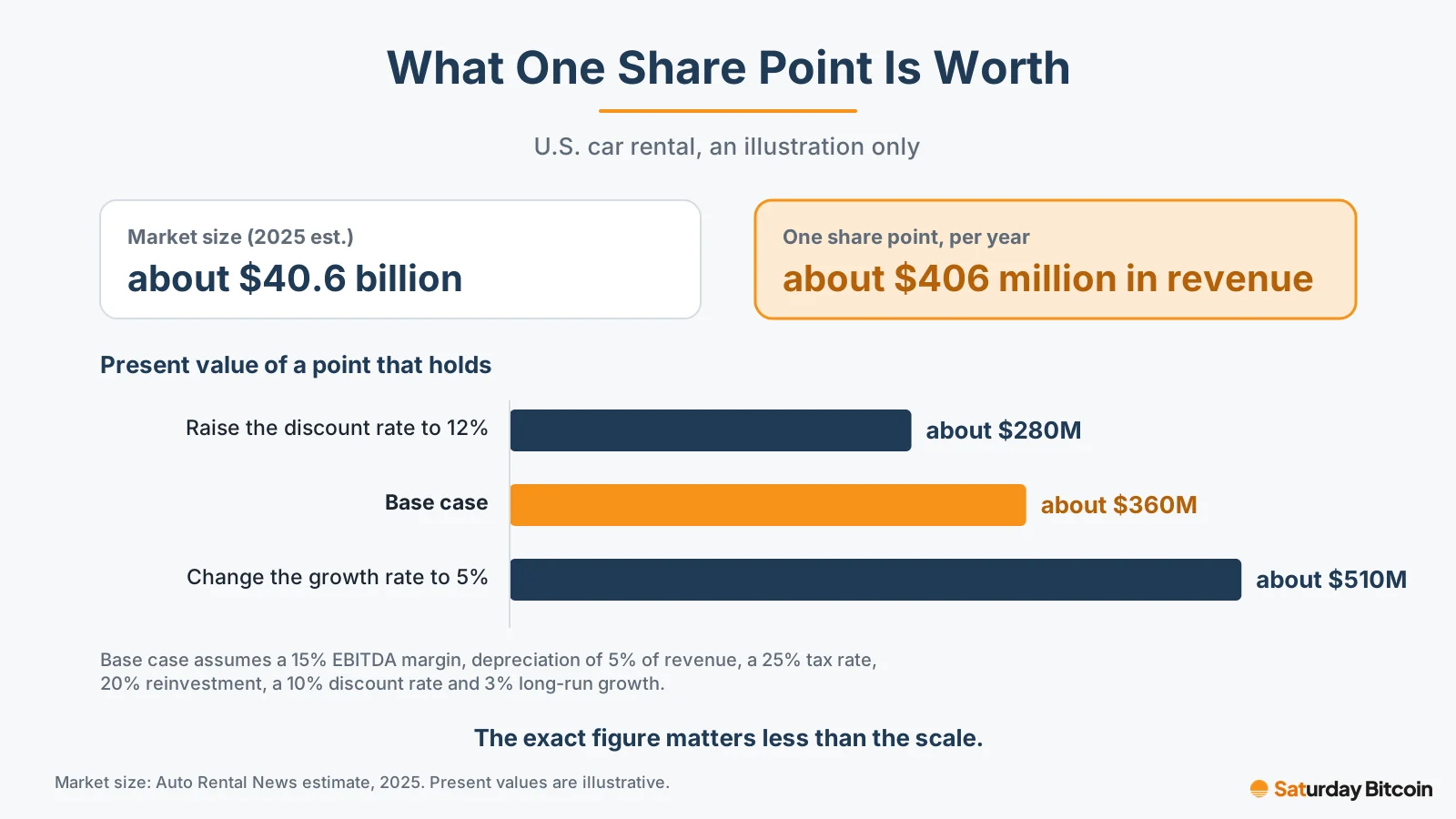
In that market, one share point is about $406 million a year in revenue.
The value of a durable point is bigger than one year’s revenue. As an illustration only: assume a 15% EBITDA margin, depreciation of 5% of revenue, a 25% tax rate, 20% reinvestment, a 10% discount rate and 3% long-run growth. On those assumptions, a point that holds is worth roughly $360 million in present value. Change the growth rate to 5% and it’s about $510 million; raise the discount rate to 12% and it’s about $280 million. The exact figure matters less than the scale.
Now run the same arithmetic on your own category. That number is what your rivals are spending heavily on loyalty, pricing and advertising to defend.
A channel your rivals aren’t watching
Most marketing is broadcast: designed to reach the widest possible audience, which means your competitors see it too. Reaching Bitcoiners is narrowcast.
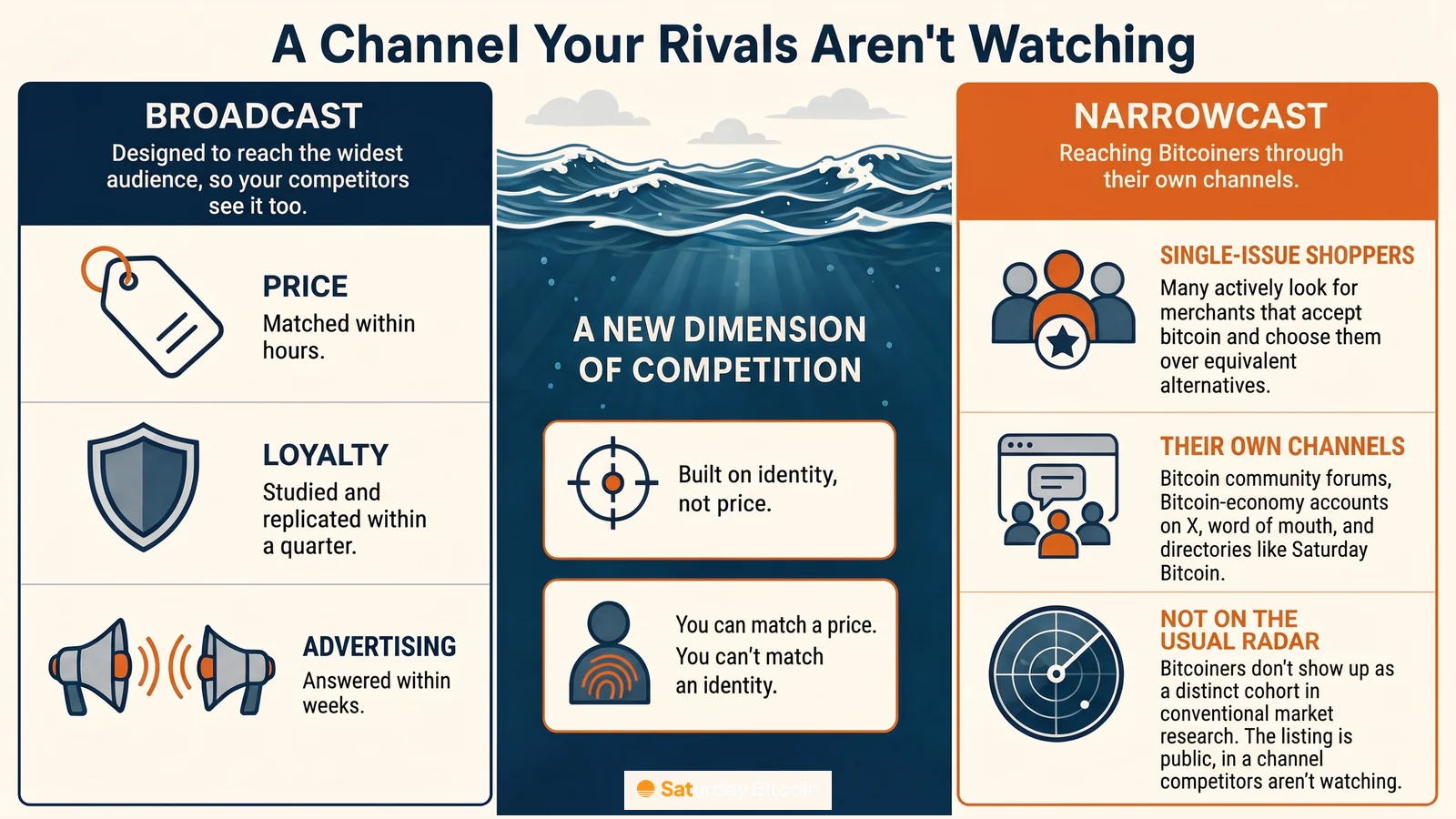
Bitcoiners are single-issue shoppers. Many actively look for merchants that accept bitcoin and choose them over equivalent alternatives. They find those merchants through their own channels: Bitcoin community forums, X accounts focused on the Bitcoin economy, word of mouth, and directories like Saturday Bitcoin.
Your rivals don’t monitor Bitcoiner channels. That’s the point. Bitcoiners don’t show up as a distinct cohort in conventional market research or competitive-intelligence tools. The listing isn’t secret, since the Saturday Bitcoin directory is public and anyone can look. But it sits in a channel your competitors aren’t watching. And if an analyst does notice “bitcoin accepted here,” it reads as just another payment option, not a customer strategy.
That gives you a new dimension of competition. It’s built on identity, not price. You can match a price. You can’t match an identity. (More on that in You Can Match a Price. You Can’t Match an Identity.) When those customers pay in bitcoin, they arrive on your cheapest rail: lower processing costs, final settlement, no chargebacks, and you decide refunds. Many Bitcoiners still pay by card, out of habit, for the rewards, or because of tax friction. You won that customer just the same.
Quiet advantages last longer
How visible you are is a choice. You can be visible to Bitcoiners without being visible to your rivals’ strategy teams. It takes restraint, not secrecy:
- Don’t issue a press release, at least not at first. The Bitcoiners who care will find you through their own channels. A press release is exactly the signal that prompts competitors to investigate.
- Don’t put it in mass-market materials. You don’t need a “Now accepting bitcoin” homepage banner for customers who don’t care.
- Don’t feature it on earnings calls prematurely. If it comes up, it’s a payment option, as uncontroversial as adding PayPal.
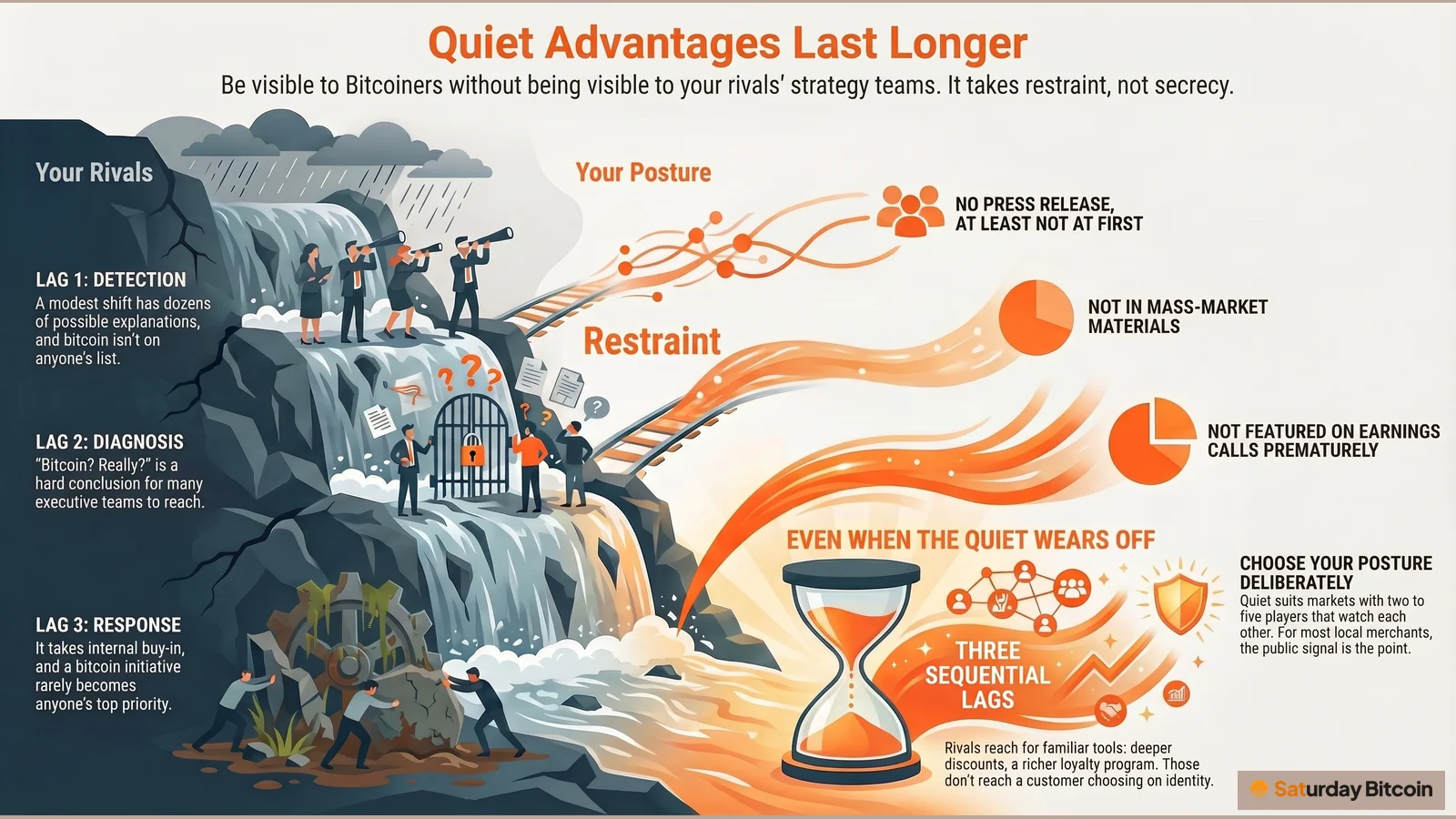
This suits markets with two to five players that watch each other closely. In fragmented categories, and for most local merchants, the public signal is the point. The sticker in the window and the post on X are how Bitcoiners find you. Choose your posture deliberately.
Even when the quiet wears off, competitors face three sequential lags. The first is detection: a modest shift has dozens of possible explanations, and bitcoin isn’t on anyone’s list. The second is diagnosis: “Bitcoin? Really?” is a hard conclusion for many executive teams to reach, and a quick look at the segment’s size invites dismissal. The third is response: it takes internal buy-in, and a bitcoin initiative rarely becomes anyone’s top priority. Rivals who can’t diagnose the cause often reach for the familiar tools, such as deeper discounts and a richer loyalty program. Those don’t reach a customer who is choosing on identity.
What we can and can’t promise
We can’t promise share. The committed segment is small: an estimated ~1 million committed, mission-driven Bitcoiners in the U.S., and growing, within the tens of millions of Americans who own some bitcoin. In a $40 billion category, that alone won’t move a share point, and a listing is discovery, not a guarantee of volume. Saturday Bitcoin isn’t a payment processor and can’t see your sales.
What we can offer is access to a customer segment your rivals probably aren’t courting, through a channel they aren’t watching. You don’t need a view on bitcoin for that to be true; the customers are real either way. Being Bitcoin-friendly is a differentiator now, and it won’t stay one forever.
The quiet first step
If you already accept bitcoin, claim your free listing at saturdaybitcoin.com/business. Verify it, add a welcome offer for Bitcoiners, and let the people who are looking for you find you. It’s free, reversible and low effort, with real upside. No press release required.