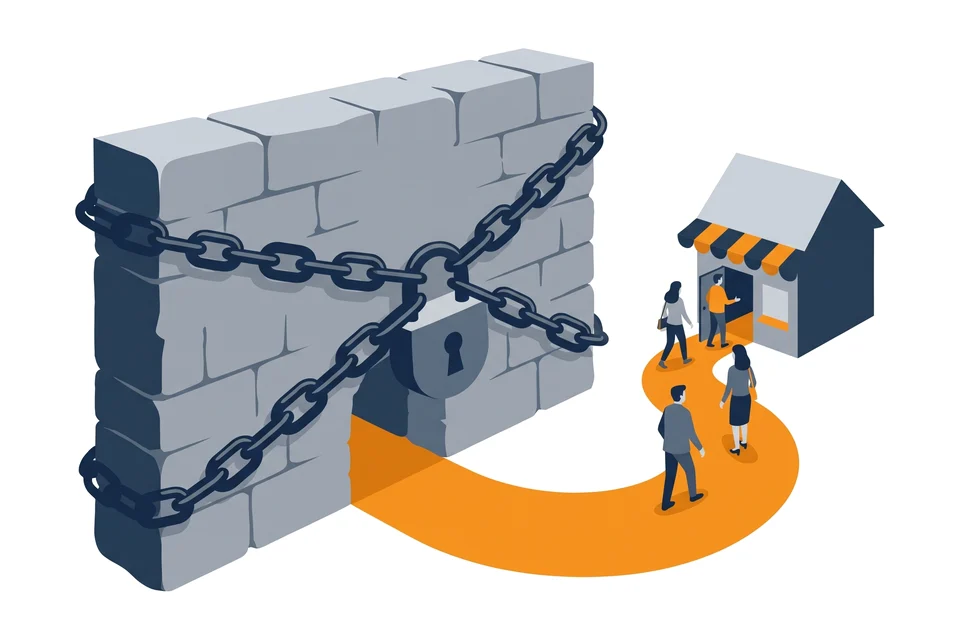

Amazon accounts for roughly 40% of U.S. retail e-commerce. For most online merchants, that isn’t news. It’s the defining constraint of the business. Every strategic decision sits in the shadow of one question: how do we compete when the default for most consumers is to buy from Amazon?
This article is about a customer who starts their search somewhere Amazon isn’t looking.
The friction stack: Amazon’s moat is four layers deep
Amazon’s dominance isn’t just more products or lower prices. It’s a carefully engineered set of friction barriers, what I call the friction stack, that makes it psychologically and practically expensive to shop anywhere else.
You can’t out-Amazon Amazon. But you can be the merchant Bitcoiners find when they go looking somewhere Amazon isn’t.
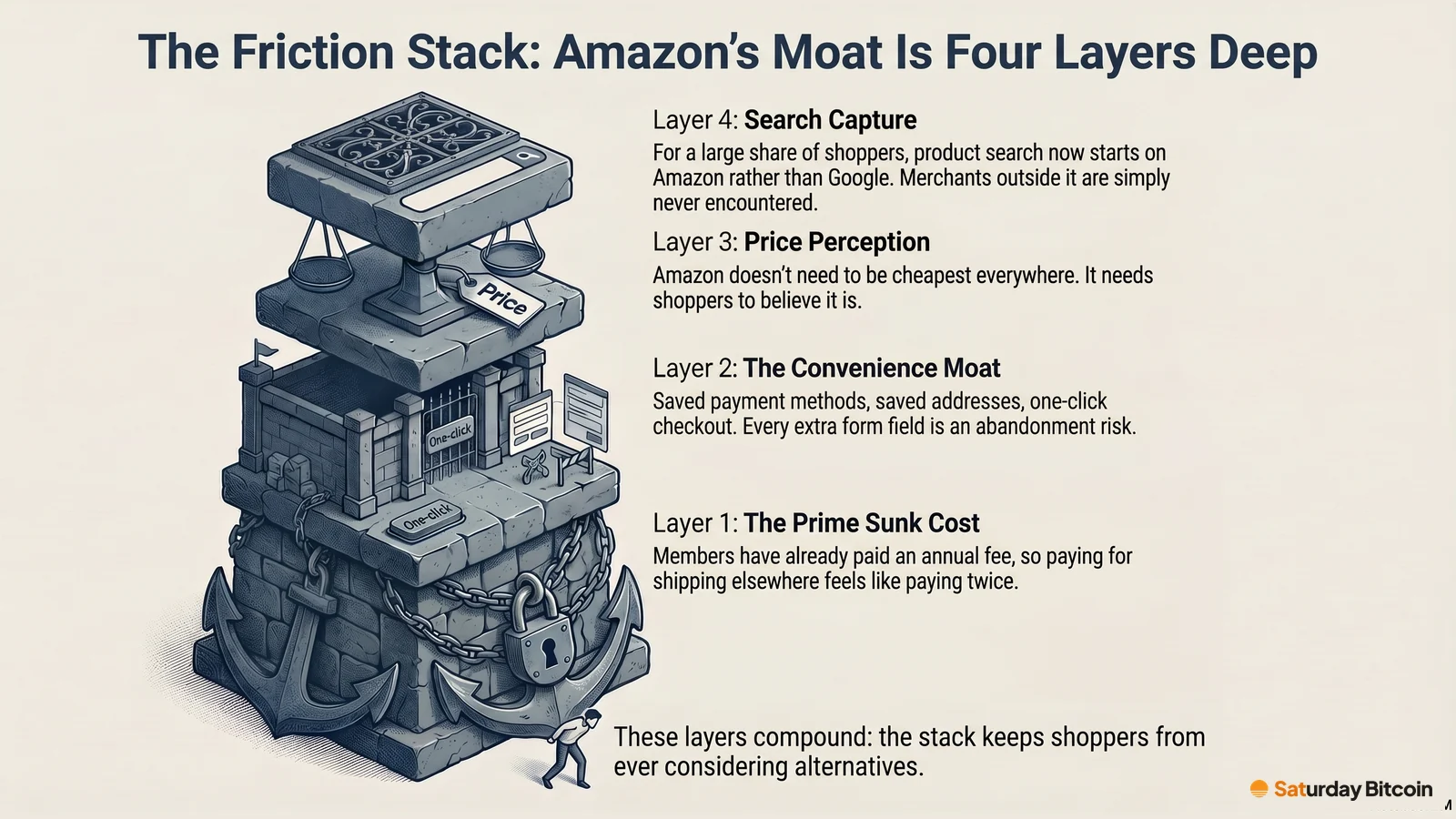
Layer 1: the Prime sunk cost. Members have already paid an annual fee, so every Amazon purchase feels like it’s extracting value from that investment. Paying $7 or $8 for shipping on a third-party site doesn’t just cost $7 or $8. It feels like paying twice.
Layer 2: the convenience moat. Saved payment methods, saved addresses, one-click checkout, biometric login on mobile. For a shopper used to that, a new merchant means creating an account, typing in a card, and trusting an unfamiliar return policy. Every extra form field is an abandonment risk.
Layer 3: price perception. Amazon doesn’t need to be cheapest everywhere. It needs shoppers to believe it is. Deep, visible discounts in high-traffic categories anchor a reputation for low prices, so many shoppers check Amazon before buying elsewhere, even when your price is competitive.
Layer 4: search capture. For a large share of shoppers, product search now starts on Amazon rather than Google. If discovery happens inside Amazon, merchants outside it are simply never encountered. Not because the product is worse, but because the shopper never looked.
These layers compound. The stack doesn’t just retain customers; it keeps them from ever considering alternatives. And it shows up on your P&L: paid search, social and affiliate customers are expensive to win, and the stack pulls many of them back to Amazon for the next purchase.
You can’t out-Amazon Amazon
The strategies merchants typically deploy share a common flaw.
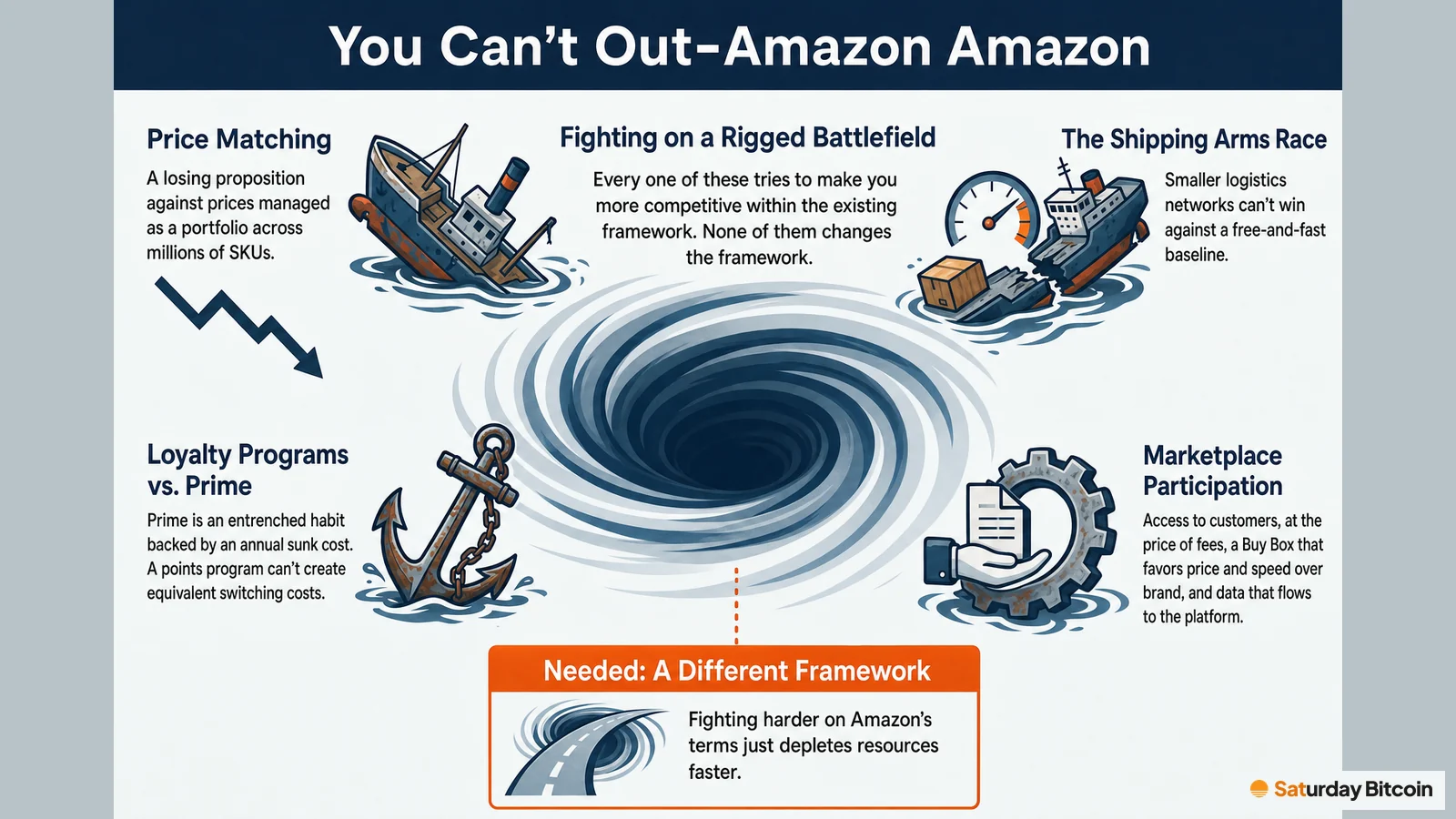
Price matching is a losing proposition against a company that treats individual product prices as variables in a portfolio across millions of SKUs, funded by advertising, marketplace fees and subscriptions rather than product margin.
Loyalty programs compete against Prime, which isn’t really a loyalty program. It’s an entrenched habit backed by an annual sunk cost, with renewal rates that research firm CIRP describes as “extraordinary.” A points program or free-shipping tier can’t create equivalent switching costs.
Shipping investment is an arms race smaller logistics networks can’t win, against a free-and-fast standard the largest retailers have made the baseline.
Marketplace participation gives you access to customers, but at the price of fees, a Buy Box that favors price and fulfillment speed over brand, and data that flows to the platform rather than to you.
Every one of these tries to make you more competitive within the existing framework. None of them changes the framework. Fighting harder on a rigged battlefield just depletes resources faster.
The one question Amazon doesn’t ask
Amazon’s friction stack is engineered for shoppers who optimize for convenience, speed and price. That is most shoppers. But there is a segment that leads with something else.
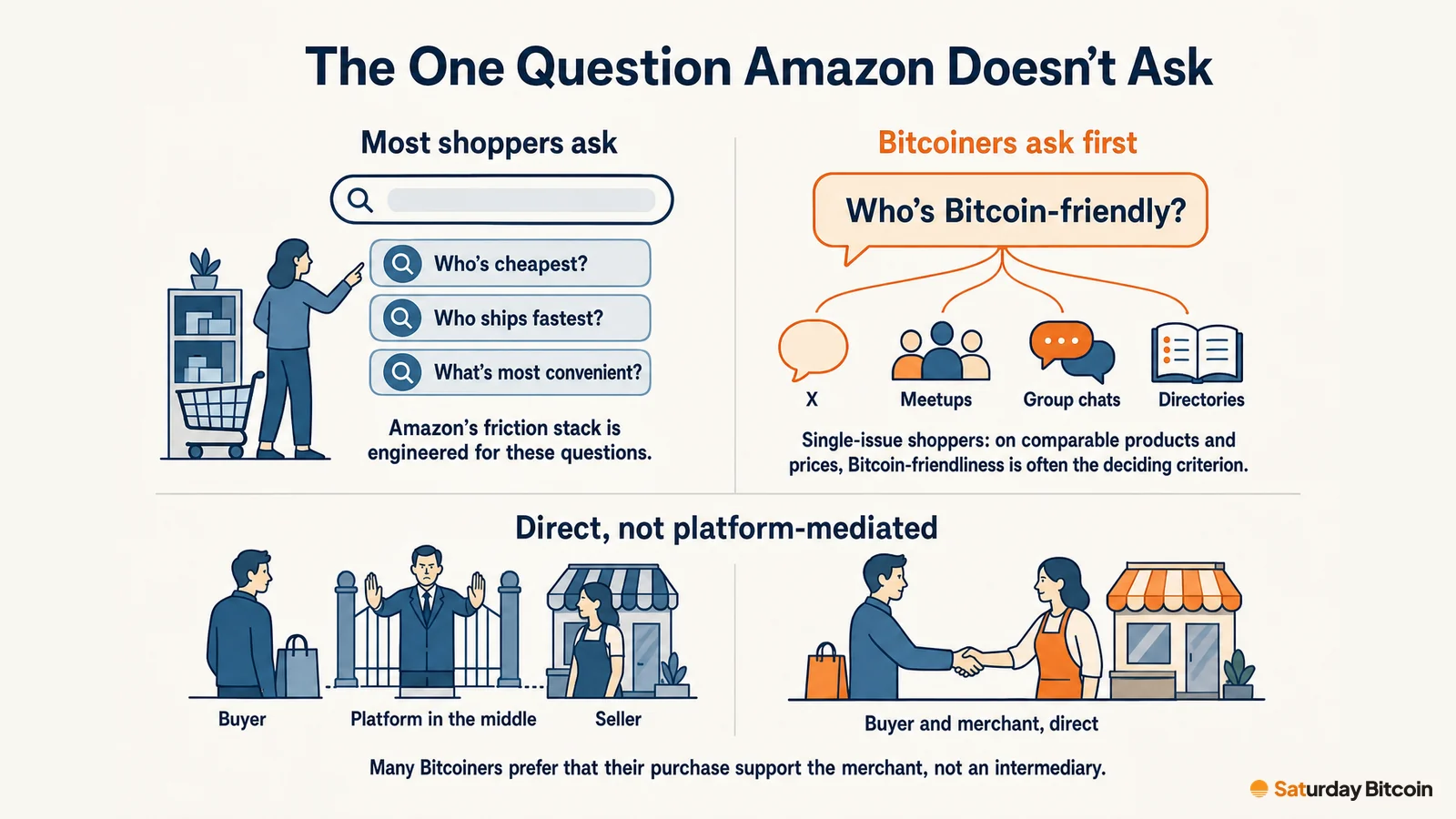
Bitcoiners are single-issue shoppers. On comparable products and prices, Bitcoin-friendliness is often the deciding criterion. Their search doesn’t start with “who’s cheapest?” or “who ships fastest?” It starts with one question: who’s Bitcoin-friendly?
That question isn’t asked in Amazon’s search bar, and Amazon’s algorithms aren’t built to answer it. It’s asked on X, at meetups, in group chats, and in directories built for the purpose. It is a customer acquisition channel that Amazon, and probably your rivals, aren’t watching.
There’s a deeper reason it works against Amazon in particular. Bitcoin was designed to be peer-to-peer: direct transactions between parties, no gatekeeper extracting value in between. Many Bitcoiners carry that into how they shop. They have a natural preference for direct merchant relationships over platform-mediated ones, and want their purchase to support the merchant rather than enrich an intermediary. Amazon is, by design, the opposite. For a Bitcoiner, choosing you over Amazon isn’t only about recognition. It’s about the kind of direct relationship between buyer and seller that bitcoin was built to enable.
We’ve seen a version of this behavior in the physical world. Bitcoiners went out of their way to visit, post about and recruit others to Steak ’n Shake after it began accepting bitcoin in 2025. That was an in-store case with other changes underway at the same time; I cover it carefully in “A Fraction of the Segment: What Steak ’n Shake Proved About Bitcoiners.”
Reclaim the customers Amazon took, and win ones it never had
Being visibly Bitcoin-friendly opens two distinct pathways.
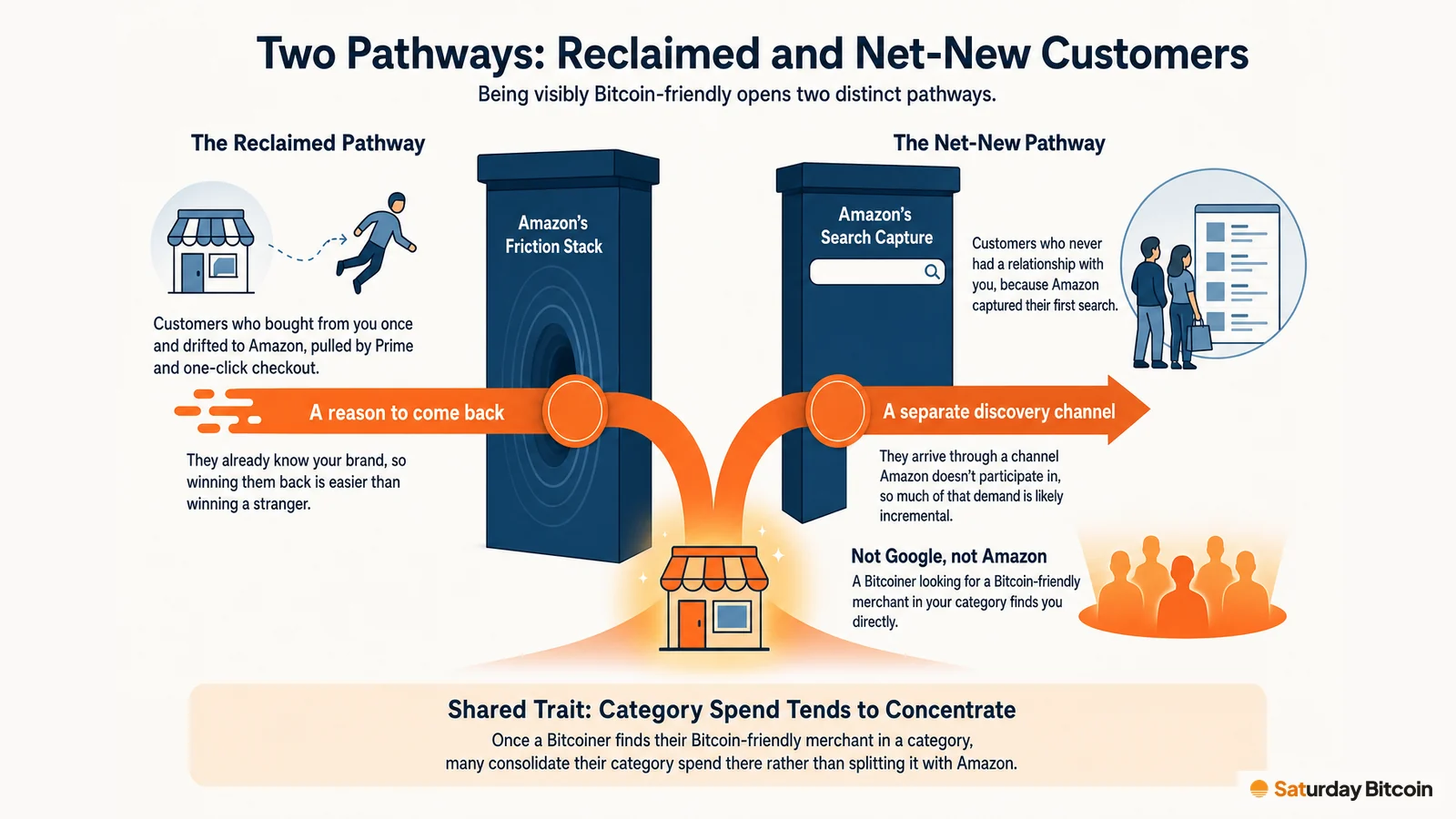
Reclaimed customers bought from you once and drifted to Amazon, pulled by Prime and one-click checkout. They didn’t leave because your product was worse; they left because Amazon made it easier. If they’re Bitcoiners, you now give them a reason to come back that has nothing to do with matching Amazon’s convenience. And because they already know your brand, winning them back is easier than winning a stranger.
Net-new customers never had a relationship with you, because Amazon captured their first search. A Bitcoiner looking for a Bitcoin-friendly merchant in your category finds you through a separate discovery channel, not through Google or Amazon. You aren’t taking them from Amazon with better pricing or more ad spend. They arrive through a channel Amazon doesn’t participate in, so much of that demand is likely incremental.
Both share a useful trait: once a Bitcoiner finds their Bitcoin-friendly merchant in a category, many consolidate their category spend there rather than splitting it with Amazon.
Quiet channels compound longest
Advantages built in this segment tend to widen over time.
Organic evangelism. Bitcoiners are tightly networked on X and at local meetups and conferences. Sharing a new Bitcoin-friendly merchant earns standing in the community. That’s not the diluted “refer a friend” of a loyalty program; it’s high-conviction advocacy.
First-mover retention. The first Bitcoin-friendly merchant in a category earns allegiance on principle. Bitcoiners don’t just want to buy from you; they want you to succeed, to prove that Bitcoin-friendly merchants win. When a second merchant in your category arrives, some spend will move, but the first mover keeps a durable edge in recognition.
A channel rivals aren’t watching. A price war, an ad campaign or a new loyalty tier is visible and copyable within weeks. A Bitcoiner following is built in community channels most competitors don’t monitor and Amazon’s flywheel was never designed to serve. It isn’t secret, but it is slow to notice and hard to copy quickly.
The honest limits
This segment is small: an estimated ~1 million committed, mission-driven Bitcoiners in the U.S., and growing, within the tens of millions of Americans who own some bitcoin. It won’t replace your Amazon-shaped customer base, and Bitcoiners still buy plenty on Amazon. Discovery isn’t a guarantee of volume; your product, price and service still have to be right. And many Bitcoiners still pay by card, out of habit, for rewards, or because of tax friction. They still chose you, and that counts. When they do pay in bitcoin, those sales come with lower processing costs, final settlement and no chargebacks; you decide refunds.
Irrespective of what you think about bitcoin, the customer segment is real, and the merchant bitcoin strategy works independently of bitcoin’s price.
Where Saturday Bitcoin fits
Saturday Bitcoin is a discovery directory that helps Bitcoiners find merchants that already accept bitcoin, online and nearby. It’s where the question “who’s Bitcoin-friendly?” gets answered. We bring you the customer. When they pay in bitcoin, they arrive on your cheapest rail.
If you already accept bitcoin, you’re probably already listed. Claiming that listing is free and takes minutes: verify your details, add a welcome offer or promo code for Bitcoiners, and tell the segment your category is covered.
You can’t out-Amazon Amazon. But you can be the merchant Bitcoiners find when they go looking somewhere Amazon isn’t.