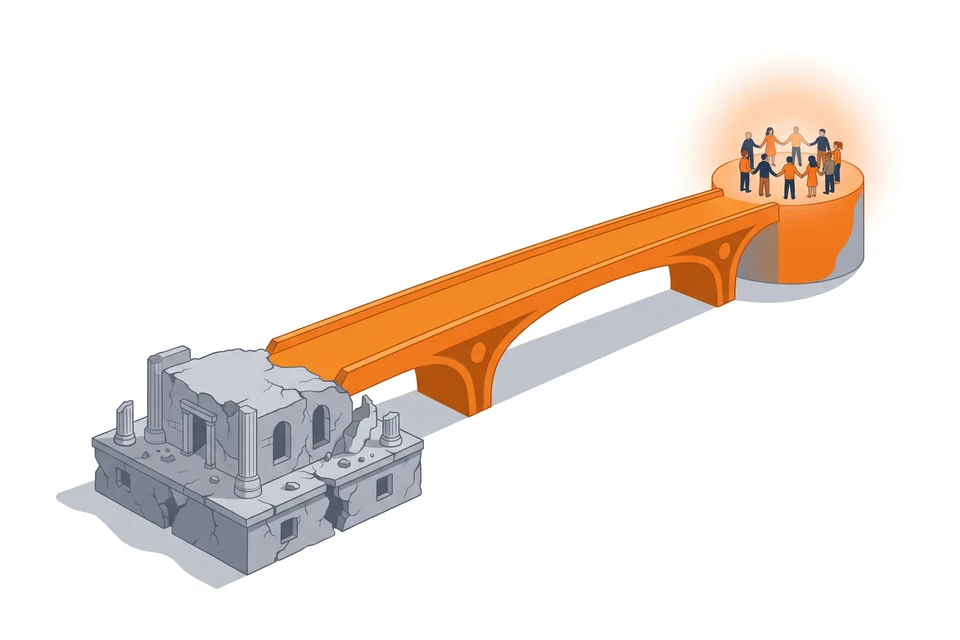
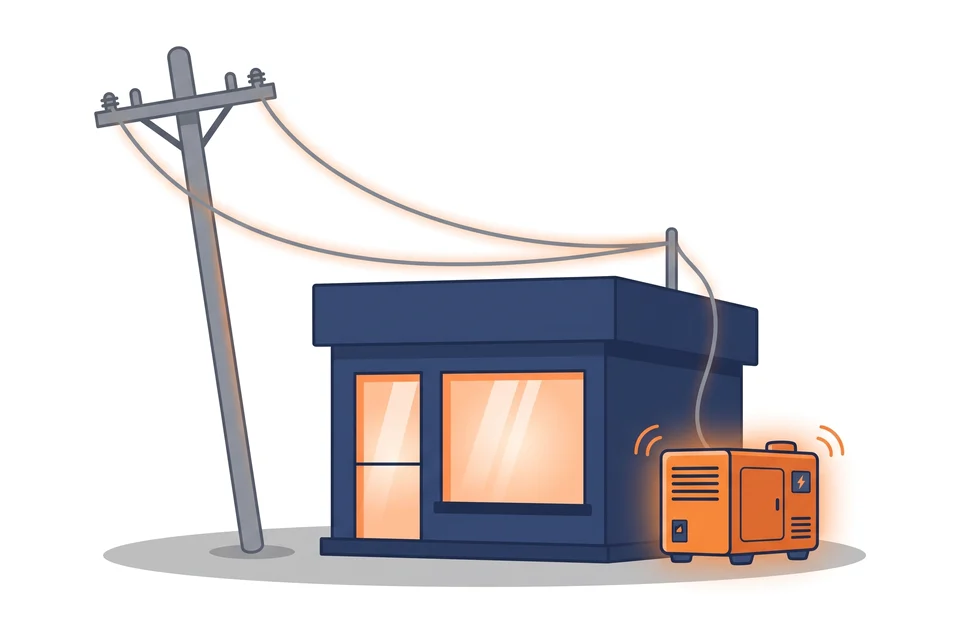

Most of the case for accepting bitcoin is about customers. This piece covers two quieter benefits a CFO or owner will care about. A bitcoin channel gives your business a second set of payment rails. It also gives you the option, never the obligation, to build a bitcoin position on your balance sheet without buying any.
Your business runs on one set of rails
Most merchants depend completely on one financial infrastructure: banks, card networks and processors. That is a single point of failure most owners never consider until it fails.
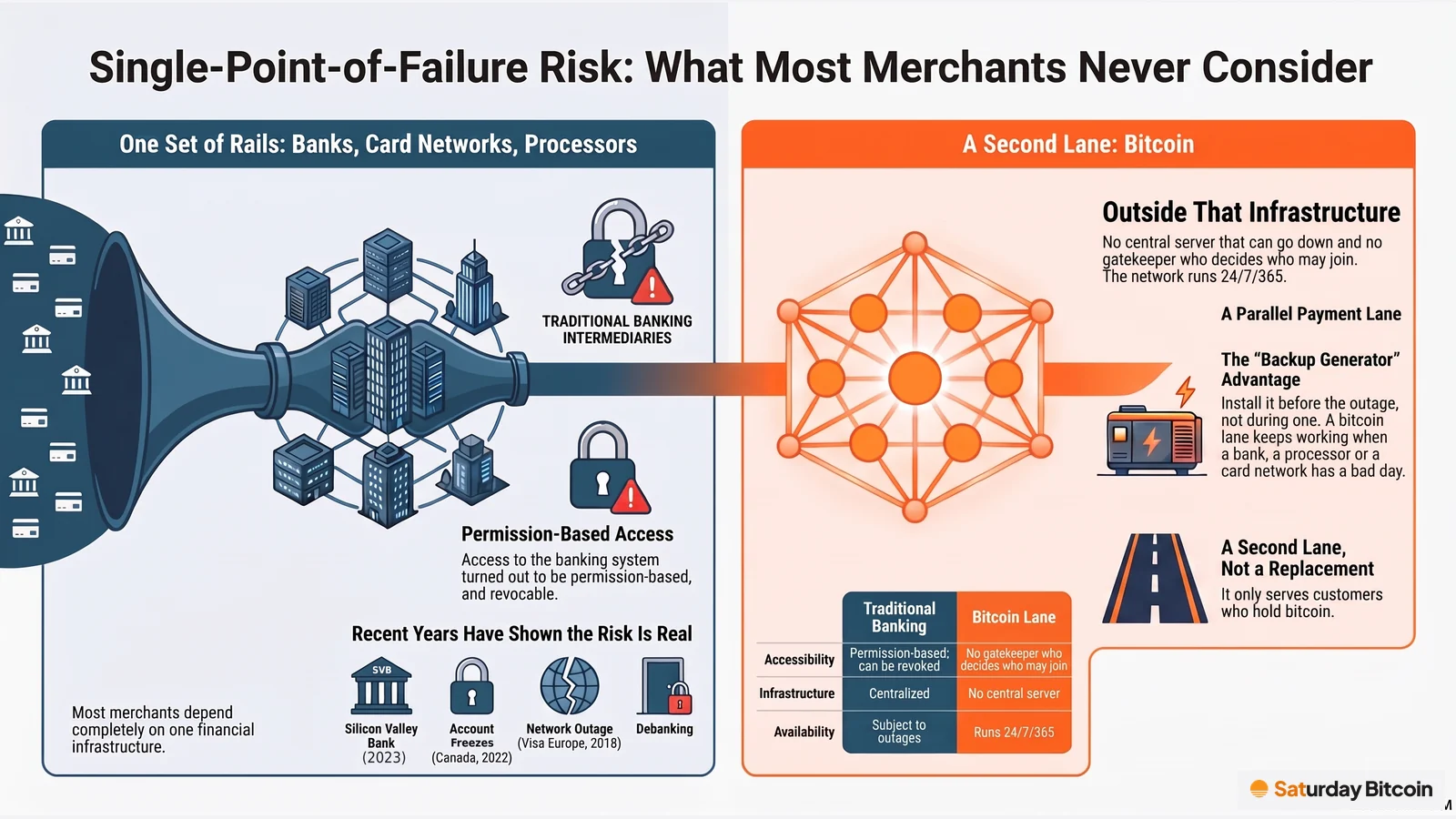
Recent years have shown the risk is real:
Accepting bitcoin doesn’t mean holding it. Holding it doesn’t mean buying it.
- Silicon Valley Bank (2023). Regulators closed SVB on Friday, March 10. Over that weekend thousands of companies didn’t know whether they could get to their deposits or make payroll. Depositors got full access on Monday, March 13, only because the Treasury, the Fed and the FDIC stepped in. Now imagine the government doesn’t, or can’t, step in.
- Canada (2022). Under the Emergencies Act, financial institutions froze 257 accounts and other financial products linked to the trucker protests. Access to the banking system turned out to be permission-based, and revocable.
- Network outages. In June 2018 a hardware failure at Visa Europe caused about 5.2 million card transactions to fail over roughly ten hours. Merchants with no alternative simply stopped taking card payments until it was fixed.
- Debanking. Banks have closed accounts over a business’s industry or reputation, often without explanation. The problem was serious enough that a 2025 executive order told federal regulators to stop using “reputation risk” as grounds for it.
A second lane, not a replacement
Bitcoin runs outside that infrastructure. It has no central server that can go down and no gatekeeper who decides who may join, and the network runs 24/7/365. A merchant who accepts bitcoin directly has a parallel payment lane that keeps working when a bank relationship, a processor or a card network has a bad day. You don’t need to believe bitcoin will become global money to see the value of that. This is business continuity planning, not ideology.
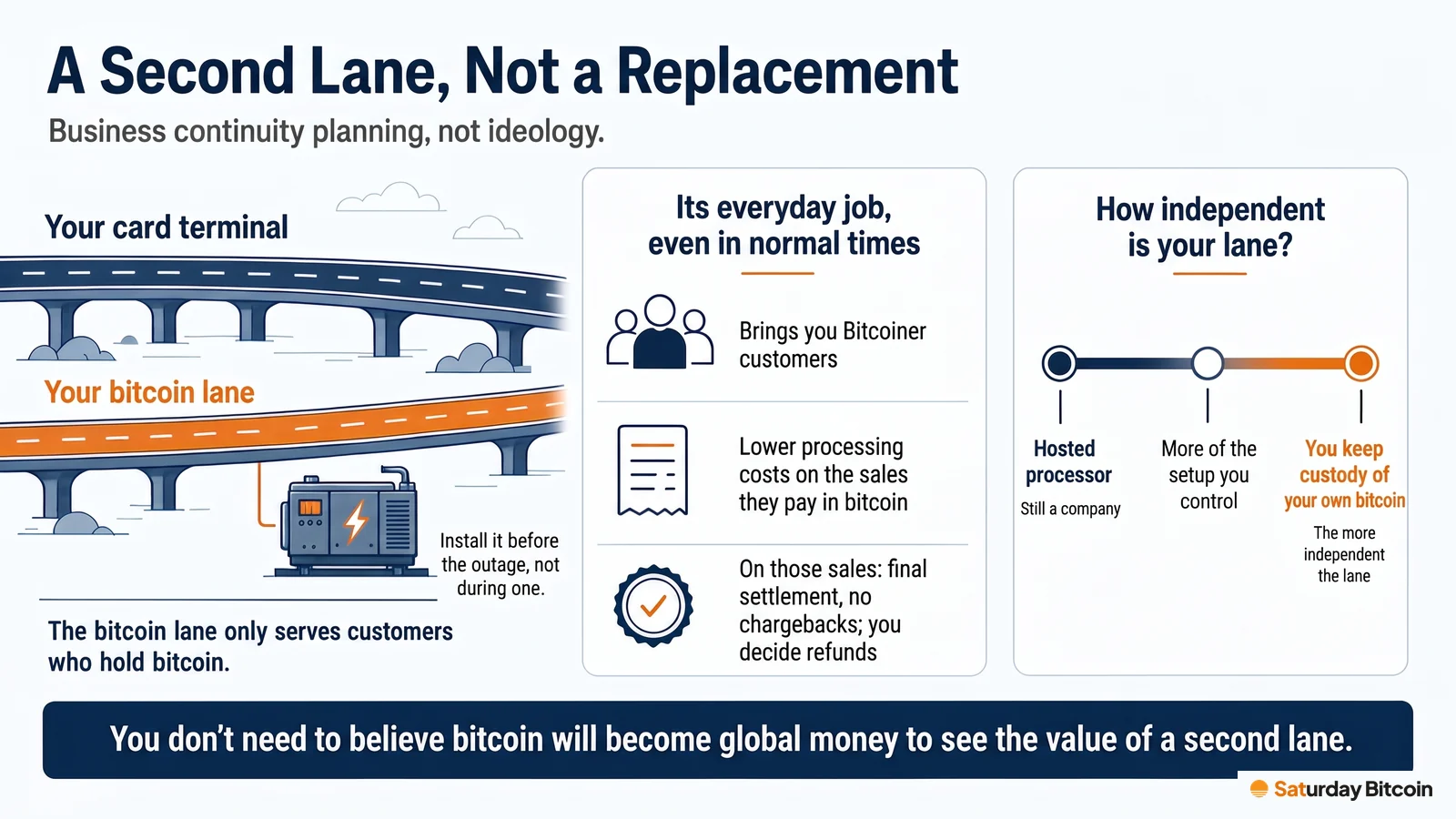
Think of it like a backup generator. You install it before the outage, not during one. Even in normal times, the bitcoin channel does its everyday job: it brings you Bitcoiner customers, and on the sales they pay in bitcoin you get lower processing costs, final settlement and no chargebacks; you decide refunds.
Be honest with yourself about the limits. The bitcoin lane only serves customers who hold bitcoin, so it is a second lane, not a replacement for your card terminal. How independent it is depends on how you set it up. A hosted processor is still a company, and the Canadian authorities also flagged bitcoin addresses to exchanges. The more of the setup you control, including whether you keep custody of your own bitcoin, the more independent the lane is.
Accepting bitcoin doesn’t mean holding it
The most common worry: “Bitcoin is volatile. Won’t this add risk to my operations?”
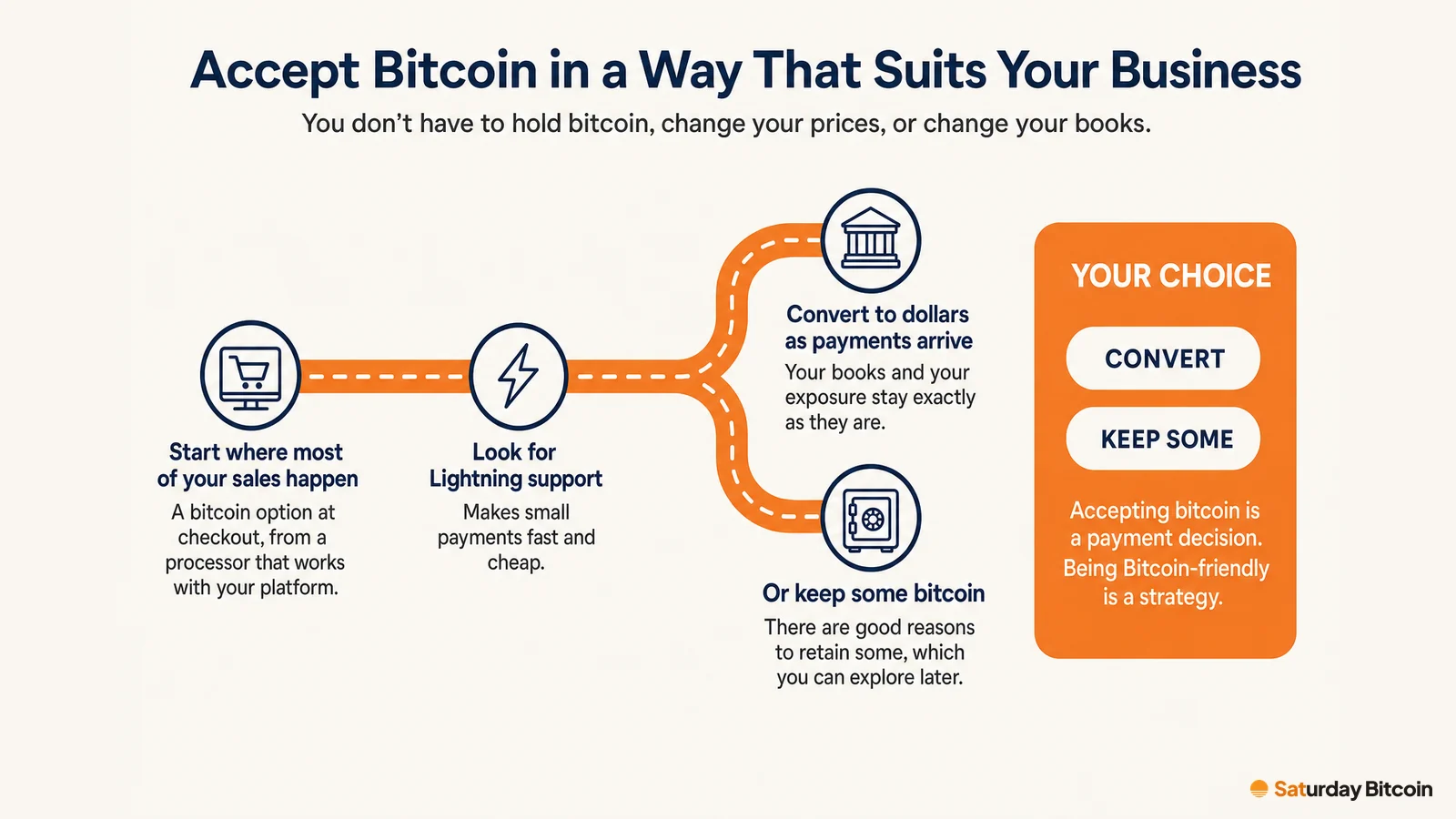
It doesn’t have to. Most bitcoin payment processors let you convert some or all of each payment to dollars automatically, at the moment of sale. If you want no exposure to the bitcoin price, convert everything. Your operating economics stay the same, and everything in the first half of this article still applies. Volatility only matters for the bitcoin you choose to keep, and that is a long-term treasury question, not an operating risk.
Optional treasury exposure, earned rather than bought
If you do keep some, something useful happens. Every bitcoin sale delivers bitcoin to your business, and over time you build a position on your balance sheet out of normal operations, not out of a treasury allocation.
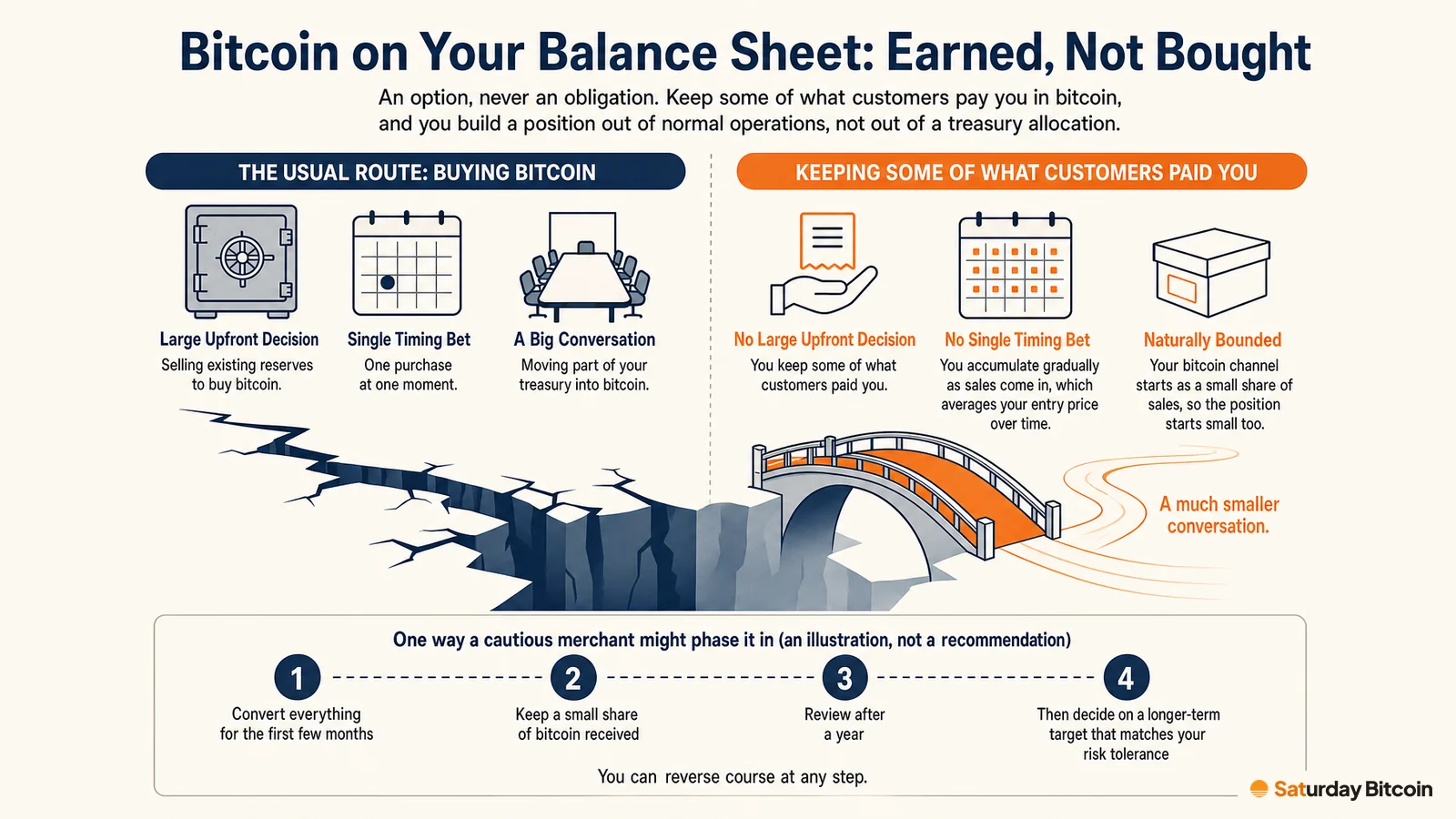
That is a far easier step than the usual route:
- No large upfront decision. You aren’t selling existing reserves to buy bitcoin; you’re keeping some of what customers paid you. “We accept bitcoin and keep some of it” is a much smaller conversation than “we’re moving $10 million of treasury into bitcoin.”
- No single timing bet. You accumulate gradually as sales come in, which naturally averages your entry price over time.
- Naturally bounded. Your bitcoin channel starts as a small share of sales, so the position starts small too. Much of that revenue is likely incremental, which means you’re adding bitcoin alongside your cash reserves rather than replacing them.
Here is one way a cautious merchant might phase it in (an illustration, not a recommendation). Convert everything for the first few months. Then keep 10-25% of bitcoin received. Review after a year. Only then decide whether to set a longer-term target that matches your risk tolerance. You can reverse course at any step. Bitcoin has historically appreciated over multi-year periods, but past performance is no guarantee, and the merchant bitcoin strategy works independently of bitcoin’s price. Bitcoin you hold is also liquid on weekends and bank holidays, which is a resilience payoff of its own.
The regulatory picture has largely cleared
The concerns that kept many businesses away a few years ago have mostly been addressed in the U.S.:
- Accounting. Under FASB’s ASU 2023-08, effective for fiscal years beginning after December 15, 2024, companies report in-scope crypto assets at fair value. The old rules forced impairment write-downs that could never be reversed.
- Custody. In January 2025 the SEC rescinded SAB 121, the staff guidance that had made it hard for banks to hold bitcoin for customers.
- Commodity status. The CFTC has treated bitcoin as a commodity since 2015.
- Mainstream access. The SEC approved spot bitcoin ETFs in January 2024. In March 2025, an executive order created a U.S. Strategic Bitcoin Reserve.
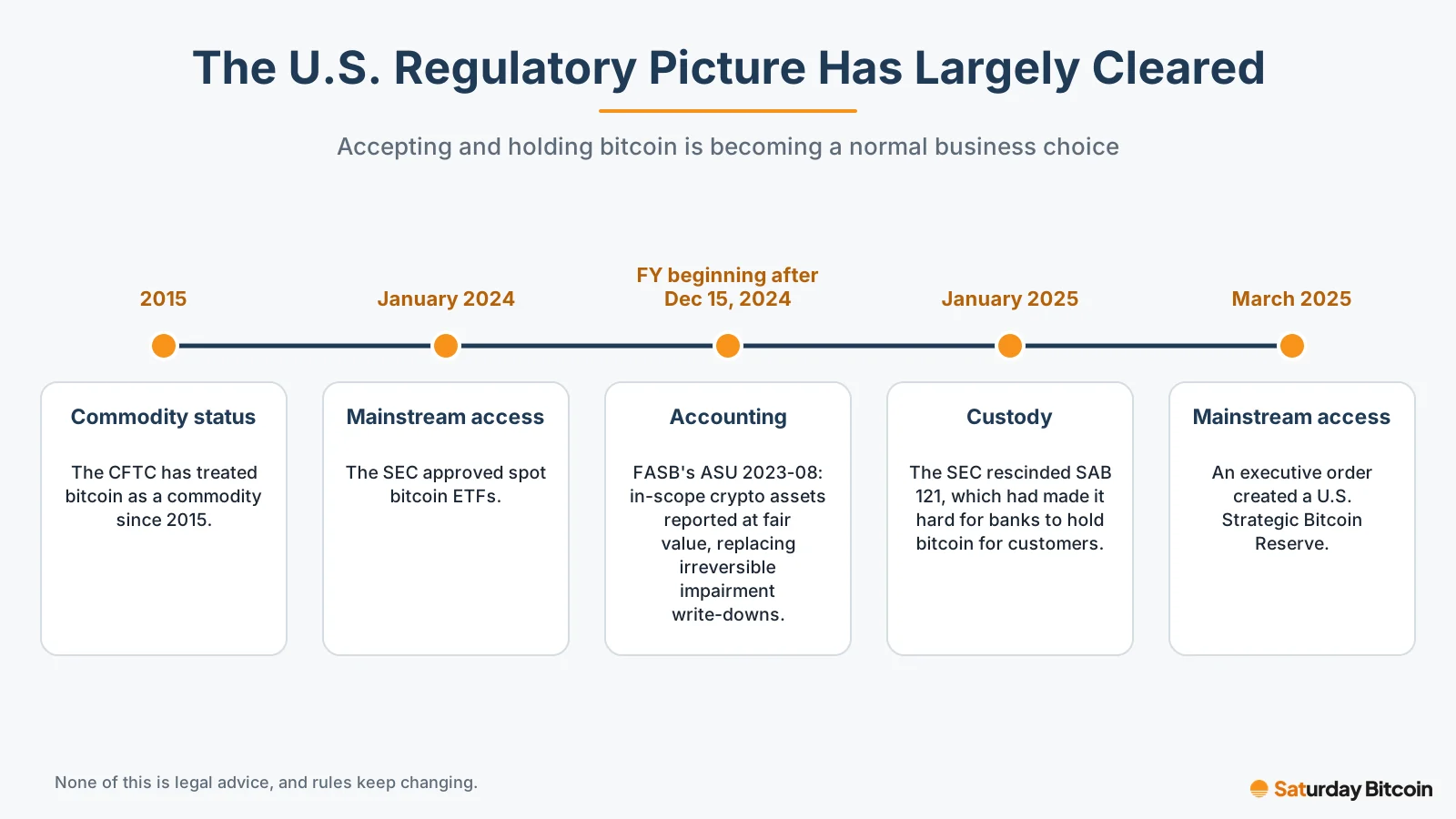
None of this is legal advice, and rules keep changing. The direction, though, is clear: accepting and holding bitcoin is becoming a normal business choice.
You wouldn’t be first
Treasury adoption is now a mainstream corporate conversation. Strategy holds more than 800,000 bitcoin. Block and Tesla both carry bitcoin on their balance sheets. Bitbo keeps a running list of public and private companies that hold bitcoin (bitbo.io/treasuries).
Closer to Main Street, Steak ’n Shake says the bitcoin it receives from customers goes into a Strategic Bitcoin Reserve instead of being converted to cash. In January 2026 it added roughly $10 million more. (We cover its bitcoin story in “A Fraction of the Segment: What Steak ’n Shake Proved About Bitcoiners.”) Those firms bought bitcoin outright. A merchant who keeps part of its bitcoin sales is doing a smaller, gentler version of the same thing.
Bitcoiners notice who holds
Many Bitcoiners want merchants to actually keep bitcoin, not just accept it and convert it at once. When a business says publicly that it holds what it earns, Bitcoiners read it as shared long-term conviction: a merchant that belongs to the Bitcoin economy. If you hold, say so where Bitcoiners will see it. If you convert everything, you’re still a Bitcoin-friendly merchant.
Talk to your accountant first
Before you keep any bitcoin, bring your advisors in:
- Tax. The IRS treats bitcoin as property. Bitcoin you receive for goods or services generally counts as income at its dollar value when received, and selling it later produces a capital gain or loss.
- Accounting. Ask how fair-value reporting will appear in your financial statements.
- Governance. For a small business, keeping some bitcoin is an operating choice. A public company, or any company with a board, should adopt a written treasury policy covering limits, custody and who can move funds.
- Risk tolerance. Start at a level that lets you sleep at night.
Where Saturday Bitcoin fits
Saturday Bitcoin is a free discovery directory. It helps Bitcoiners find merchants that already accept bitcoin, online and nearby. We aren’t a payment processor and we can’t see your sales. All of the above depends on the bitcoin channel you choose and run. Our job is to make sure the customers who want to use that channel can find you. When they pay in bitcoin, the sale lands on your cheapest rail.
If you accept bitcoin today, claim your free listing at saturdaybitcoin.com/business. Verify it, add a welcome offer if you like, and make your second lane easy to find.