
Not all customers are created equal. Two people can buy the same thing at the same price and be worth very different amounts to you over five years. One is gone the moment a competitor runs a better promotion. The other comes back, buys more, and brings friends.
Bitcoiners tend to be the second kind. This article explains why we expect that, what is and isn’t proven yet, and where it matters most.
Retention is the enterprise-value lever
Most merchants obsess over customer acquisition cost and undervalue what happens after the first sale. That is backwards. Acquisition cost, gross margin and pricing are linear levers. Retention compounds.
Acquisition cost, margin and pricing are linear levers. Retention compounds.
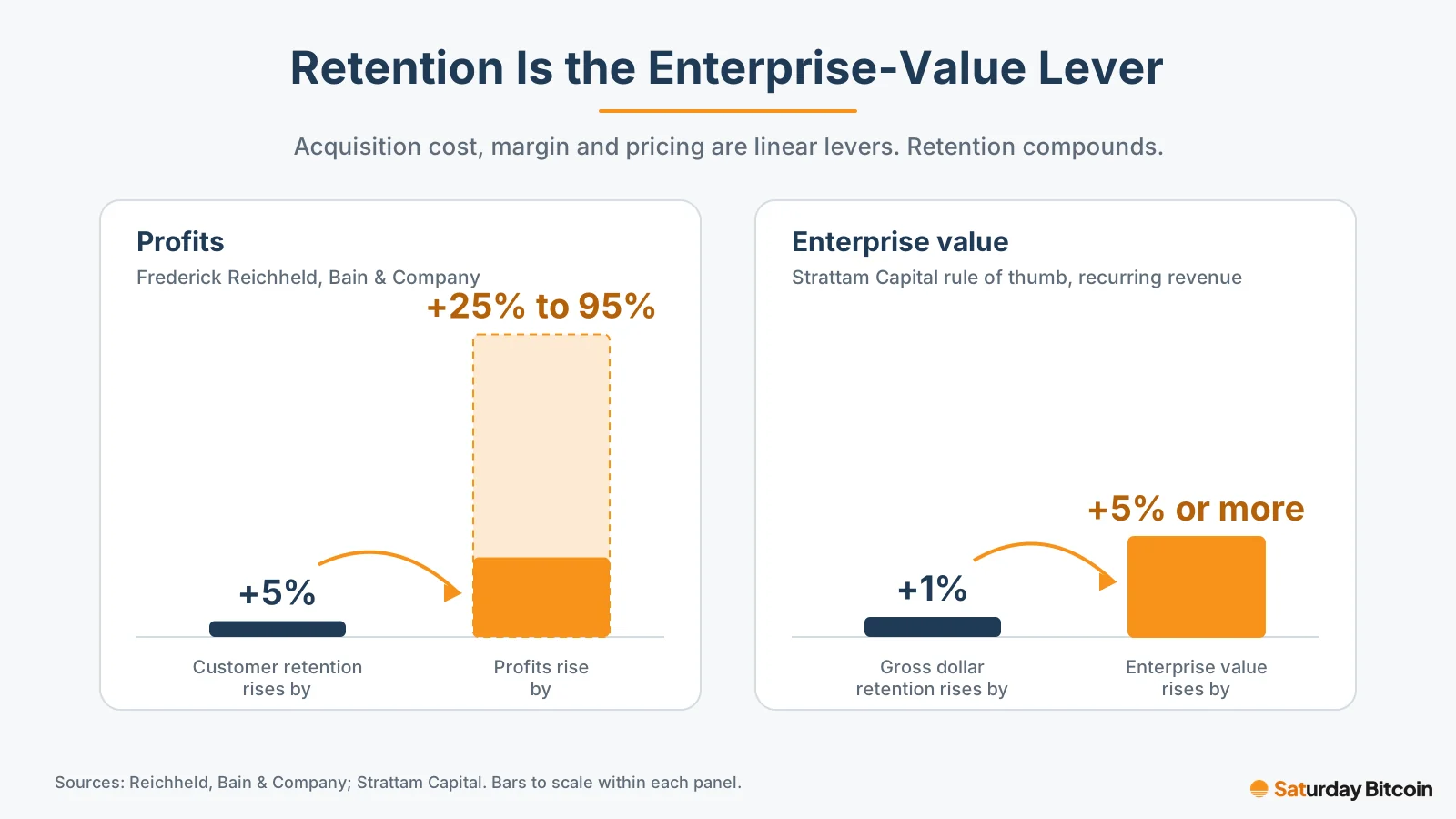
The research on this is well established. Frederick Reichheld of Bain & Company found that increasing customer retention rates by 5% increases profits by 25% to 95%. Retention compounds through acquisition costs spread over more years, more repeat purchases, more referrals and less price sensitivity.
Investors make the same point in valuation terms. Strattam Capital’s rule of thumb for recurring-revenue businesses is that, all else equal, every 1% increase in gross dollar retention implies a 5% or greater increase in enterprise value. A customer who stays one more year contributes not just one more year of revenue, but the present value of every year that follows.
Why most retention is rented
If retention is the primary lever, why is it so hard to move? Because most retention tools work on the most fragile mechanism available.
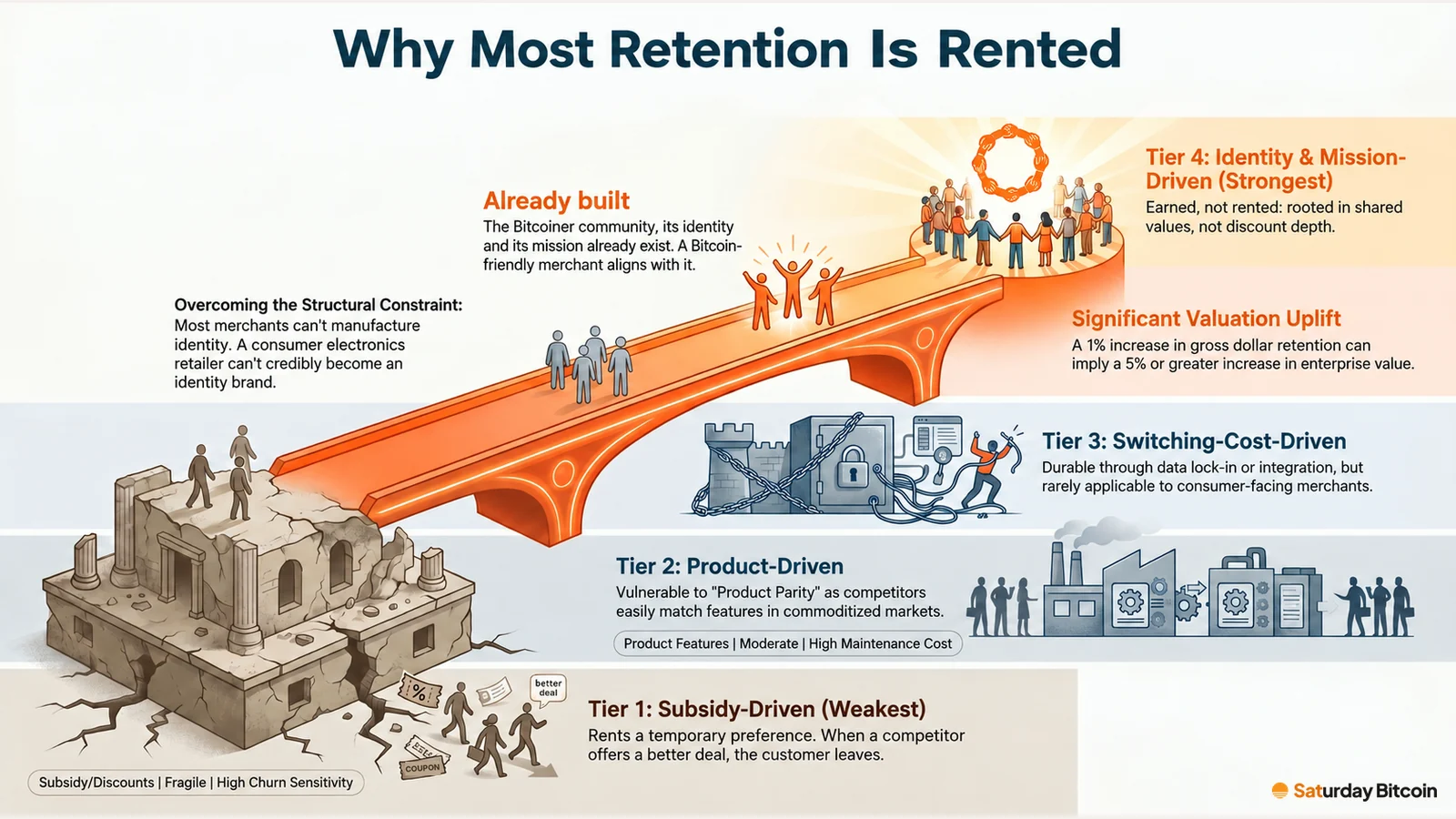
There are broadly four reasons customers stay:
- Subsidy. Discounts, points, cash-back. This is the most common and the most fragile. The incentive doesn’t create loyalty; it rents a temporary preference. When a competitor offers a better deal, the customer leaves.
- Product. The product is genuinely better. More durable, but competitors eventually catch up.
- Switching costs. Leaving is painful. Durable, but mostly a B2B phenomenon. For most consumer merchants, switching costs are minimal.
- Identity. The customer stays because the brand aligns with who they are. This is the most durable form, and the one most merchants can’t access. A consumer electronics retailer can’t credibly become an identity brand; a meal-kit company can’t manufacture community out of a product category.
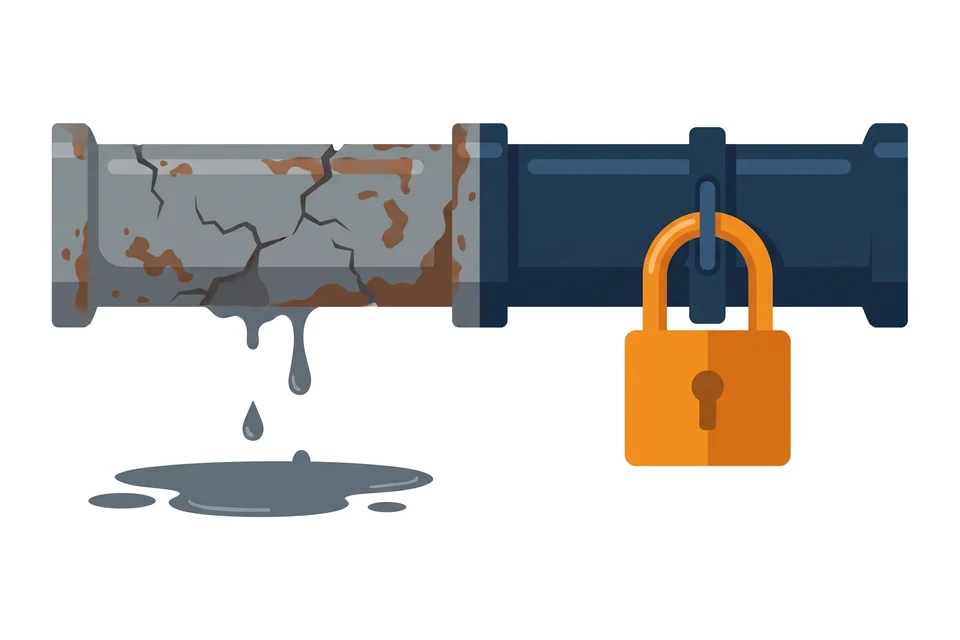
Marketers call the result of subsidy-driven retention the leaky bucket: customers constantly churn out, and you keep paying to refill the bucket just to stay level.
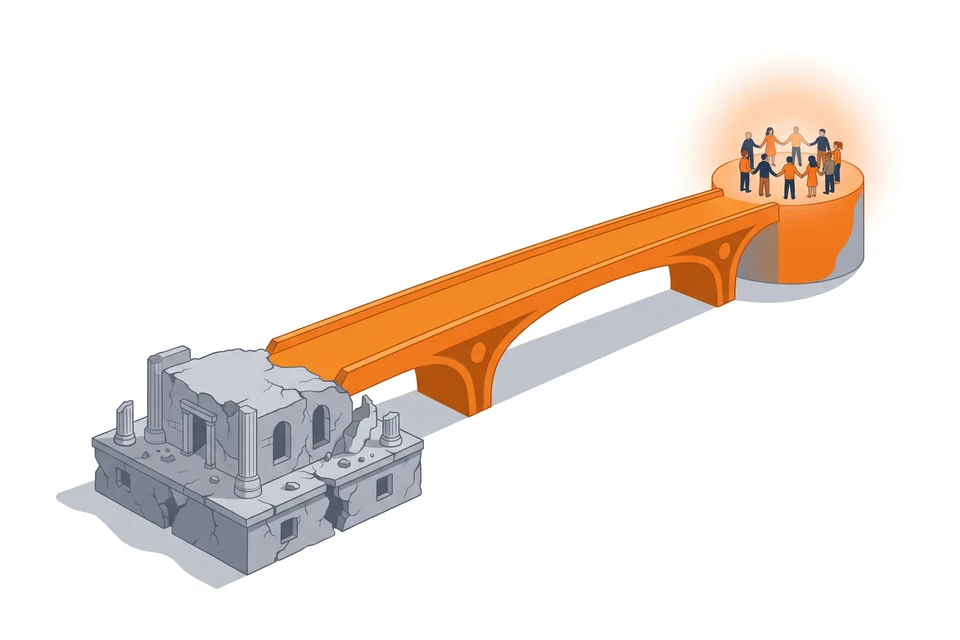
Bitcoiner allegiance is structurally different. It’s earned, not rented, and rooted in shared values rather than discount depth. The Bitcoiner community already exists, its identity is already established, and its mission is already articulated. A merchant who becomes visibly Bitcoin-friendly doesn’t have to build that identity. They align with one that is already there.
Four drivers, one segment
We expect Bitcoiner customers to deliver higher lifetime value through four drivers. These are reasons to expect a premium, not multipliers we can promise.
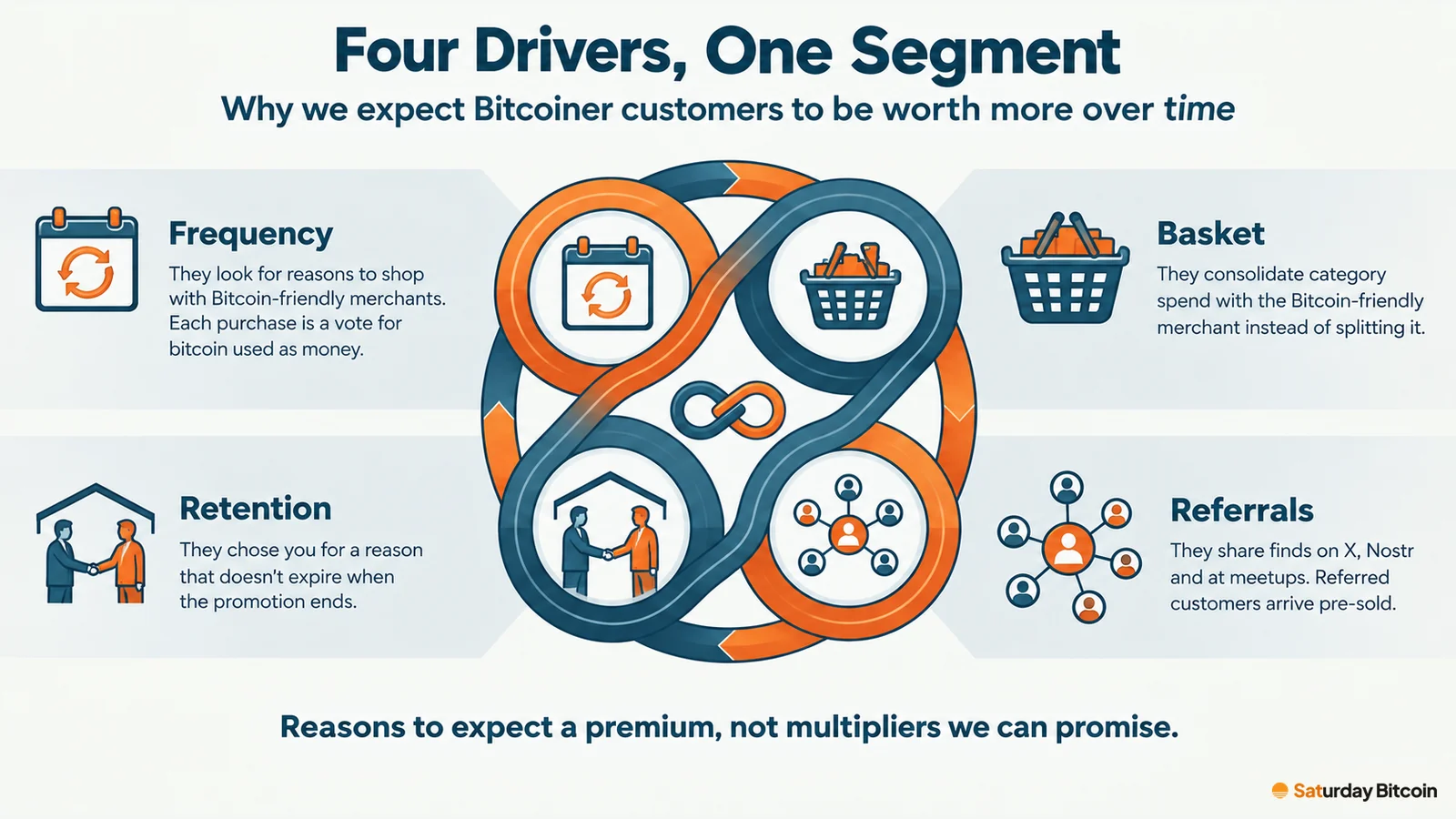
Frequency. Bitcoiners actively look for reasons to shop with Bitcoin-friendly merchants, sometimes going out of their way to do so. They see each purchase as a vote for the kind of commerce they want to see succeed: bitcoin used as money, not just held as an investment. They also want you to succeed.
Basket. Rather than splitting a category across several merchants, many Bitcoiners consolidate their category spend with the Bitcoin-friendly one. If you are the only Bitcoin-friendly wine merchant they know, more of their wine budget comes to you, and some may expand into adjacent products you carry. They are single-issue shoppers: on comparable products and prices, being Bitcoin-friendly decides the sale.
Retention. Bitcoiners aren’t shopping with you because you offered the best deal this week; they’re shopping with you because you’re Bitcoin-friendly. That reason doesn’t expire when the promotion ends. Bitcoiners also tend to remember who stepped forward first in a category, even after competitors follow.
Referrals. Bitcoiners congregate on X and Nostr, at local meetups and in tight online communities. When they find a Bitcoin-friendly merchant, many share it, sometimes posting the purchase itself, which almost no other customer group does. Recommending you isn’t just a favor to a friend; to them it advances bitcoin adoption. Referred customers arrive pre-sold by someone they trust.
Set aside your view of bitcoin; the customers are real: an estimated ~1 million committed, mission-driven Bitcoiners in the U.S., and growing, within the tens of millions of Americans who own some bitcoin. And the merchant bitcoin strategy works independently of bitcoin’s price, because it runs on identity, not on what the asset does next.
What’s proven, and what isn’t
Full transparency: higher lifetime value is a hypothesis we expect to hold, not a figure we can cite yet. We’d rather say that than publish numbers prematurely.
What supports it: observable community behavior, unusually high public engagement, and precedent from other mission-driven movements.
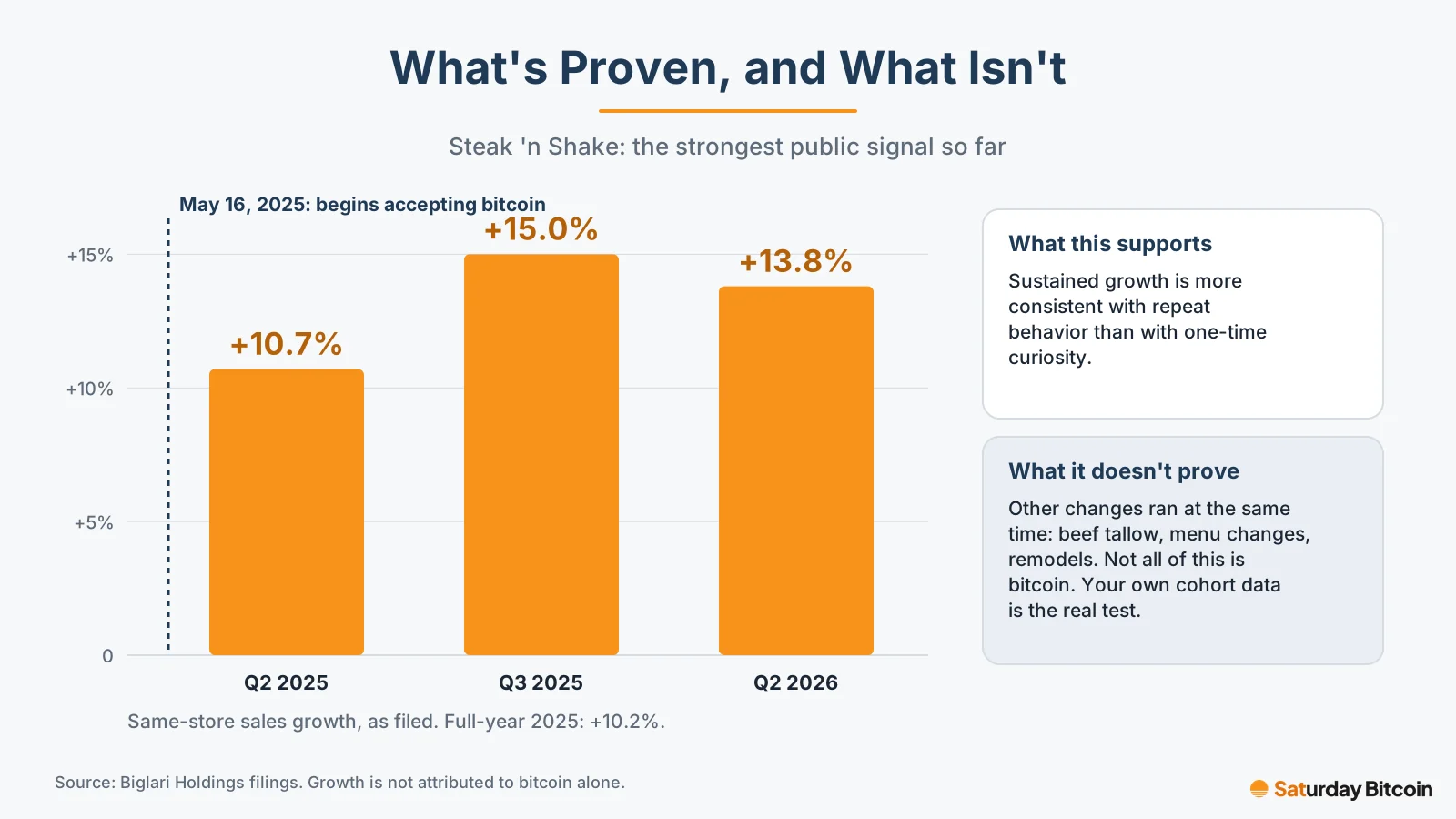
The strongest public signal so far is Steak ’n Shake. It began accepting bitcoin on May 16, 2025, and its filed same-store sales rose 10.7% in Q2 2025, 15.0% in Q3 2025 and 13.8% in Q2 2026. Other changes ran at the same time (beef tallow, menu changes tied to “Make America Healthy Again”, remodels), so not all of that is bitcoin. But sustained growth is more consistent with repeat behavior than with one-time curiosity. We cover it in detail in “A Fraction of the Segment: What Steak ’n Shake Proved About Bitcoiners”.
What we can’t tell you: Saturday Bitcoin is a discovery directory, not a payment processor, so we can’t see purchases. The proof of lifetime value will show up in your data. If you take part, compare your Bitcoiner customers’ repeat rate, order size and retention against your other cohorts over 12 months.
The honest diagnostic
This is not a universal retention fix. Retention problems fall into four types:
- Product-market fit. Customers leave because the product doesn’t deliver. Bitcoiners can’t help here. If the product isn’t right, no segment saves it. Fix the product first.
- Commoditization. Your product is indistinguishable from the next vendor’s. Identity is one of the few differentiators that can override product parity, so being Bitcoin-friendly can help meaningfully.
- Soft loyalty. Customers are satisfied but not committed. Satisfaction and loyalty aren’t the same thing (Jones and Sasser made this point in “Why Satisfied Customers Defect”, Harvard Business Review, 1995), and satisfied-but-unattached customers are a large hidden risk. An identity reason to stay is exactly what they lack.
- Acquisition cost. Retention is fine but acquisition keeps getting more expensive. Here, even modest retention gains improve payback, and Bitcoiners discovering you through a directory is a channel you aren’t paying an ad auction for.
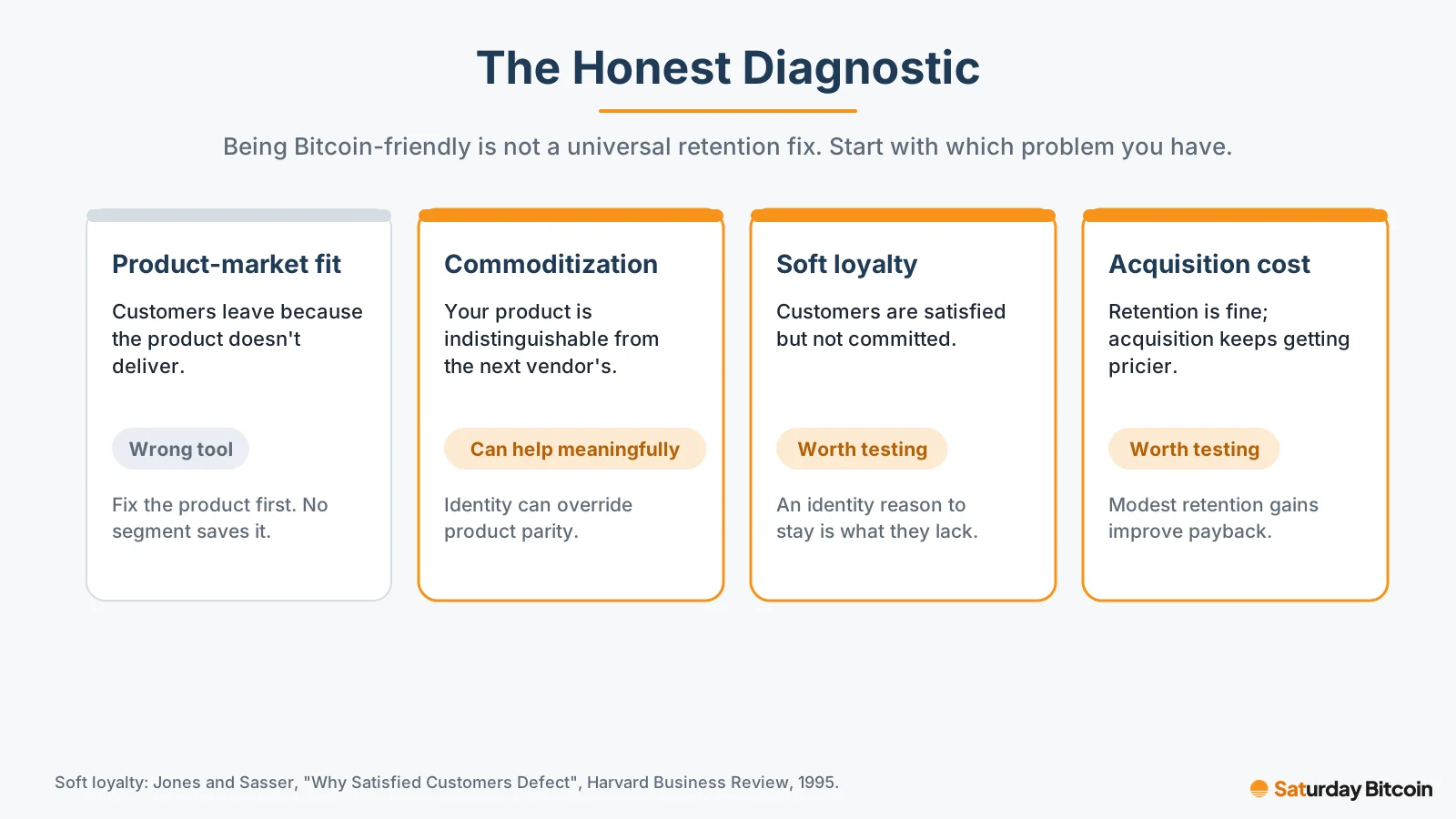
If your dynamic is mostly the first type, this is the wrong tool. If it’s the second, third or fourth, it’s worth testing.
Where it lands first
Retention-driven categories first. The highest-density opportunities are where the retention challenge is well documented and Bitcoiners are likely to overlap with your target customer:
- Beauty and personal care, where engagement is high but durable loyalty is hard to hold.
- Home and lifestyle, especially high-ticket brands where the gap between first and second purchase is long.
- Values-aligned apparel, where an additional shared value deepens an identity that already exists.
- Functional food and beverage, where repeat purchase is the whole business.
- Subscriptions, where cost-conscious consumers are pruning recurring expenses and an identity reason to stay beats a habit that’s being questioned.
These are illustrations. Any merchant whose retention problem is commoditization, soft loyalty or acquisition cost is a candidate.
What to do
Saturday Bitcoin helps Bitcoiners find merchants that already accept bitcoin, online and nearby. We make the introduction. When those customers pay in bitcoin, the sale lands on your cheapest rail: lower processing costs, final settlement, no chargebacks, and you decide refunds. Many Bitcoiners will still pay by card out of habit, for card rewards or for tax reasons. That customer still counts; the relationship is what you’re building.
A welcome offer is how you turn discovery into a first visit. It isn’t the loyalty mechanism; it’s the introduction. The identity relationship is what does the retaining.
Claim your free listing and add a welcome offer at saturdaybitcoin.com/business. Then watch the cohort. What sets you apart today will be expected of everyone in time.