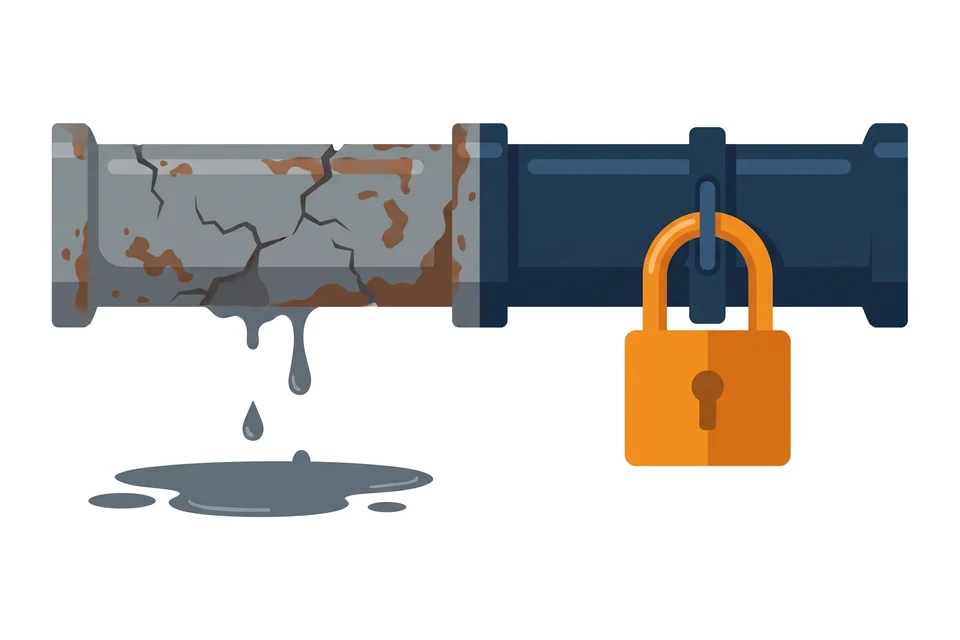


Most online merchants know their card processing rate, but few take a close look at it. It sits on the statement as a percentage of revenue, a couple of cents on the dollar, and it feels like the cost of doing business.
But revenue isn’t what keeps a business alive. Profit is. And if you already accept bitcoin, one of your payment rails costs a fraction of the others. This article is about that rail: what it costs, what finality changes, and why it matters most when your margins are thin.
What a card sale really costs
Online card payments average about 2.3% plus $0.25 per transaction on Visa, Mastercard and Discover, and about 3% plus $0.25 on Amex, based on 2026 network schedules and Helcim’s effective averages. In-store rates are lower. That is just the processing fee. On top of it comes the cost of fraud tools, the staff time spent on disputes, and the goods lost when a chargeback goes against you.
Every Bitcoiner who pays you in bitcoin is a sale with no card fee.
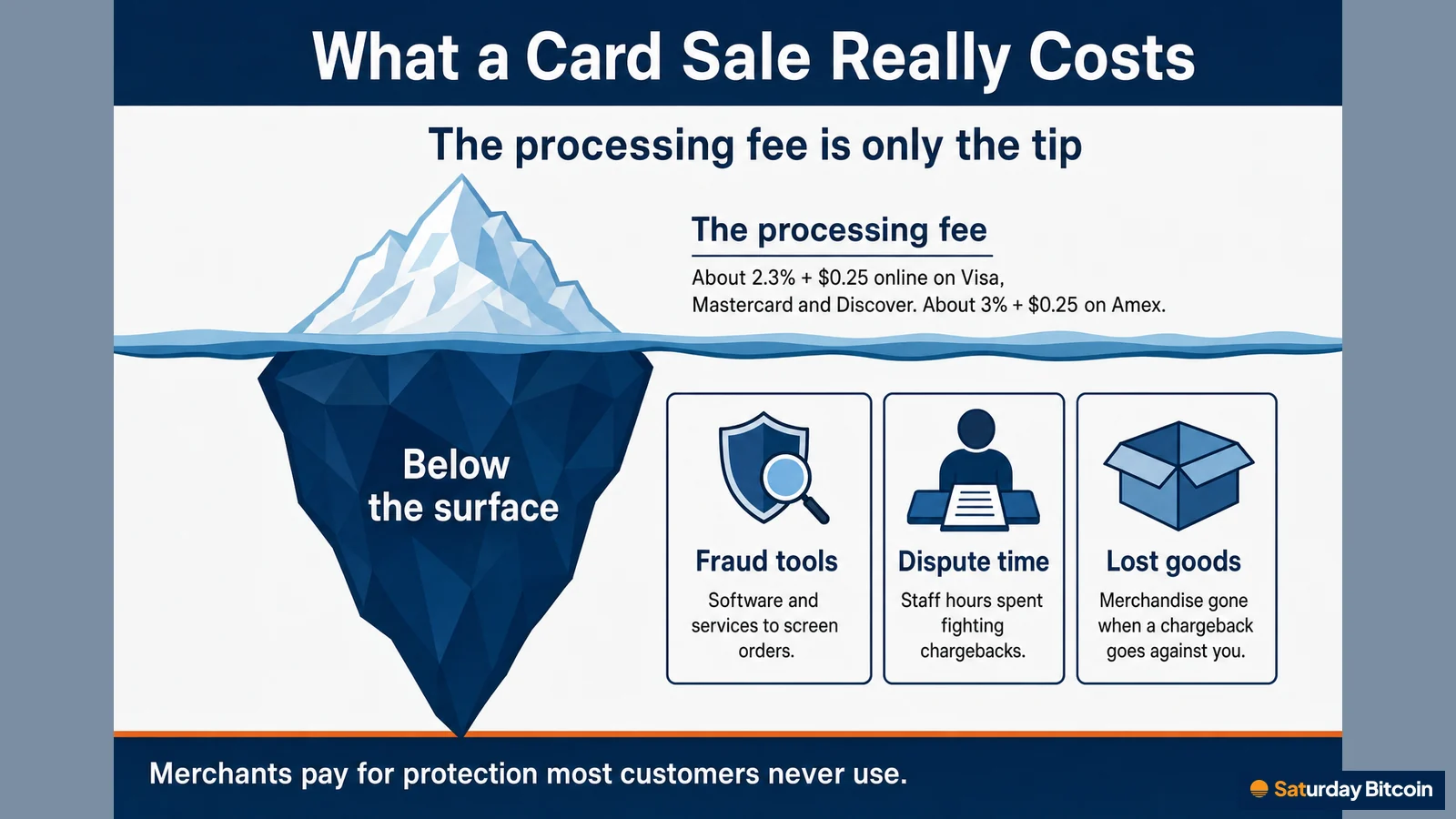
The fixed part of the fee hurts small orders most. On a $100 order, $0.25 barely registers. On a $25 basket it adds a full percentage point, taking the effective rate on that sale to about 3.3%. Coffee, consumables, everyday goods: the smaller the ticket, the bigger the share the card network takes.
Much of what that fee funds is protection. Interchange is justified by fraud guarantees, dispute resolution and purchase protection. But in most categories the great majority of transactions never touch any of it. Think of a grocery store you’ve used for ten years. You’ve paid by card every time and maybe never returned anything. If you did, the store simply refunded you, with no chargeback needed. The merchant paid for buyer insurance on every one of those purchases, and nobody used it. Merchants pay for protection most customers never use.
The apathy tax
Now take the fee as a share of profit instead of revenue. This is where thin-margin merchants should pay attention.
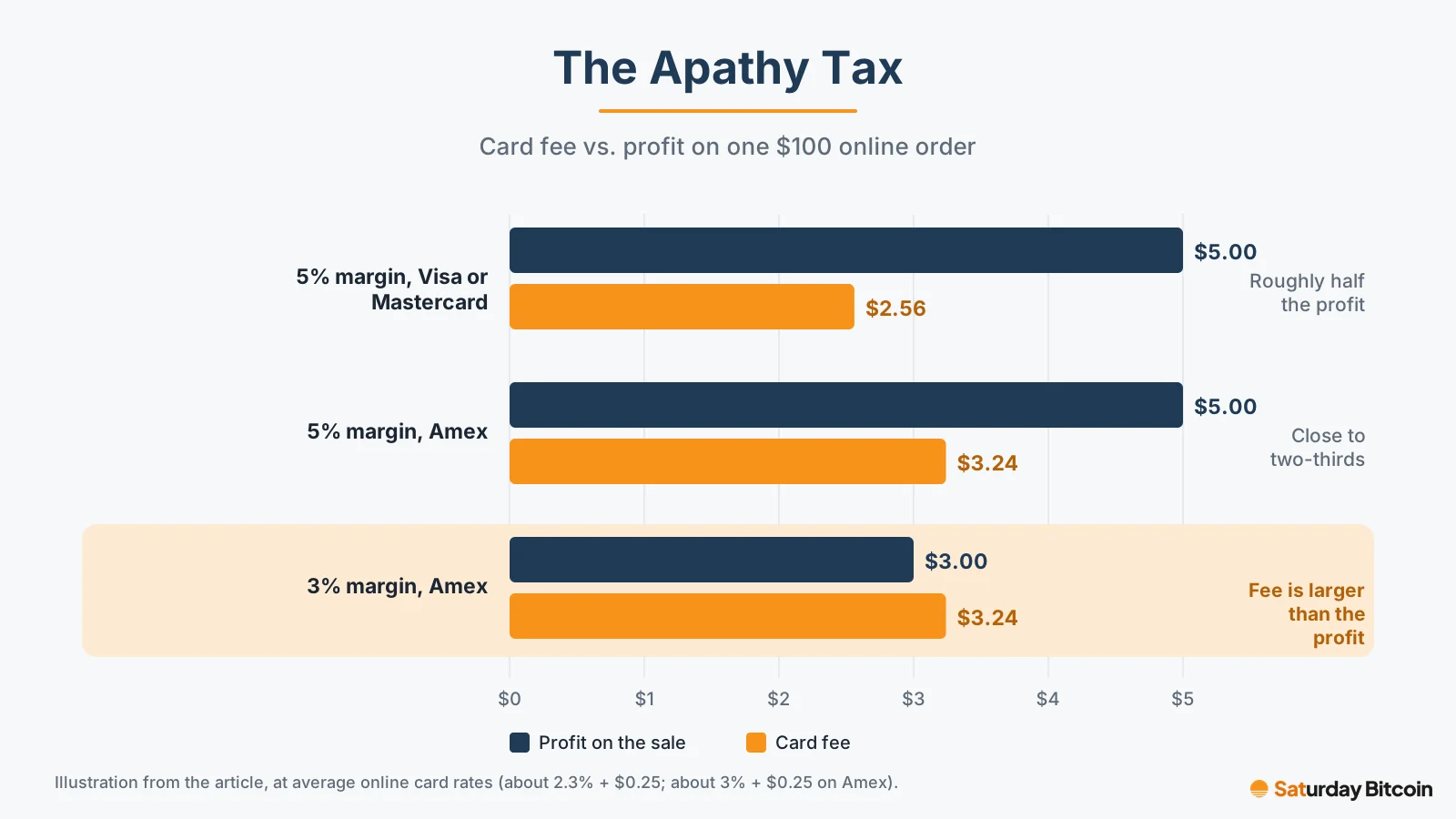
An illustration: a merchant sells $100 orders at a 5% net margin, so each order earns $5 of profit. A Visa or Mastercard sale at the average online rate costs about $2.56 in processing, which is roughly half the profit on that order. On Amex it’s about $3.24, close to two-thirds. At a 3% net margin on Amex, the card fee ($3.24) is larger than the merchant’s profit on the sale ($3.00).
I call this the apathy tax. Merchants aren’t apathetic about it; they know exactly what it costs. The tax persists because cards are the default plumbing of commerce and, until recently, there was no real alternative. In high-margin businesses the card fee is an annoyance. In thin-margin businesses it can decide whether the business is viable.
Your cheapest rail
If you accept bitcoin, you already run a different kind of rail, and its economics come from how it works, not from negotiation or scale.
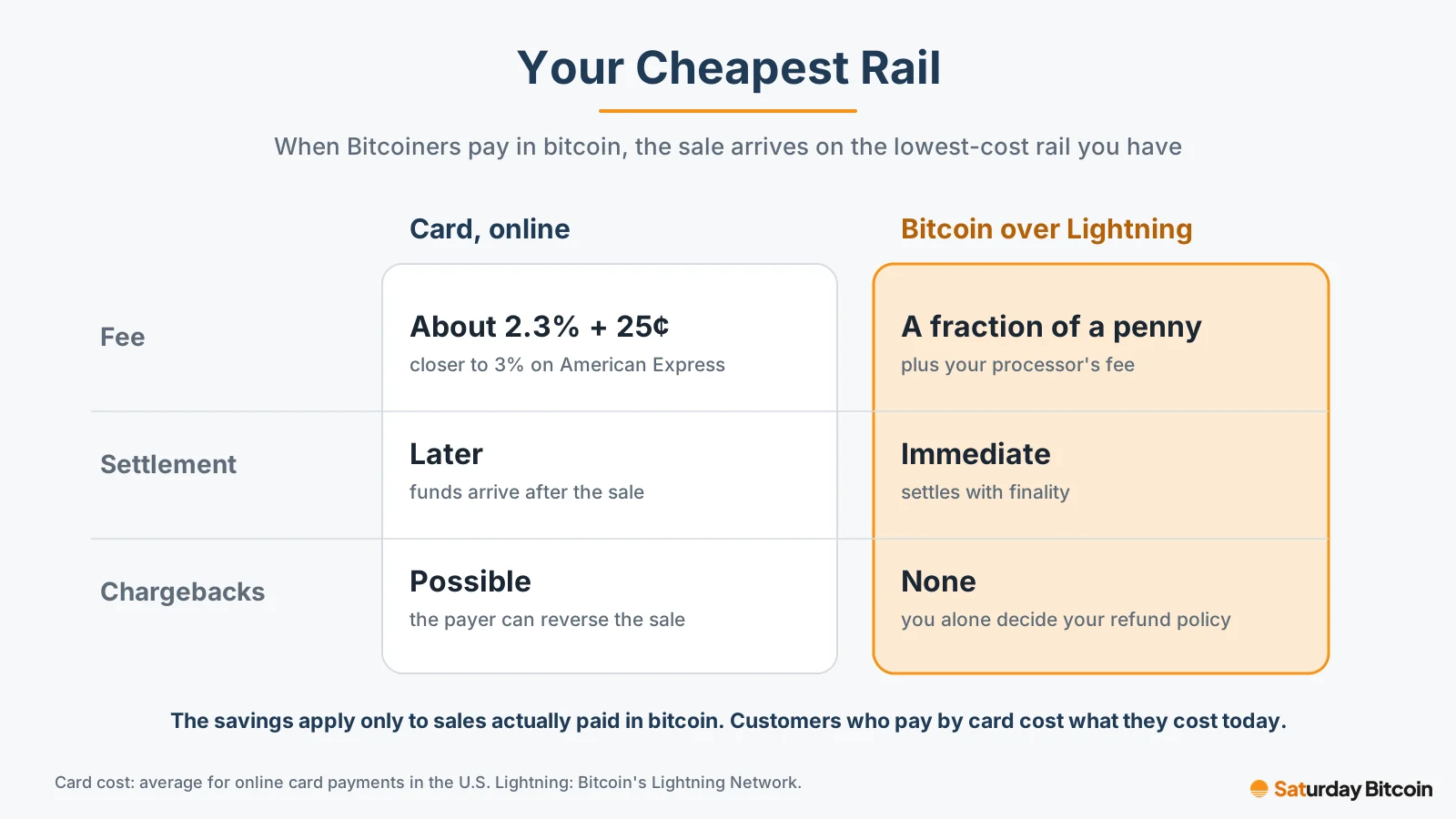
It costs less. Lightning network fees are typically a fraction of a cent. Your payment processor may add its own fee, often around 1%. All in, a bitcoin payment typically costs well below what a card costs you.
It’s final. Bitcoin is a push payment: the customer sends it to you, and you don’t pull it from an account an intermediary controls. Once it settles, it’s settled. There are no chargebacks, and no stolen card numbers to be used against you. It works like receiving cash, but it works online and nobody can skim the till.
You decide refunds. If chargebacks don’t exist, what happens when a customer wants a return? You handle it exactly as you do today, under your own stated policy. The difference is that you control the process. No third party can reverse a sale you consider valid or charge you a fee for second-guessing you. That’s how commerce worked before cards created a parallel dispute system, one that, as most merchants know, usually sides with the cardholder.
You don’t need a view on bitcoin’s price for any of this to hold. The rail’s economics, like the merchant bitcoin strategy as a whole, work independently of bitcoin’s price. You can convert what you receive to dollars or keep some. That’s your call.
The evidence that this matters at scale is public. Steak ’n Shake, which began accepting bitcoin in May 2025, has said that when a customer pays in bitcoin rather than by credit card, it saves about 50% on processing fees. (For what its results do and don’t show, see A Fraction of the Segment: What Steak ’n Shake Proved About Bitcoiners.)
Where it matters most
Every bitcoin sale is cheaper to accept. Some merchants feel that more than others:
- Thin-margin categories such as consumer electronics, household consumables and general merchandise, where a point or two of fees is a large share of profit.
- Small-ticket, high-frequency sellers, where the fixed per-transaction fee inflates the effective rate on every order.
- High-fraud or high-dispute categories such as digital goods, high-ticket items and international sales, where fraud losses and prevention costs run high and final settlement removes a real risk.
- Merchants under processor scrutiny for their dispute rates.
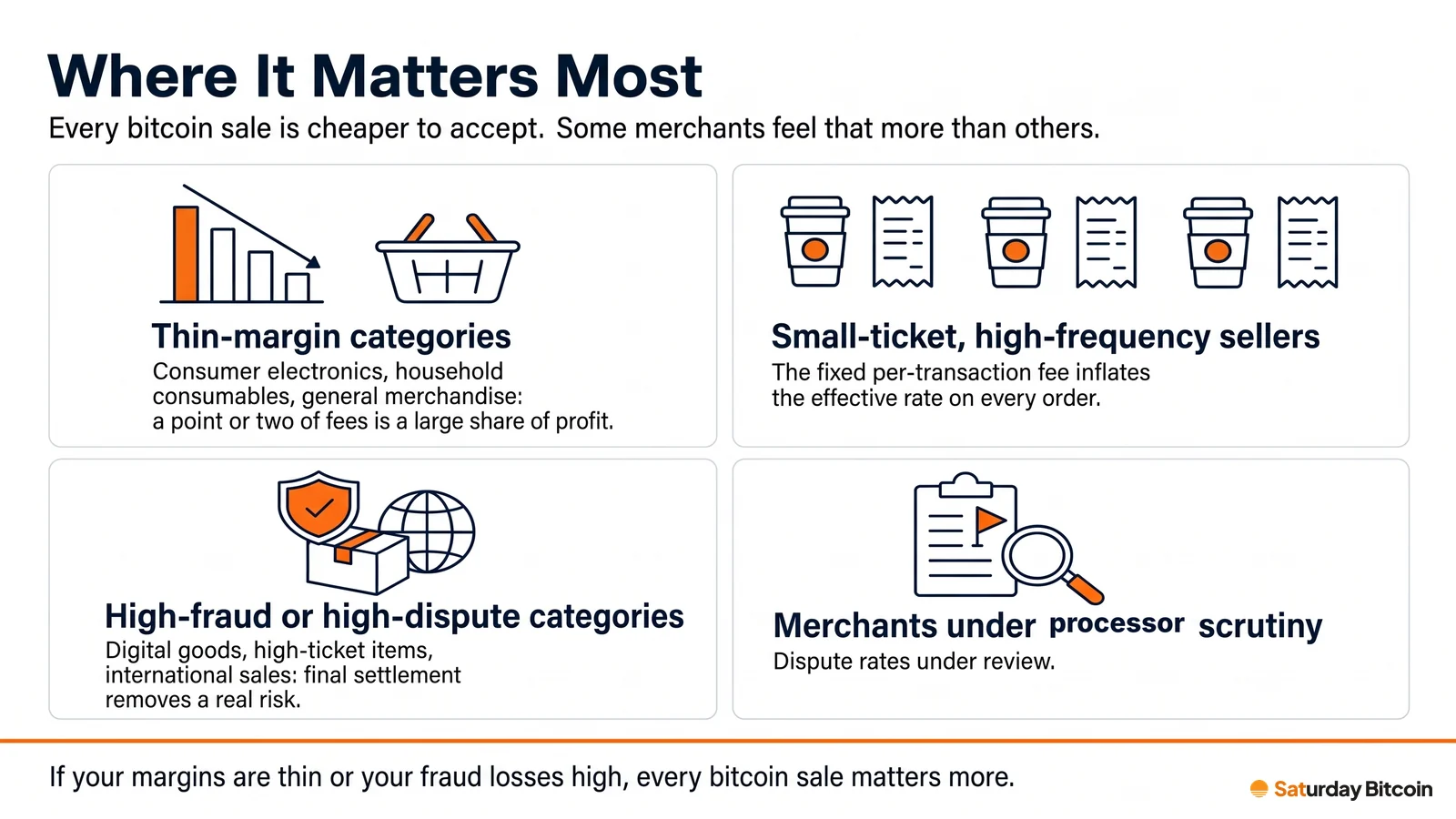
If your margins are thin or your fraud losses high, every bitcoin sale matters more.
The honest math
The savings apply only to sales actually paid in bitcoin, so the size of the prize depends on how much of your volume moves to that rail.
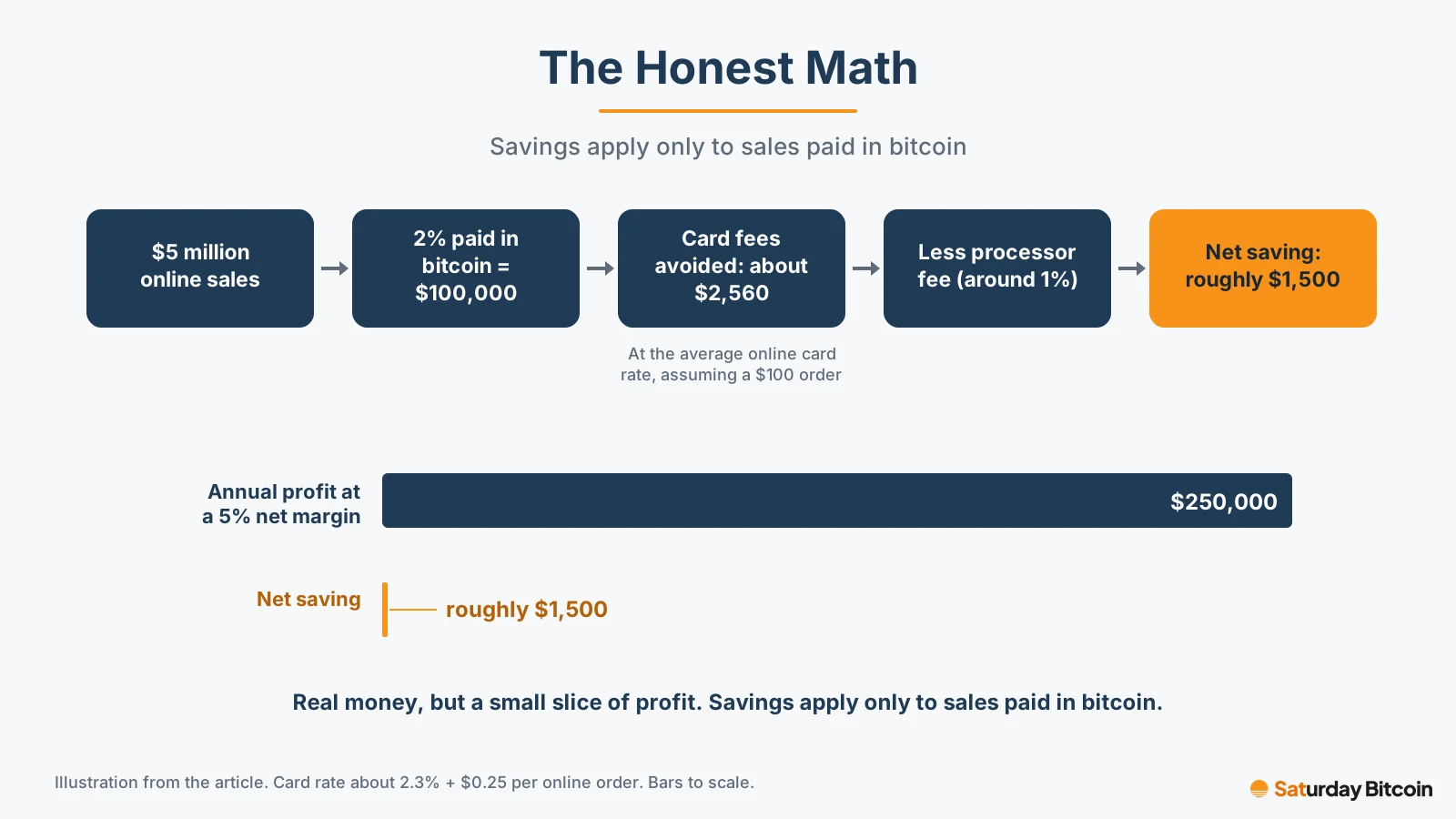
An illustration: a $5 million online merchant at a 5% net margin earns $250,000 a year. If 2% of its sales were paid in bitcoin, that’s $100,000 of volume. At the average online card rate (assuming a $100 order) the card fees avoided would be about $2,560. Against a processor fee of around 1%, the net saving is roughly $1,500. That’s real money, but it’s a small slice of profit. Anyone who quotes you a 50-70% jump in net profit is assuming every sale moves to bitcoin. That won’t happen.
There’s a second honest limit. Many Bitcoiners still pay by card, out of habit, to keep card rewards, to avoid the tax paperwork of spending bitcoin, or sometimes on principle. That customer is still a win. They chose you because you’re Bitcoin-friendly, and the sale is yours either way.
So the cheaper rail isn’t the main reason to be Bitcoin-friendly. Access to the customer is. The payment economics are the icing: an obvious, easily understood benefit on the sales where it applies, and it grows as more of your customers pay in bitcoin.
Where Saturday Bitcoin fits
Saturday Bitcoin is a discovery directory. It helps Bitcoiners find merchants that already accept bitcoin, online and nearby. We are not a payment processor, and we can’t see your sales. What we can do is put you in front of the customers most likely to use your cheapest rail.
Many of them will be net-new to you: people who weren’t shopping with you and are now looking for a Bitcoin-friendly option in your category. Much of that business is likely incremental. When they pay in bitcoin, it costs you very little to accept.
We bring you the customer. When they pay in bitcoin, they arrive on your cheapest rail. Every Bitcoiner who pays you in bitcoin is a sale with no card fee.
What to do next
If you already accept bitcoin, make sure Bitcoiners can find you. Claim your free listing at saturdaybitcoin.com/business. Verify that you accept bitcoin, tell Bitcoiners how to pay you, and add a welcome offer if you want to give them a reason to try you first. It’s free, it takes minutes, and you can change it any time.