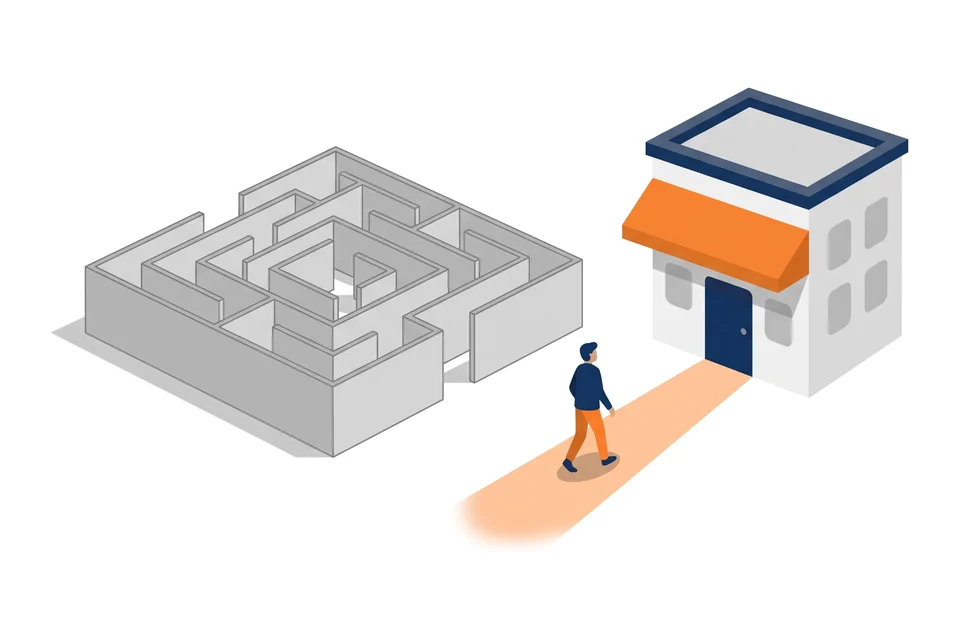


Some markets have a differentiation problem that no amount of marketing can solve, because the products themselves are converging. A Bosch alternator is a Bosch alternator, whether you buy it from a specialist, a big-box chain or Amazon. A 500mg vitamin C capsule is a 500mg vitamin C capsule, whatever the label says. A memory foam mattress with a 10-year warranty and a 100-night trial is exactly what dozens of other brands also offer.
When products look interchangeable, merchants are forced to compete on the only dimension that remains: price. And price competition is a trap. It compresses margins, teaches customers to wait for the next sale, and puts you on a treadmill where the only way to hold volume is to cut deeper.
This piece is about a way out: a competitive lever that has nothing to do with product features or price.
If price is your only lever, add one your competitors don’t have.
A sea of sameness
Products become the same through standardization, price transparency, or both. Then the shopper’s question shifts from “who has the best product?” to “who has the lowest price?” Three categories show it clearly.
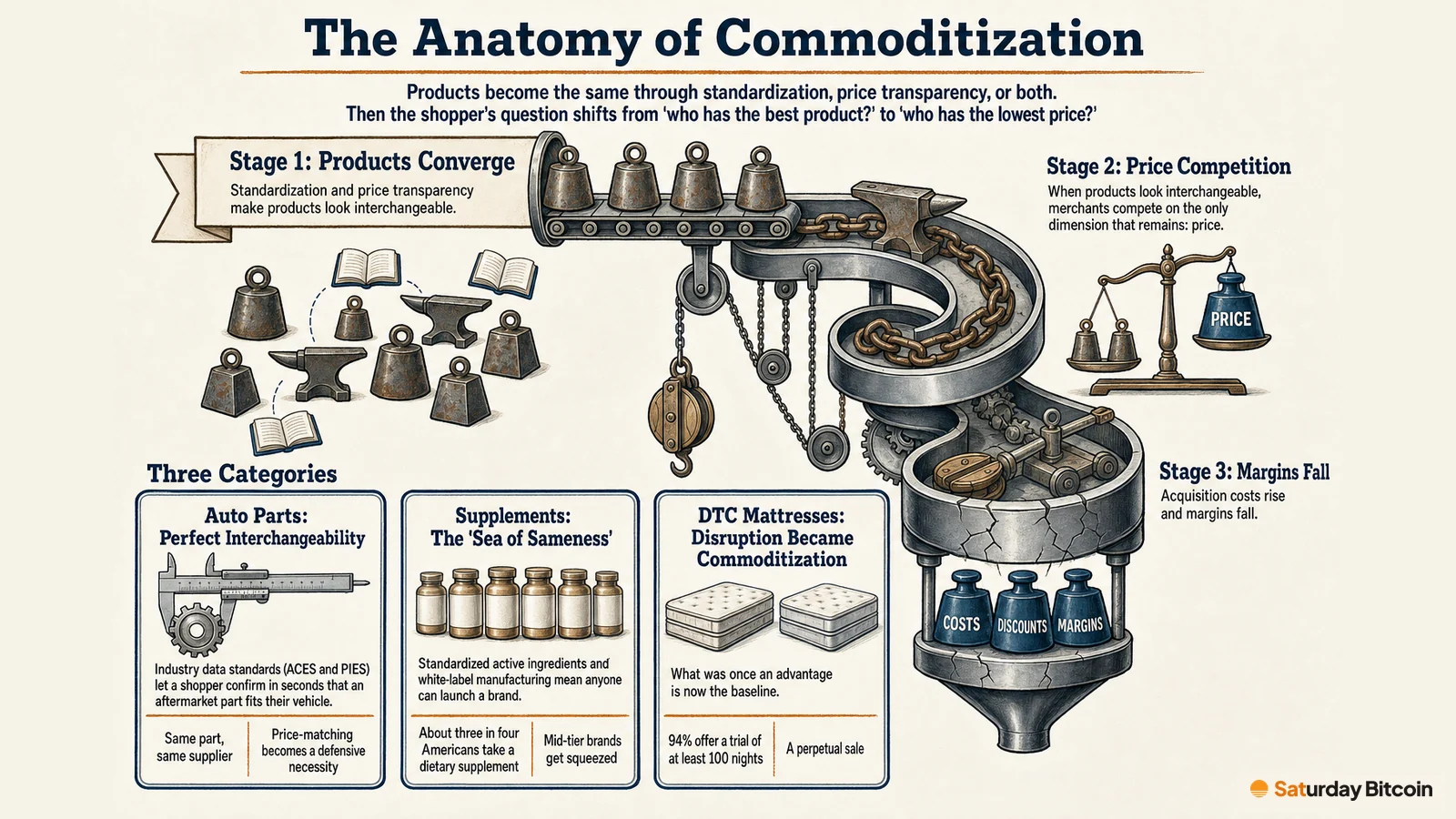
Auto parts: perfect interchangeability. Industry data standards (ACES and PIES) let a shopper confirm in seconds that an aftermarket part fits their vehicle. Often it is the same part, from the same supplier, that the carmaker uses. When the part is identical everywhere, any price premium evaporates, and price-matching becomes a defensive necessity. Even the online leaders feel the squeeze. CarParts.com reported an adjusted EBITDA loss of $3.1 million for Q2 2025, with operating expenses at about 41% of net sales.
Supplements: the “sea of sameness.” Demand is mainstream: about three in four Americans take a dietary supplement. But active ingredients are standardized, formulations are easy to copy, and white-label manufacturing means anyone can launch a brand. Mid-tier brands get squeezed between premium names with a story and scale players with a price.
DTC mattresses: when disruption becomes commoditization. Mattress-in-a-box started as a story about being different and ended in product parity. One independent testing site has reviewed about 290 mattresses. 94% of them come with a trial of at least 100 nights, and about half carry a 10-year warranty. What was once an advantage is now the baseline, and the category runs on what amounts to a perpetual sale.
The pattern is the same in all three. Products converge, so merchants compete on price, so acquisition costs rise and margins fall. Interchangeable products need a reason to choose that isn’t the product.
Your competitors use the same toolkit you do
Merchants in these categories aren’t passive. They’ve tried everything the playbook offers. The problem is that everyone has the same playbook:
- The same marketing platforms: Google, Meta, programmatic networks, affiliates.
- The same loyalty infrastructure: points programs, subscribe-and-save, card-linked offers.
- The same data: behavioral targeting, attribution modeling.
- The same optimization: A/B testing, incrementality measurement, return on ad spend.
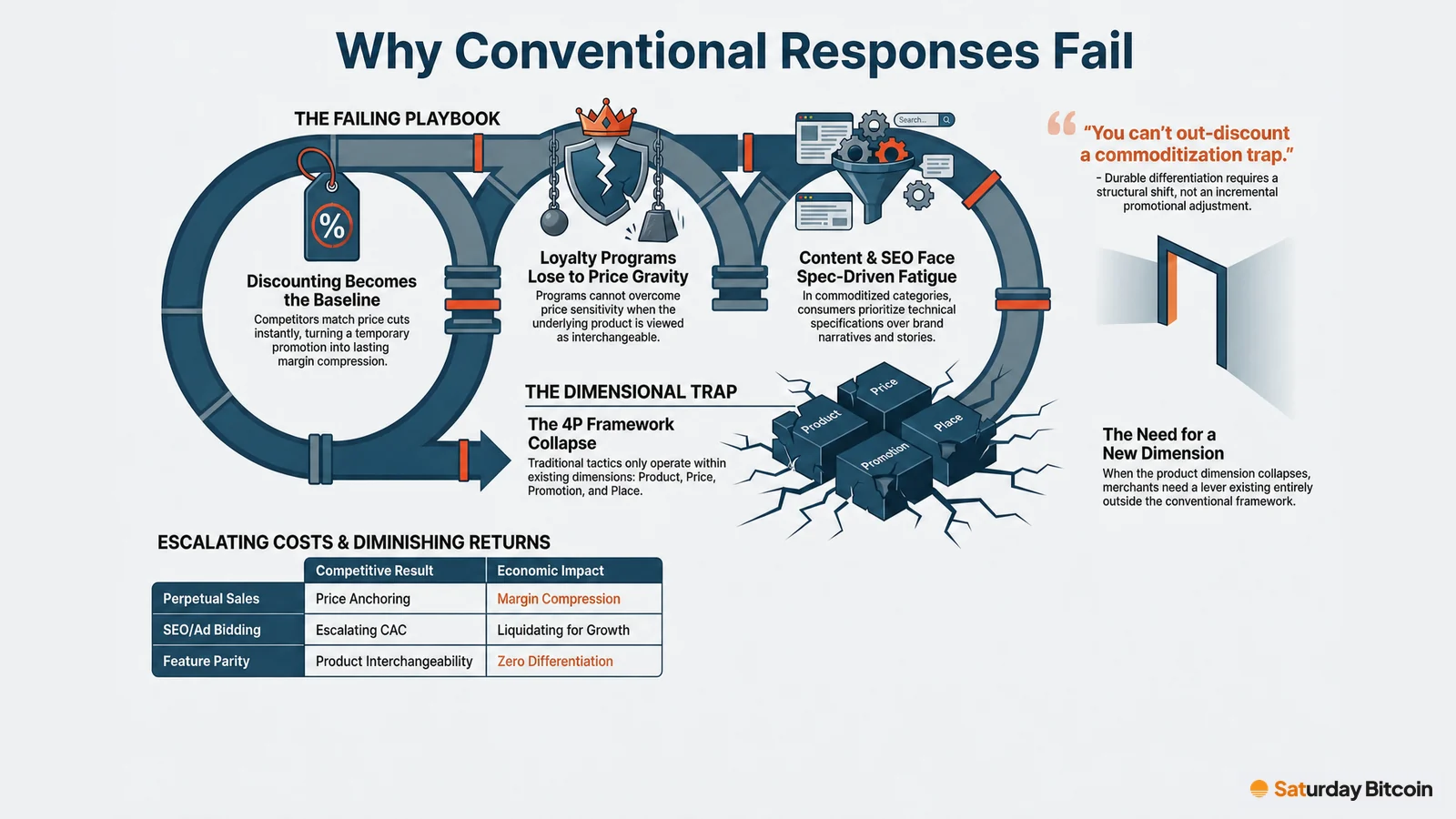
When everyone has the same tools, the advantage goes to the biggest budget and the deepest discount, and the customer is won only temporarily. Discounts become the baseline, and every competitor can match a cut instantly. Loyalty programs struggle against the pull of price, because in commoditized markets the brand is often the least significant factor in the purchase.
That’s why nothing sticks. These programs build rented loyalty: repeat purchases that last only as long as the incentive does. When the product dimension has collapsed and price is the only lever left, you need one that sits outside that framework entirely.
If price is your only lever, add one your competitors don’t have
There is a customer segment that chooses merchants on a criterion most merchants have never considered: whether the merchant is Bitcoin-friendly.
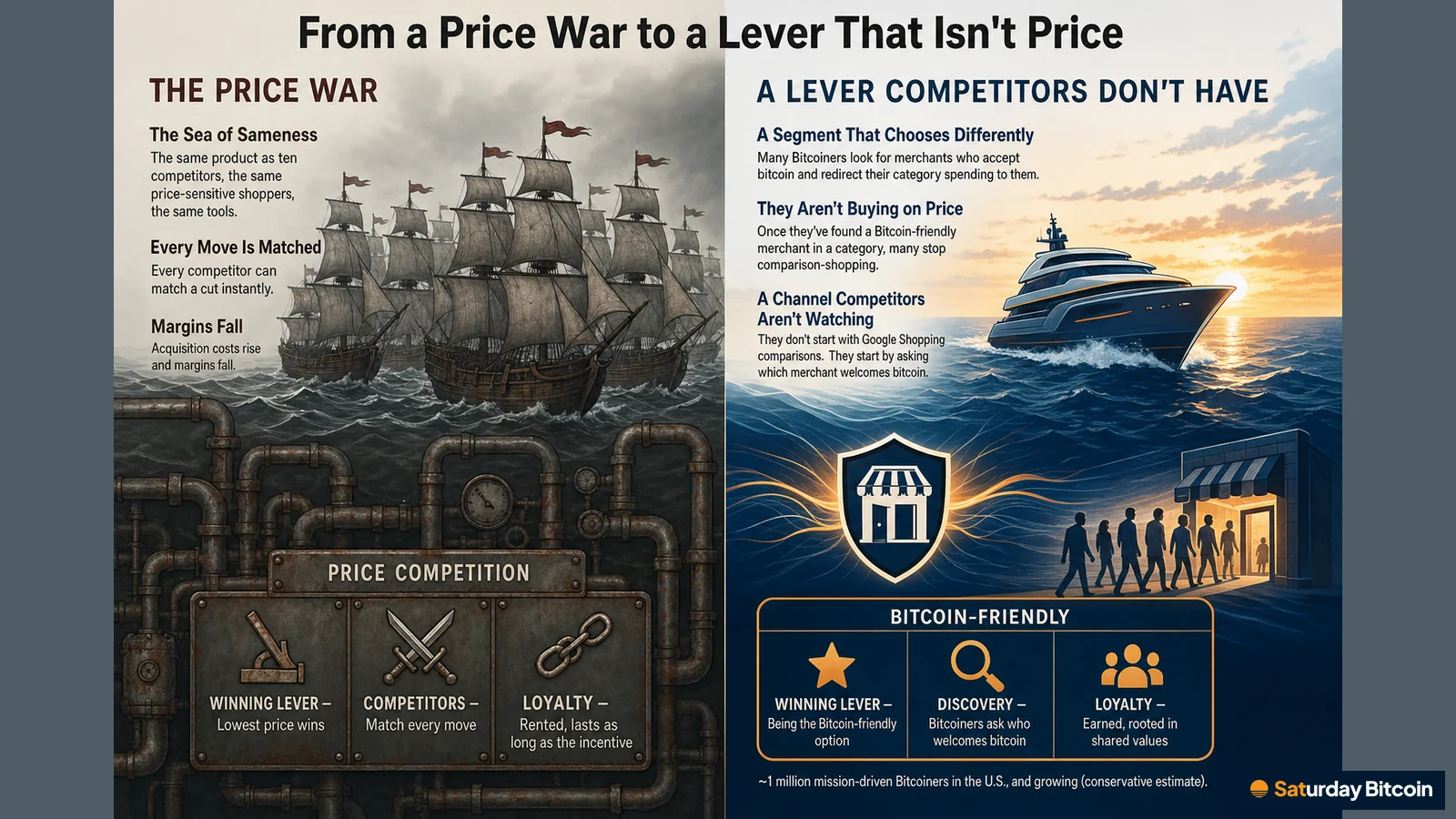
Tens of millions of Americans own some bitcoin. Inside that group is a smaller, committed core: an estimated ~1 million mission-driven Bitcoiners in the U.S., and growing. That is a conservative estimate; no direct survey exists. Many of them actively look for merchants who accept bitcoin, and redirect their category spending to them wherever they can. They behave like single-issue shoppers: once a Bitcoin-friendly option exists in a category, that’s where many of them go first.
For a merchant selling the same product as ten competitors, that changes the equation.
- They aren’t buying on price. Once a Bitcoiner has found a Bitcoin-friendly merchant in a category, many stop comparison-shopping. They’ve found their merchant. The product is the same everywhere; you’re the one aligned with how they want to take part in the economy.
- They come through a channel your competitors aren’t watching. They don’t start with Google Shopping comparisons or affiliate reviews. They start by asking which merchant welcomes bitcoin.
Irrespective of what you think about bitcoin, the customer segment is real. And the merchant bitcoin strategy works independently of bitcoin’s price.
A differentiation no coupon can match
A competitor can match your discount overnight. They can’t match the allegiance of a segment that chose you for reasons that have nothing to do with a temporary offer. You can match a price. You can’t match an identity.
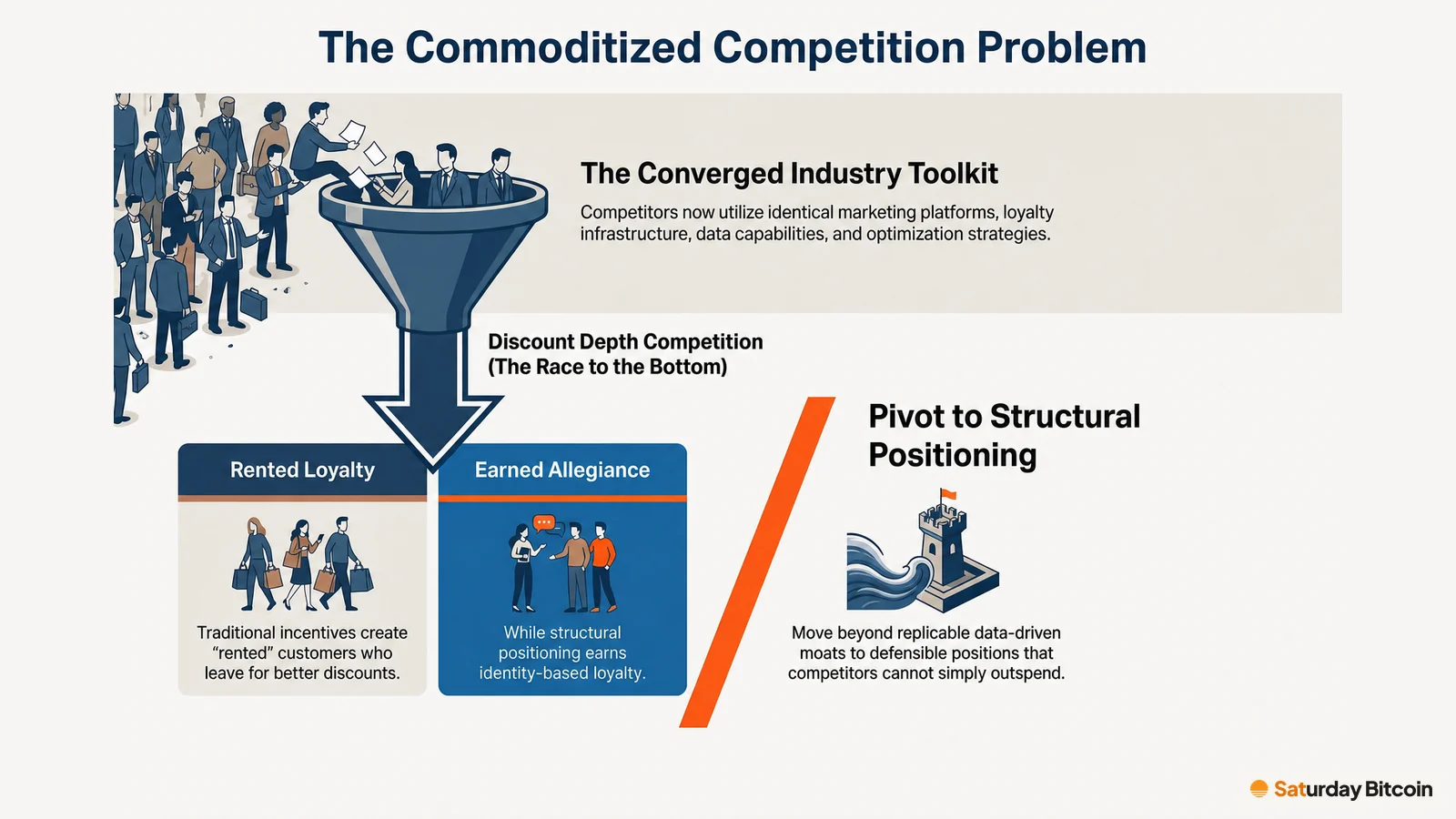
This is the difference between a moat built from data and one built from positioning. Data advantages can be copied by a well-funded rival, and staying ahead takes ongoing spend. Positioning works differently. Bitcoiner allegiance is earned, not rented. It’s rooted in identity and shared values, so it doesn’t need constant reinforcement, and a rival can’t simply outbid it.
That makes it durable rather than promotional. It doesn’t change your public price or your mainstream positioning. It adds one more reason to choose you.
A leapfrog moment for challengers
With most marketing innovations, being first is a short-lived edge. Here, being first in your category counts for more.
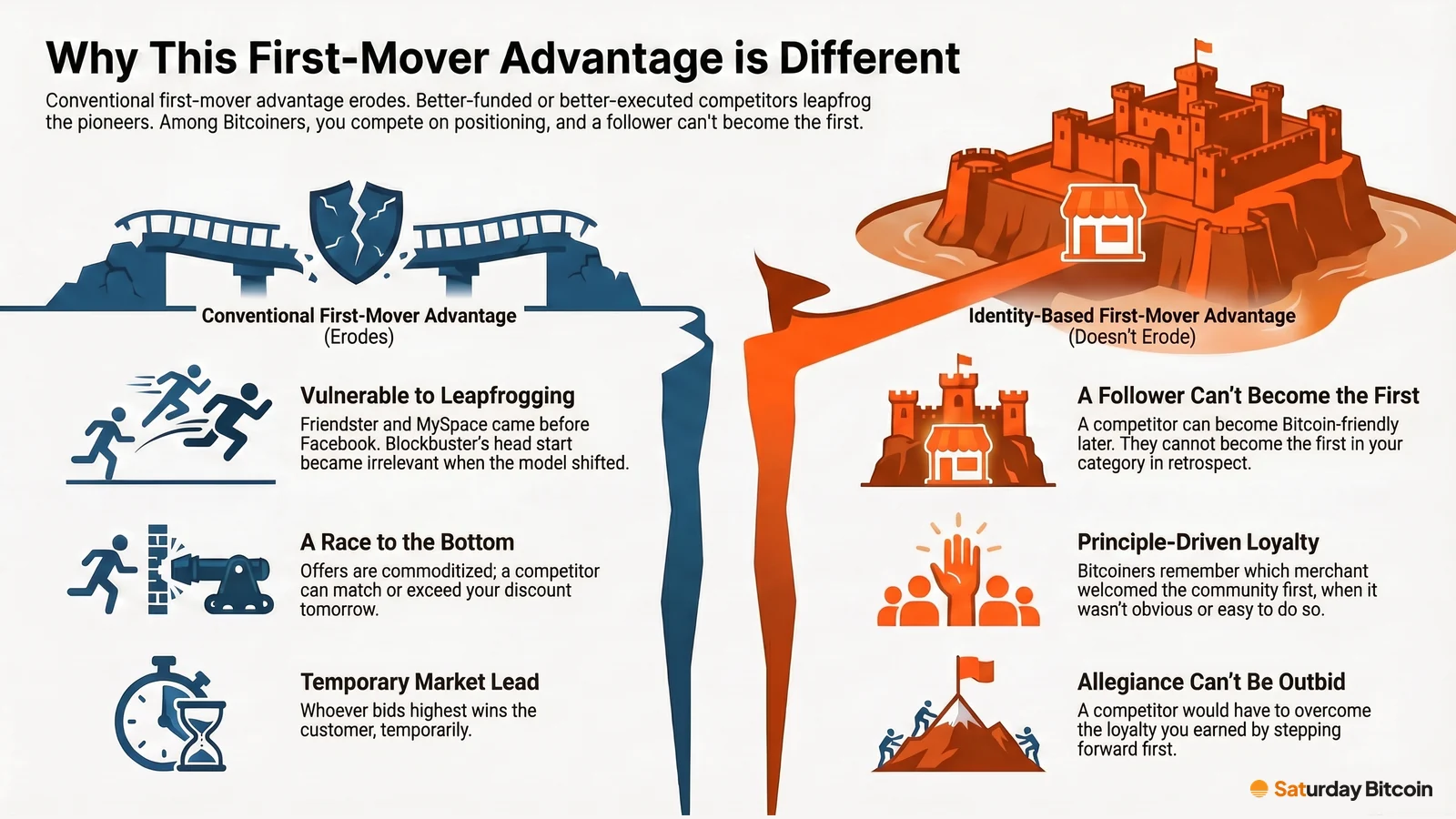
Bitcoiners look for a Bitcoin-friendly option in each category. Where none exists yet, the first credible merchant to step forward becomes the obvious answer. Some competitors will follow. When they do, they’re trying to win back customers who have already moved their category spending to you, and who tend to remember who stepped forward first. A follower can reach the same customers. It doesn’t automatically get the relationship.
That makes this a leapfrog moment for challengers: the mid-tier supplement brand squeezed between premium and private label, the independent parts retailer matching Amazon’s price, the mattress brand that looks like forty others. None of them can outspend the category leader. All of them can move first.
Category consolidation is underway. Being Bitcoin-friendly sets a challenger apart now; it won’t stay rare forever.
What this is, and what it isn’t
Be clear-eyed about the limits. The committed Bitcoiner segment is small next to your whole market. It adds customers; it doesn’t replace your business, and being easy to find doesn’t guarantee volume. Being Bitcoin-friendly decides the choice between comparable options. It won’t rescue a clearly worse one. In a commoditized category, though, being comparable is your starting position.
Not every Bitcoiner will pay in bitcoin, either. Many still pay by card: out of habit, for rewards, because of tax friction, or to support the merchant on principle. That customer still chose you. On sales paid in bitcoin, the channel you already run brings lower processing costs, final settlement, no chargebacks; you decide refunds.
Where Saturday Bitcoin fits
Saturday Bitcoin is a free directory that helps Bitcoiners find merchants that already accept bitcoin, online and nearby, with tens of thousands of places listed. It isn’t a payment processor, and it can’t see your sales.
If you already accept bitcoin, you can claim and verify your listing for free, add a welcome offer or promo code for Bitcoiners, and get featured in your category. If you don’t accept bitcoin yet, that’s the first step; Accepting Bitcoin Isn’t Enough covers what comes after.
Our part is helping these customers find you. When they pay in bitcoin, the sale lands on your cheapest rail.
What to do now
If you sell what your competitors sell, you don’t need a better product or a lower price to win this customer. You need a reason for them to choose you that sits outside the price war.
Claim your free listing at saturdaybitcoin.com/business. It’s free, it takes little effort, it’s reversible, and the upside is real. Then add a welcome offer, as a thank-you to the Bitcoiners in your category rather than the reason they come.