


If you sell a digital product, such as software, a VPN, an online course, a newsletter or an AI tool, your gross margins are among the best in commerce. Once the product is built, serving one more customer costs almost nothing.
And yet when every competitor has the same favorable margins, everyone can afford to spend heavily on acquisition, and they do. The result is an arms race: rising ad costs, affiliate bidding wars, and constant pressure to discount.
This piece makes three points. Discounting is the wrong answer. Bitcoiners are already drawn to exactly these categories. And when every product is good, loyalty has to come from somewhere other than features.
Discounts buy the wrong customers and train them to wait.
The discounting trap
Visit any VPN comparison site and you’ll find a wall of promotions. Two-year plans are advertised at $2-4 a month, and seasonal sales promise 70% off or more. These aren’t occasional promotions; they are the normal state of the market. Course marketplaces push creators into the same pattern of seasonal sales, bundles and launch discounts.
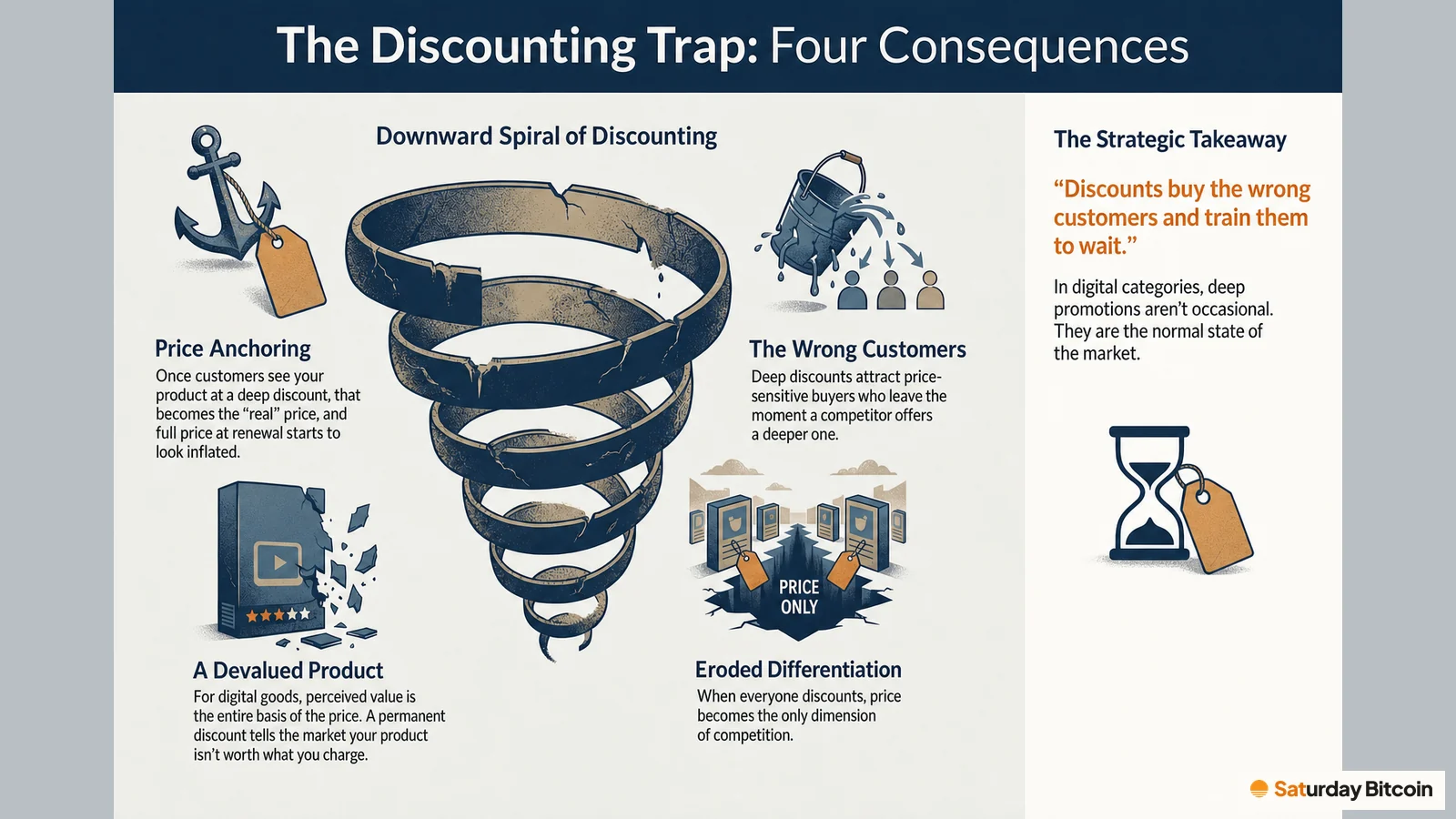
The consequences are well understood by the merchants caught in it:
- Price anchoring. Once customers see your product at 70% off, that becomes the “real” price in their minds, and full price at renewal starts to look inflated.
- The wrong customers. Deep discounts attract price-sensitive buyers who leave the moment a competitor offers a deeper one.
- A devalued product. For digital goods, perceived value is the entire basis of the price. A permanent discount tells the market your product isn’t worth what you charge.
- Eroded differentiation. When everyone discounts, price becomes the only dimension of competition, and genuine differentiation disappears.
Put simply, discounts buy the wrong customers and train them to wait.
The industry’s best lever for annual is a discount, and it barely works
Every subscription business knows that annual billing is more valuable than monthly: cash up front, faster payback on acquisition cost, predictable revenue, and better retention. Annual subscribers stay better through their first year than monthly subscribers.
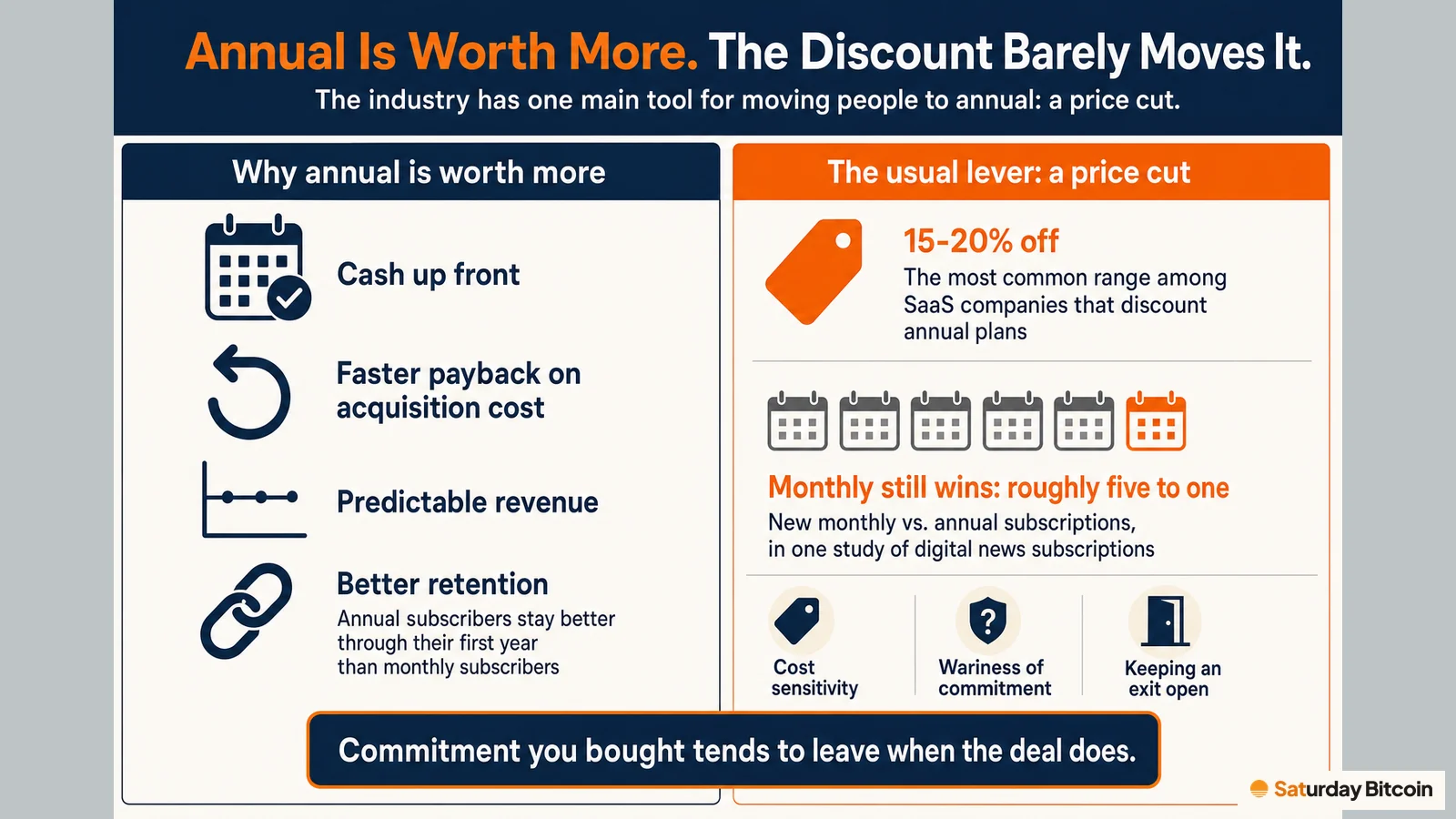
The industry has one main tool for moving people to annual: a price cut. Among SaaS companies that discount annual plans, 15-20% off is the most common range. Even so, monthly still wins by a wide margin. In one study of digital news subscriptions, new monthly subscriptions outnumbered annual ones roughly five to one. A discount is an economic lever pushing against deep consumer habits: cost sensitivity, wariness of commitment, and a preference for keeping an exit open.
It also has a cost of its own. A subscriber who committed for the discount is still a discount customer, and the first renewal date is when you find out. Commitment you bought tends to leave when the deal does.
When every product is good, loyalty has to come from somewhere else
Consumer AI shows this problem in its most extreme form. The leading models have converged toward parity on the tasks most people actually use them for, and leads change hands from one release to the next. Switching costs are close to zero: outputs are portable, no files are stranded, and moving provider means opening a different app. Many users pay for more than one tool at once and move between them as the leaderboard shifts.
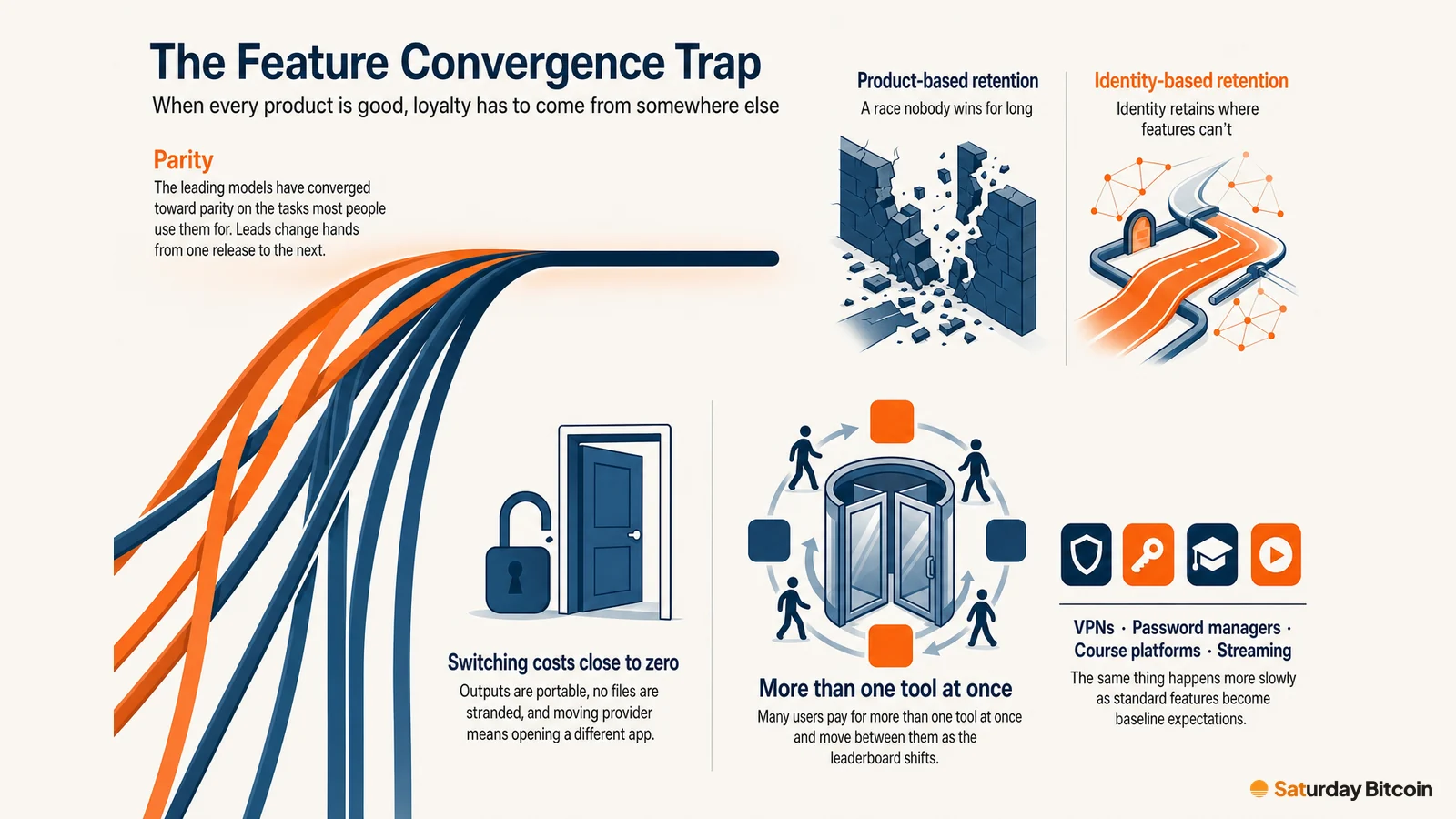
This is the feature convergence trap: retention that depends on staying ahead of your nearest competitor is a race nobody wins for long. The same thing happens more slowly across VPNs, password managers, course platforms and streaming, as standard features become baseline expectations.
So retention has to come from something that isn’t a feature. Identity retains where features can’t.
The Bitcoiner’s natural categories
This is where the Bitcoiner comes in. Whatever your view of bitcoin, the segment is real: an estimated ~1 million committed, mission-driven Bitcoiners in the U.S., and growing, inside a much broader population of tens of millions of Americans who own some bitcoin.
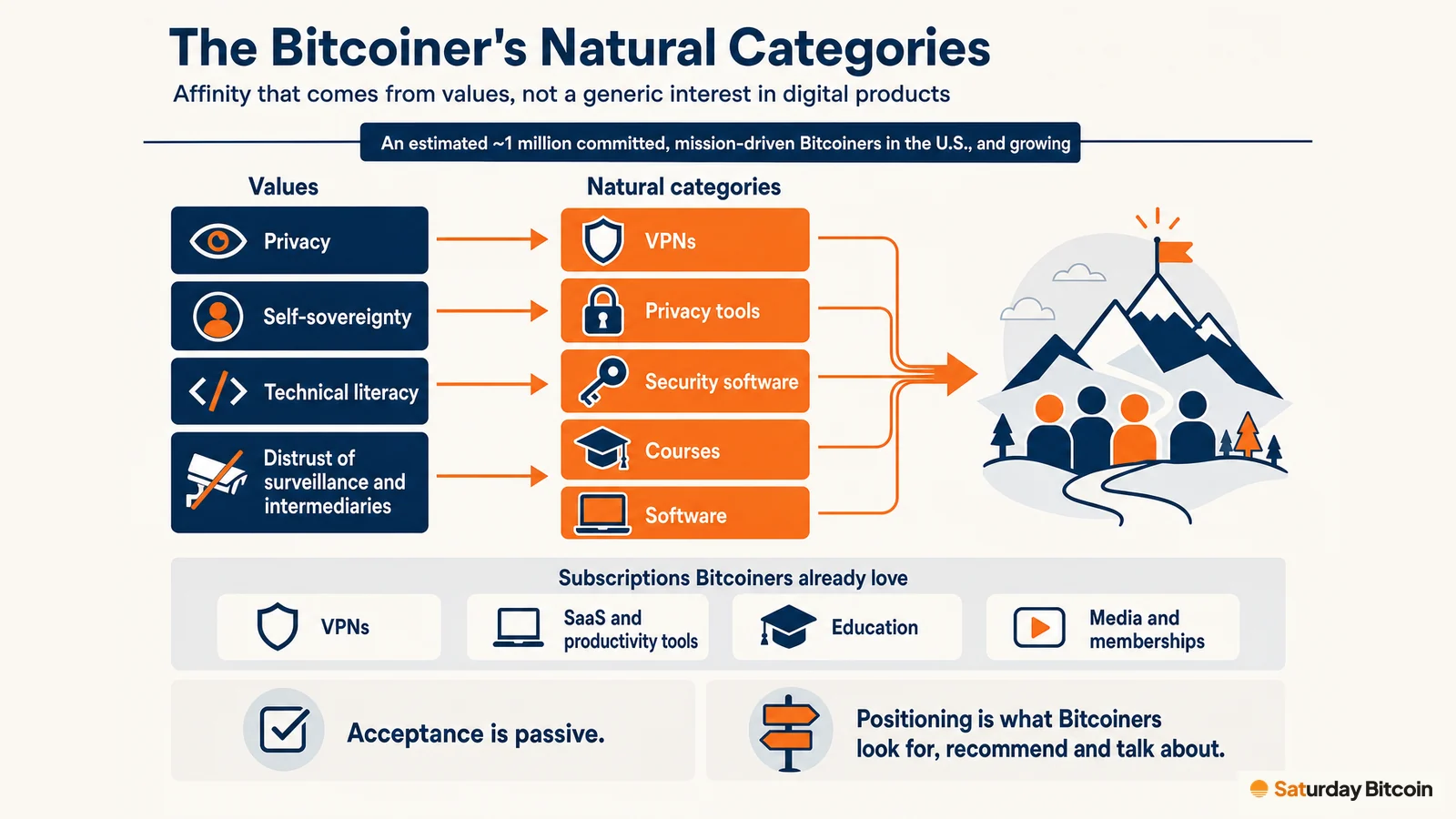
Bitcoiners aren’t a generic consumer group with a generic interest in digital products. Their affinity for these categories comes from their values: privacy, self-sovereignty, technical literacy, and distrust of surveillance and intermediaries. VPNs, privacy tools, security software, courses and software are the Bitcoiner’s natural categories. Their subscription habits follow the same pattern. VPNs, SaaS and productivity tools, education, media and memberships are subscriptions Bitcoiners already love.
Some privacy companies have noticed. Several VPNs, Mullvad among them, already accept bitcoin. But there’s a significant difference between adding a bitcoin payment option and becoming the Bitcoin-friendly VPN. Acceptance is passive. Positioning is what Bitcoiners look for, recommend and talk about. (For more on this distinction, see Accepting Bitcoin Isn’t Enough.)
Single-issue subscribers
Bitcoiners are single-issue shoppers. Where a Bitcoin-friendly option exists in a category, many consolidate their category spend there. In subscriptions, that makes them single-issue subscribers.
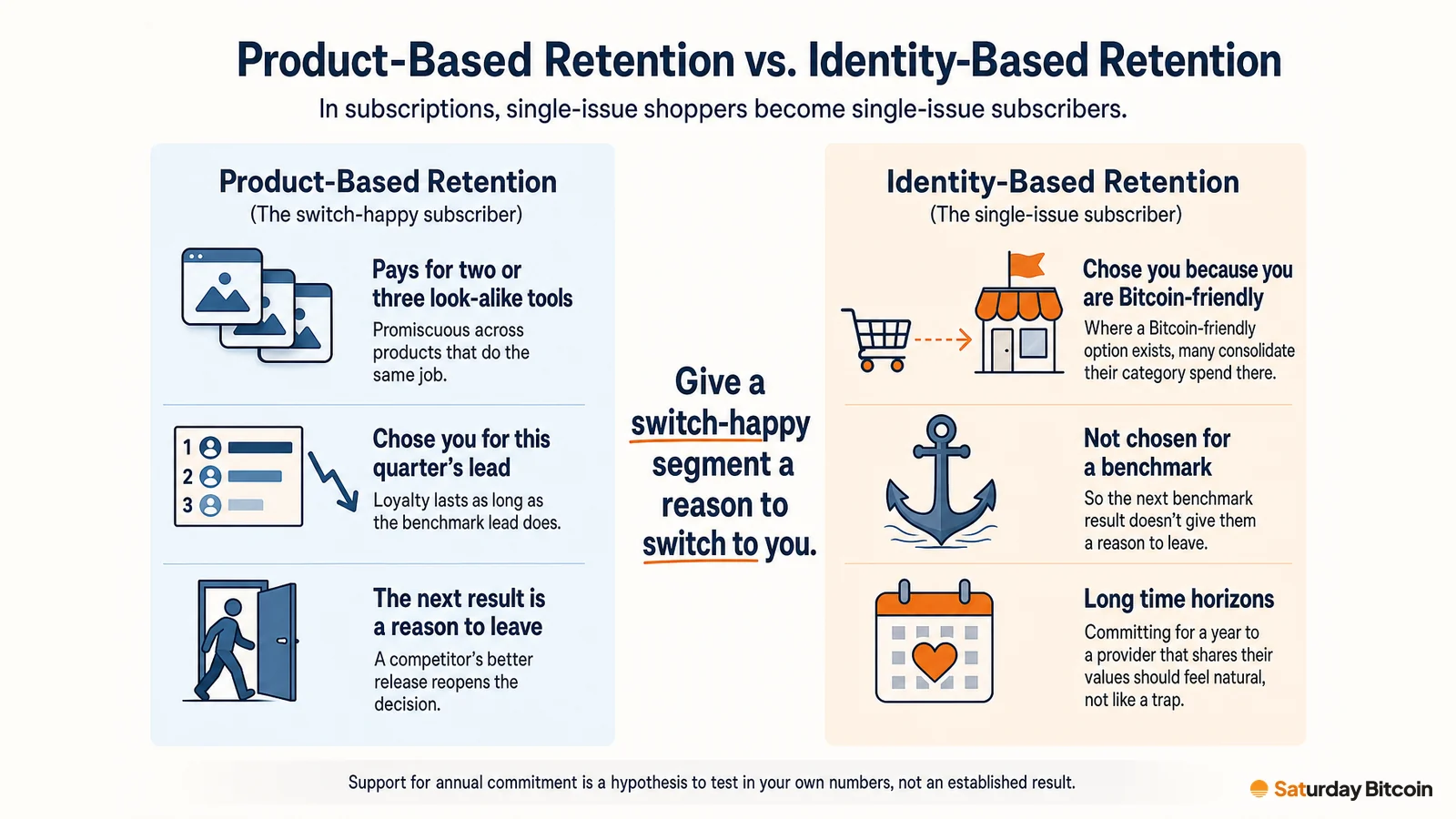
Consider consumer AI again. A Bitcoiner who pays for two or three AI tools today is exactly the kind of switch-happy subscriber the category struggles with. But the same trait that makes that person promiscuous across look-alike products makes them loyal to the one that stands for something they care about. Be the Bitcoin-friendly AI and you give a switch-happy segment a reason to switch to you.
This is identity-based retention in place of product-based retention. A subscriber who chose you because you are Bitcoin-friendly didn’t choose you for this quarter’s benchmark lead, so the next benchmark result doesn’t give them a reason to leave. It also changes how commitment feels. Bitcoiners are known for long time horizons, and committing for a year to a provider that shares their values should feel natural rather than like a trap. We expect this to support annual commitment, but it remains a hypothesis to test in your own numbers, not an established result.
New category, early movers
Consumer AI is new, and so is the idea of a Bitcoin-friendly provider in most digital categories. In markets with hundreds of functionally similar products, positioning-based differentiation is valuable and rare. The first provider to claim it tends to be the one recommended by a segment that is unusually motivated, vocal about privacy tools, and vocal about the businesses that support it. Category consolidation is underway, and the businesses that position first tend to be the ones recommended first. It’s a differentiator now; it won’t stay that way forever.
The commercial case doesn’t depend on where bitcoin trades next month. The merchant bitcoin strategy works independently of bitcoin’s price.
Where Saturday Bitcoin fits
Saturday Bitcoin is a free directory that helps Bitcoiners find merchants that already accept bitcoin, online and nearby. It’s a channel many digital businesses aren’t watching yet. Bitcoiners use it to browse categories, save merchants and share them with friends.
If you already accept bitcoin, you can claim and verify your listing for free and add a welcome offer for Bitcoiners. The welcome offer matters in these categories. It doesn’t need to be a deep discount that resets your price anchor. It’s a targeted welcome to one segment: an extended trial, a bonus feature or add-on, or a modest first-purchase code. Your public price stays where it is.
When Bitcoiners pay in bitcoin, you get the properties of the bitcoin channel you already run: lower processing costs than cards, which average about 2.3% plus $0.25 online; final settlement; and no chargebacks, with refunds on your own terms. Many Bitcoiners will still pay by card, out of habit or for card rewards, and that subscriber still chose you.
To be clear about the limits: the committed segment is small relative to the mass market, and being listed is not a guarantee of volume. Saturday Bitcoin can’t see purchases, so measure the result in your own data, using your promo code redemptions and your renewal rates. And the product still has to be good. Bitcoin-friendliness decides the choice between comparable options; it doesn’t rescue a weak one.
What to do this week
- Claim your free listing at saturdaybitcoin.com/business.
- Add a welcome offer that rewards a new Bitcoiner without putting a public discount on your product.
- Say it plainly on your site: you’re Bitcoin-friendly, and you want these customers.
You can match a price. You can’t match an identity.