
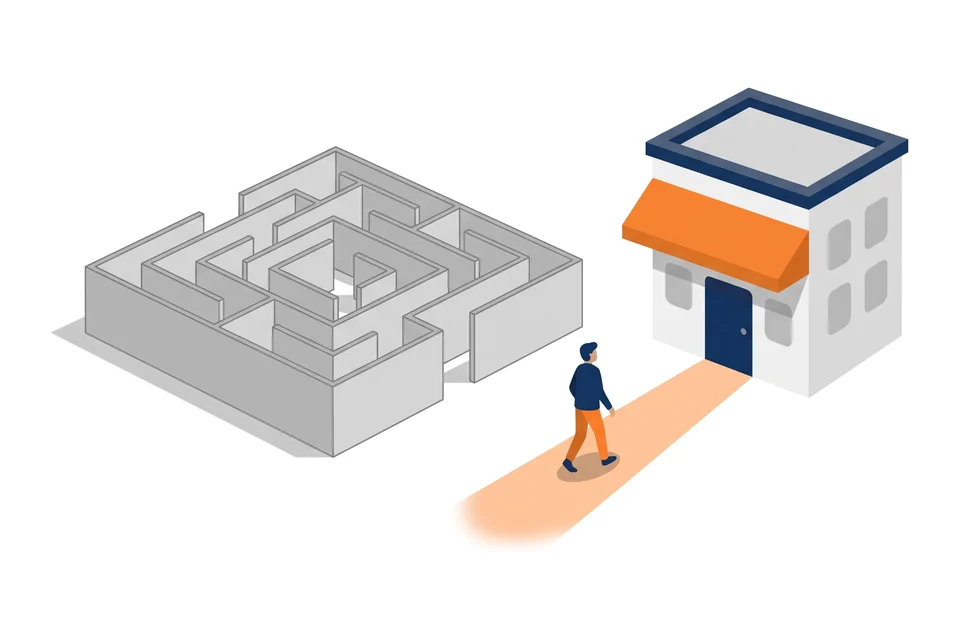

If you run a hotel, you already know the problem. Online travel agencies like Booking.com and Expedia, and meta-search sites like Kayak and Google Hotels, sit between you and your guest. They own the first touchpoint. They control the comparison. And they charge you for the privilege.
Every “book direct” campaign of the last decade tried to win that guest back inside the aggregator’s own game. There is a customer who never enters that game in the first place.
The aggregator tax
OTA commissions typically run 15 to 25 percent of the room rate. That is the visible cost, and it is a big one. To show how big, take an illustrative boutique-hotel room at $200 a night. After a 20% OTA commission ($40), variable costs ($50) and a fixed-cost allocation ($60), the hotel keeps about $50. Book the same room direct, pay roughly $5 in card processing instead of the commission, and the hotel keeps about $85: some 70% more on the same room, the same night, the same guest. (These are illustrative numbers, not benchmarks. Your mix will differ, but the shape won’t.)
OTAs take up to a quarter of the booking and all of the relationship.
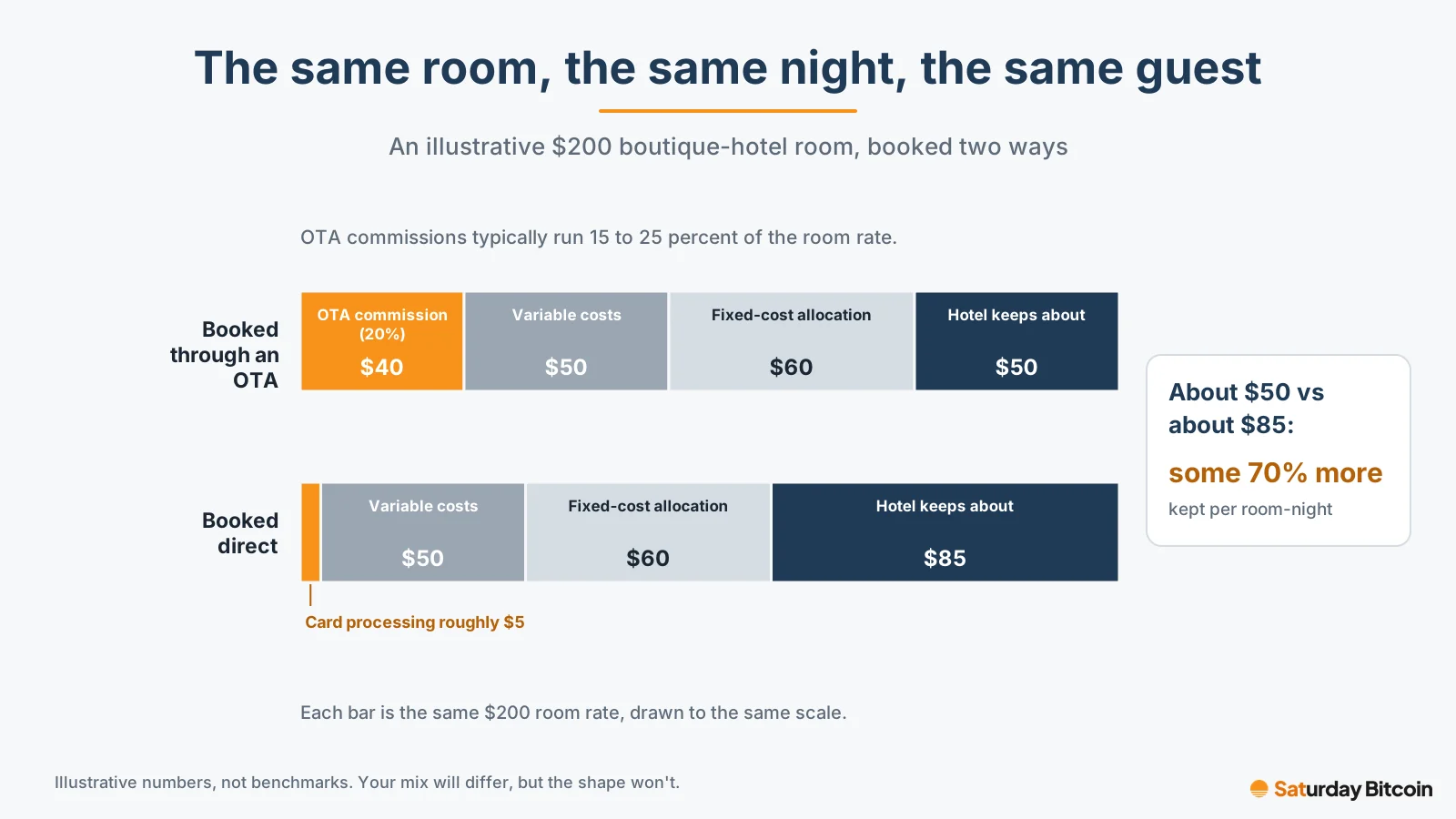
Because hotels carry high fixed costs, a room that would have sat empty is worth even more. Nearly all of its rate goes against costs you were paying anyway.
But the commission isn’t the deepest cost. The deeper cost is the relationship. When a guest books through an OTA, the hotel often gets limited information about them. Many OTAs pass along a masked or proxy email address. You serve the guest, earn their satisfaction, and then have no reliable way to reach them for the next trip. They go back to the OTA, and you pay full commission to re-acquire someone who was already your customer. The hotel is effectively renting its own customers.
Put simply: OTAs take up to a quarter of the booking and all of the relationship.
And the aggregators’ advantage reinforces itself. Booking Holdings and Expedia Group together spent about $13.7 billion on marketing in 2023. No individual hotel brand can match that at the top of the funnel.
Why “book direct” was always an uphill fight
The industry hasn’t been passive. In February 2016, Hilton launched “Stop Clicking Around,” the largest campaign in the company’s 97-year history. Its central data point: more than 1.6 million free nights’ worth of Hilton Honors points went unearned the previous year because guests booked through third parties. Marriott ran “It Pays to Book Direct” around the same time, and most major U.S. chains followed with member-only rates.
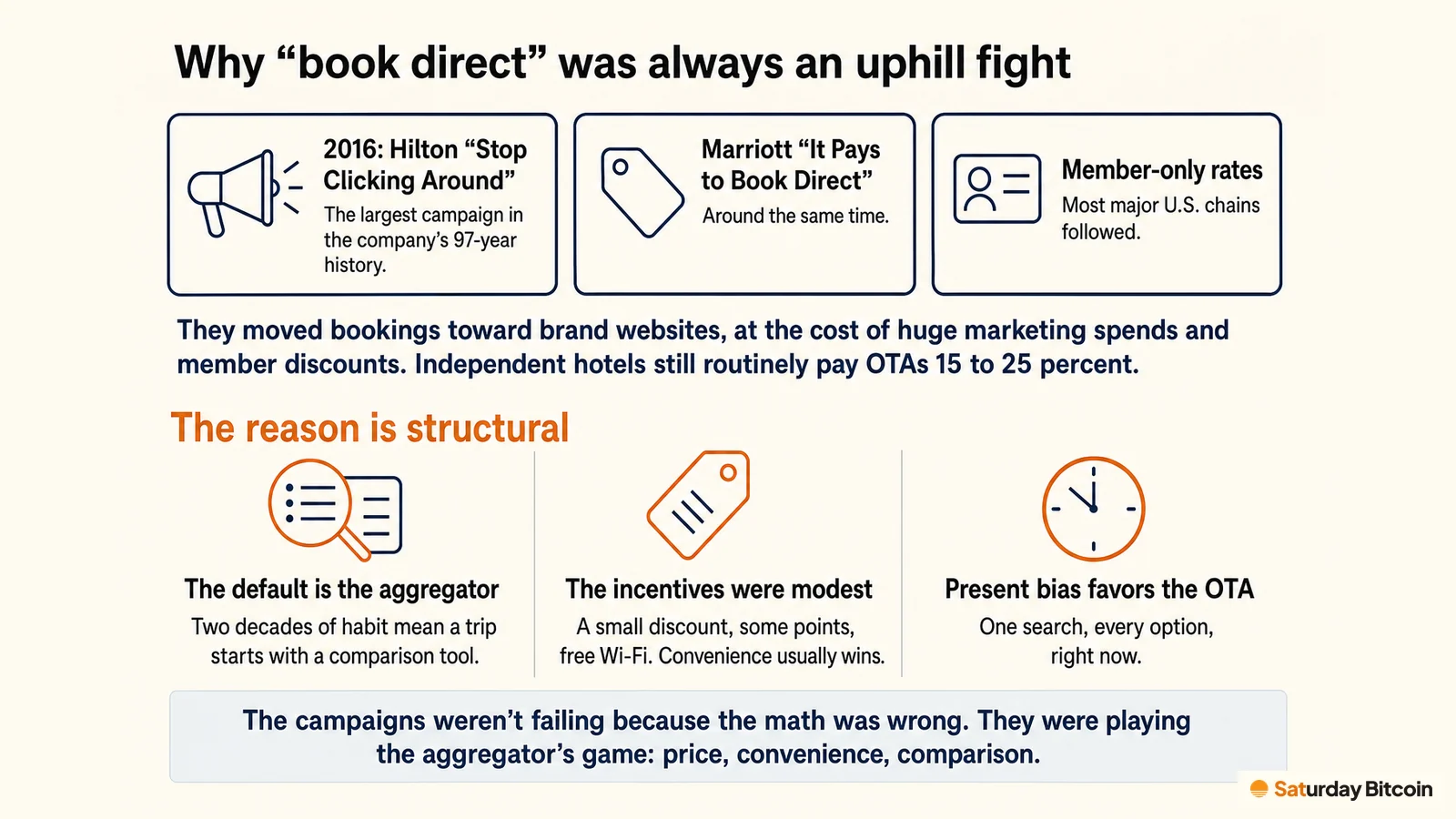
Those campaigns did move bookings toward brand websites, especially for the big chains with large loyalty programs. But look at what it took: the largest marketing spends in the companies’ histories, plus member discounts that cut into the average rate on every room sold direct. And a decade later, independent hotels still routinely pay OTAs 15 to 25 percent, because they can’t fund a national ad campaign or a global loyalty program.
The reason is structural:
- The consumer’s default is the aggregator. Two decades of habit mean a trip starts with a comparison tool.
- The incentives were modest. A small discount, some points, free Wi-Fi. Each was an economic offer competing with the aggregator’s economic offer of convenience, and convenience usually wins.
- Present bias favors the OTA. One search, every option, right now. The direct offer asks for an extra step today for a benefit later.
The campaigns weren’t failing because the math was wrong. They were struggling because they were playing the aggregator’s game: price, convenience, comparison.
A different first question
Now consider a different traveler. A Bitcoiner planning a trip often doesn’t start with “where can I compare hotels?” They start with “which hotel is Bitcoin-friendly?”
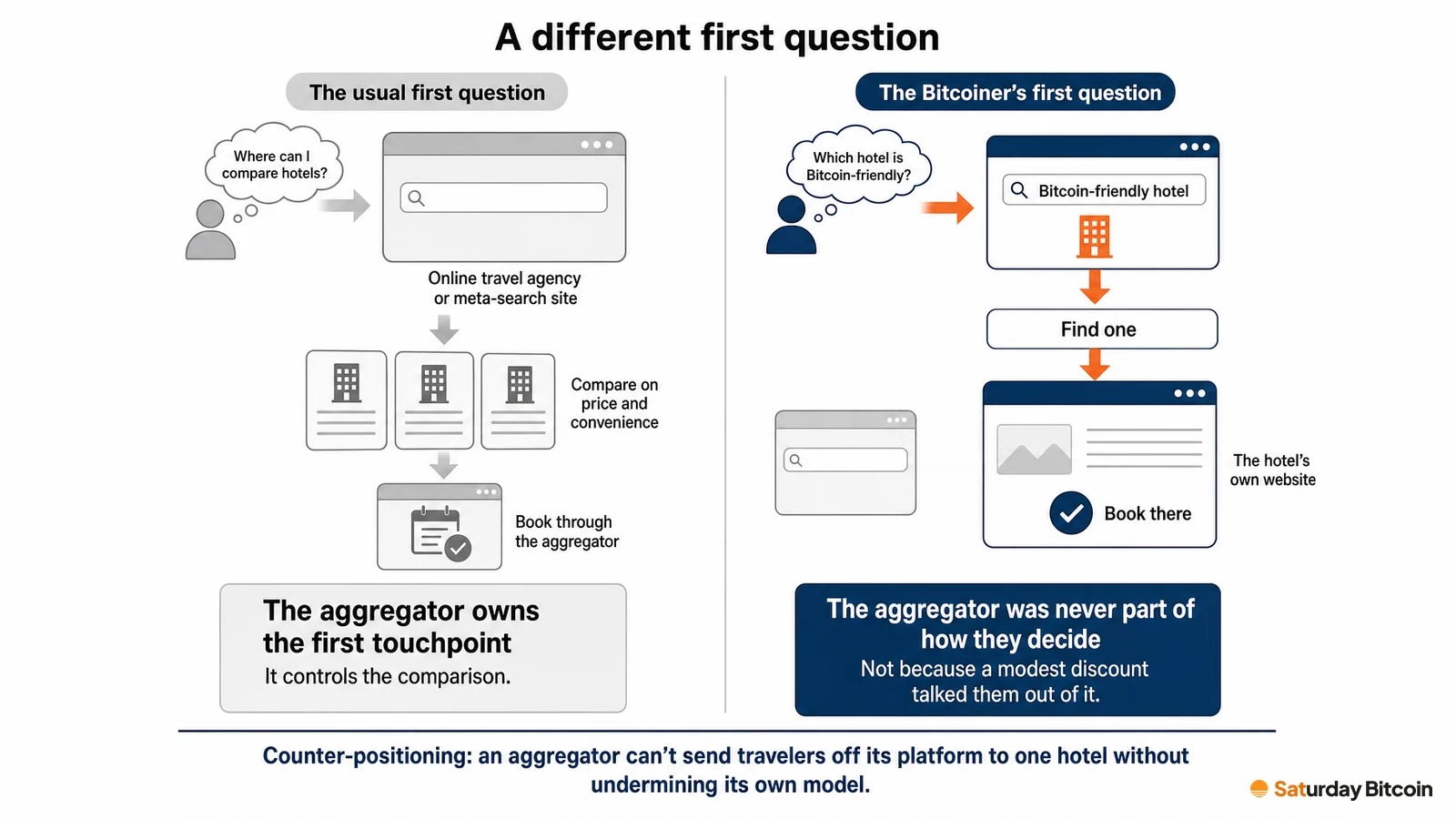
That one change in the first question changes everything after it. They look for a Bitcoin-friendly hotel, find one, and go to its own website to book. A customer who starts with “which hotel is Bitcoin-friendly?” never opens the OTA. Not because a modest discount talked them out of it, but because the aggregator was never part of how they decide.
There’s a deeper reason this sticks. Bitcoin was built to remove rent-extracting intermediaries and replace gatekeepers with direct, peer-to-peer relationships. An OTA is exactly the kind of middleman Bitcoiners are inclined to skip. For them, booking direct isn’t only practical; it fits their worldview. Behavior that rests on identity tends to be more durable than behavior bought with a discount.
The aggregator also has a hard time copying this. Its whole value is “compare everyone here.” It can’t tell travelers to leave the platform and book with a specific hotel without undermining its own model. That’s counter-positioning, and it works in your favor.
Travel’s ideal customer, pre-assembled
The travel industry has spent years shifting from counting nights and miles to valuing a guest’s total financial contribution. The ideal guest in that model is digitally engaged, books direct, joins the loyalty program and spends on the property.
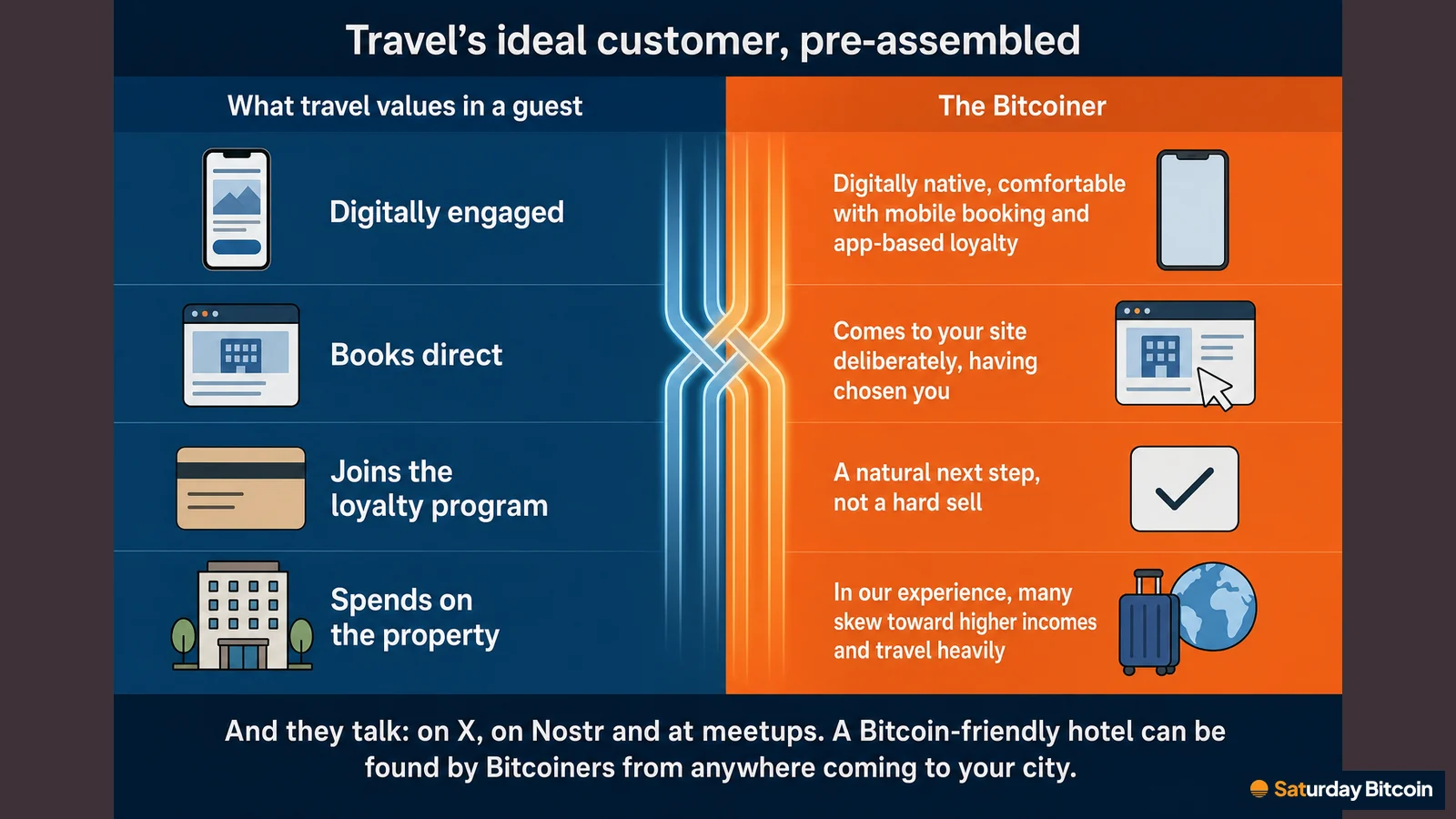
Hold the Bitcoiner up against that list. They are digitally native and comfortable with mobile booking and app-based loyalty. They come to your site deliberately, having chosen you, so joining your loyalty program is a natural next step rather than a hard sell. In our experience, many skew toward higher incomes and travel heavily, not least on a global conference circuit that moves thousands of them between cities every year. And they talk: a Bitcoiner who finds a Bitcoin-friendly hotel tells other Bitcoiners on X, on Nostr and at meetups.
Travel is also one of the few categories where your market isn’t bounded by your neighborhood. A Bitcoin-friendly hotel can be found by Bitcoiners from anywhere who are coming to your city.
Your opinion of bitcoin doesn’t change the size of this group: an estimated ~1 million committed, mission-driven Bitcoiners in the U.S., and growing, inside the tens of millions of Americans who own some bitcoin.
What Saturday Bitcoin does today
Saturday Bitcoin is a free discovery directory that helps Bitcoiners find merchants that already accept bitcoin, online and nearby. For a hotel, B&B or rental operator that already takes bitcoin, that’s the missing piece: being findable at the exact moment a Bitcoiner asks “which one is Bitcoin-friendly?”
When you claim and verify your listing, you can link guests straight to your own booking page, add a welcome offer (a direct-booking perk, a late checkout, a promo code) and apply to be featured. We help guests find you. When they pay in bitcoin, the booking lands on your cheapest rail: lower processing costs, final settlement, no chargebacks, and you decide refunds.
Be clear-eyed about the limits. Saturday Bitcoin doesn’t take bookings, and we can’t see your reservations. The segment is small next to the OTAs’ reach, so this is one more direct channel, not a replacement for your distribution strategy. Many Bitcoiners will still pay by card, for habit, rewards or tax reasons. That guest is still a win: they booked direct, and the relationship is yours. And the room still has to be right; being Bitcoin-friendly earns you the visit, not the review.
Being the Bitcoin-friendly hotel in your city stands out today; in time, travelers will expect it.
What to do this week
If you already accept bitcoin, claim your free listing at saturdaybitcoin.com/business. Point it at your direct booking page, add a welcome offer for Bitcoiners, and make sure the next traveler who asks “which hotel is Bitcoin-friendly?” finds you before they ever think of the OTA.