


Luxury brands have a customer acquisition problem that is the inverse of what most merchants face.
Most merchants can discount. They can run promotions, offer coupon codes, deploy affiliate programs, and use the full arsenal of performance marketing to drive conversion. Luxury brands can’t use any of them. A 20% discount on a premium suitcase doesn’t just reduce margin. It damages the positioning that justifies the price in the first place. For brands where the perception of exclusivity is the product, discounting is not a tool; it’s a toxin.
That leaves luxury with a hard question: how do you reach new, qualified customers when almost every efficient acquisition tool damages the brand? One answer is hiding in plain sight, in a customer segment that already values exactly what luxury sells.
For brands where exclusivity is the product, discounting is not a tool; it’s a toxin.
The constraint that defines luxury marketing
In luxury, price is a signal of scarcity and desirability. Compromise the price and you compromise the signal, and ultimately the brand itself. Hermès is famous for waitlists, not markdowns. Chanel has pushed prices up, not down. The pressure to trade price for volume is real: LVMH reported profit from recurring operations down 14% in 2024. But the luxury playbook says you protect the price anyway.
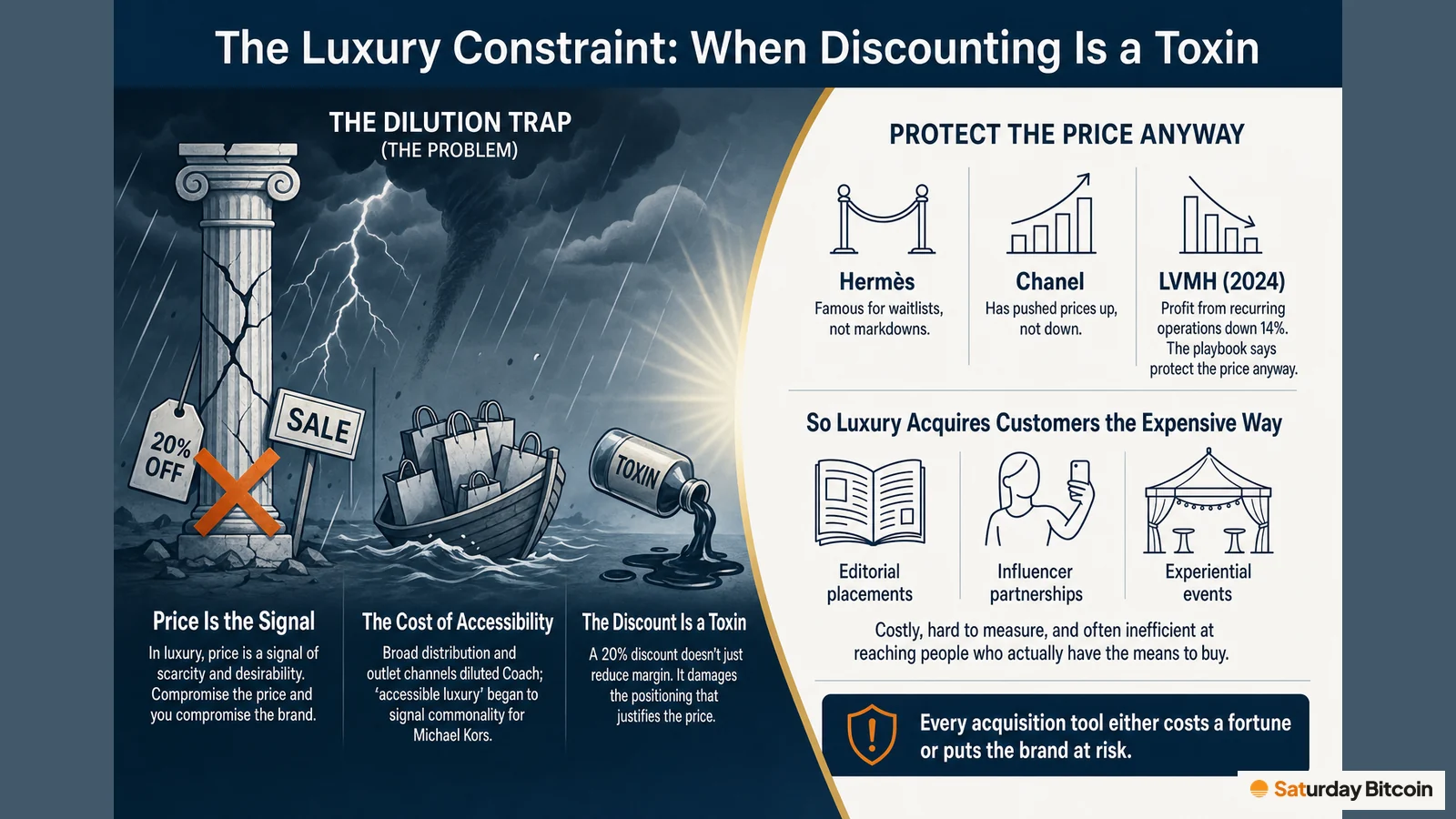
The cautionary tales are well known. Coach built a powerful leather goods brand, then diluted it through broad distribution and outlet channels; the recovery took years of repositioning. Michael Kors pushed hard into “accessible luxury,” and accessibility began to signal commonality. These were failures of pricing discipline, not product quality.
So luxury acquires customers the expensive way. Editorial placements in top fashion titles. Influencer partnerships. Experiential events in affluent enclaves like the Hamptons, Aspen or Palm Beach. These channels work, but they are costly, hard to measure, and often inefficient at reaching the people who actually have the means to buy. Digital ad targeting struggles to tell the genuinely affluent from people who merely look affluent online. In short, every acquisition tool luxury has either costs a fortune or puts the brand at risk.
A customer who already values scarcity
Your view of bitcoin doesn’t change the fact that these customers exist. There are an estimated ~1 million committed, mission-driven Bitcoiners in the U.S., and growing, inside a much larger base: tens of millions of Americans own some bitcoin.
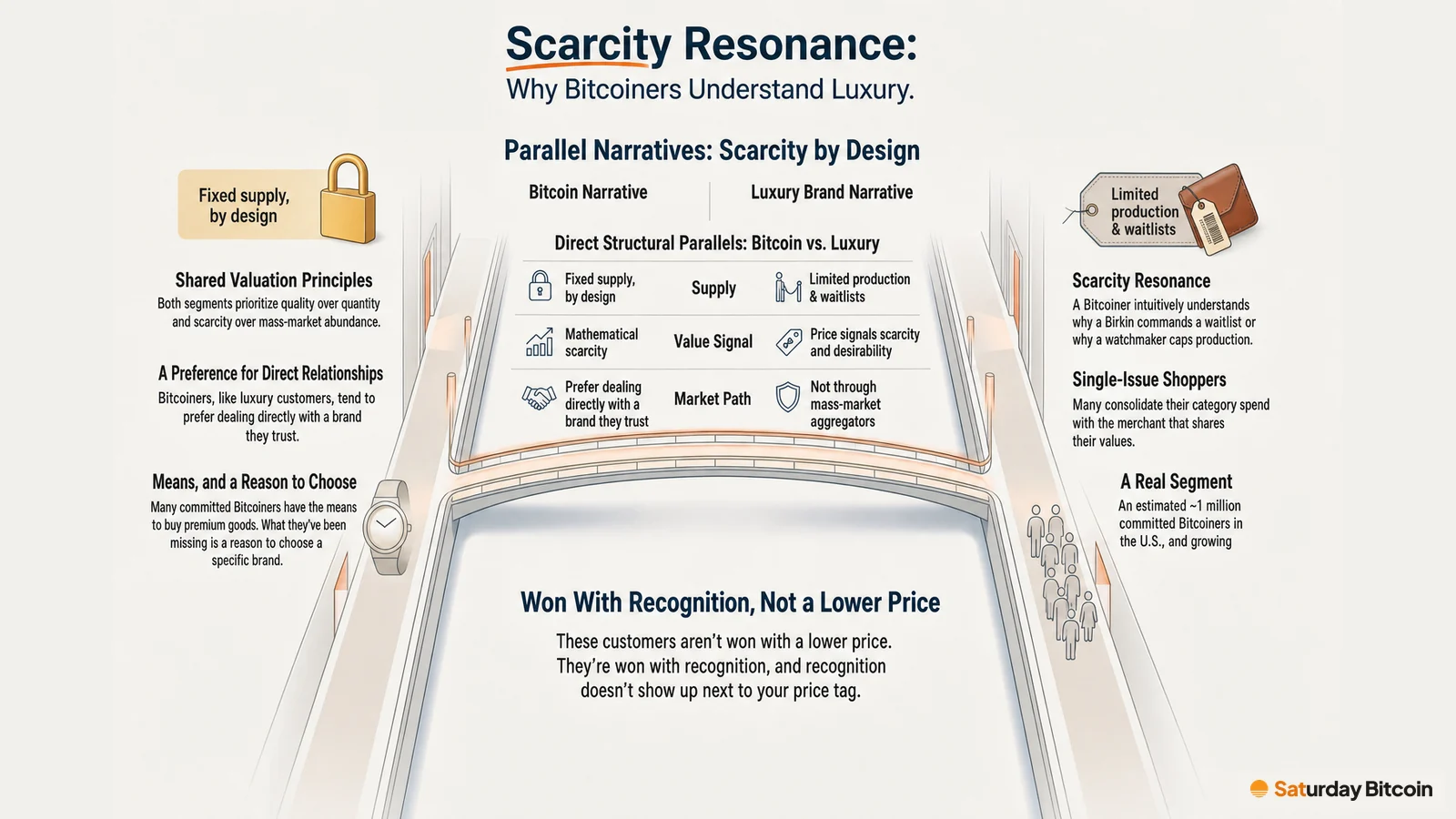
The overlap with luxury runs deeper than demographics. The psychographic fit may matter more:
Scarcity resonance. Bitcoin’s story is mathematical scarcity: a fixed supply, by design. That parallels the scarcity story luxury brands are built on. A Bitcoiner intuitively understands why a Birkin commands a waitlist or why a watchmaker caps production. Scarcity resonates with people who own the scarcest asset.
A preference for direct relationships. Bitcoiners, like luxury customers, tend to prefer dealing directly with a brand they trust rather than through mass-market aggregators. That is close to the opposite of the deal-seeking, price-comparing shopper that luxury’s digital channels often attract.
Means, and a reason to choose. Many committed Bitcoiners have the means to buy premium goods. What they’ve been missing is a reason to direct that spending toward a specific brand. For a growing number of them, the reason is simple: this brand accepts bitcoin and welcomes them. They are single-issue shoppers, and many consolidate their category spend with the merchant that shares their values.
The point for a luxury brand: these customers aren’t won with a lower price. They’re won with recognition, and recognition doesn’t show up next to your price tag.
Creating demand, not just capturing it
Most customer acquisition targets people who are already in-market: searching, comparing, ready to buy. That’s demand capture. It’s what paid search, affiliates and retargeting are built for. Luxury has always needed something harder: the ability to create desire in people who weren’t shopping at all.
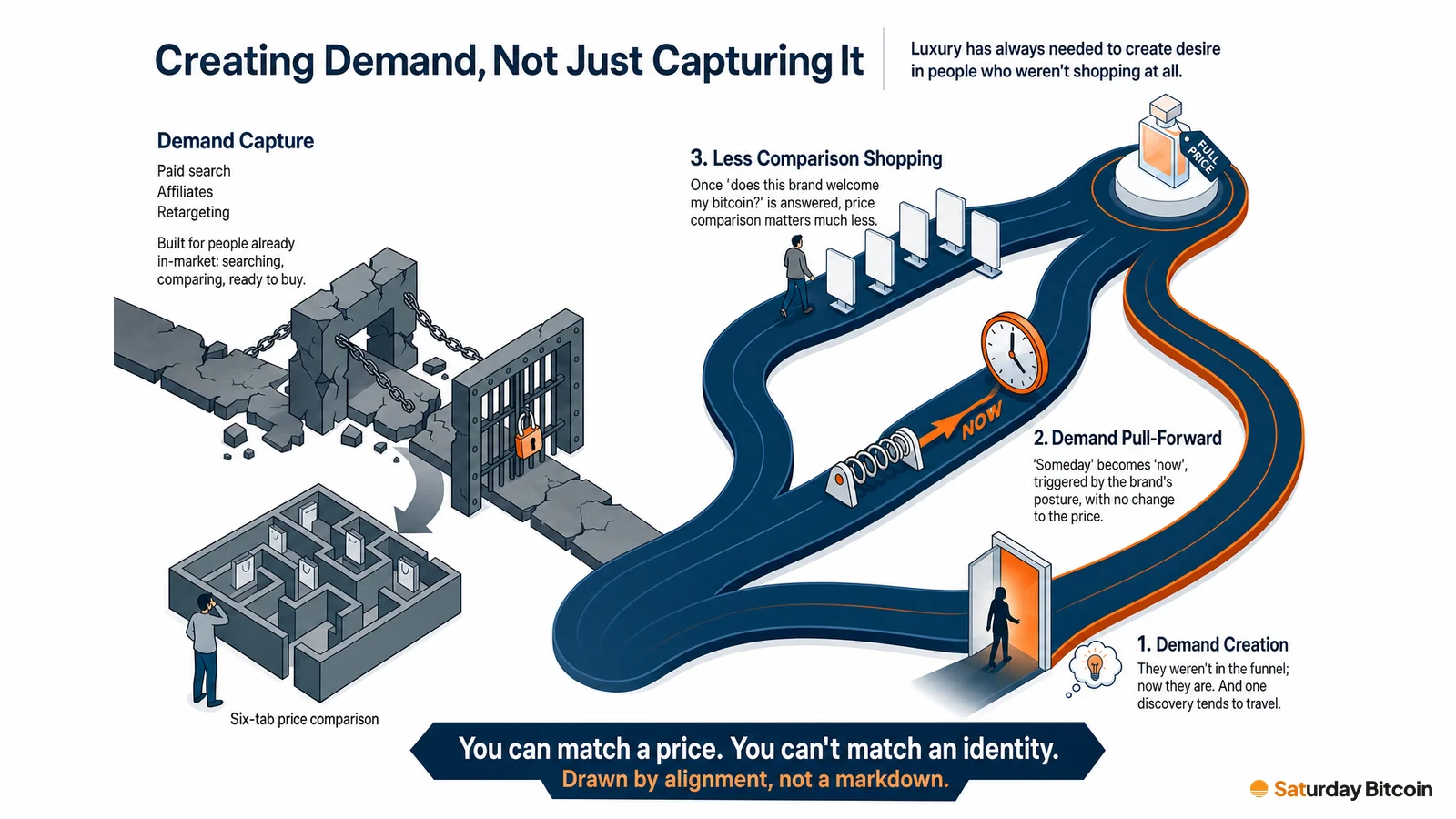
Being discovered by this community does that, in three ways.
Demand creation. A Bitcoiner who learns that a premium outerwear or luggage brand accepts bitcoin doesn’t necessarily need a new jacket or new luggage. But the discovery creates consideration from zero. They weren’t in the funnel; now they are. Bitcoiners also have a natural habit of sharing and celebrating merchants that join the bitcoin economy, so one discovery tends to travel.
Demand pull-forward. Some customers were going to buy eventually, just not now: the watch buyer on a two-year timeline, the traveler who knows their luggage is tired. Discovering a brand that welcomes their bitcoin can turn “someday” into “now.” In conventional marketing, pulling demand forward usually takes a sale or a limited-time offer. Here the trigger is the brand’s posture toward the customer, with no change to the price.
Less comparison shopping. For Bitcoiners already in-market, the decision often turns on the dimension that matters most to them: does this brand welcome my bitcoin? Once that’s answered, the six-tab price comparison matters much less. You can match a price. You can’t match an identity.
In all three, the customer is drawn by alignment, not a markdown.
When they pay in bitcoin
Many Bitcoiners will still pay by card, out of habit, for card rewards, because of tax friction, or simply to support you on principle. That’s still a client you won, at full price.
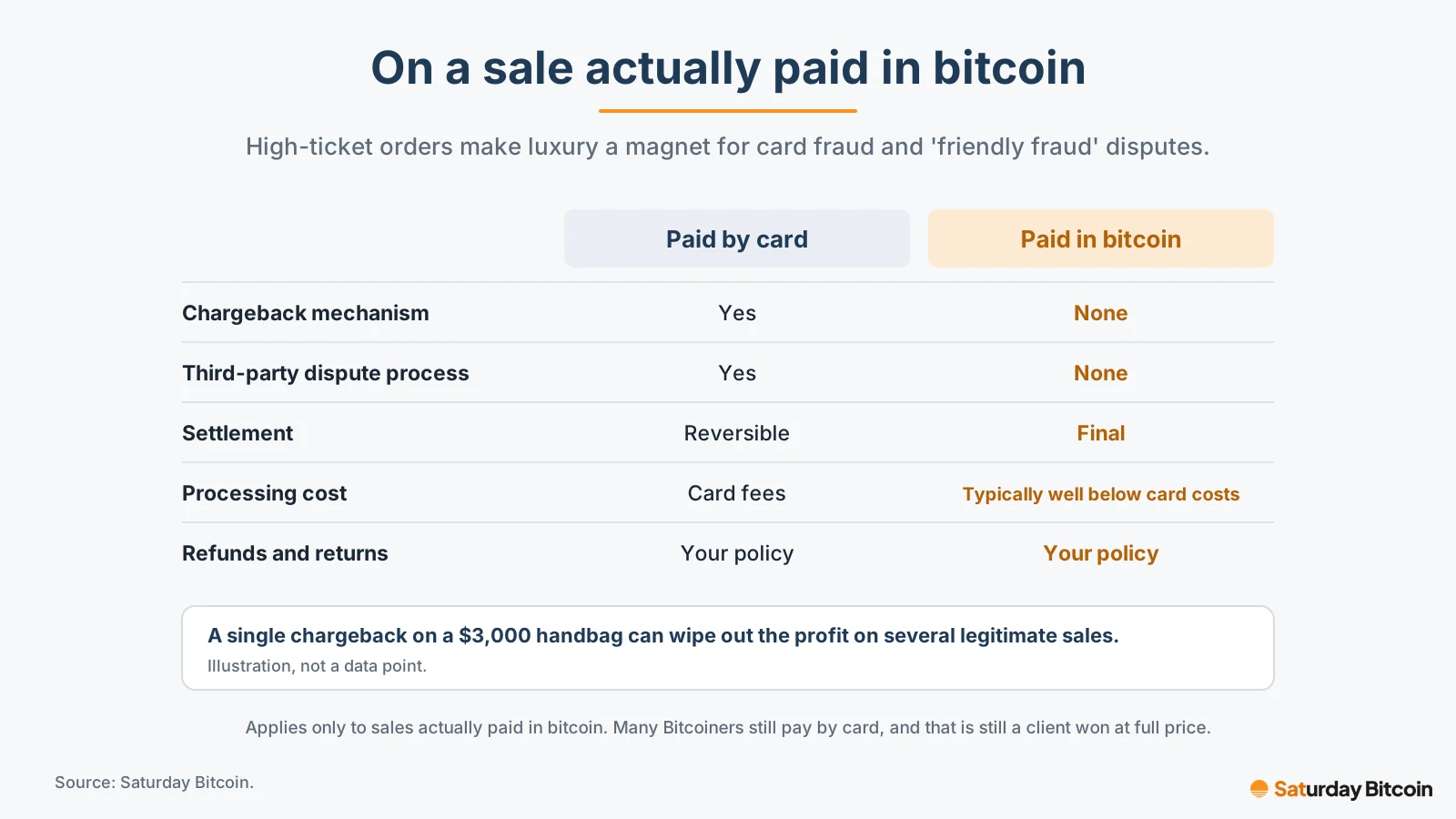
When they do pay in bitcoin, the economics of your existing bitcoin channel matter more in luxury than almost anywhere else. High-ticket orders make luxury a magnet for card fraud and “friendly fraud” disputes, where a customer claims an item never arrived while keeping it. A single chargeback on a $3,000 handbag (an illustration, not a data point) can wipe out the profit on several legitimate sales.
On sales actually paid in bitcoin, settlement is final. There is no chargeback mechanism and no third-party dispute process, and processing costs are typically well below card costs. You still decide refunds and returns, under your own policies.
What Saturday Bitcoin does for a luxury brand
Saturday Bitcoin is a discovery directory that helps Bitcoiners find merchants that already accept bitcoin, online and nearby. Tens of thousands of places are listed. For a luxury or premium brand that already accepts bitcoin, it is a way to be found by a qualified, values-aligned audience without running a promotion.
- Claim and verify your listing, free. Control how your brand is presented to Bitcoiners: your description, your imagery, your positioning.
- Add a welcome offer, if it fits your brand. It doesn’t have to be a discount. A private appointment, complimentary personalization or early access to a release can welcome a new customer without moving your price.
- Get featured. Featured merchants put the brand in front of Bitcoiners who are actively looking for places to spend, and Bitcoiners can save and share what they find.
Being found is our part. When those clients pay in bitcoin, the sale lands on your cheapest rail.
An honest limit
This is not a mass-market channel. The committed Bitcoiner segment is small relative to luxury’s global customer base, and discovery is not a guarantee of volume. Saturday Bitcoin isn’t a payment processor and can’t see purchases, so measuring what this audience is worth to you is your job, through the welcome offer, your own analytics or simply asking. And no amount of discovery replaces the product: Bitcoiners still have to want what you make.
But luxury thinks in decades, not quarters. A small number of high-value, loyal customers matters disproportionately in a category where a fraction of clients drives a large share of sales. Category consolidation is underway: the first premium brands that Bitcoiners find, trust and talk about in each category can build a durable position with this community. And competitors focused on the usual channels are unlikely to notice a shift happening in a channel they aren’t watching. What distinguishes a house today becomes expected in time.
What to do this week
If your brand already accepts bitcoin, the first step is free, reversible, low effort, and has real upside: claim your listing at saturdaybitcoin.com/business. Make sure Bitcoiners can find you, see that you welcome them, and choose you at full price.
For the broader case, see “Accepting Bitcoin Isn’t Enough” and “You Can Match a Price. You Can’t Match an Identity.”