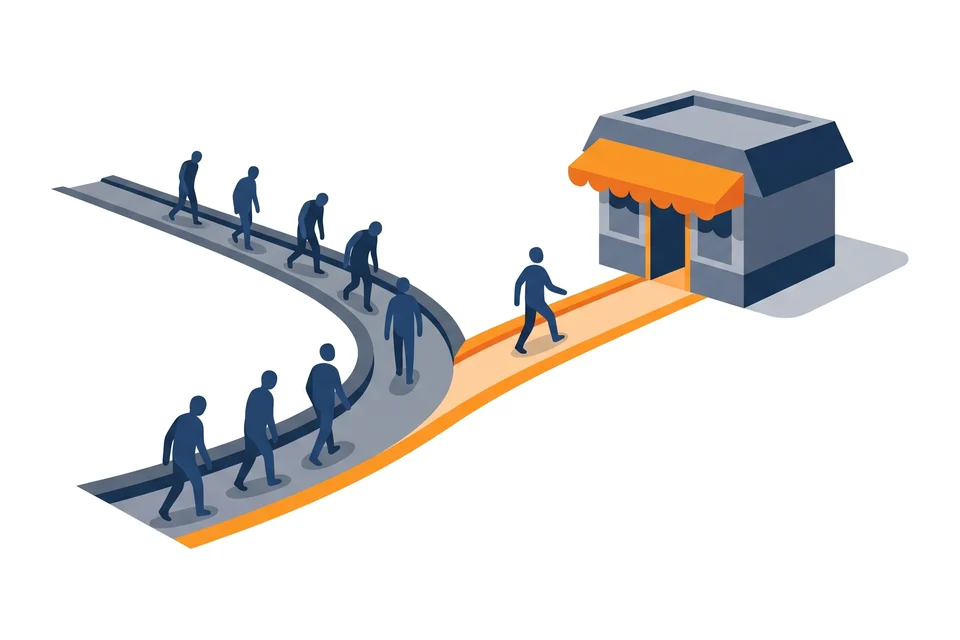

Most of what we write about the bitcoin opportunity concerns the domestic segment: an estimated ~1 million committed, mission-driven Bitcoiners in the U.S., and growing, who will go out of their way to support merchants who welcome them. Saturday Bitcoin is a U.S.-first company, and that segment is our focus.
But if you ship internationally, there’s a second cohort that most merchants haven’t considered at all.
A global audience you didn’t know you had
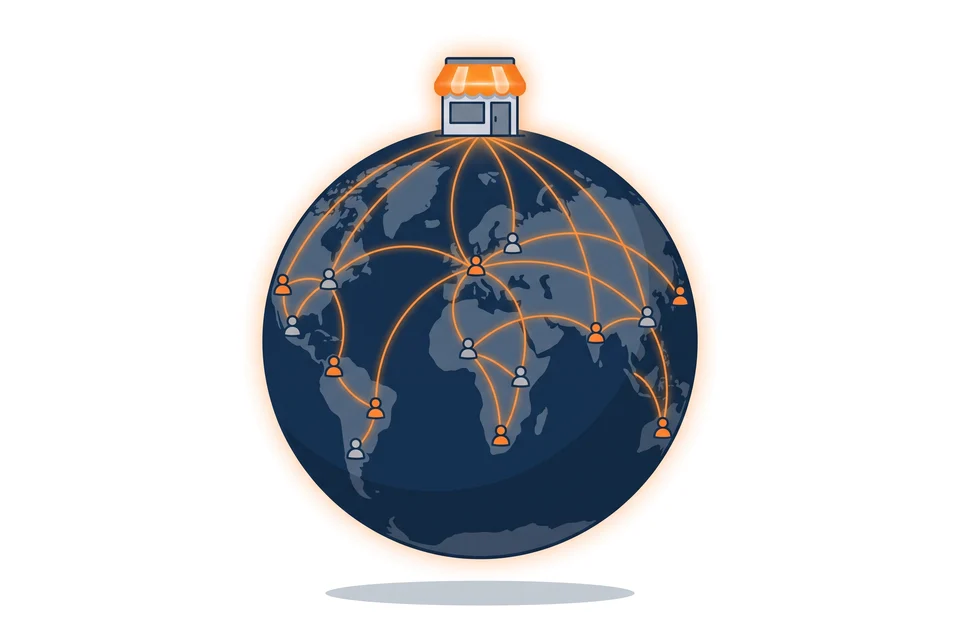
Bitcoin communities are active in the UK, Germany, Japan, Brazil, Australia, the UAE and dozens of other countries. Inside each one is the same committed core we see at home: people for whom bitcoin isn’t just an asset but part of their identity. They look for merchants who welcome them and share those merchants with each other. Whatever you think of bitcoin, this customer segment is real, and it doesn’t stop at the border.
Merchants don’t reject regions irrationally; the economics are hostile.
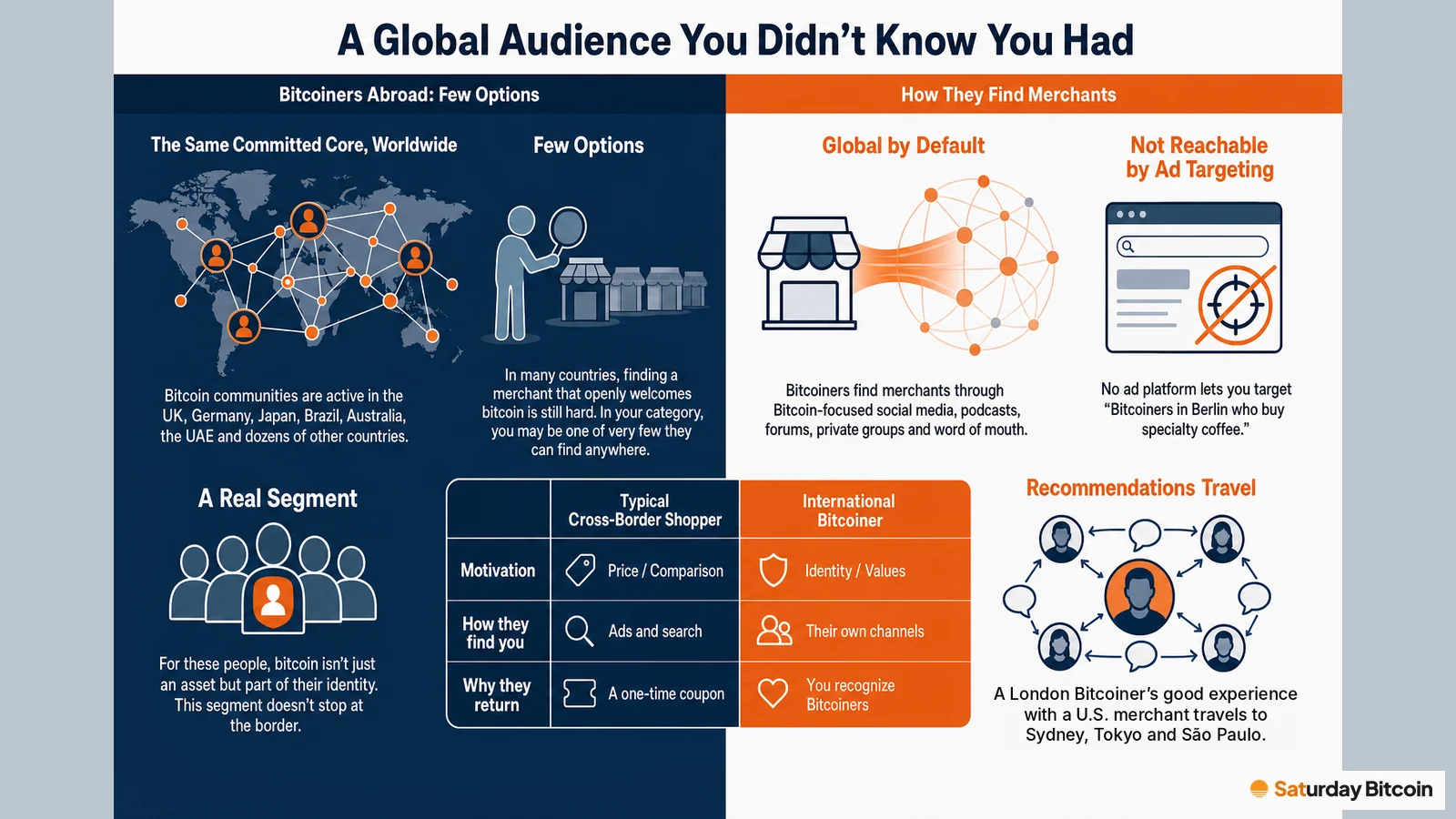
What these Bitcoiners lack is options. In many countries, finding a merchant that openly welcomes bitcoin is still hard. Bitcoiners abroad are searching for merchants who’ll welcome them. When they find a U.S. merchant that does, they often aren’t choosing between you and another Bitcoin-friendly alternative. In your category, you may be one of very few they can find anywhere.
You can’t buy your way to these people. No ad platform lets you target “Bitcoiners in Berlin who buy specialty coffee.” They find merchants through their own channels: Bitcoin-focused social media, podcasts, forums, private groups and word of mouth. Those channels are global by default. When a Bitcoiner in London has a good experience with a U.S. merchant, the recommendation travels to Sydney, Tokyo and São Paulo, into markets you aren’t advertising in and couldn’t cost-effectively reach.
The comparison is to zero
International customers won’t behave like a domestic regular. Shipping costs, delivery times and customs mean they will probably order less often. That framing misses the point.
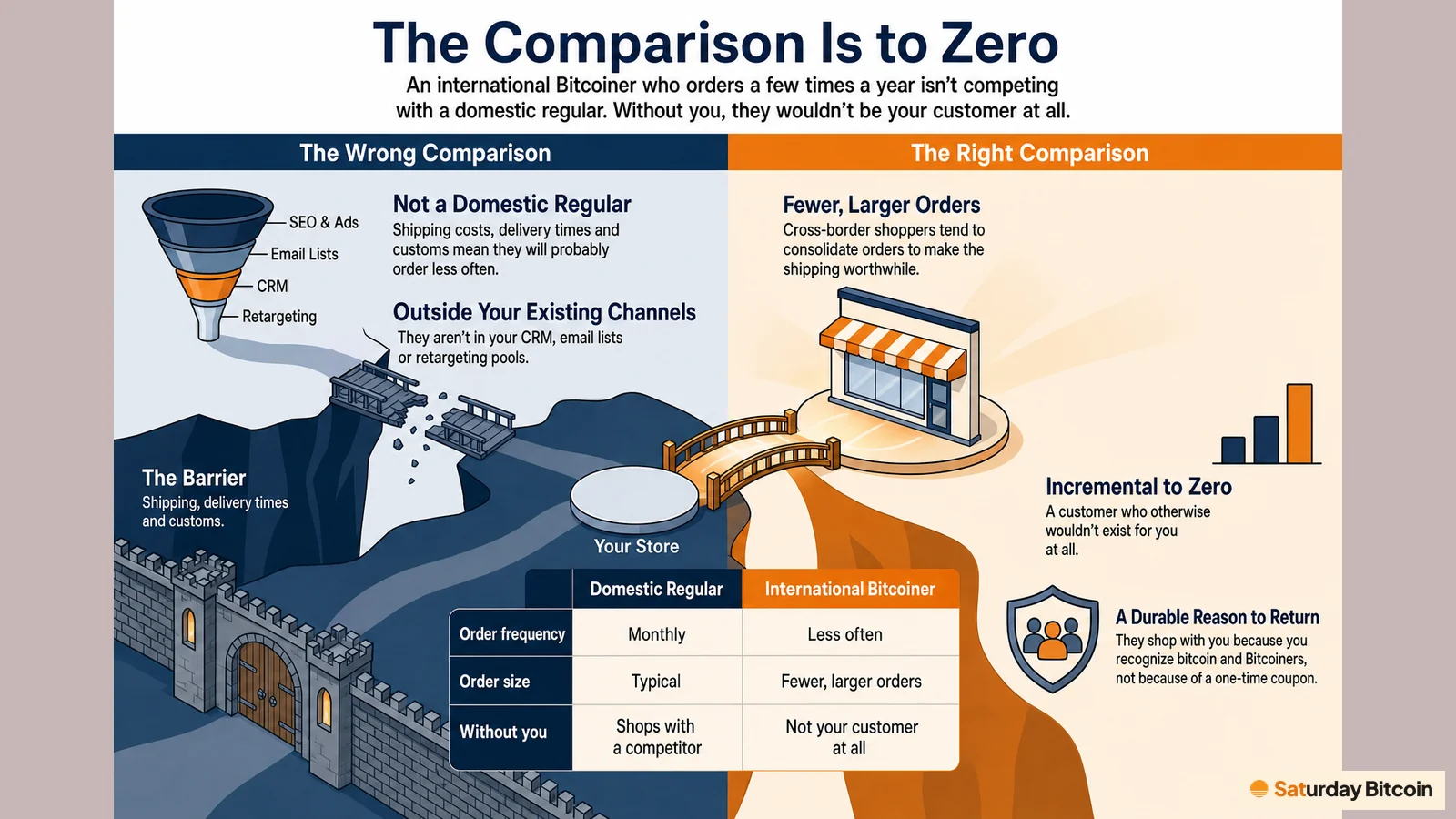
Cross-border shoppers tend to consolidate into fewer, larger orders to make the shipping worthwhile. They shop with you because you recognize bitcoin and Bitcoiners, not because of a one-time coupon, and that is a durable reason to come back, even at lower frequency. Most importantly, the right comparison isn’t “a domestic customer who orders monthly.” It’s a customer who otherwise wouldn’t exist for you at all. These customers are incremental to zero. Even two or three orders a year from someone who would otherwise have bought at home is real upside.
The travel bonus
International visitors are the second way in. The U.S. welcomed 72.4 million international visitors in 2024, and they spent a record $253.9 billion on U.S. travel and tourism, about $696 million a day.
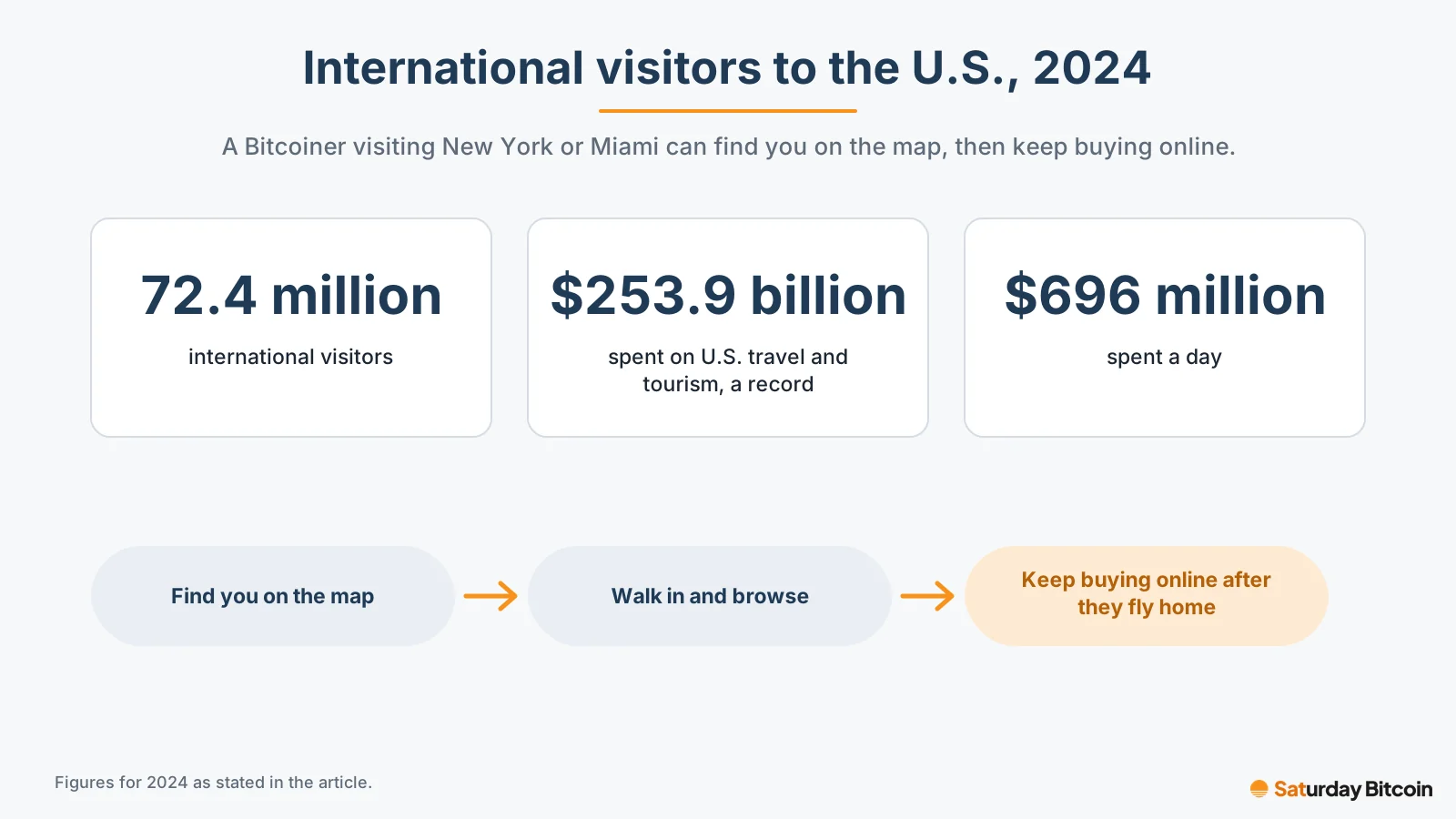
Some of those visitors are Bitcoiners. A Bitcoiner visiting New York or Miami can open the Saturday Bitcoin map, find a merchant that already accepts bitcoin nearby, walk in, and browse. A good visit gives them a reason to keep buying from you after they fly home. Visitors find you on the map, then keep buying online. The trip becomes a discovery path that turns a one-time visit into an ongoing relationship.
Why merchants block whole regions
The bigger story is the trade that never happens at all.
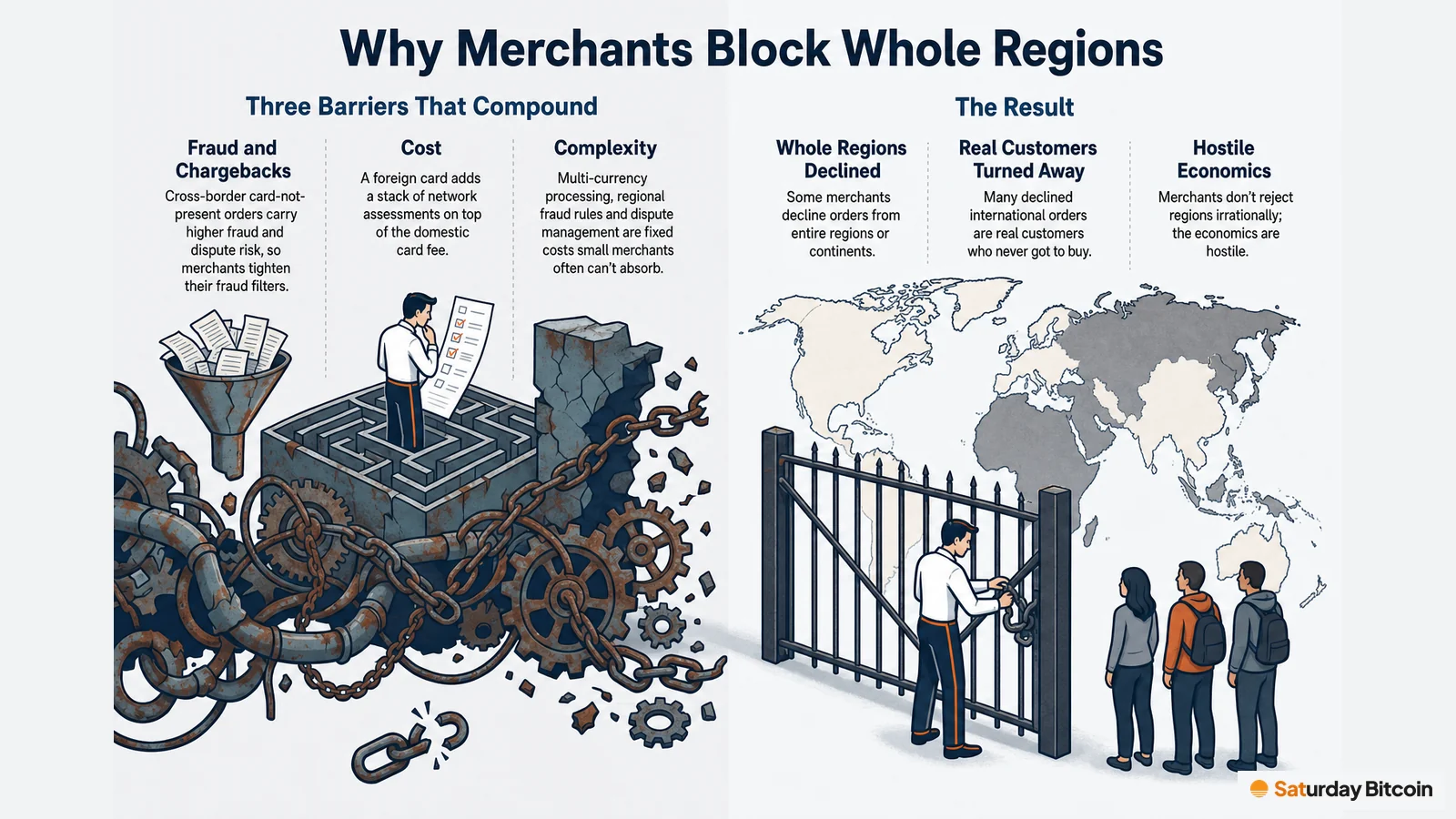
Many merchants, especially smaller ones, have quietly concluded that international orders aren’t worth it. Some decline orders from entire regions or continents. They aren’t being irrational. They’re responding to three barriers that compound:
Fraud and chargebacks. Cross-border card-not-present orders carry higher fraud and dispute risk, and a chargeback costs far more than the sale it reverses. So merchants tighten their fraud filters. Tighter filters then turn away legitimate buyers too, because a system can’t easily tell a real customer in São Paulo from a stolen card. Many declined international orders are real customers, people who wanted what you sell and never got to buy it.
Cost. A domestic online card payment averages about 2.3% plus $0.25. A foreign card adds a stack of network assessments on top. On Visa, the international service assessment and acquirer fees alone come to roughly 1.45-1.85% for a foreign-card payment, before any currency-conversion markup or higher interchange. On a small international order, payment costs, fraud screening and dispute handling can consume most of the margin.
Complexity. Multi-currency processing, regional fraud rules and dispute management are fixed costs that large enterprises can absorb and small merchants often can’t.
Merchants don’t reject regions irrationally; the economics are hostile.
What changes when the customer pays in bitcoin
If you already accept bitcoin, you already have a channel that doesn’t carry those barriers. On sales actually paid in bitcoin, you get lower processing costs, final settlement and no chargebacks, and you decide refunds under your own policy. A bitcoin payment from Tokyo works the same way as one from Texas. There’s no foreign-card surcharge and no issuer on the other side declining your buyer.
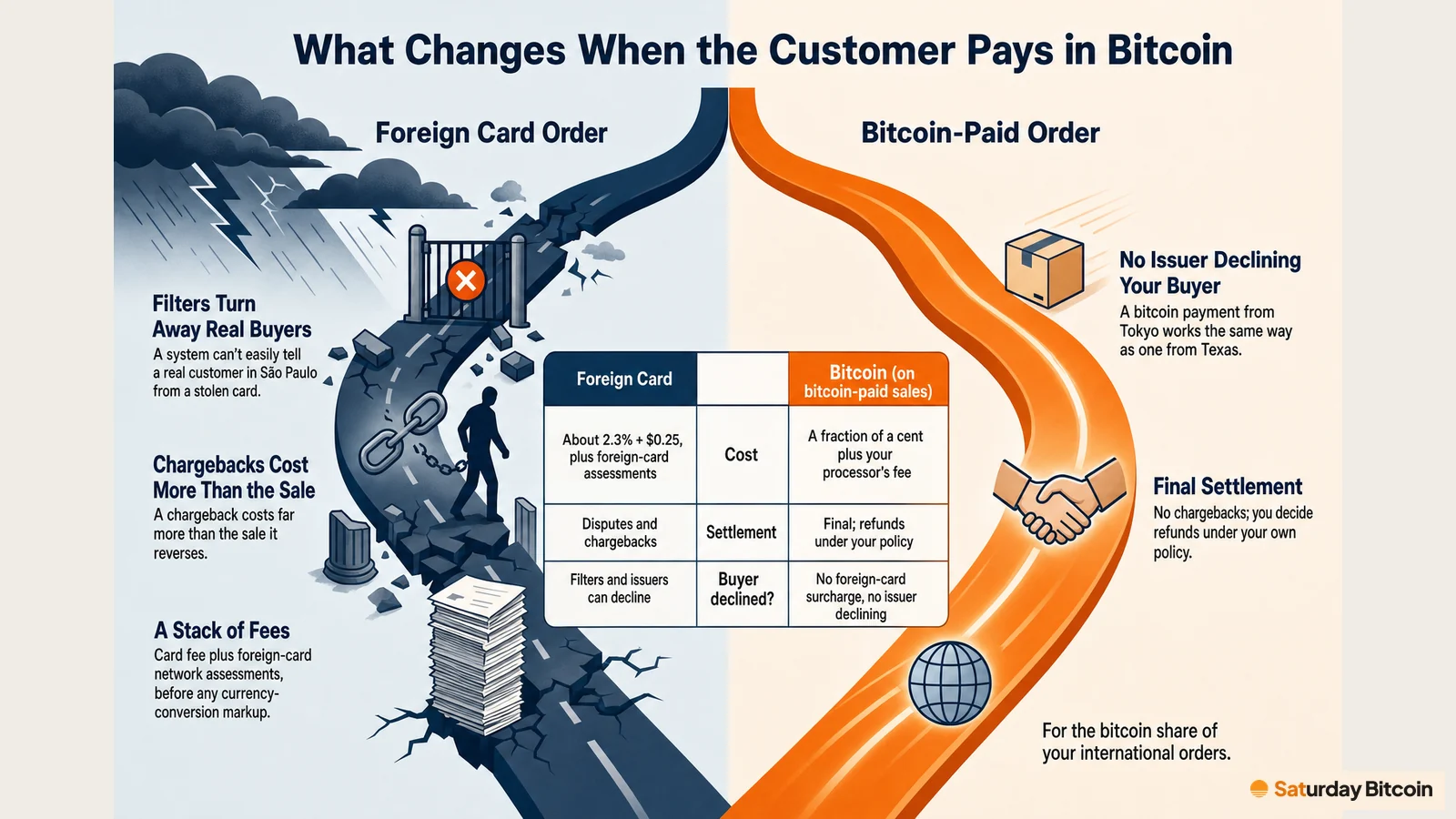
Network fees on Lightning are typically a fraction of a cent. Processors may add their own fee, often around 1%, which is still typically well below card costs. That’s especially true on cross-border sales, where card costs are highest. For the bitcoin share of your international orders, bitcoin removes the fraud and cost barriers that make merchants block whole regions.
Rails don’t create customers. Communities do.
This is where most cross-border thinking stops, and it’s where the real point begins. A cheaper, safer rail makes international trade possible. It doesn’t make it happen. Plenty of merchants technically accept bitcoin and still never hear from a Bitcoiner in Berlin, because nobody in Berlin knows they exist. (We made the domestic version of this argument in “Accepting Bitcoin Isn’t Enough.”)
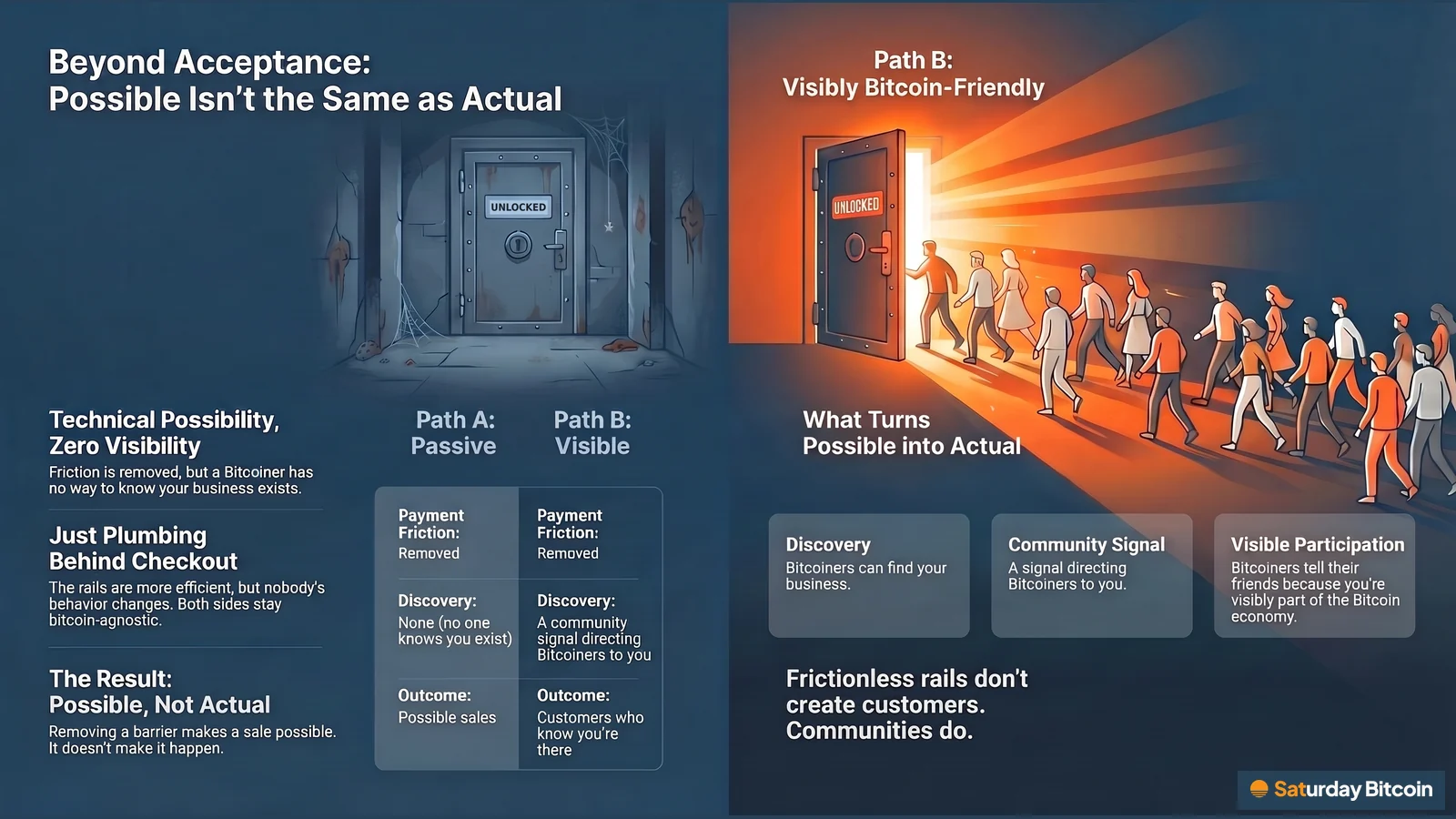
The customer arrives because the merchant is visibly welcoming to Bitcoiners in a place Bitcoiners look, and because one Bitcoiner tells another. That is identity, not plumbing. You can match a price. You can’t match an identity.
Who has the most to unlock
Global appeal, local reach: these are the merchants with the most to unlock.
- U.S. merchants who already ship abroad. The logistics are in place, and your listing can make you findable by Bitcoiners in the countries you already serve.
- Niche, specialty and artisanal brands. The specialty coffee roaster, the leather goods maker, the premium supplement brand. In fragmented categories, being the Bitcoin-friendly option can make you the name Bitcoiners in that niche recommend to each other worldwide.
- American brands with global appeal. Outdoor gear, fashion, specialty food: categories where international shoppers already seek out U.S. merchants.
- Digital goods. Software, courses, subscriptions and media face no shipping constraint at all.
- Small merchants locked out today. If cross-border card economics have kept you domestic, a bitcoin channel lets you serve Bitcoiners abroad without building an international payments stack.
An honest limit
Bitcoin solves the payment side, not the rest. Shipping, customs, duties, returns and product regulations are still yours to manage, and for physical goods they are often the largest cost of a cross-border order. The international Bitcoiner segment is a small slice of global shoppers, not a general-purpose export market. Many Bitcoiners will still pay by card, out of habit, for card rewards, to avoid tax friction, or to support you on principle, and that customer still chose you. Discovery isn’t a guarantee of volume, and because Saturday Bitcoin is a directory, not a payment processor, we can’t see your purchases. You’ll want to watch your own orders to see where they come from.
What to do now
Saturday Bitcoin helps Bitcoiners find merchants that already accept bitcoin, online and nearby, and it’s free for merchants. If you ship internationally, sell digital goods, or serve visitors in a gateway city:
- Claim your free listing at saturdaybitcoin.com/business and verify it.
- Say clearly on your listing that you ship internationally and which regions you serve.
- Add a welcome offer so a first-time Bitcoiner, domestic or international, has a reason to try you today.
Being Bitcoin-friendly abroad is a differentiator today; in time it will be expected. Category consolidation is underway at home and abroad, and the merchants Bitcoiners find first are the ones they recommend to each other.