
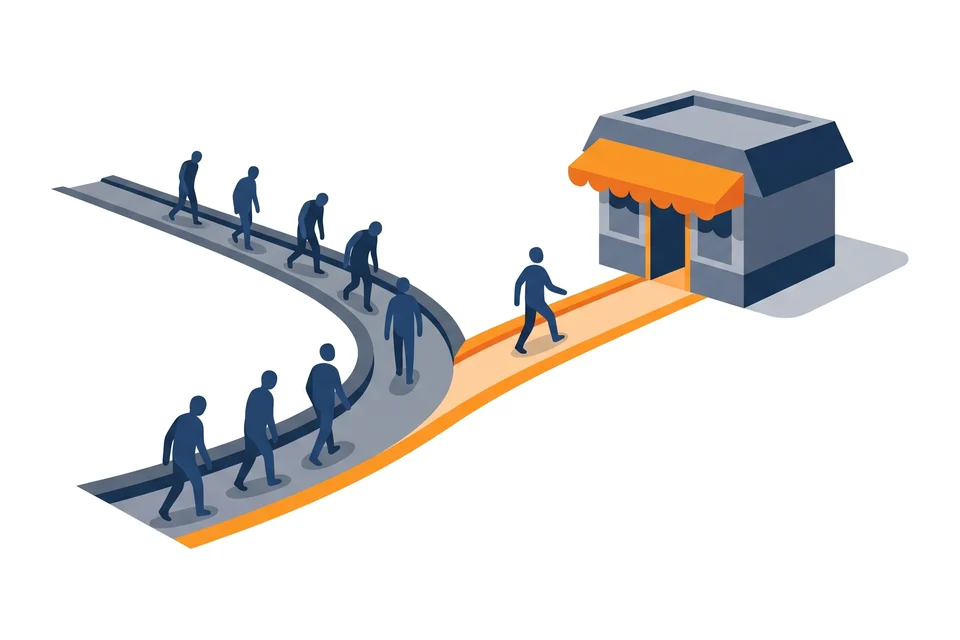

Some businesses don’t just ask customers to switch brands. They ask them to change how they do something. If that’s your business, your toughest competitor isn’t another company in your category. It’s the customer’s existing habit: comfortable, familiar, already paid for, and deeply entrenched.
Your real competitor isn’t who you think
Grocery delivery isn’t mainly competing with other delivery apps. It’s competing with the habit of driving to the store, walking the aisles and choosing your own produce. A connected home-fitness platform isn’t mainly competing with other platforms. It’s competing with the gym, the same faces and the same routine. An online course is competing with the classroom.
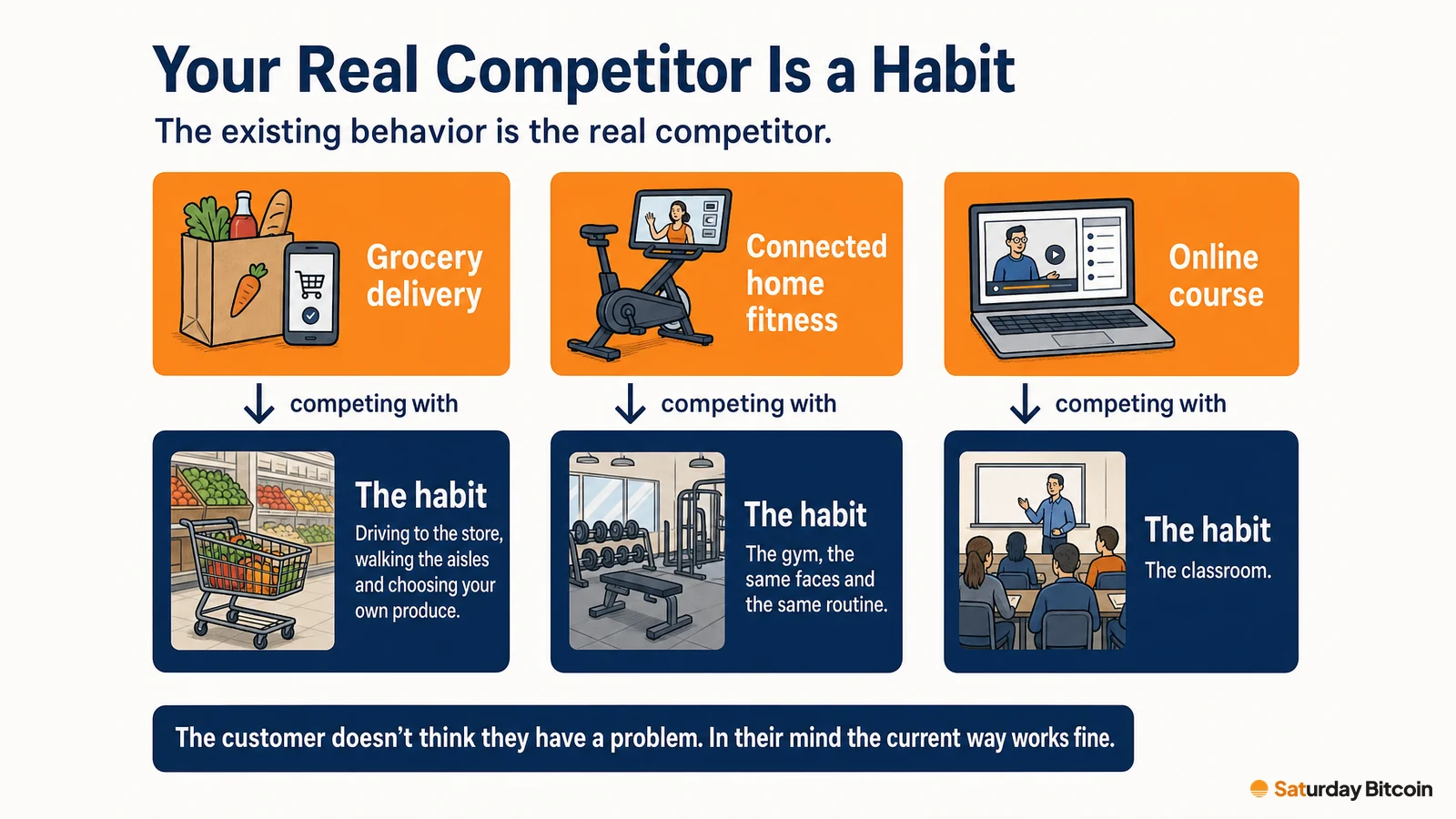
In each case the existing behavior is the real competitor. It’s woven into the customer’s week. Most importantly, the customer doesn’t think they have a problem. They aren’t looking for a better way, because in their mind the current way works fine.
Your competitor isn’t a brand. It’s a habit.
The 9x barrier
Harvard Business School professor John Gourville described the size of this problem in a 2006 Harvard Business Review article, “Eager Sellers and Stony Buyers.” People overvalue what they already have. The companies selling the new thing overvalue their own innovation. Put the two biases together and Gourville estimated a mismatch of roughly nine to one between what innovators think customers want and what customers actually value.
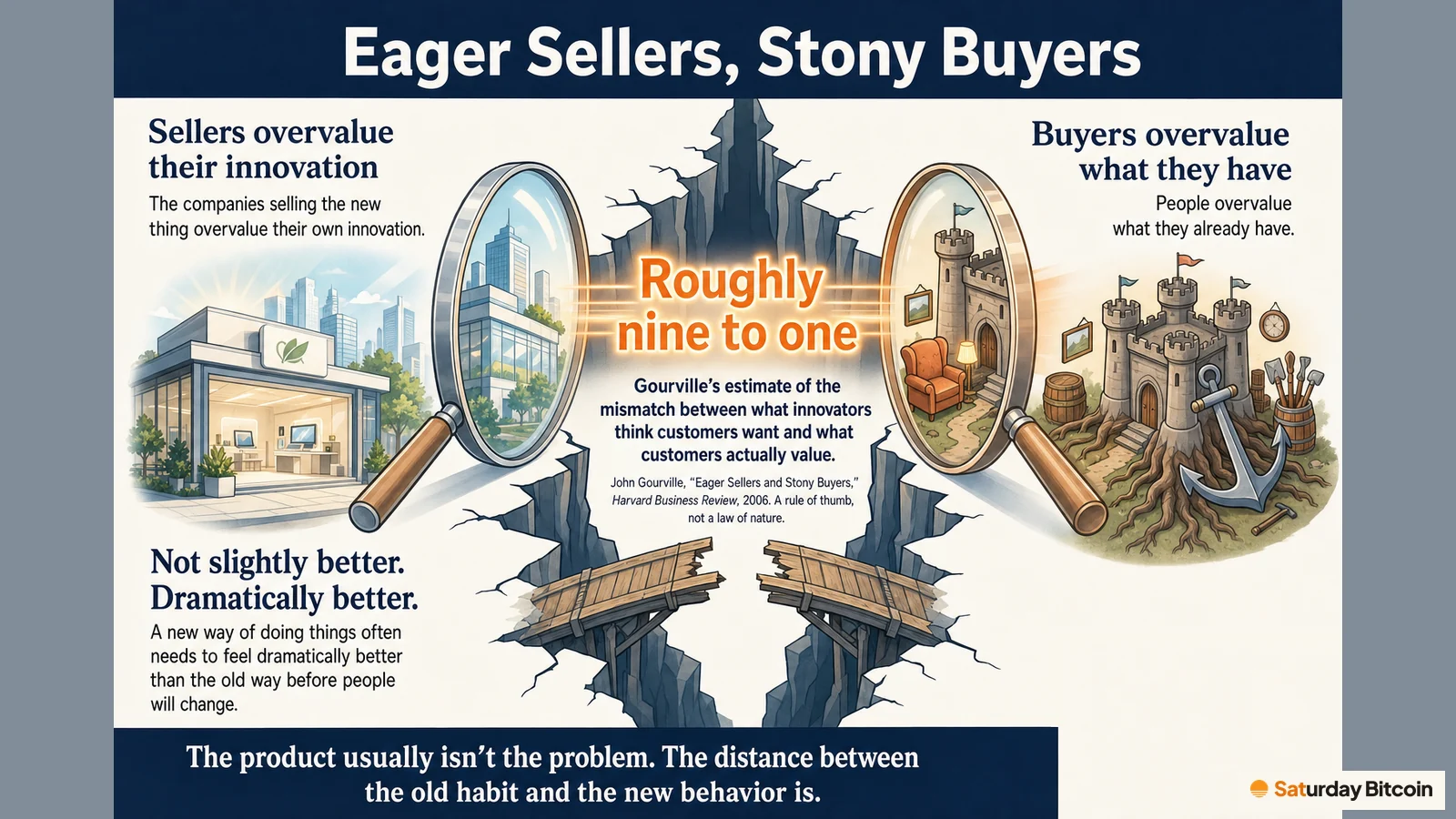
It’s a rule of thumb, not a law of nature. But the point lands for anyone who has run a behavior-change business: a new way of doing things often needs to feel dramatically better than the old way, not slightly better, before people will change. The customer doesn’t need to be convinced your product is good. They need to be convinced it’s so much better than what they already do that it’s worth the friction of changing.
That’s why behavior-change businesses spend so heavily to acquire customers. The product usually isn’t the problem. The distance between the old habit and the new behavior is.
Discounts buy the first month and lose the second
The usual answer is to subsidize the gap: free first box, 60% off the first month, a free trial. It works for trial. It rarely works for retention. Meal-kit services became the textbook case: people try the box on a promotion, enjoy it, and drift back to their old grocery and cooking routine when the deal ends.
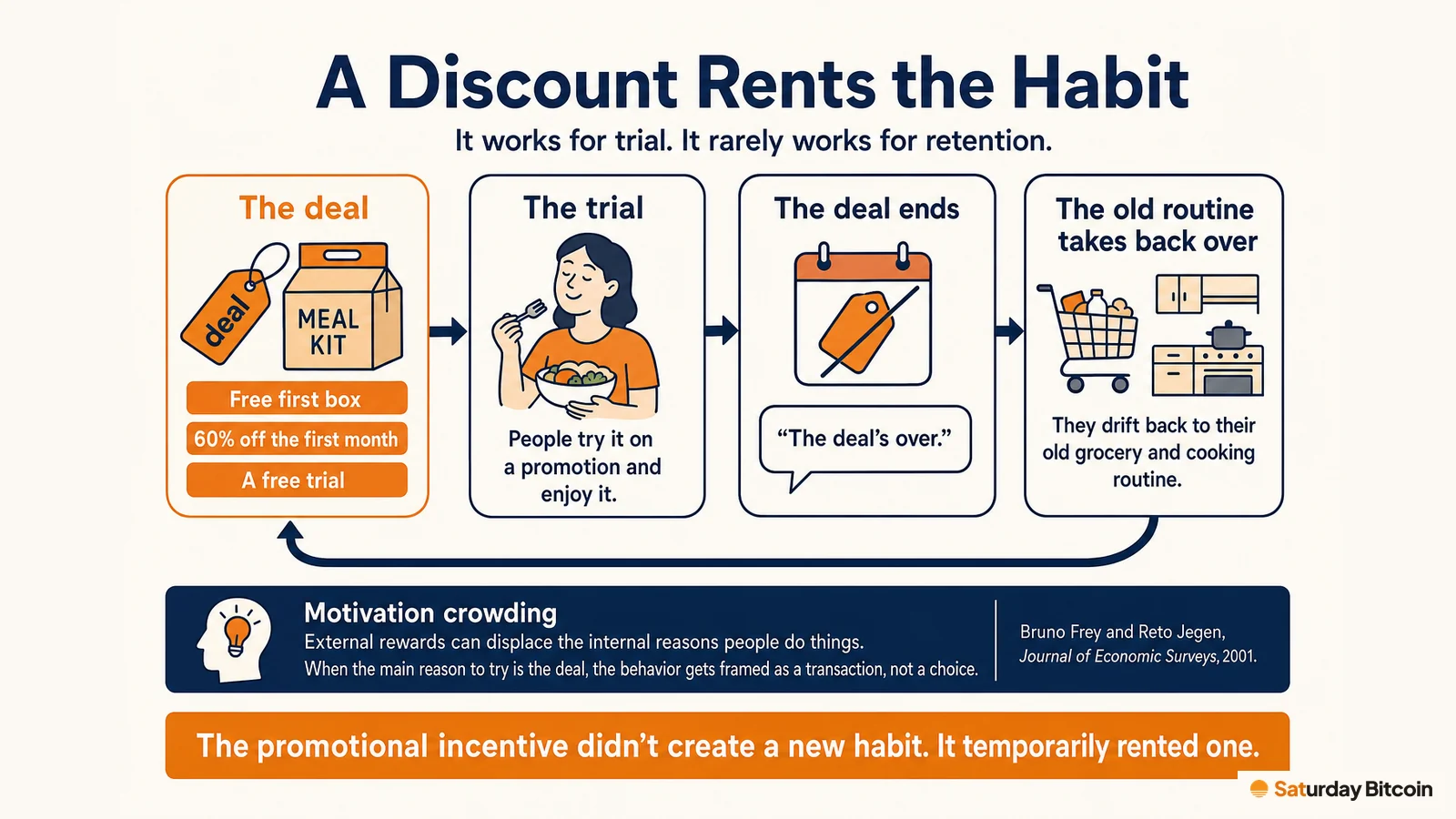
Behavioral economists have studied a related effect called motivation crowding. Bruno Frey and Reto Jegen’s 2001 review in the Journal of Economic Surveys collects evidence that external rewards can displace the internal reasons people do things. When the main reason to try something is the deal, the behavior gets framed as a transaction, not a choice. When the deal ends, the customer doesn’t think “I’ll keep going because I liked it.” They think “the deal’s over,” and the old routine takes back over.
The promotional incentive didn’t create a new habit. It temporarily rented one.
Identity works on a different axis
Bitcoiners give you a different kind of trial customer. Many committed, mission-driven Bitcoiners go out of their way to spend with merchants who welcome bitcoin. For them, trying a Bitcoin-friendly service is a way of supporting the Bitcoin economy they want to see grow. They are single-issue shoppers: in a category with a Bitcoin-friendly option, being Bitcoin-friendly can be the reason to try it first.
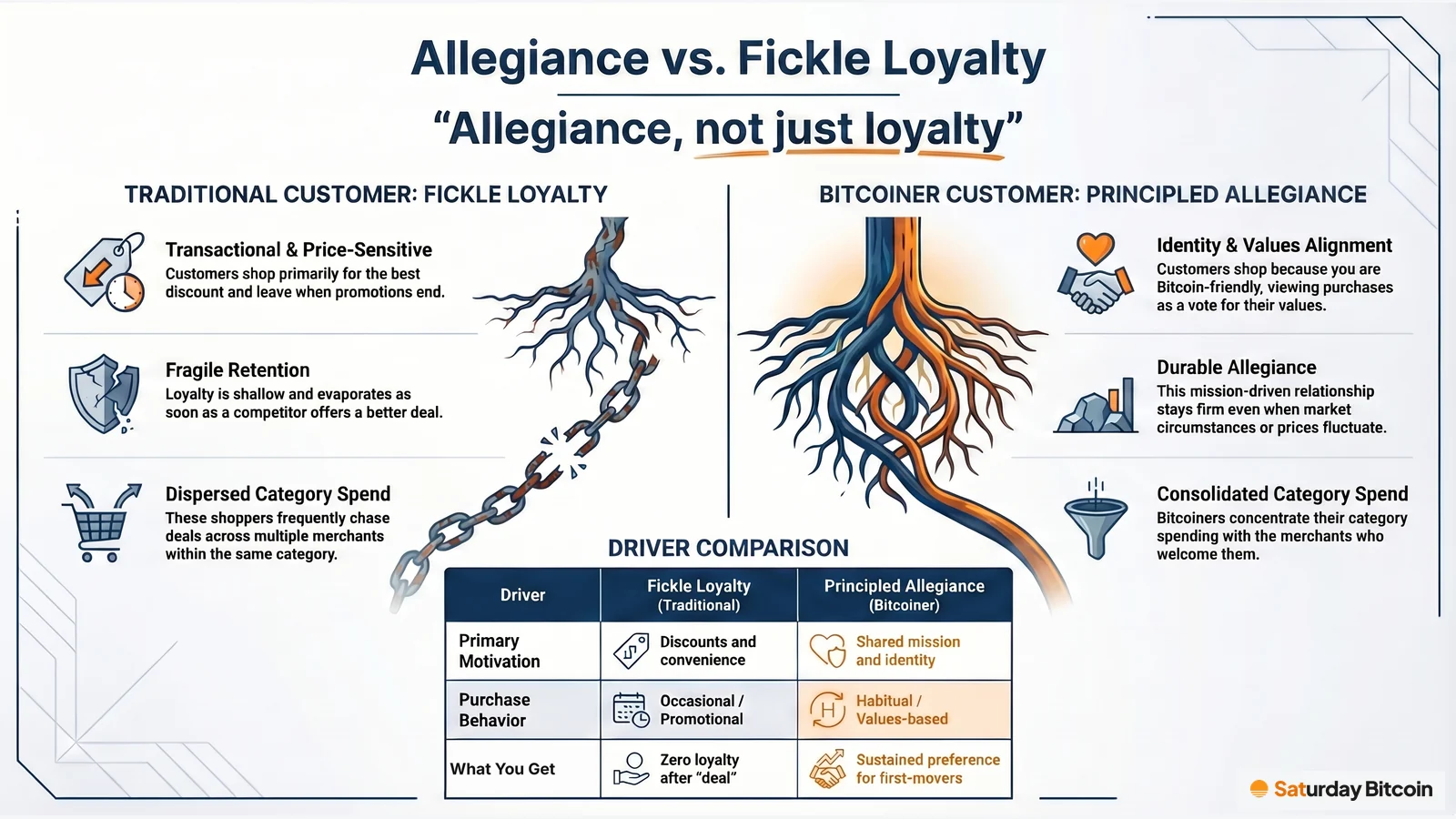
That reason doesn’t expire the way a coupon does. A Bitcoiner who tries a Bitcoin-friendly grocery delivery service isn’t renting the behavior for a promotional month. They’re making a choice that fits who they are, and identity doesn’t run out at the end of the billing cycle. They also tend to see a Bitcoin-friendly business as an ally and want it to succeed.
This doesn’t make your service nine times better. It gives a motivated group of customers a reason to try it that has nothing to do with price. To be clear, this is an argument from how this community behaves, not a measured finding; no one has yet published data comparing how often Bitcoiners stay with a new behavior against discount-acquired customers. Whatever you make of bitcoin, though, the customers themselves are real: an estimated ~1 million committed, mission-driven Bitcoiners in the U.S., and growing, within the tens of millions of Americans who own some bitcoin.
The community keeps the habit alive
The most successful behavior-change businesses learned that the product isn’t the whole product. Connected fitness showed it clearly: leaderboards, instructors and shared rides gave people a reason to keep coming back. A behavior sticks when other people reinforce it, not just when the product is good.
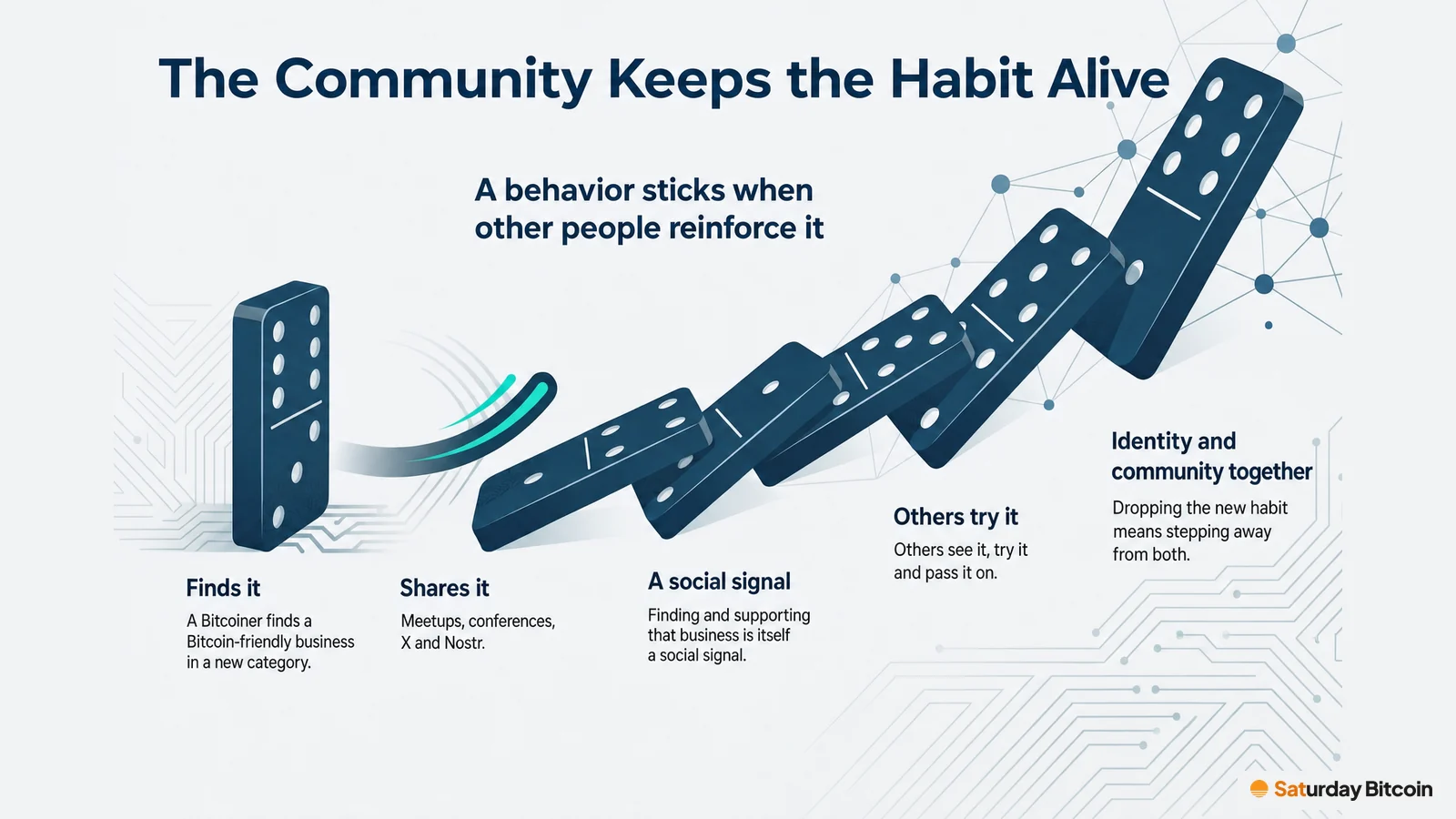
Bitcoiners are an unusually connected community, built on meetups, conferences, X and Nostr. When a Bitcoiner finds a Bitcoin-friendly business in a new category, they often share it. Finding and supporting that business is itself a social signal. Others see it, try it and pass it on. Over time, identity and community work together, and dropping the new habit means stepping away from both.
Everyday categories are where the habit forms
Earlier in my career, running loyalty programs, I saw the same pattern again and again: everyday, habitual spend such as grocery, fuel and pharmacy drives a disproportionate share of engagement, because people buy there whether they think about it or not.
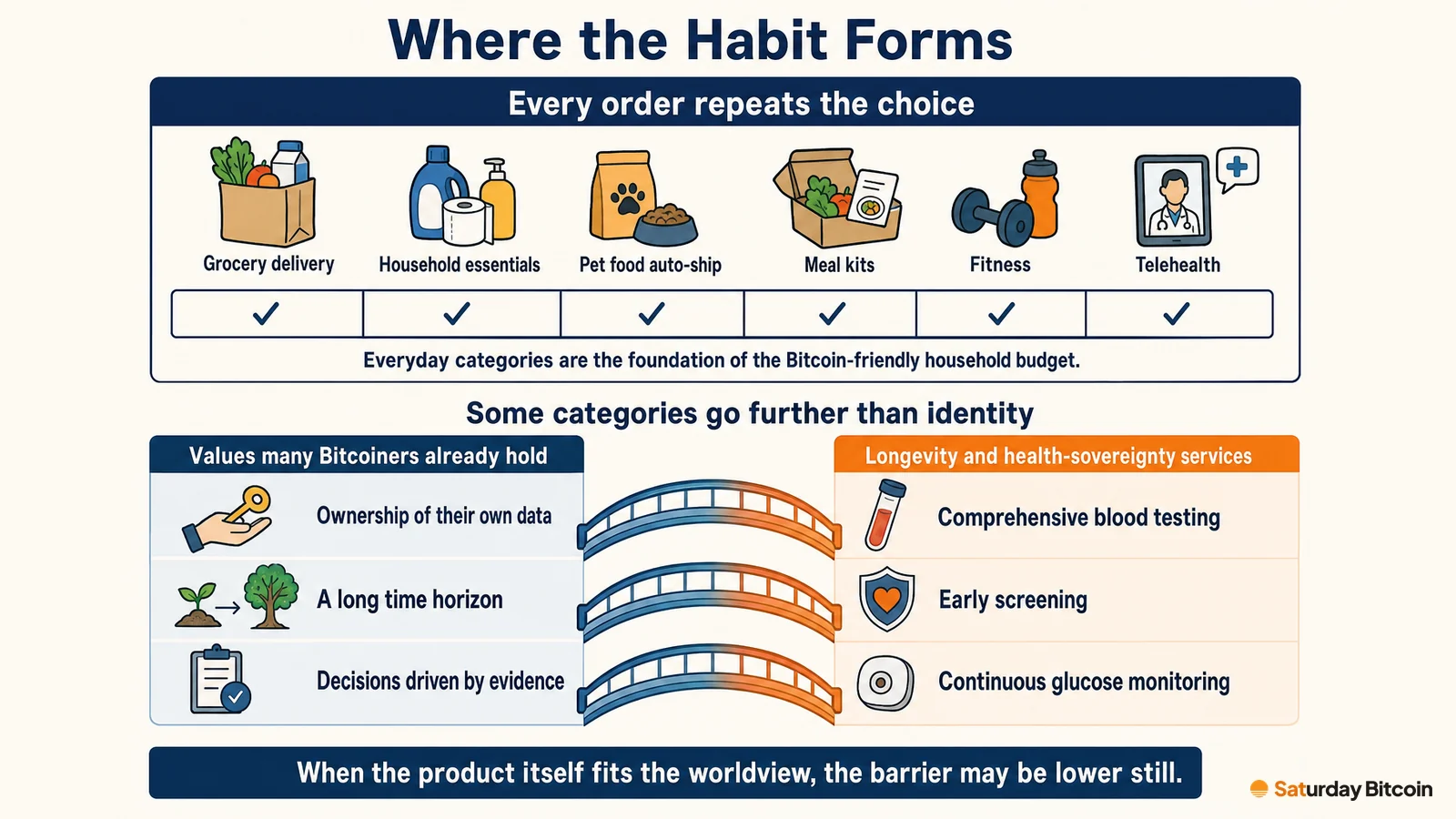
That matters for behavior-change businesses in or next to everyday categories: grocery delivery, household essentials, pet food auto-ship, meal kits, fitness, telehealth. If a Bitcoiner moves their weekly grocery order to a Bitcoin-friendly delivery service, every order repeats the choice. The service becomes part of daily life in a way a one-time discretionary purchase never does. Everyday categories are the foundation of the Bitcoin-friendly household budget, and that’s where the habit forms.
One more note. Some categories go further than identity. Longevity and health-sovereignty services (comprehensive blood testing, early screening, continuous glucose monitoring) reflect values many Bitcoiners already hold: ownership of their own data, a long time horizon, decisions driven by evidence. For those businesses the barrier may be lower still, because the product itself fits the worldview.
Where Saturday Bitcoin fits
Saturday Bitcoin is a discovery directory. It helps Bitcoiners find merchants that already accept bitcoin, online and nearby, and save and share them. If you run a behavior-change business that accepts bitcoin, the directory puts you where these customers look, a channel most of your competitors aren’t watching.
Your listing is free. Claim and verify it, tell Bitcoiners what you offer, and add a welcome offer or promo code if you like. Keep that offer modest and frame it as a welcome, not the reason to come. Given everything above about discounts, you want identity, not the coupon, to do the work.
When customers pay in bitcoin, they arrive on your cheapest rail: lower processing costs, final settlement, no chargebacks; you decide refunds. Many Bitcoiners still pay by card out of habit, for card rewards or for tax reasons, and that customer still counts toward the habit you’re building.
Be clear-eyed about the limits. The segment is small next to the mass market. A listing is discovery, not a guarantee of volume, and Saturday Bitcoin can’t see your sales, so measure trial and repeat orders yourself. Identity gets someone to try you. Your service still has to be good enough to keep them.
What to do next
If your business asks people to change a habit, you face the 9x barrier every day, and discounts alone won’t get you across. Give the customers most motivated to try you a way to find you. Few behavior-change businesses are visibly Bitcoin-friendly yet; that won’t last.