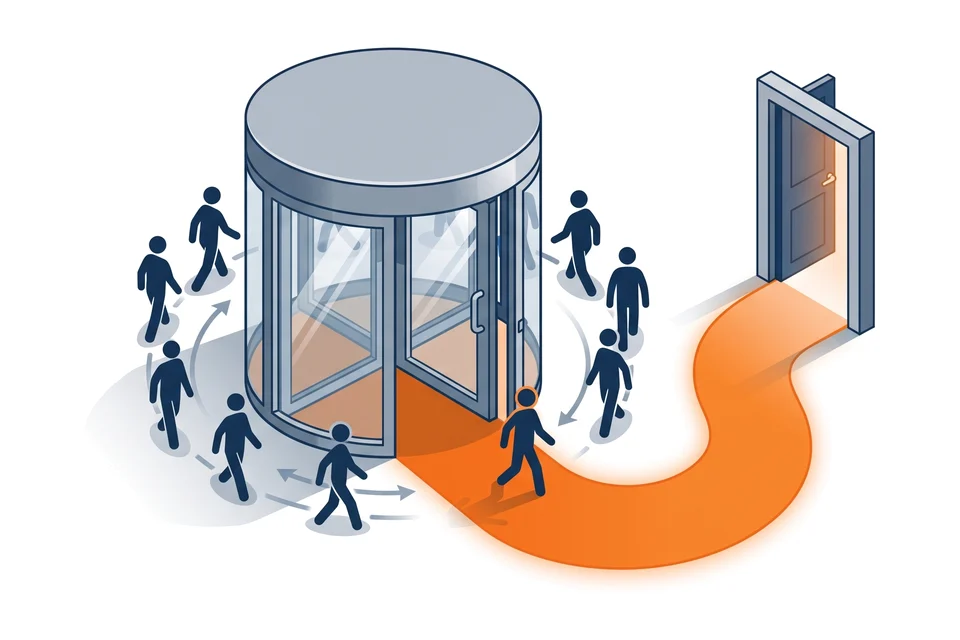


Every merchant understands customer acquisition. You run campaigns, optimize spend, and compete for consumers who are already shopping in your category. The goal is to redirect existing demand toward your business and away from competitors.
That’s a reasonable strategy, and it’s where most conversations about Bitcoiners start. There are an estimated ~1 million committed, mission-driven Bitcoiners in the U.S., and growing. Many of them look for the Bitcoin-friendly option in a category before they look anywhere else.
But redirecting existing demand is only the beginning. The Bitcoiner’s psychology adds effects that go beyond simple merchant preference: ideological motivation, identity-driven purchasing, wealth that has grown for many long-term holders (past performance is no guarantee), and a deep desire to support the emerging Bitcoin economy. Bitcoiners don’t just switch brands. They change how, when and whether they buy.
Bitcoiners don’t just switch brands. They change how, when and whether they buy.
Five levels of demand
Not all customer acquisition is created equal. How a customer arrives determines how valuable they will be: the motivation behind their decision, the friction they overcame, and the alternatives they rejected. Bitcoiner demand shows up at five progressively more powerful levels.
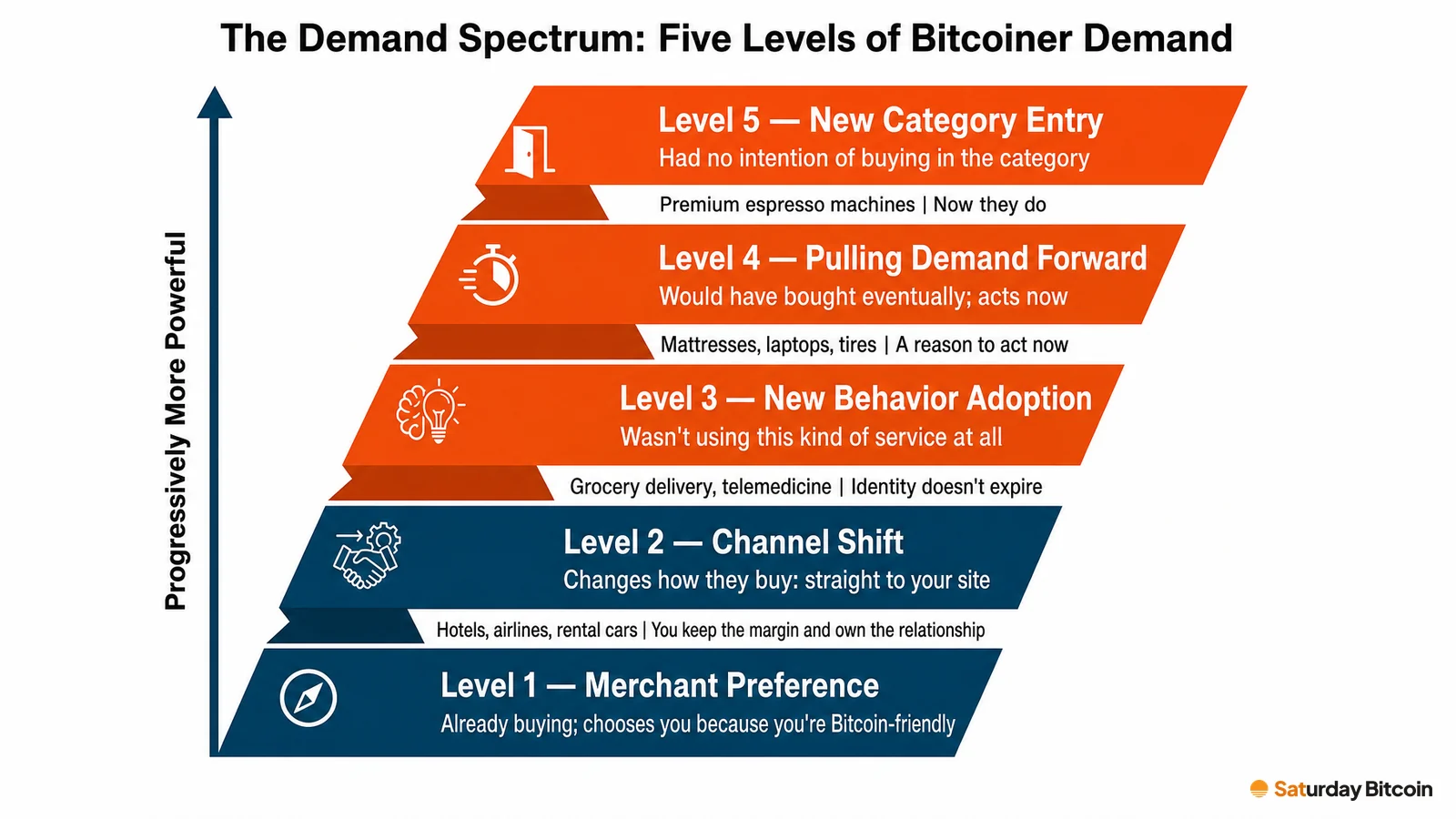
Level 1: Merchant preference. The customer was already buying, or ready to buy, in your category. A Bitcoiner needs running shoes, vitamins or a VPN. They were going to buy from someone, and they choose you because you’re Bitcoin-friendly. That motivation is about identity, not price, and it persists after the first purchase. As I wrote in You Can Match a Price. You Can’t Match an Identity., a competitor can match your discount, but not that.
Level 2: Channel shift. The customer was already buying, but they change how they buy. Hotels, airlines and rental-car firms lose margin and the customer relationship to aggregators: online travel agency commissions commonly run 15% or more of the booking. “Book direct” campaigns have struggled because the aggregator’s convenience usually wins. A Bitcoiner doesn’t start on the aggregator. They start by looking for the Bitcoin-friendly option, then go straight to your site. You keep the margin and own the relationship, and you get a natural moment to enroll them in your loyalty program.
Level 3: New behavior adoption. The customer wasn’t using this kind of service at all. Grocery delivery competes with the habit of driving to the store. Telemedicine competes with the familiar office visit. Harvard Business School’s John Gourville described a nine-to-one mismatch: sellers overvalue their innovation and consumers overvalue what they already have. Subsidies can buy a trial, but customers drift back when the promotion ends. Identity doesn’t expire.
Level 4: Pulling demand forward. The customer would have bought eventually, but not for months or years. The Bitcoin-friendly option gives them a reason to act now.
Level 5: New category entry. The customer had no intention of buying in the category at all, and now they do.
Many customers are postponing purchases
Level 4 matters because deferral is a structural feature of every durable-goods category. People know the mattress is past its best, the laptop is slowing down and the tires are worn. The product still works, deferring feels like saving money, and so the purchase waits until something breaks. As one recent sign of how readily people defer, a J.D. Power survey of 4,000 U.S. consumers, fielded in April 2026, found that 62% had delayed a bigger purchase in the previous month as everyday costs rose.
The industry’s standard answer is urgency: limited-time sales, seasonal promotions, countdown timers. But a “Sale ends Sunday” message doesn’t make the consumer feel urgent. When urgency mechanics do work, they mostly attract price-sensitive buyers who were already comparison-shopping. They redistribute existing demand among competitors. The pie doesn’t grow.
A Bitcoin-friendly option is a reason to stop postponing
When a Bitcoiner finds a Bitcoin-friendly merchant in a category where they have a deferred need, the purchase becomes a chance to do something they care about. Supporting the Bitcoin economy is something they want to do now, not in six months. The urgency is organic: it comes from their own convictions, not from a countdown timer.
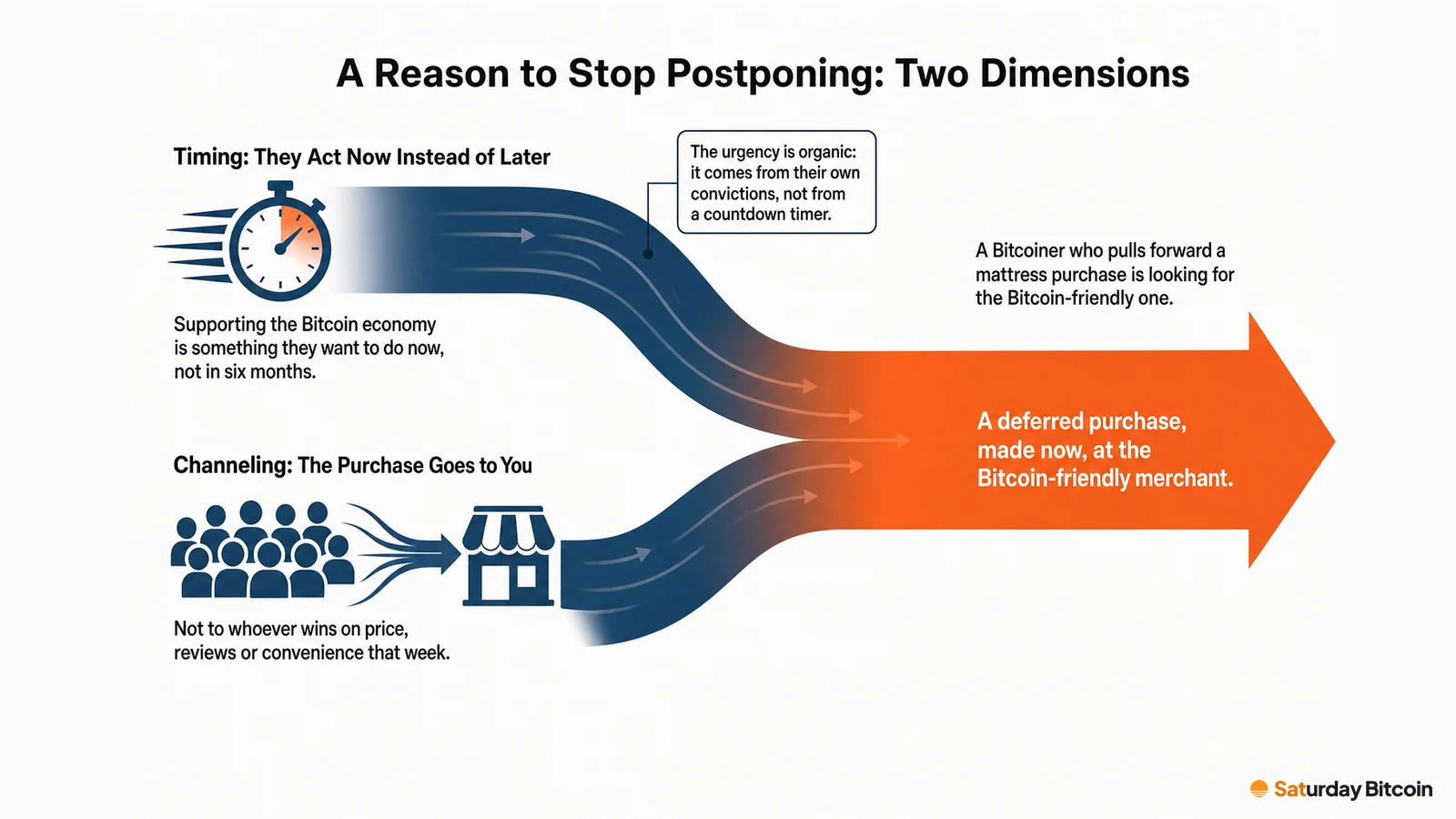
The effect has two dimensions. The first is timing: they act now instead of later. The second is channeling: the purchase goes to you specifically, rather than to whoever wins on price, reviews or convenience that week. A Bitcoiner who pulls forward a mattress purchase isn’t looking for the cheapest mattress. They’re looking for the Bitcoin-friendly one.
Growing wealth, looking for places to spend it
Level 5 is the most unusual. Consider a Bitcoiner who has never thought much about specialty coffee equipment. Then they discover that a premium espresso-machine merchant is Bitcoin-friendly. The product looks intriguing. Their bitcoin holdings have grown, so what once felt extravagant now feels within reach. And buying from a Bitcoin-friendly merchant in a new category reinforces their identity and their role in growing the Bitcoin economy. No single one of those conditions would have been enough. Together they turn a vague interest into a purchase. That buyer wasn’t in anyone’s funnel. They had searched for nothing, so no search ad, retargeting campaign or affiliate program could have found them.
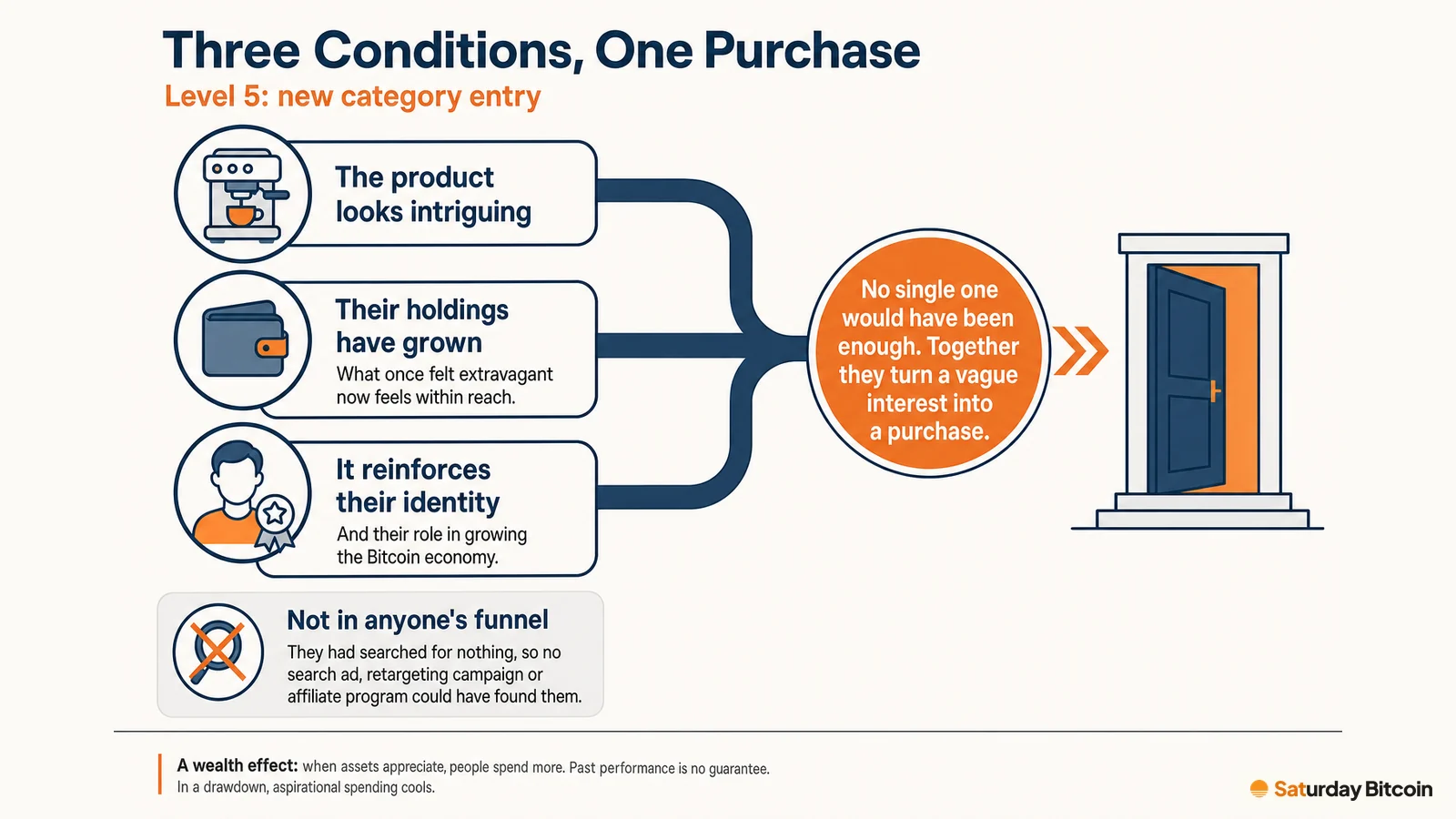
Economists call this a wealth effect: when assets appreciate, people spend more, including in new categories. For Bitcoiners it is more directed, because many are actively looking for Bitcoin-friendly merchants to support. Bitcoin has historically appreciated over multi-year periods, but past performance is no guarantee. The effect cuts both ways: in a drawdown, aspirational spending cools.
The higher the level, the better the customer
Conventional marketing operates on expressed intent. Someone searches, and you pay to intercept them. That works at Level 1 and partly at Level 2. It has no mechanism for Levels 3 through 5, because those customers haven’t generated any signal of intent to intercept.
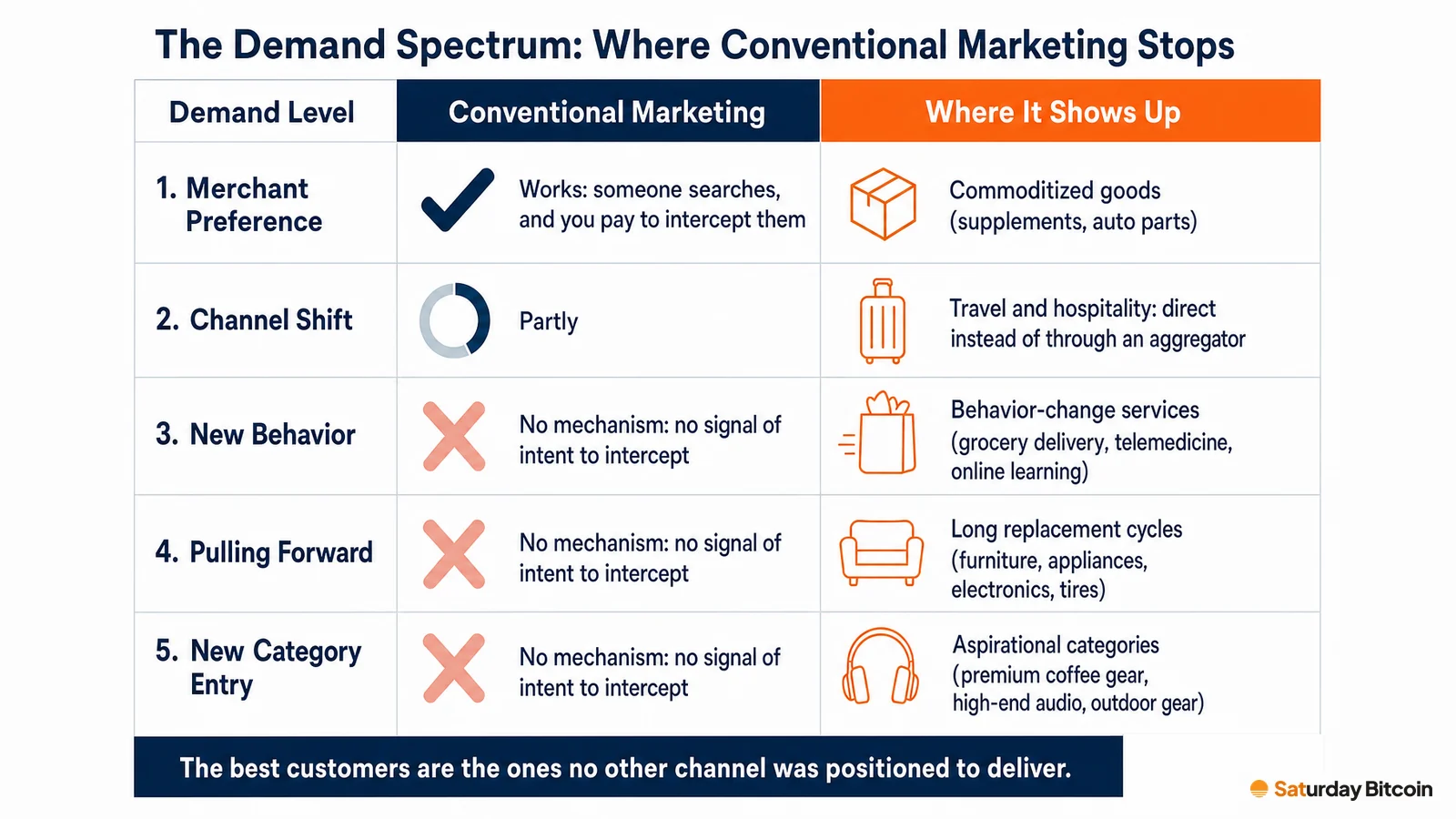
So the further up the spectrum, the more valuable and exclusive the customer. The best customers are the ones no other channel was positioned to deliver. Much of that demand is likely incremental. Level 4 is partly a timing shift, since some of those customers would have bought eventually, but even then the purchase came sooner and came to you.
Most merchants will find Bitcoiner demand operating at several levels at once:
- Commoditized goods (supplements, auto parts): mostly Level 1, a reason to choose you that has nothing to do with price.
- Travel and hospitality: Level 2, direct instead of through an aggregator.
- Behavior-change services (grocery delivery, telemedicine, online learning): Level 3.
- Long replacement cycles (furniture, appliances, electronics, tires): Level 4.
- Aspirational categories (premium coffee gear, high-end audio, outdoor gear): Levels 4 and 5.
What we won’t overclaim
We’re still learning how big this is. Nobody has measured how much Bitcoiner demand gets pulled forward, and we won’t put a number on it until we can stand behind one. Demand also doesn’t come from zero. A Bitcoiner with no interest in premium audio isn’t going to buy a $5,000 amplifier because you’re Bitcoin-friendly. The product still has to be compelling and the experience still has to be good. And Saturday Bitcoin can’t see purchases, so the best measure of this is your own sales data.
Where Saturday Bitcoin fits today
Levels 1 and 2 start with being found. Saturday Bitcoin is a free discovery directory that helps Bitcoiners find merchants that already accept bitcoin, online and nearby. When a Bitcoiner looks for the Bitcoin-friendly option in your category, your listing is how they find you, and it sends them straight to you, not to a middleman. As I argued in Accepting Bitcoin Isn’t Enough, accepting bitcoin isn’t the same as being found.
Levels 3 through 5 come from identity and from wealth that has grown for many long-term holders (past performance is no guarantee), and they build over time.
When they pay in bitcoin, they arrive on your cheapest rail: lower processing costs, final settlement, no chargebacks, and you decide refunds. Many will still pay by card out of habit, for card rewards or for tax reasons, and that sale counts just the same.
There’s much more we can build around merchants and spending over time, but we’ll talk about those products when they’re ready to use.
Your next step
You don’t need a view on bitcoin to act on this; the customers are real. Ask where your category sits on the spectrum, then make sure Bitcoiners can find you. Claim your free listing at saturdaybitcoin.com/business. It’s free, quick and reversible.