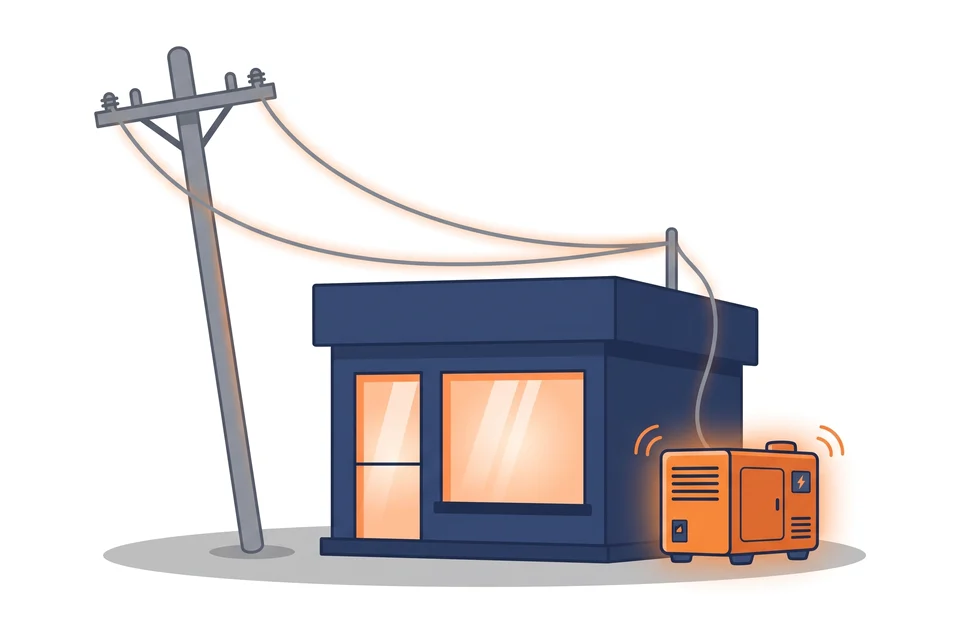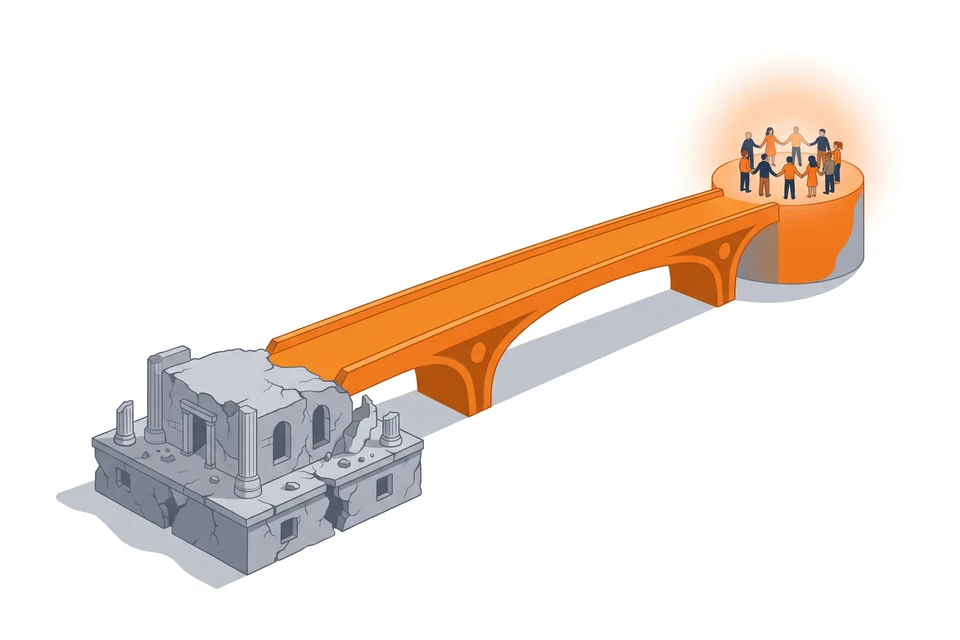
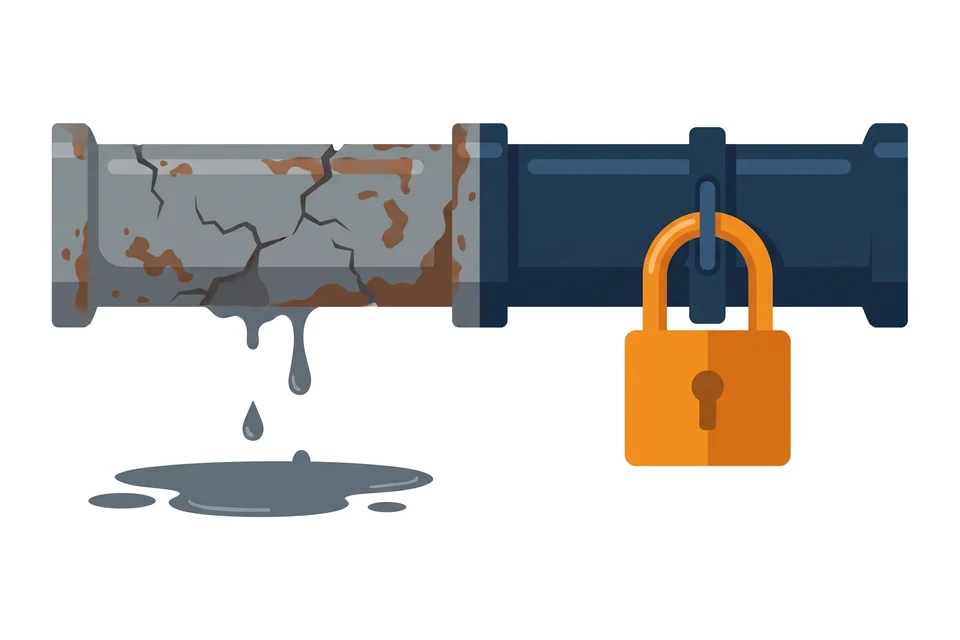

Chargebacks and fraud are among the largest hidden costs in modern commerce. Most merchants accept them as an unavoidable cost of doing business. On the sales you take in bitcoin, they aren’t.
The scale of the problem
If you accept credit cards, you’re absorbing fraud and chargeback losses, whether you track them closely or not. Mastercard estimates that about 261 million chargebacks will be filed worldwide in 2025, rising to 324 million a year by 2028. It also estimates that roughly 45% of merchant chargeback volume is fraudulent.
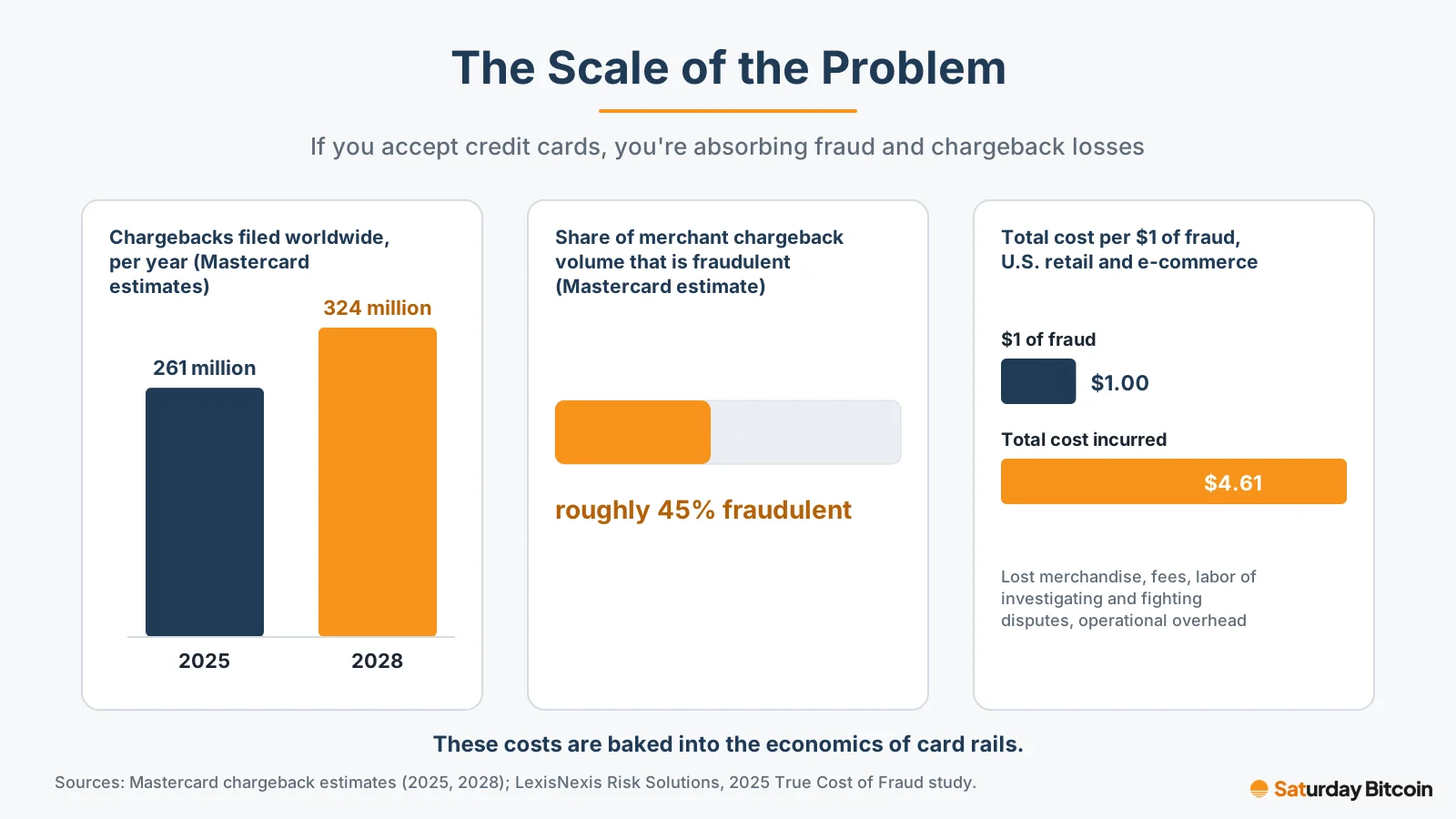
The face value of a disputed sale is only the start. LexisNexis Risk Solutions’ 2025 True Cost of Fraud study found that U.S. retail and e-commerce merchants incur an average of $4.61 in total cost for every $1 of fraud. That total includes the lost merchandise, the fees, the labor of investigating and fighting disputes, and the operational overhead.
On bitcoin sales there are no chargebacks. Not fewer: none.
These costs are baked into the economics of card rails. Every merchant who accepts cards pays for fraud tools, chargeback management and the losses that slip through anyway.
Friendly fraud: the dispute as a refund button
Criminal fraud is what most merchants picture: stolen card numbers, identity theft, phishing. The more insidious category is “friendly fraud.” A customer makes a legitimate purchase, receives the product, then disputes the charge to get their money back while keeping what they bought.
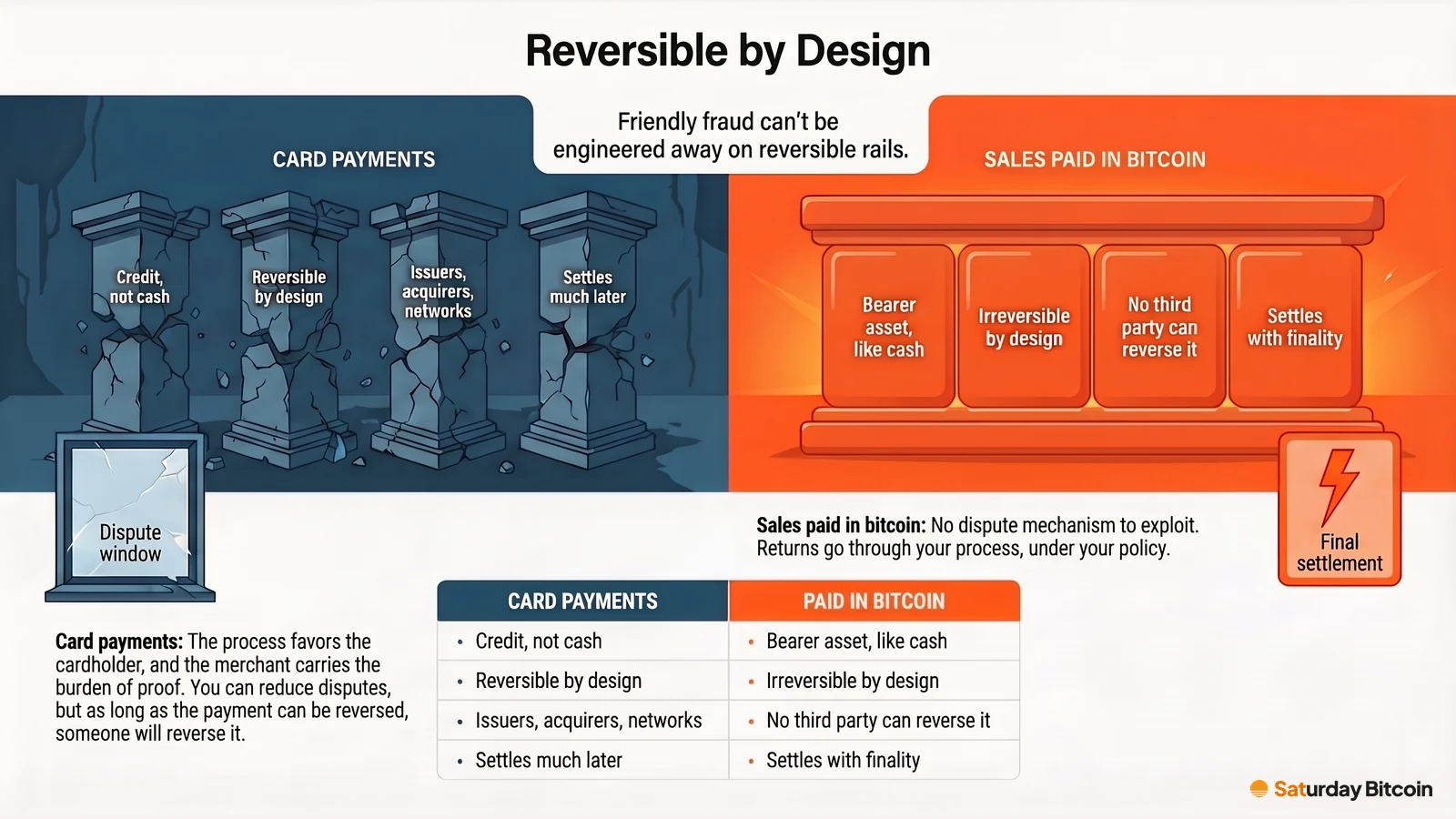
Disputing a charge has become a consumer convenience as much as a fraud protection. The process favors the cardholder, and the merchant carries the burden of proof through “representment.” Merchants lose a large share of the disputes they fight.
Friendly fraud can’t be engineered away on reversible rails. Card payments are credit, not cash, and they don’t truly settle until much later. They are reversible by design. They pass through issuers, acquirers and networks whose first customer is the cardholder, not you. You can reduce, manage and mitigate disputes, but as long as the payment can be reversed, someone will reverse it.
Card-not-present is structural
The problem is sharpest online. Card-not-present transactions have no chip, no signature and no face-to-face moment, so there is less to verify and less evidence when a dispute arrives. In-store, card-present sales carry much less fraud risk. If you run a café, chargebacks probably aren’t your biggest worry.
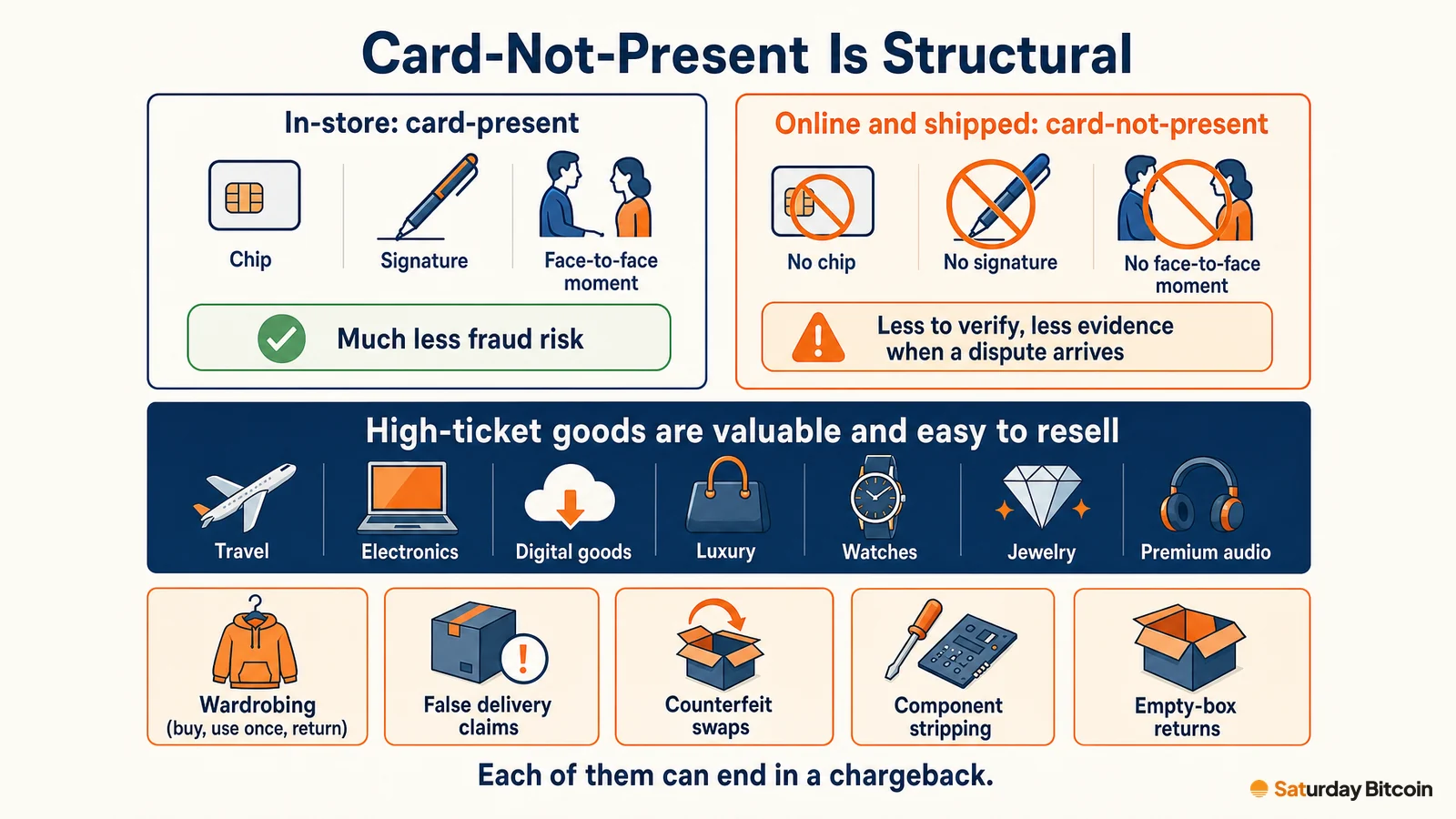
For high-ticket merchants selling online and shipping, they are. Travel, electronics, digital goods, luxury, watches, jewelry and premium audio attract both organized fraud and individual abuse, because the goods are valuable and easy to resell. The tactics include “wardrobing” (buy, use once, return), false delivery claims, counterfeit swaps, component stripping and empty-box returns. Each of them can end in a chargeback.
Same percentages, different dollars
Card fees are percentages, so they scale with the ticket. Online card payments average about 2.3% plus $0.25 on Visa, Mastercard and Discover, and about 3% plus $0.25 on American Express. Premium rewards cards, the ones affluent customers carry, typically cost more to process than basic cards. The more affluent the customer, the more expensive the transaction.
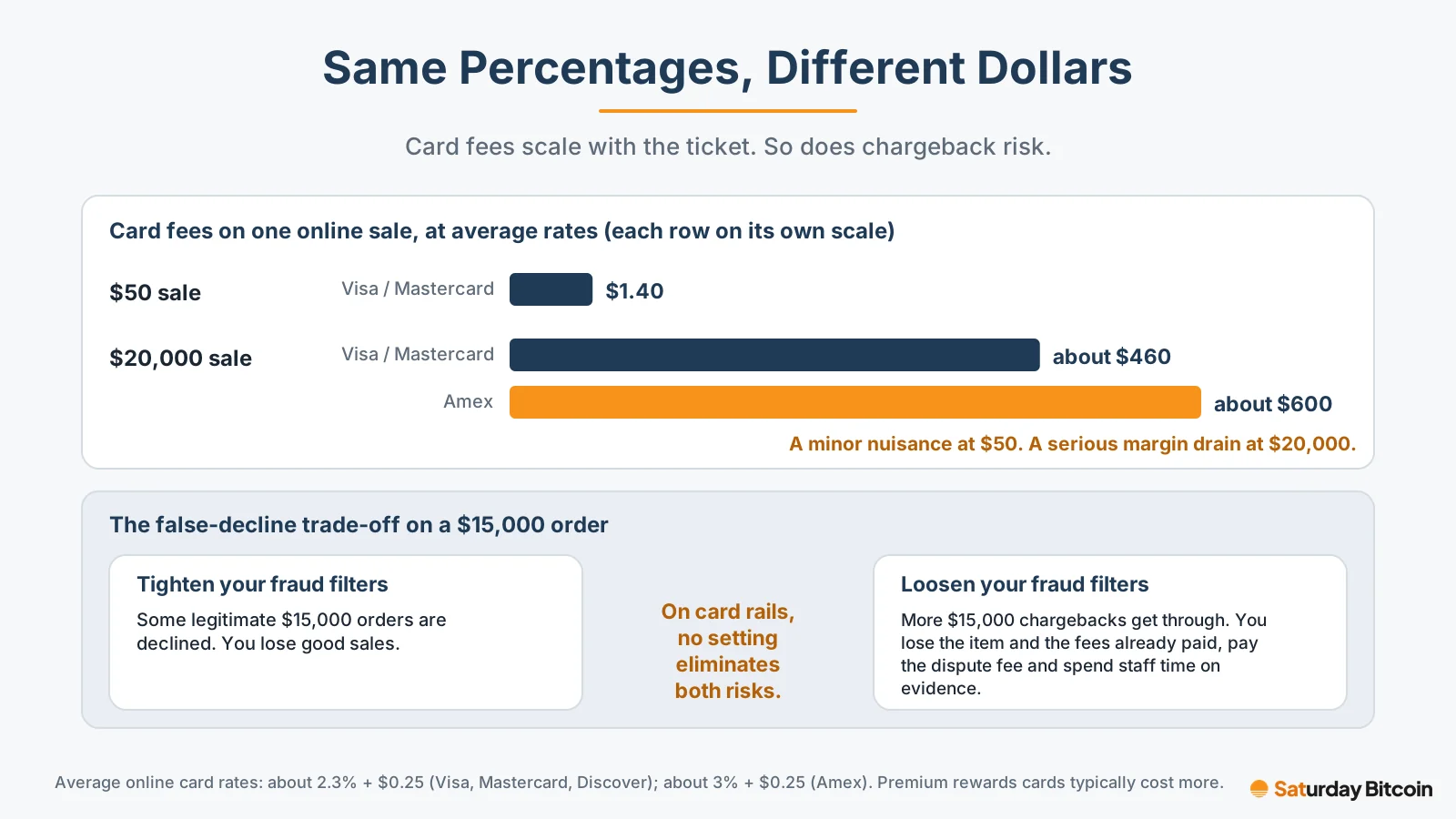
Illustration: at those averages, a $50 online sale costs the merchant about $1.40 in fees. A $20,000 sale costs about $460 on Visa or Mastercard and about $600 on Amex. Those are the same percentages, producing a minor nuisance at $50 and a serious margin drain at $20,000.
Chargebacks scale the same way. At general retail price points, friendly fraud is a volume problem: high frequency, low per-incident impact. At high-ticket price points, a single chargeback can erase the profit from dozens of legitimate sales. The merchant loses the item and the fees already paid, pays the dispute fee, spends staff time on evidence, and risks seeing the same tactic repeated.
There’s also a cost high-ticket merchants feel but rarely quantify: false declines. Filters tuned to stop a $15,000 chargeback will also block some legitimate $15,000 orders. Tighten them and you lose good sales; loosen them and you take on more chargebacks. On card rails, no setting eliminates both risks.
Final settlement: not fewer chargebacks, none
Bitcoin works differently. It is a bearer asset, like cash. When a customer pays you in bitcoin, the payment settles with finality. There is no IOU, no credit extended and no window for a third party to reverse it.
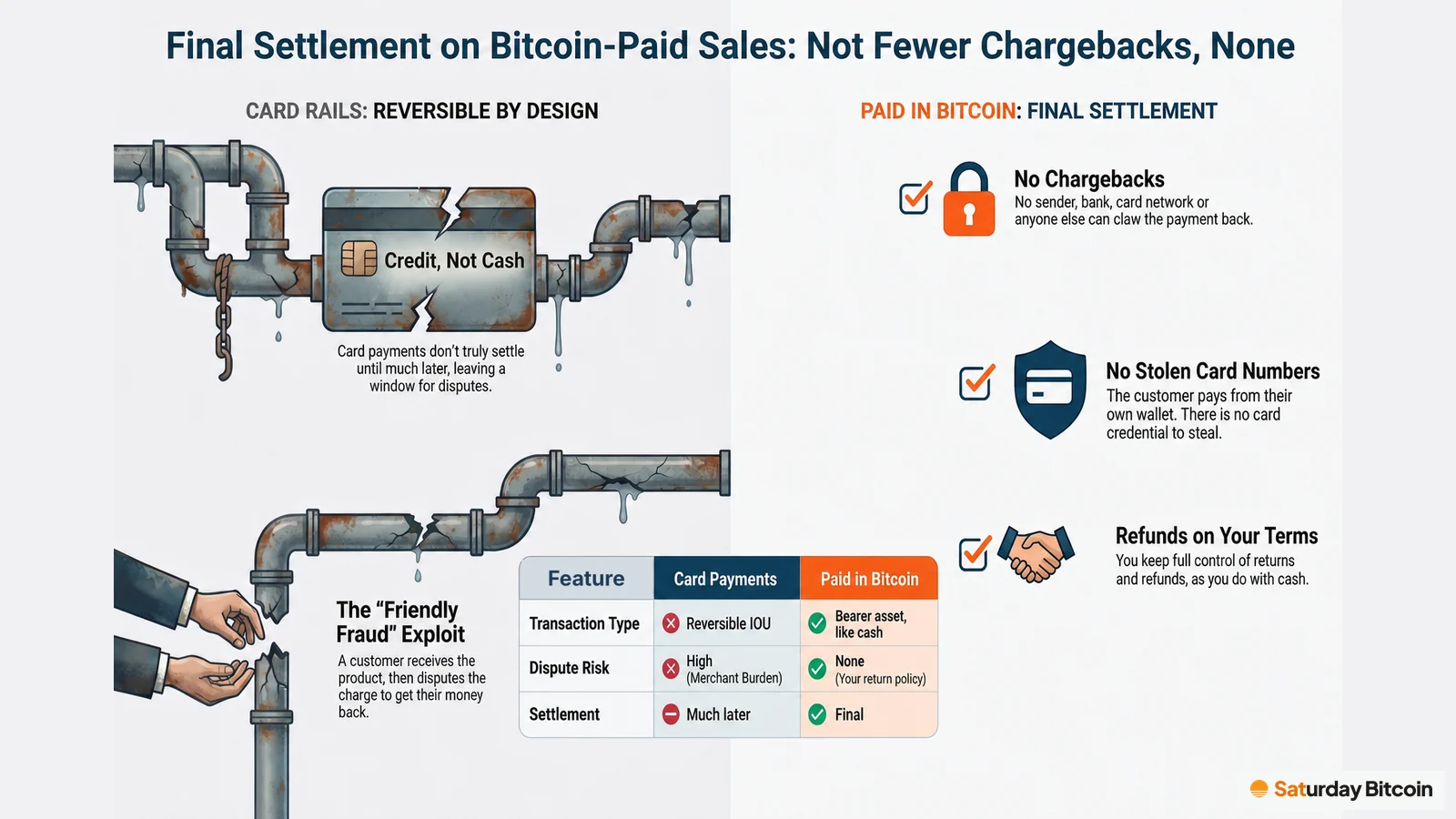
On bitcoin sales there are no chargebacks. Not fewer: none. No sender, bank, card network or anyone else can claw the payment back. That changes several things at once:
- No friendly fraud on that sale. Friendly fraud needs a dispute mechanism to exploit, and there isn’t one. A customer who wants to return something goes through your return process, under your policy.
- No stolen card numbers. The customer pays from their own wallet, so there’s no card credential to steal and no CNP card-fraud vector. It is like being paid in cash, but over the internet.
- No reason to decline a good order for fear of reversal. A $20,000 sale settled in bitcoin can’t be reversed, so there’s no chargeback risk to screen for on that payment.
- Lower processing costs. Lightning network fees are typically a fraction of a cent. Processors may add their own fee, but the total is typically well below card costs.
None of this means customers lose recourse for genuine problems. You keep full control of returns and refunds, as you do with cash. The difference is that refunds happen at your discretion, through your customer service, and no third party can override your judgment and take money from your account.
In high-fraud categories, every sale that settles in bitcoin is a sale that can’t be charged back.
The honest limits
Final settlement applies only to sales actually paid in bitcoin. Many Bitcoiners still pay by card, out of habit, for card rewards, because of tax friction, or to support the merchant on principle. You still won that customer, but you’ll need your card fraud tools for those sales as long as you take cards. Other scams, such as social engineering around refunds, still exist. And very large payments may settle on-chain rather than over Lightning, so check with your processor how it handles five-figure payments.
The customer you’re built for, already looking for you
The payment economics would matter even if Bitcoiners arrived through ordinary channels. They don’t. Bitcoiners are single-issue shoppers: in category after category, they look first for the merchant who accepts bitcoin. Many value craftsmanship, authenticity and long-term quality over promotional pricing, which is the profile high-ticket merchants are built to serve. We estimate there are about 1 million committed, mission-driven Bitcoiners in the U.S., and the number is growing. Tens of millions of Americans own some bitcoin.
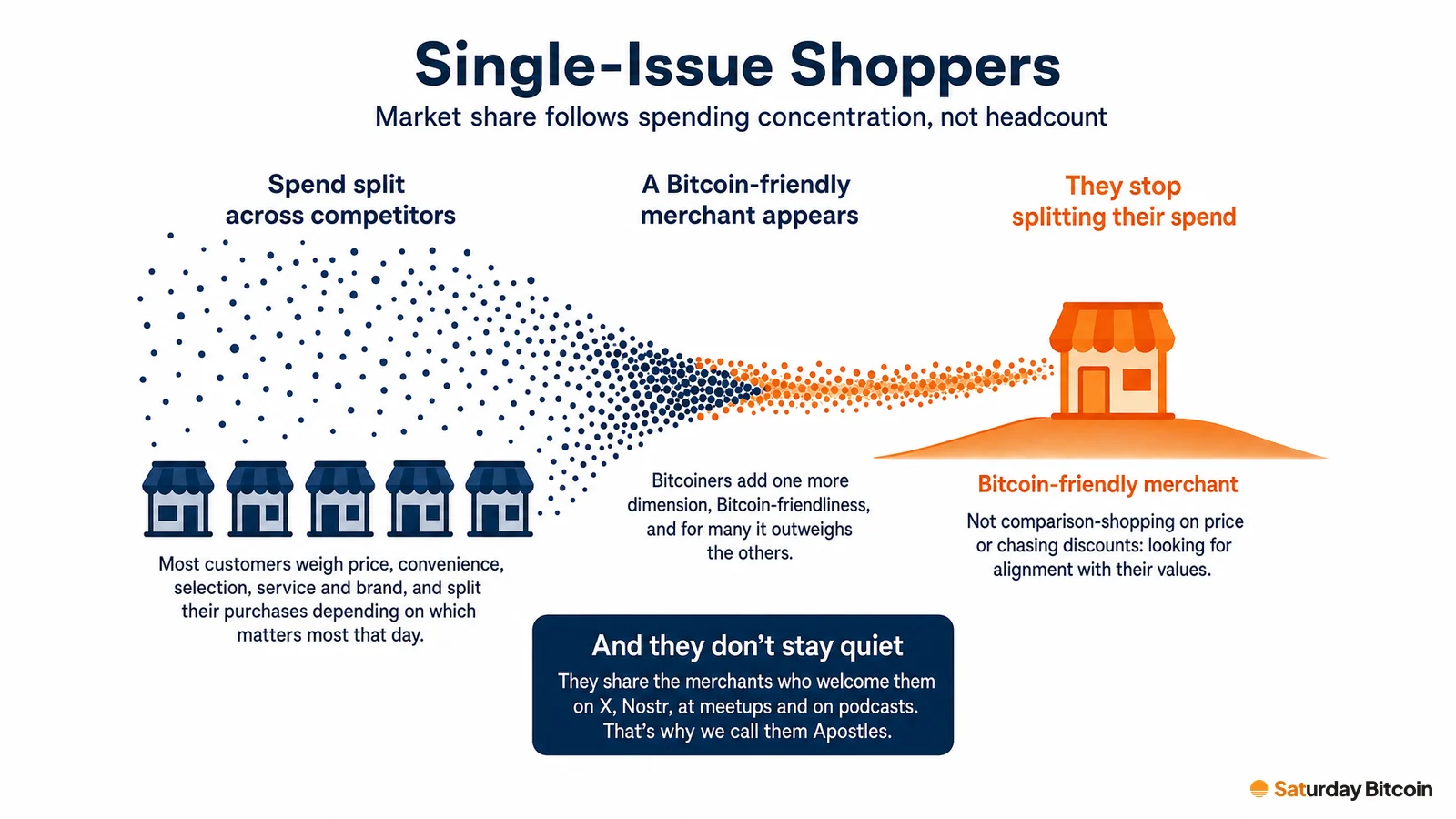
High-ticket categories also lean hardest on aggregators. Chrono24 for watches, 1stDibs for art and furniture, The RealReal for luxury resale and Reverb for instruments have become discovery gatekeepers, and sellers pay them for the privilege. A Bitcoiner looking for a bitcoin-friendly watch dealer doesn’t need the marketplace to find you. They need to know you exist.
That’s what Saturday Bitcoin does. It’s a free directory that helps Bitcoiners find merchants that already accept bitcoin, online and nearby. We bring you the customer. When they pay in bitcoin, they arrive on your cheapest rail, with no chargeback risk. (We’re not a payment processor and can’t see purchases. Your bitcoin channel is your own.)
Being listed is not a guarantee of volume, and your product, price and service still have to be right. But a high-ticket merchant who already accepts bitcoin and doesn’t make it findable is leaving the best part of that decision on the table. As we argued in “Accepting Bitcoin Isn’t Enough,” acceptance is the start, not the strategy.
What to do this week
If you already accept bitcoin, claim your free listing at saturdaybitcoin.com/business and verify it. Add a welcome offer so Bitcoiners have a reason to choose you first. Then say on your own site and product pages that bitcoin payments are welcome. It’s free, it’s reversible, it takes little effort, and the upside is real.