


The term “first-mover advantage” is overused and often misleading. Being first frequently means being wrong. Friendster and MySpace came before Facebook. Netscape Navigator dominated browsers, until it didn’t. Blockbuster’s head start in video rental became irrelevant when the model shifted.
Being first only matters when specific structural conditions create defensibility. Otherwise, better-funded or better-executed competitors leapfrog the pioneers.
So why is being the first Bitcoin-friendly merchant in your category different? Because of who the customer is, and how they shop.
Conventional first-mover advantage erodes. Identity-based first-mover advantage doesn’t, because a follower can’t become the first.
Single-issue shoppers change the math
Most consumers spread their spending across several merchants in each category based on price, selection, convenience or habit. Many Bitcoiners don’t. Many Bitcoiners are single-issue shoppers, so being the first merchant in your category to be Bitcoin-friendly matters more than usual.
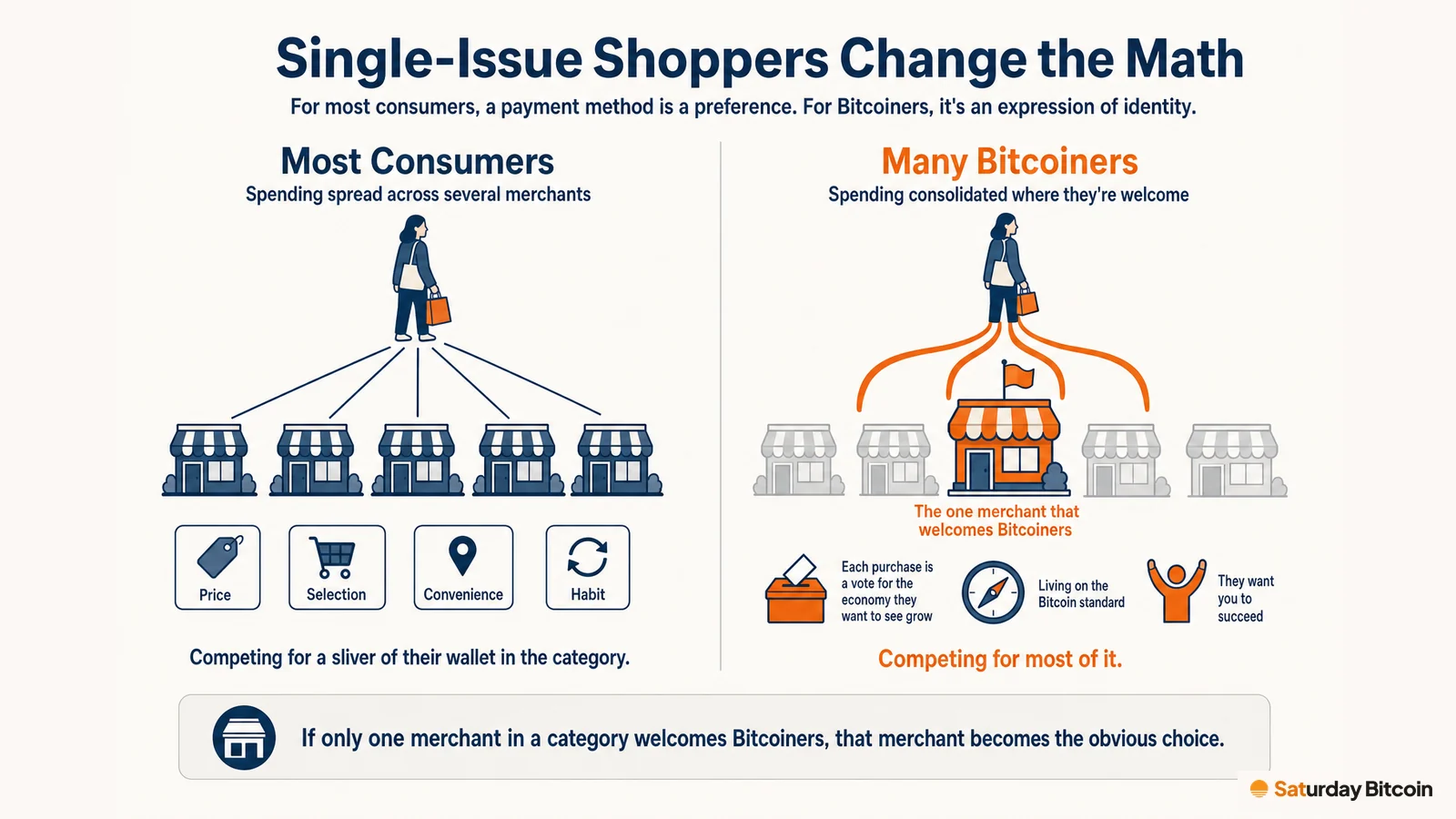
For most consumers, a payment method is a preference, like preferring one card network over another. For Bitcoiners, it’s an expression of identity. They don’t just use bitcoin; they are Bitcoiners. They actively seek to “live on the Bitcoin standard,” redirecting as much of their spending as possible toward merchants who welcome them, and they view each purchase as a vote for the kind of economy they want to see grow.
The result is unusual consumer behavior. If only one merchant in a category welcomes Bitcoiners, that merchant becomes the obvious choice for purchases in that category. Many consolidate their category spend there. You’re not competing for a sliver of their wallet in that category; you’re competing for most of it.
And they don’t just want to buy from you. They want you to succeed. They want to show the world that Bitcoin-friendly merchants can win by supporting Bitcoin.
Identity-based first-mover advantage doesn’t erode
In conventional marketing, being first rarely creates a durable advantage. Offers are commoditized; a competitor can match or exceed your discount tomorrow. You compete on discount depth, and whoever bids highest wins the customer, temporarily. It’s a race to the bottom.
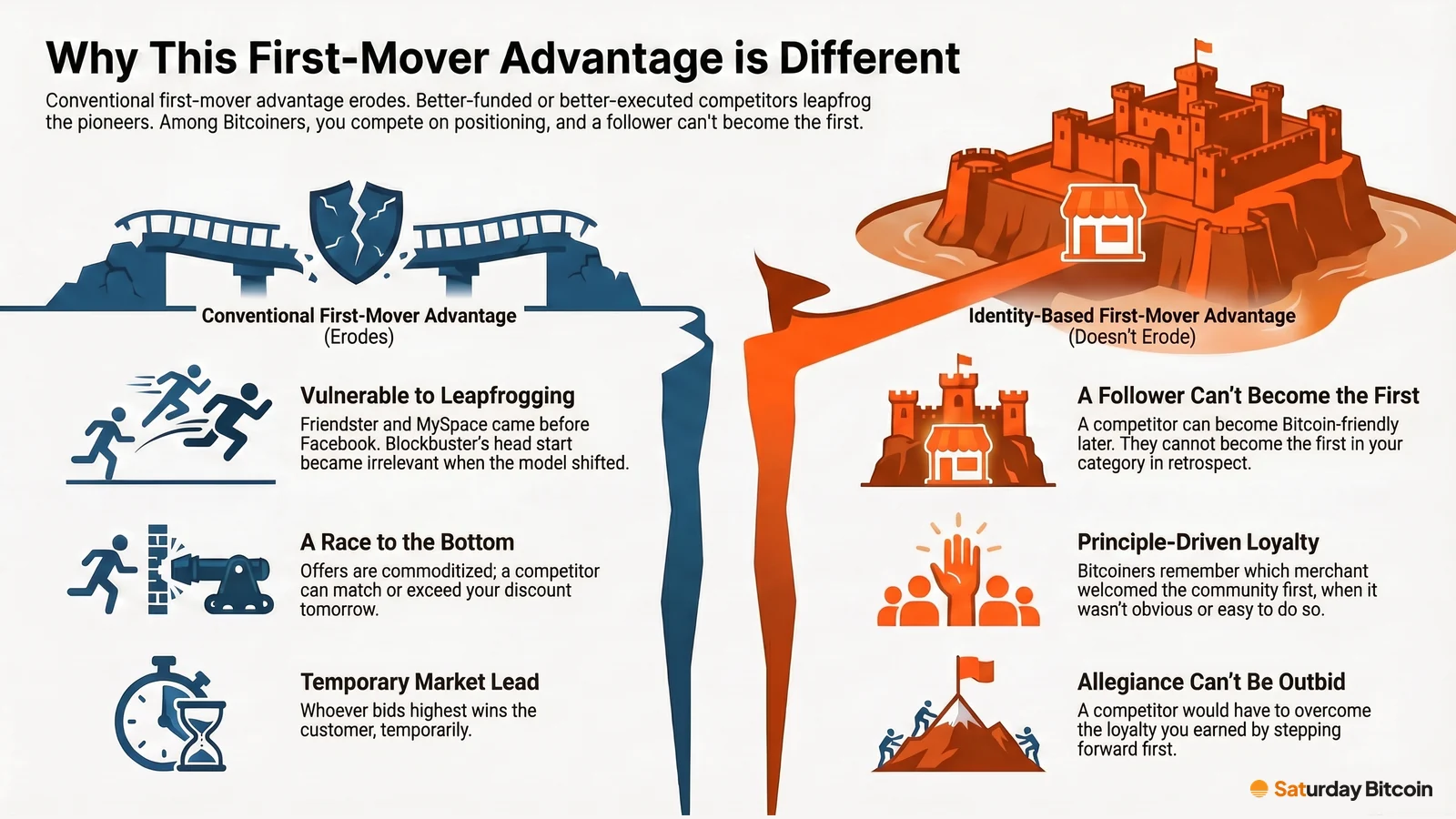
Among Bitcoiners, you compete on positioning. A competitor can’t simply outbid you for allegiance. They would have to overcome the loyalty you earned by stepping forward first in your category, when it wasn’t obvious or easy to do so.
Conventional first-mover advantage erodes. Identity-based first-mover advantage doesn’t, because a follower can’t become the first. A competitor who becomes Bitcoin-friendly six months after you can become Bitcoin-friendly; they cannot become the first Bitcoin-friendly merchant in your category in retrospect. It’s the memory of which merchant welcomed the community first, and a follower merchant can’t claim that position later.
Leadership in a category also tends to compound beyond sales. The merchant Bitcoiners recognize as theirs is the one they mention at meetups, on podcasts and online, and that recognition tends to draw press interest and partnership inquiries a follower has a harder time attracting.
There is a second effect worth naming. Bitcoiners who switch to you from a competitor aren’t switching for a better coupon. They switch for values alignment, and that changes the basis of the relationship. A customer who was a mercenary with your competitor, to borrow Jones and Sasser’s loyalty language, can become an apostle with you.
Four scenarios, one dominant strategy
Consider the decision as a simple game between you and your closest competitor, where the move is becoming the first visible, verified Bitcoin-friendly merchant in your category.
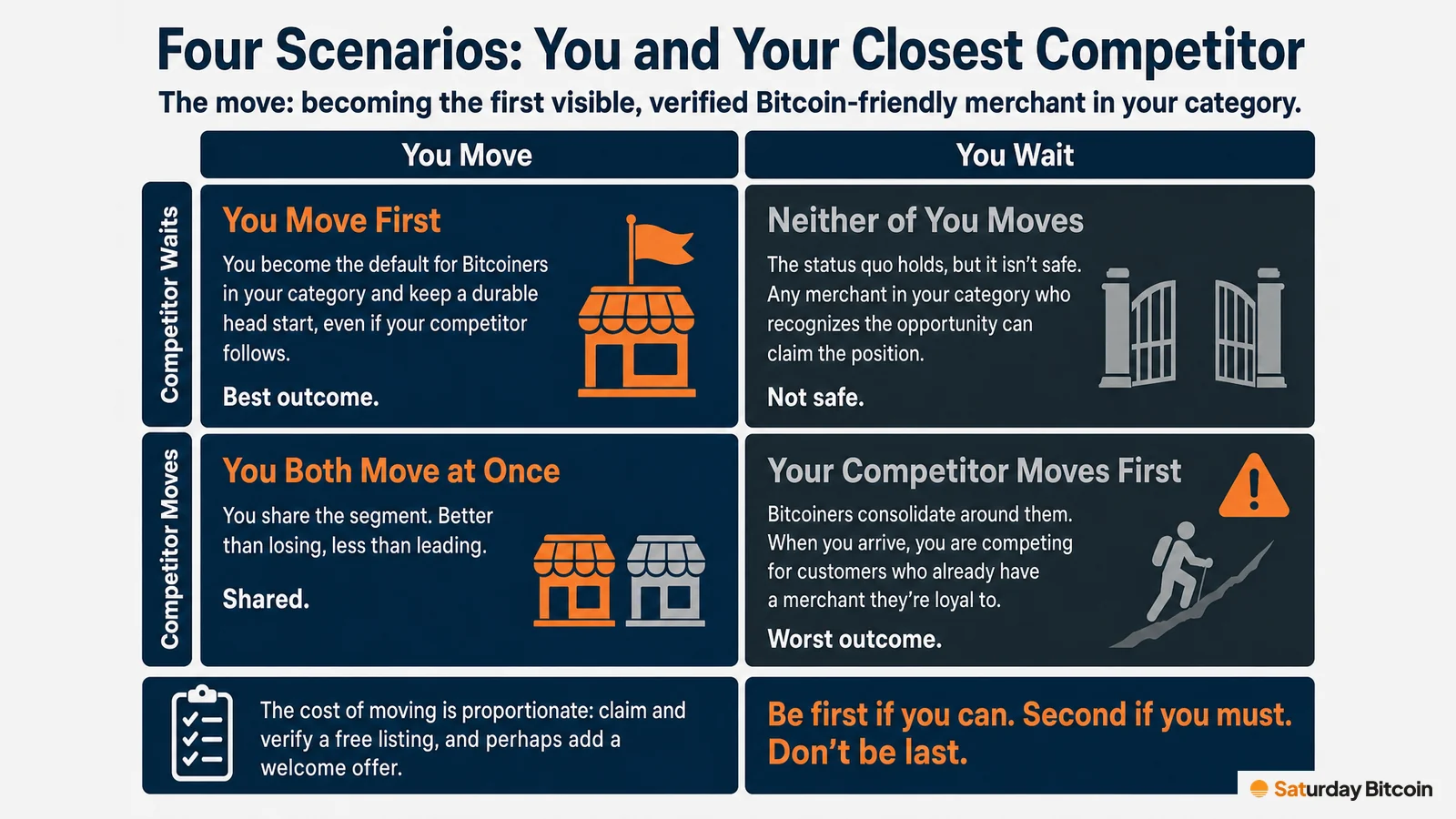
- You move first, your competitor waits. You become the default for Bitcoiners in your category and keep a durable head start, even if your competitor follows.
- Your competitor moves first, you wait. Bitcoiners consolidate around them. When you arrive, you are competing for customers who already have a merchant they’re loyal to.
- You both move at once. You share the segment. Better than losing, less than leading.
- Neither of you moves. The status quo holds, but it isn’t safe. Any merchant in your category who recognizes the opportunity can claim the position.
The best outcome requires moving first. The worst comes from waiting while a competitor moves. And the cost of moving is proportionate: claiming and verifying a free listing, and perhaps adding a welcome offer. Be first if you can. Second if you must. Don’t be last.
Second still matters. Second movers can earn meaningful share. But the longer you wait, the more likely you arrive third or fourth, competing for Bitcoiners who already have a merchant they’re loyal to.
The long tail: you don’t have to be the leader
First-visible advantage is even more pronounced in fragmented, long-tail categories, where no single merchant has dominant share.
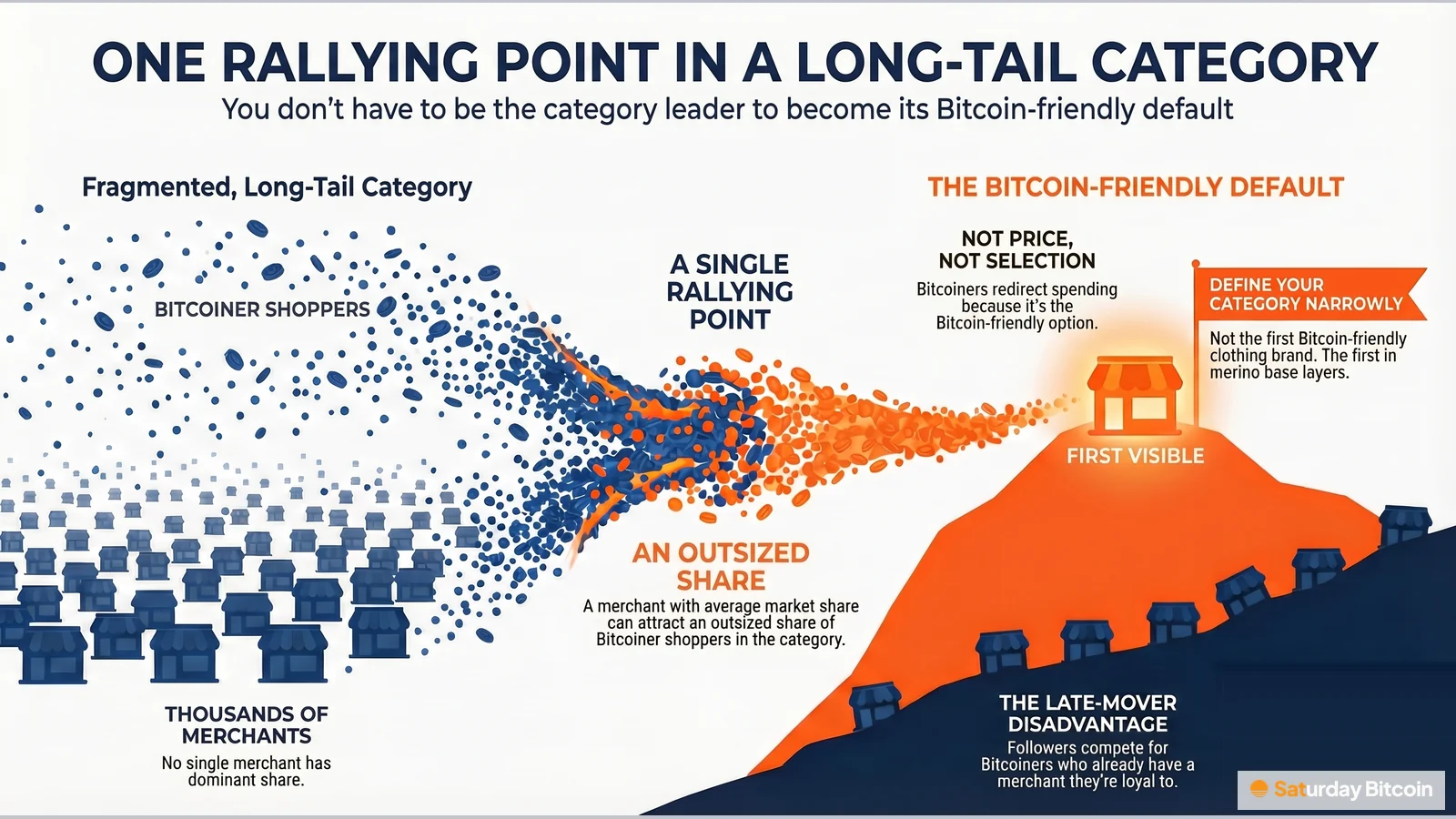
Consider the example of a wine merchant. Thousands of U.S. merchants and wineries can take orders online and ship wine. What happens when one mid-tier wine merchant becomes visibly Bitcoin-friendly first? The Bitcoiner wine shoppers scattered across all those merchants suddenly have a single rallying point. They redirect wine spending to this one merchant, not because of superior selection or pricing, but because it’s the Bitcoin-friendly option.
A merchant who previously had average market share can suddenly attract an outsized share of Bitcoiner wine shoppers. You don’t have to be the category leader to become its Bitcoin-friendly default.
That’s also why it pays to define your category narrowly. You probably won’t be the first Bitcoin-friendly clothing brand. You might be the first in merino base layers.
Slots in the jigsaw fill early
Bitcoiners don’t shop one category at a time. For a Bitcoiner, every purchase is a piece in a larger project: the incremental assembly of a full Bitcoin-friendly shopping life. Coffee, wine, cookware, pet supplies, travel, software. Each is a category-sized piece of a personal jigsaw they are working to complete. We call it the Bitcoin Shopping Jigsaw.
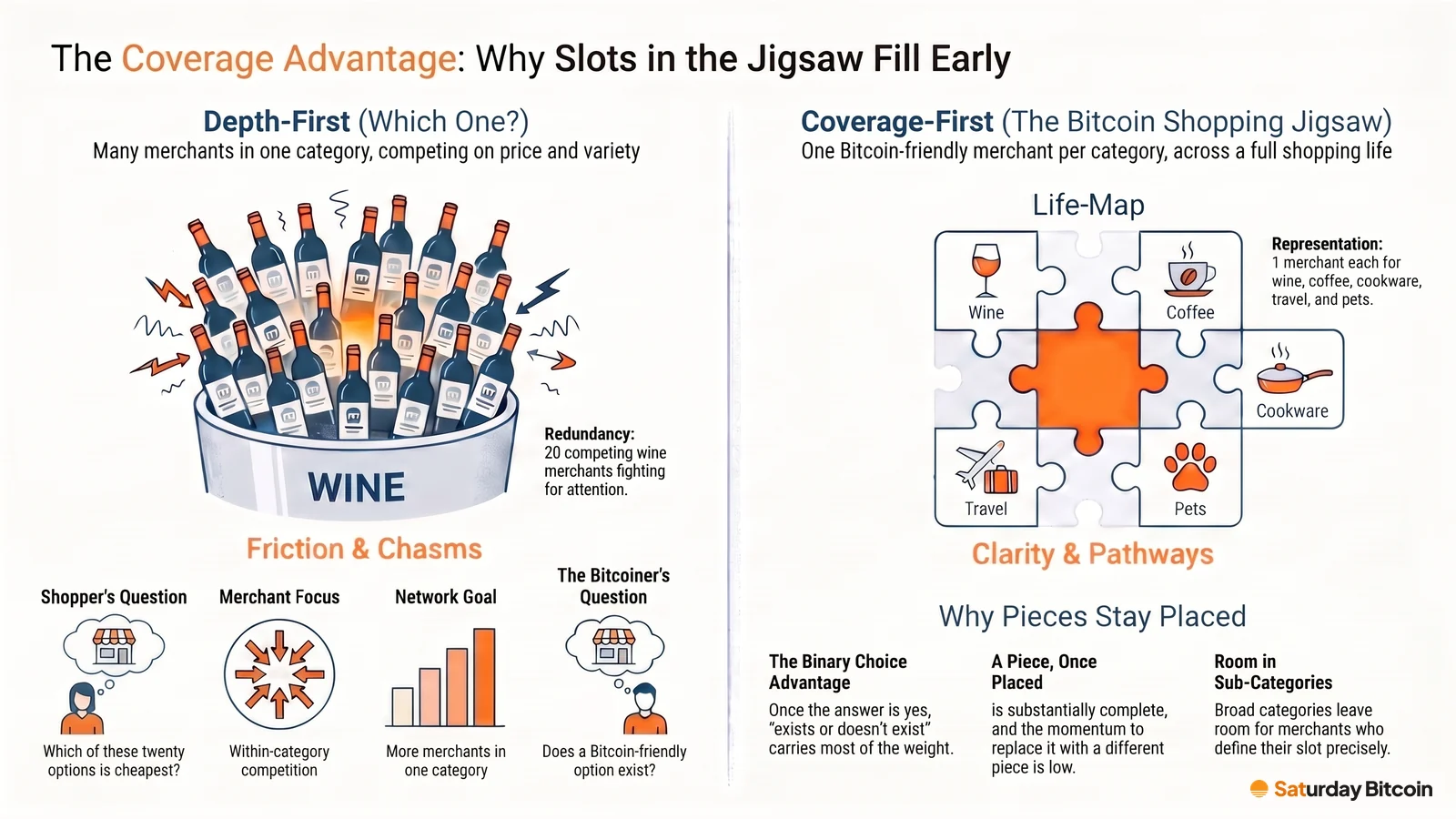
For a Bitcoiner, the operative question is not “which of the twenty Bitcoin-friendly wine merchants fits my taste?” It’s “does a Bitcoin-friendly wine merchant exist that I can buy from?” Once the answer is yes, the binary “exists or doesn’t exist” carries most of the weight. A piece, once placed, is substantially complete, and the momentum to replace it with a different piece is low.
As the efficacy of the strategy is demonstrated in the marketplace, it becomes easier to defend adopting it, but then you are following merchants who already claimed the high ground in your category. Category consolidation is underway. It’s also a channel most of your competitors aren’t watching, so categories fill one merchant at a time, often before a rival notices theirs has been taken. The caveat is real, too: broad categories contain many sub-categories, and those leave room for merchants who define their slot precisely.
The honest limit
First-visible advantage is not guaranteed. It is an advantage, not an entitlement. A weak product, poor service or a welcome offer that quietly lapses will lose it. Bitcoiners are loyal to merchants who keep earning that loyalty, and they talk to each other. Being early, not just first, opens the door. Being good keeps it open.
Where Saturday Bitcoin fits
Saturday Bitcoin is a live directory that helps Bitcoiners discover merchants that already accept bitcoin. It’s the place a Bitcoiner looks when the next piece of their jigsaw is empty.
If you already accept bitcoin, the question isn’t whether you’re Bitcoin-friendly. It’s whether Bitcoiners can see that you are, before they see your competitor. The first visible merchant has an advantage.
What to do next
- Claim and verify your free listing so Bitcoiners know you’re real and current.
- Add a welcome offer or promo code that tells the community they’re welcome.
- Get featured so you’re visible in your category before someone else is.
Start at saturdaybitcoin.com/business.