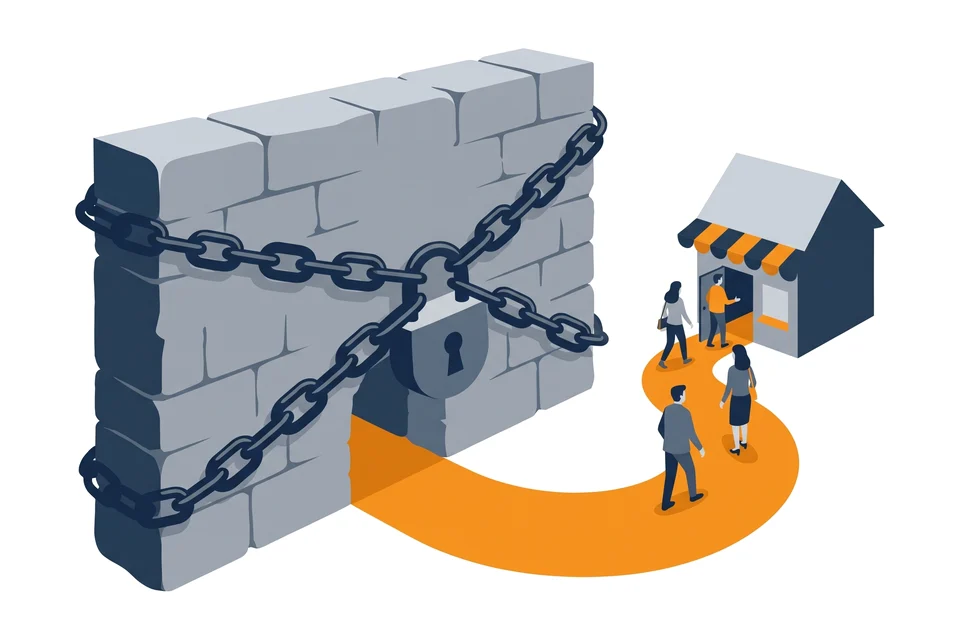


Most of what we write about bitcoin as a merchant competitive advantage is about relative positioning: you versus your competitors, and who in your category Bitcoiners find first.
This article makes a different, complementary argument. The Bitcoin economy itself is expanding: in size, in legitimacy and in commercial activity, on a trajectory that is independent of any individual merchant’s decision. It’s growing whether you participate or not. The question isn’t only “Will a competitor claim this territory before you do?” It’s also “How much larger will this territory be by the time you arrive?”
An economy, not just a segment
When we describe Bitcoiners as a “segment,” that’s accurate but incomplete. Segments are static categories within a fixed market. What’s emerging around bitcoin is better described as a parallel economy, with its own payment rails, its own consumer motivations, its own growth dynamics and, increasingly, its own merchant ecosystem.
The committed segment is the floor. The curious are the ceiling.
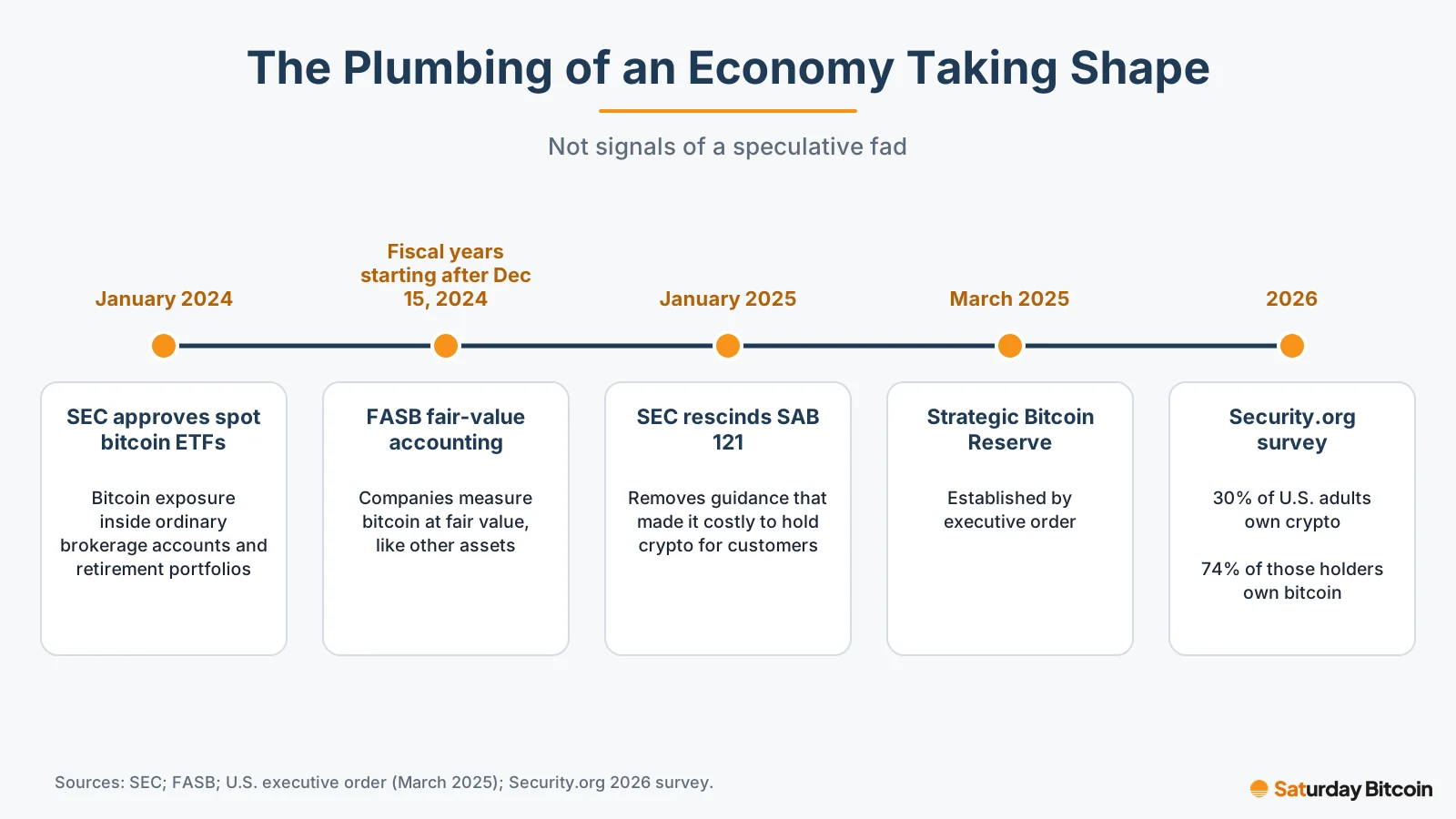
Consider what has happened in the past few years:
- Bitcoin is now among the world’s largest assets by market value, ranking alongside the biggest public companies.
- Spot bitcoin ETFs were approved by the SEC in January 2024, putting bitcoin exposure inside ordinary brokerage accounts and retirement portfolios.
- The U.S. government established a Strategic Bitcoin Reserve by executive order in March 2025.
- Accounting got simpler. Under FASB’s new standard, companies measure bitcoin at fair value, like other assets, for fiscal years starting after December 15, 2024. In January 2025 the SEC rescinded SAB 121, the staff guidance that had made it costly for banks and other firms to hold crypto for customers.
- Tens of millions of Americans own some bitcoin. A 2026 Security.org survey found 30% of U.S. adults own crypto, and 74% of those holders own bitcoin.
These are not signals of a speculative fad. They are the plumbing of an economy taking shape.
The e-commerce parallel: a pattern you’ve seen before
In the 1990s, the internet was a curiosity and e-commerce was a rounding error. When the Census Bureau first measured it, in the fourth quarter of 1999, online sales were 0.6% of U.S. retail. Most merchants saw no reason to invest in a website, let alone build an online sales channel. The consumers were too few, the technology too unfamiliar, the ROI too uncertain.
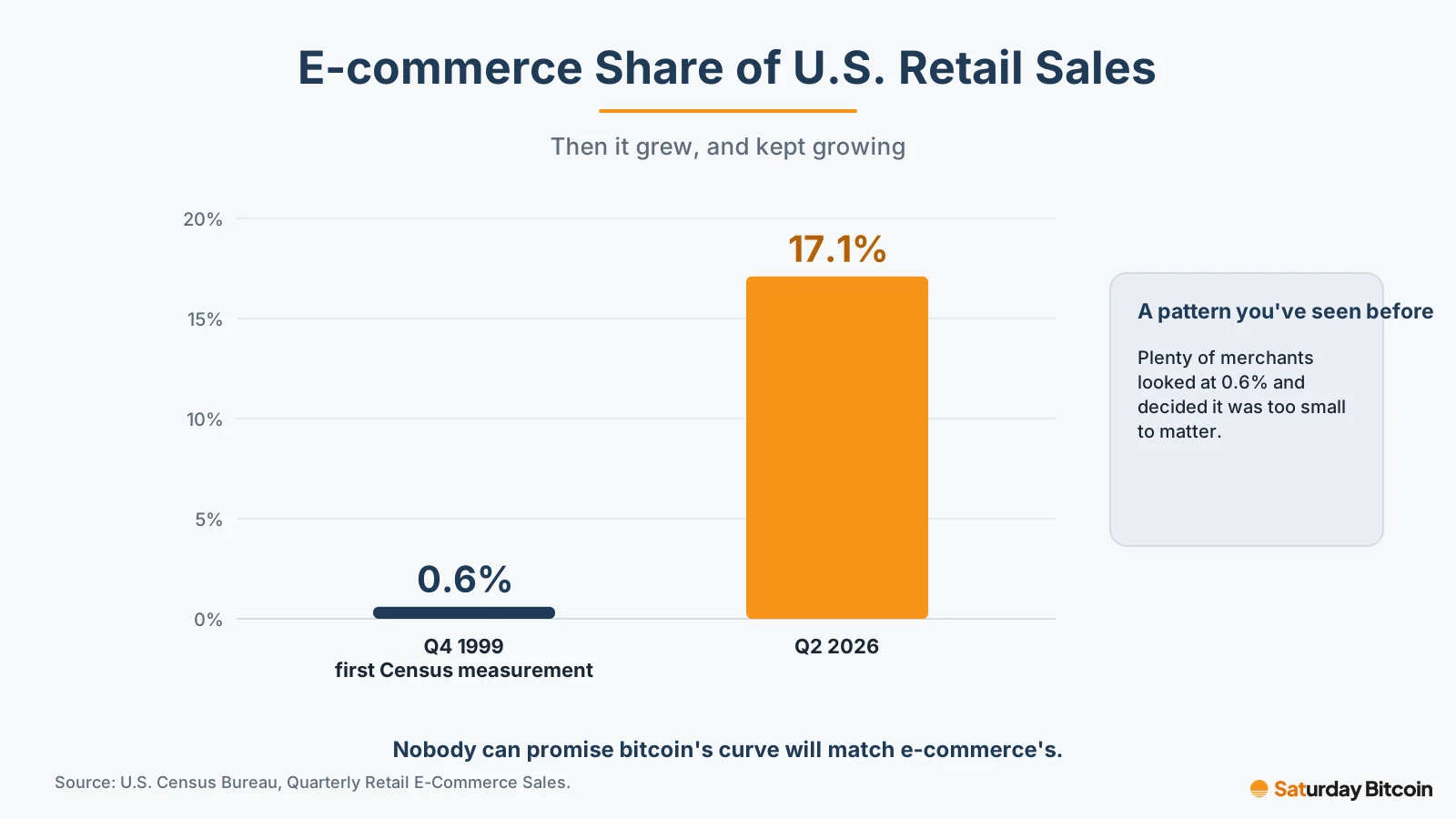
Then it grew, and kept growing. By the second quarter of 2026, e-commerce was 17.1% of U.S. retail sales. The merchants who established an online presence early didn’t just survive the transition; they built positions that late entrants spent years, and enormous sums, trying to replicate.
Merchants who dismissed e-commerce in 1999 sound a lot like merchants dismissing the Bitcoin economy today. The early adopters look strange from a mainstream perspective. The consumer base looks small by conventional standards. The technology feels unfamiliar. Nobody can promise bitcoin’s curve will match e-commerce’s. But merchants who establish a position now aren’t making a speculative bet. They’re recognizing a pattern that has played out before, and positioning accordingly.
Two growth engines, not one
Most merchants who look at this naturally focus on committed Bitcoiners: an estimated ~1 million committed, mission-driven Bitcoiners in the U.S., and growing. These are the people who identify as Bitcoiners, go to meetups and actively seek out Bitcoin-friendly merchants. Many behave like single-issue shoppers, and many consolidate their category spend with merchants who welcome them. For a merchant, that segment is already worth winning. (For what a fraction of it can look like, see “A Fraction of the Segment: What Steak ’n Shake Proved About Bitcoiners.”)
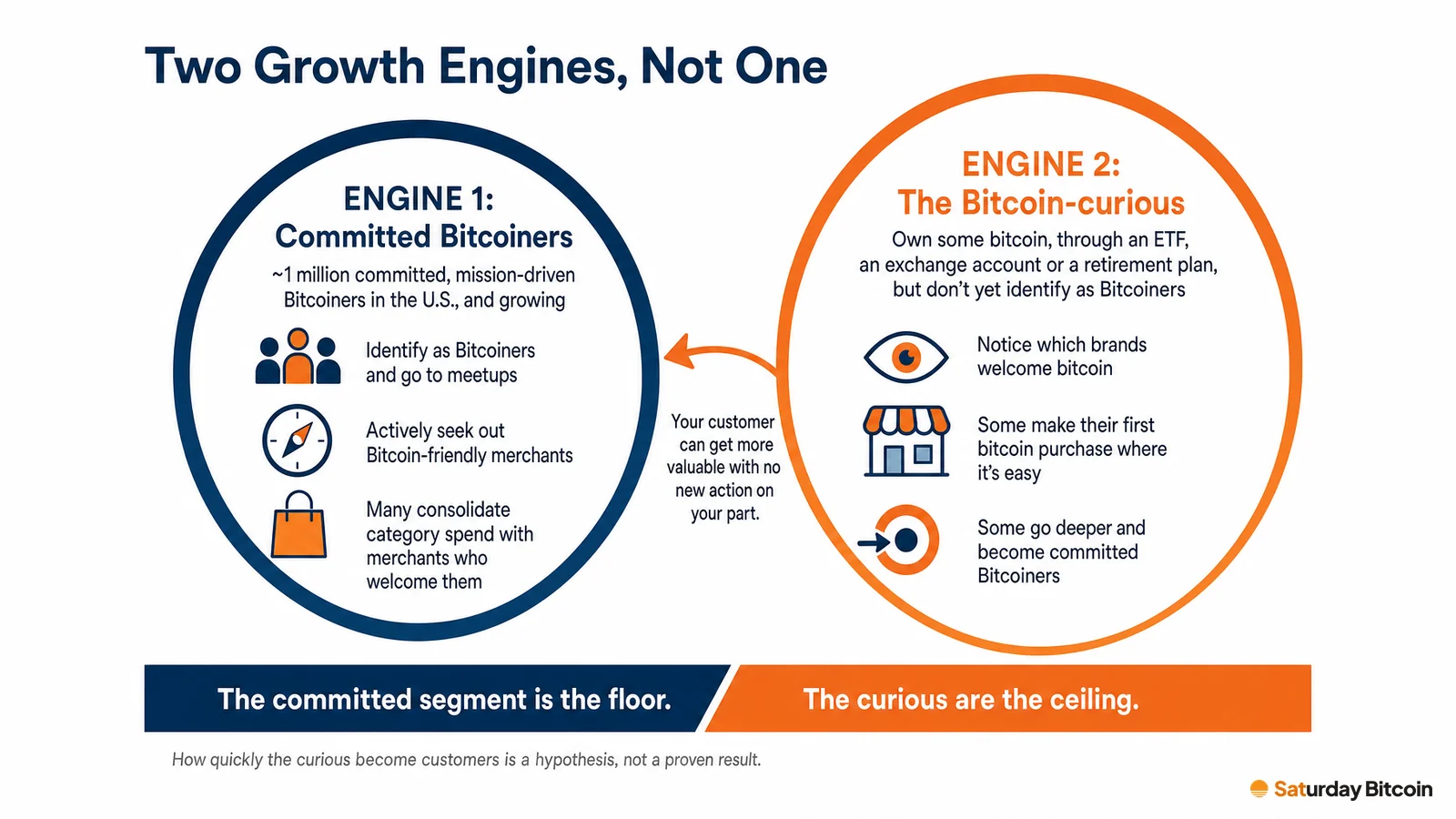
But there’s a second engine that’s often overlooked: the Bitcoin-curious. These are people who own some bitcoin, through an ETF, an exchange account or a retirement plan, and believe in it enough to hold it, but who don’t yet identify as Bitcoiners. They’re the much larger group inside those tens of millions of owners. Some of them are already your customers. They notice which brands welcome bitcoin, and some of them will make their first bitcoin purchase at a merchant that makes it easy. And some of the curious go deeper and become committed Bitcoiners, with the loyalty that comes with it. Your customer can get more valuable with no new action on your part.
That’s why the most common pushback, that the Bitcoiner segment is too small to matter, misses the point. It treats the committed segment as the ceiling. The committed segment is the floor. The curious are the ceiling.
An honest caveat: how quickly the curious become customers is a hypothesis, not a proven result. Many people who own bitcoin will never spend it, and many Bitcoiners still pay by card, out of habit, for rewards, to avoid tax friction, or to support the merchant on principle. Those sales count just the same. The point is direction, not a forecast.
The tailwinds look structural, not cyclical
Some opportunities come from temporary conditions that can reverse. The tailwinds behind the Bitcoin economy are structural:
- Institutional adoption keeps broadening. ETFs, corporate treasuries and government reserves each bring more mainstream legitimacy and more consumer curiosity.
- Regulation is moving toward accommodation. The reserve, fair-value accounting and the end of SAB 121 all reduce the uncertainty that used to give businesses pause.
- Payment infrastructure is maturing. Lightning makes bitcoin payments fast and cheap. Network fees are typically a fraction of a cent, and even with a processor’s fee, costs are typically well below card costs.
- The brand is changing. Bitcoin is moving from “fringe and geeky” to “legitimate and forward-thinking,” helped by mainstream coverage and growing familiarity.
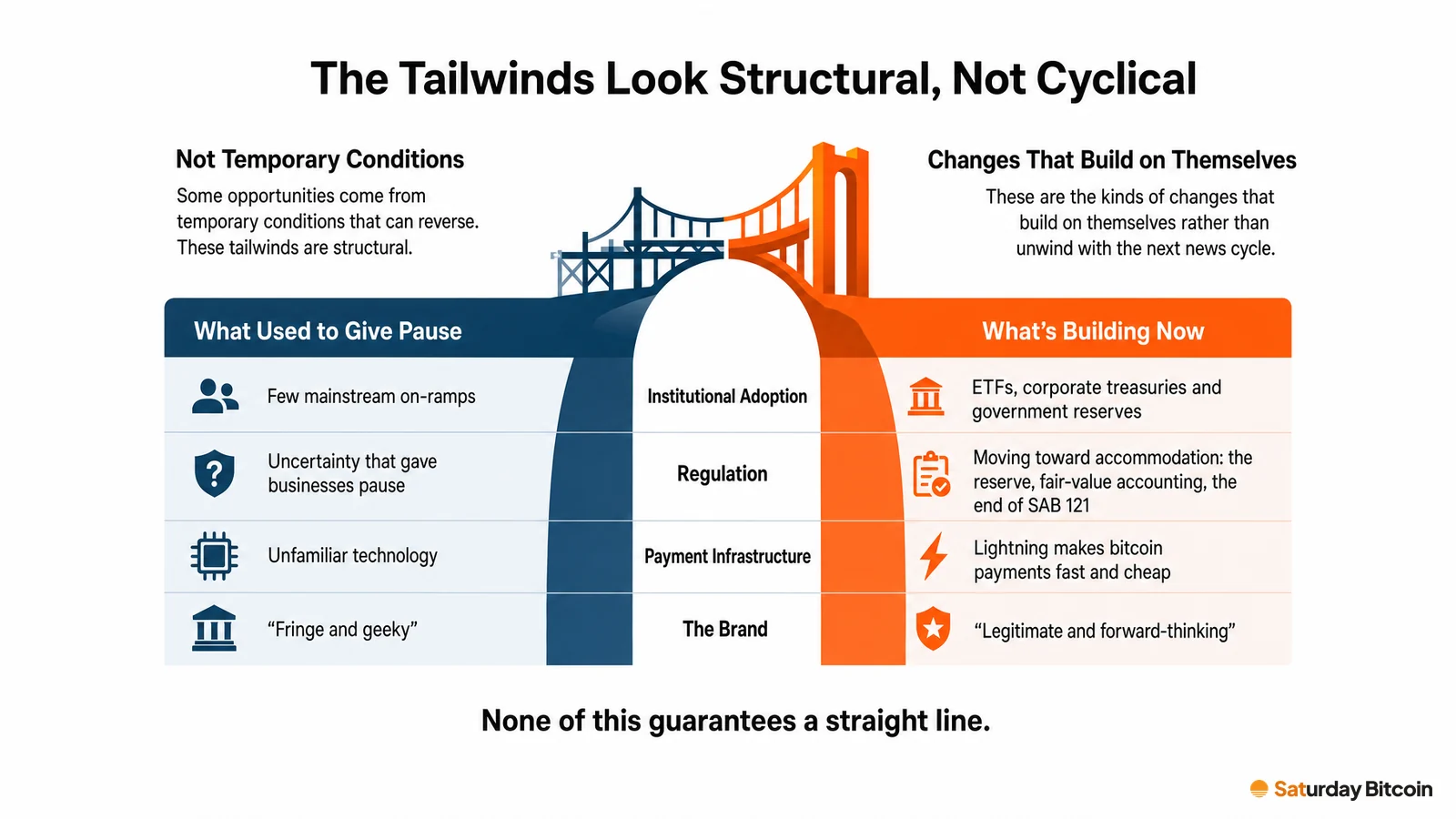
None of this guarantees a straight line. But these are the kinds of changes that build on themselves rather than unwind with the next news cycle.
The “wait and see” trap
“Wait and see” feels prudent. But it only works when an opportunity is static, when waiting doesn’t change the terms of entry.
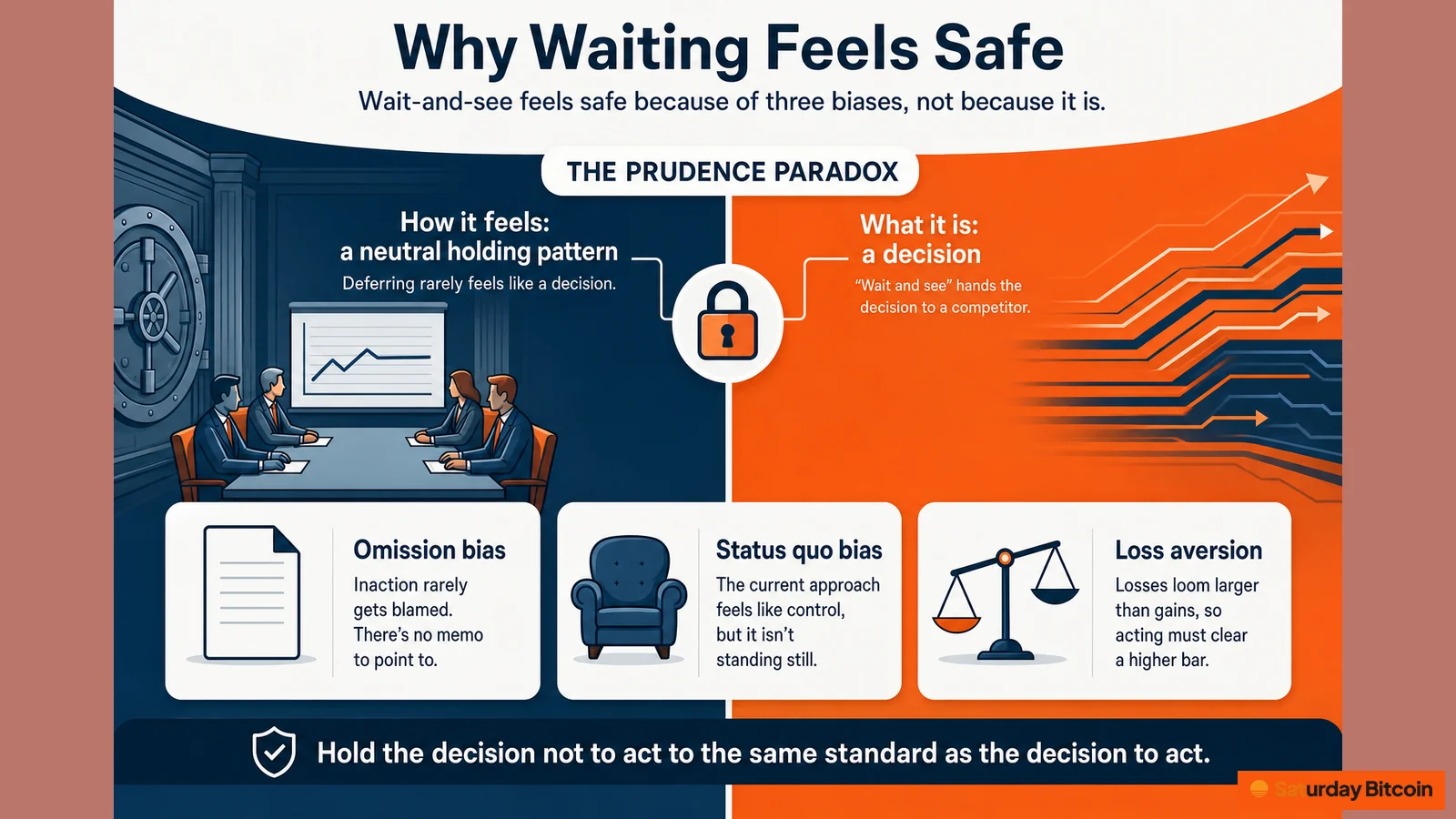
The Bitcoin economy isn’t static. Category consolidation is underway: Bitcoiners remember who stepped forward before it was obvious, and the “first Bitcoin-friendly name in the category” story is only available to the first few merchants who claim it. Customer relationships and operational learning only start compounding when you start. Today being Bitcoin-friendly is a differentiator; one day it will be table stakes. The proof you’re waiting for will come from the merchants who acted before you did.
A position, not a bet on the price
To be clear: you don’t need to believe bitcoin will become the world’s reserve currency, that its price will reach any particular level, or that the dollar will fail. Bitcoin has historically appreciated over multi-year periods; past performance is no guarantee, and none of this depends on it.
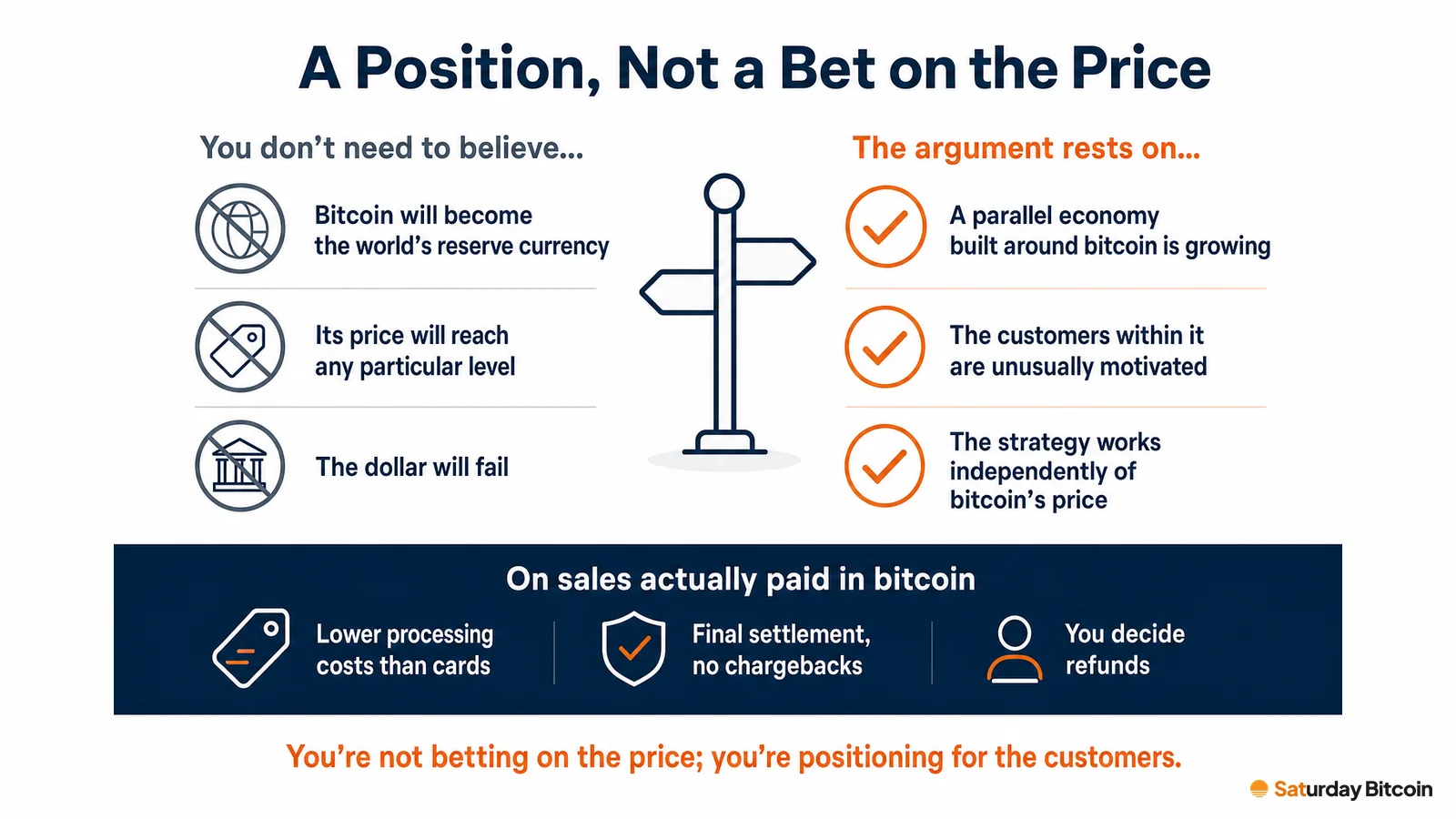
The argument is more modest and more defensible: a parallel economy built around bitcoin is growing, the customers within it are unusually motivated, and the merchant bitcoin strategy works independently of bitcoin’s price. You’re not betting on the price; you’re positioning for the customers. Irrespective of what you think about bitcoin, the customer segment is real.
And the channel itself pays its way on its own terms. On sales actually paid in bitcoin, you get lower processing costs than cards, final settlement and no chargebacks; you decide refunds. Those properties hold whatever the exchange rate does.
Where Saturday Bitcoin fits
Saturday Bitcoin is a discovery directory that helps Bitcoiners find merchants that already accept bitcoin, online and nearby, with tens of thousands of places listed. If you accept bitcoin, you may already be in it. Claiming your listing is free: verify it, add a welcome offer or promo code for Bitcoiners, and put your business in front of people actively looking for merchants like you. It’s free, reversible and low effort, with real upside.
The honest limit: a listing is discovery, not a guarantee of volume. We aren’t a payment processor and can’t see your purchases, and your product and service still have to be right. What a listing does is make sure that as the Bitcoin economy grows, the people inside it can find you.
The Bitcoin economy is growing. The question is whether you’ll be part of that growth, or watching it from the outside.
Claim your free listing at saturdaybitcoin.com/business.