

Imagine a competitor in your category whose numbers start to improve. Slowly at first, then steadily. There’s no new campaign, no price cut and no visible change in strategy. Your team checks the usual suspects (pricing, promotions, ad spend, product mix) and can’t find the cause.
Now imagine you had seen the same opportunity six months earlier. You understood it, and the logic held up. You still chose to wait. The opportunity wasn’t bad; waiting just felt safer. You weren’t saying no. You were saying “not yet.”
This article is about the cost of “not yet.”
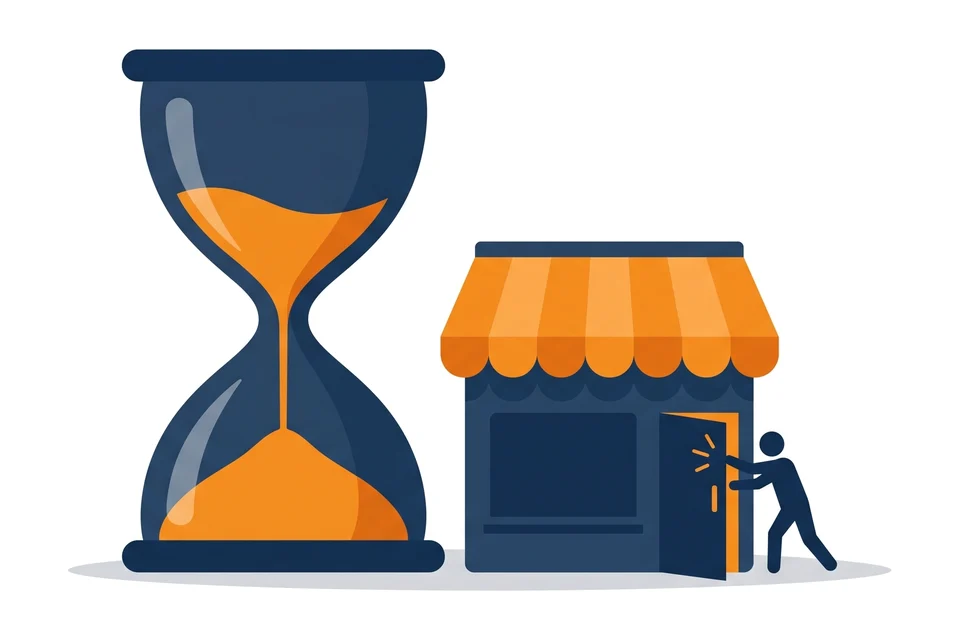
Wait-and-see is a decision. It just hands the decision to a competitor.
Doing nothing is a decision
“We can always catch up later” may be the most expensive sentence in business. It assumes the opportunity will still be there on the same terms when you’re ready. Often it will. You can launch a campaign six months from now or match a competitor’s price next quarter. The opportunity just gets a little more crowded.
Some opportunities don’t work that way. In those, the first mover earns something a follower finds hard to buy: customer allegiance, community recognition and buying habits that have already formed. Becoming the Bitcoin-friendly merchant in your category is one of those opportunities. Bitcoiners tend to remember who welcomed them first. Category consolidation is underway: a follower can still win some of them, but it starts behind.
So “wait and see” is a decision too. It just hands the decision to a competitor.
Why waiting feels safe
Deferring rarely feels like a decision. It feels like a neutral holding pattern. Behavioral research points to three biases that make it feel safer than it is:
- Omission bias. People judge harmful actions more harshly than equally harmful inaction. An executive who backs a failed initiative gets blamed. An executive who passed on the opportunity a competitor seized rarely does, because there’s no memo to point to.
- Status quo bias. The current approach feels like control. But the status quo isn’t standing still while competitors move, and its erosion is gradual enough to miss.
- Loss aversion. Losses loom roughly twice as large as equivalent gains. So we demand far more upside to justify acting than we demand to justify sitting still.
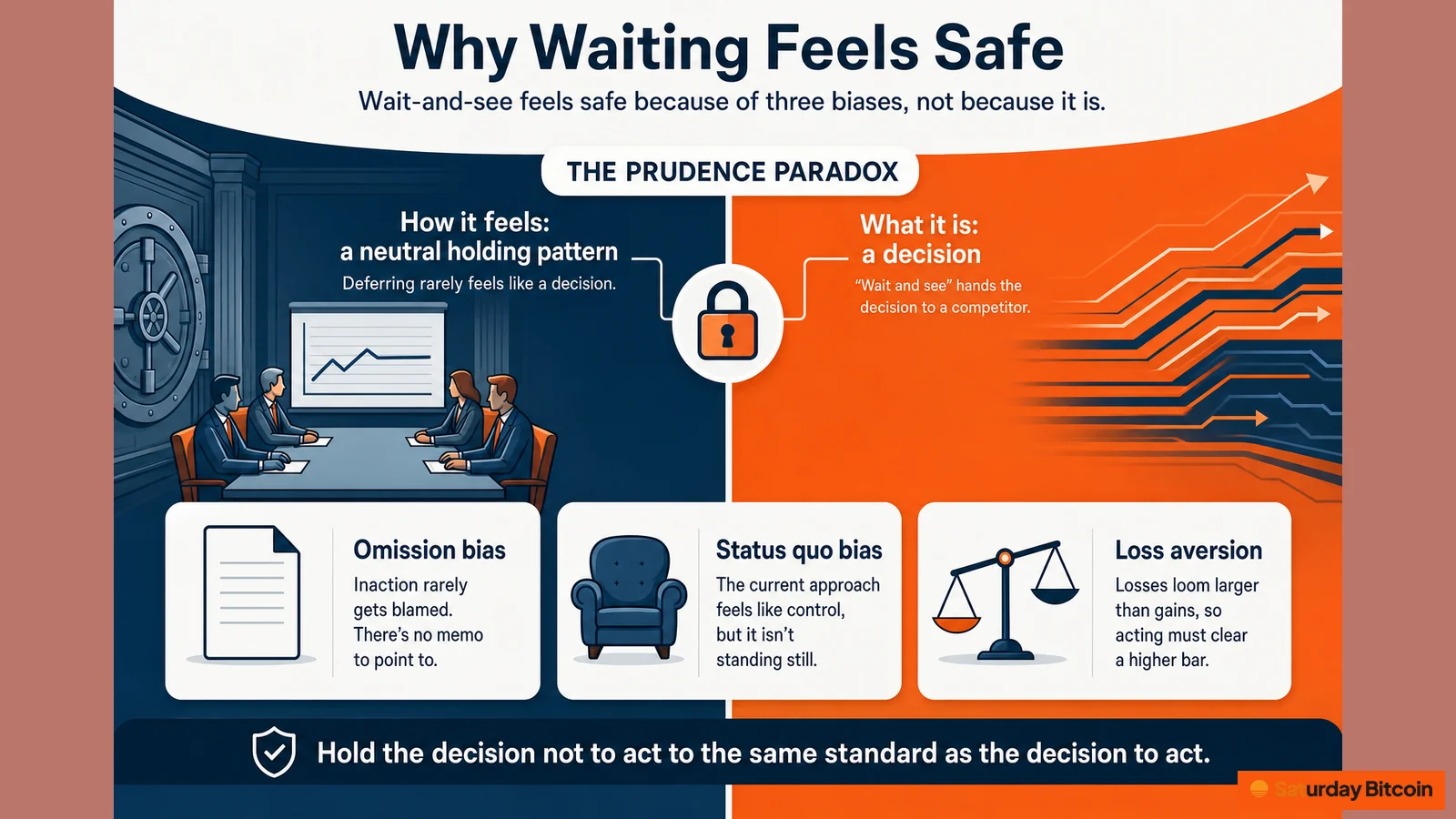
Wait-and-see feels safe because of three biases, not because it is. Here is a useful discipline: hold the decision not to act to the same standard of evidence and accountability as the decision to act. In most organizations, acting needs a business case and not acting needs nothing. That imbalance is a source of strategic error in itself.
The customers you’ve never seen
The losses from waiting don’t show up anywhere. No report has a line called “revenue lost to inaction.” But some things are happening right now whether you act or not.
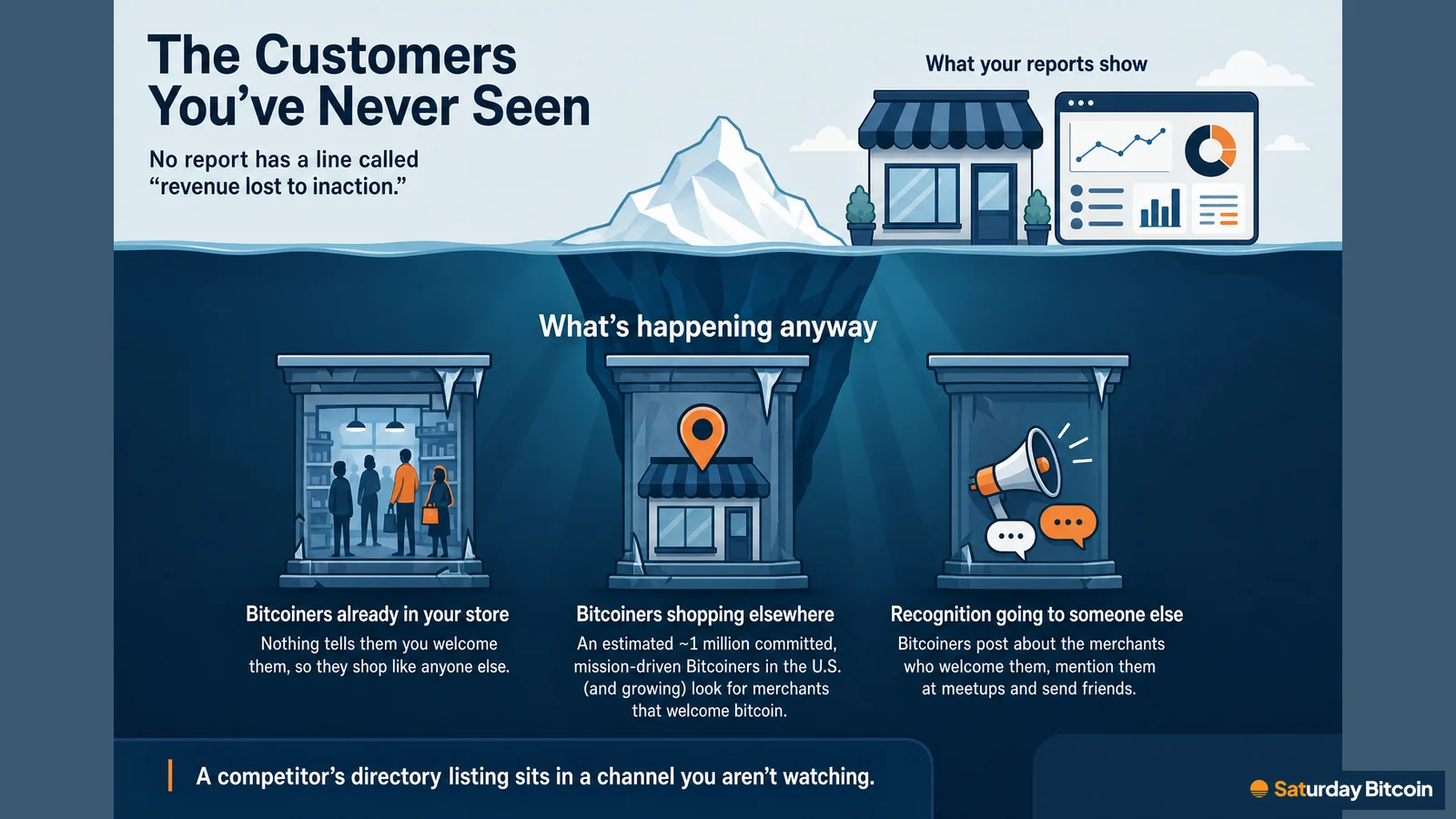
Some of your existing customers are probably Bitcoiners. You don’t know which ones. Nothing tells them you welcome them, so they shop with you like anyone else. When they go looking for a Bitcoin-friendly option in your category, they find whoever showed up.
Bitcoiners who would shop with you are shopping elsewhere. An estimated ~1 million committed, mission-driven Bitcoiners in the U.S. (and growing) look for merchants that welcome bitcoin, and tens of millions of Americans own some bitcoin. Many of the committed ones are single-issue shoppers on this point. Once they find a Bitcoin-friendly merchant in a category, many consolidate their category spend there.
Community recognition is going to someone else. Bitcoiners celebrate the merchants who welcome them. They post about them, mention them at meetups and send friends. That recognition is hard to buy back later.
A competitor’s directory listing won’t show up in your ad-tracking tools. It sits in a channel you aren’t watching. You’re losing customers you’ve never seen.
They knew, and they waited
The familiar cautionary tales share a pattern that’s easy to miss:
- Borders saw online bookselling coming and outsourced its online sales to Amazon rather than build its own. It was liquidated in 2011.
- Nokia recognized the iPhone as a threat when it launched. A hardware-first culture argued, convincingly in every meeting, that business users would never give up physical keyboards. Nokia lost its lead in phones and never got it back.
- Microsoft watched Amazon Web Services launch in 2006 and didn’t offer its direct competitor, Windows Azure, until 2010. Steve Ballmer later said he wished Microsoft had started a year or two earlier. Microsoft became a strong number two, but the catch-up was expensive.
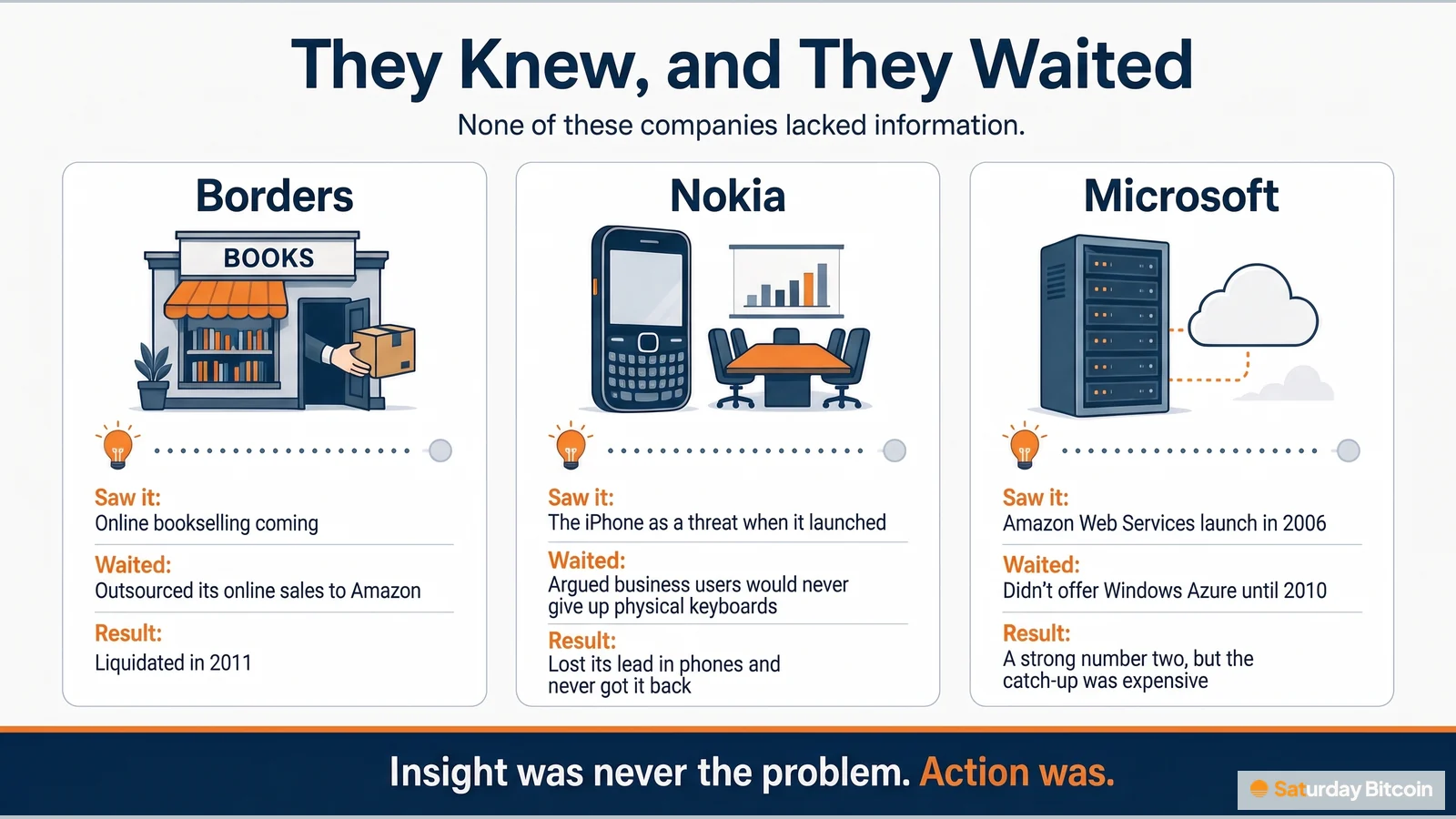
None of these companies lacked information. In every case the delay used up the options it was supposed to protect. Insight was never the problem. Action was.
Late costs more each year
“Later” isn’t the same opportunity on a later date. Every month a competitor holds the Bitcoin-friendly position in your category, its Bitcoiner customers settle in and its reputation in the community grows. A follower’s job shifts from winning new customers toward winning back settled ones. Late tends to cost more each year. Category consolidation is underway.
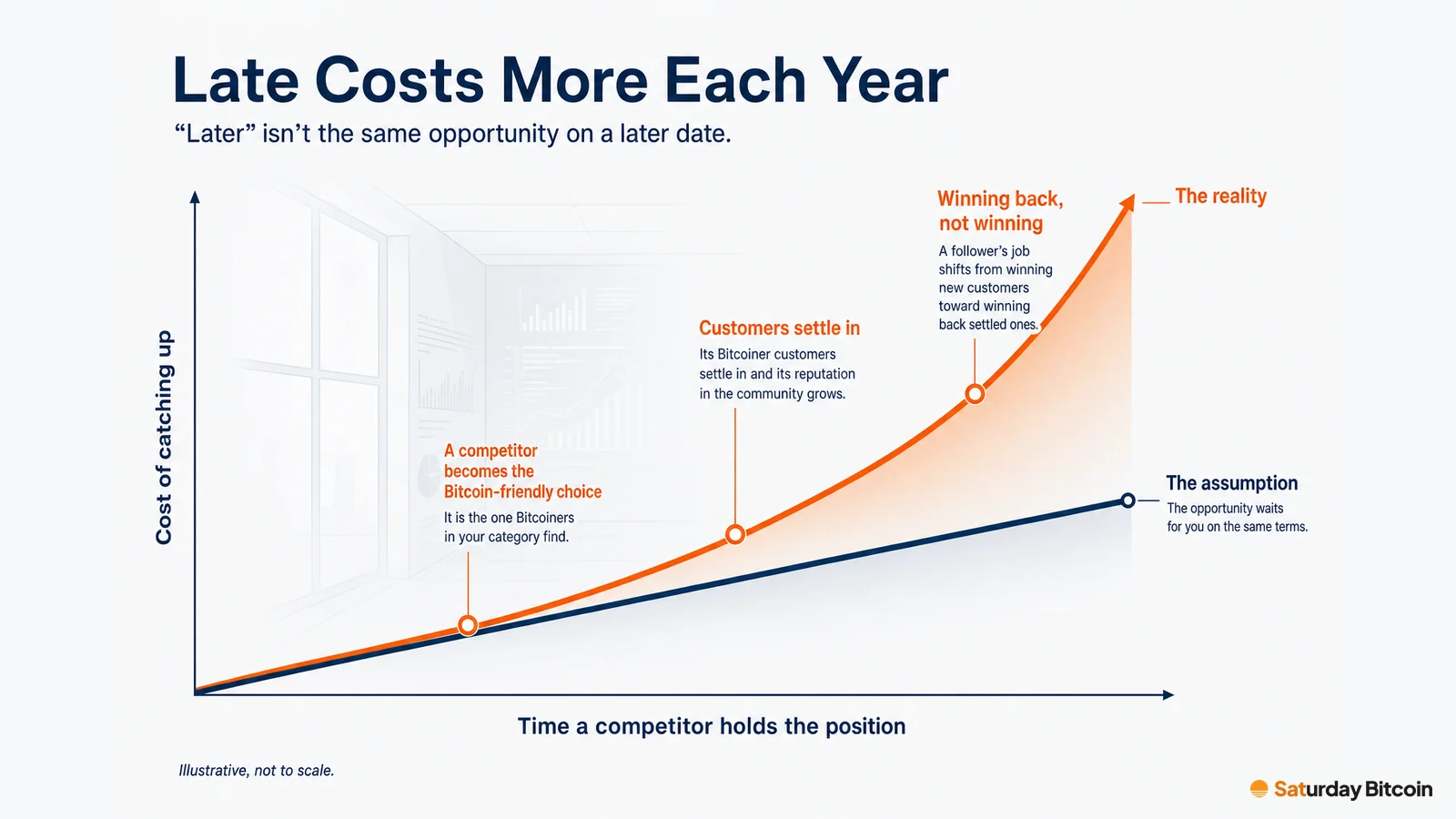
There’s a longer arc too. Selling online was a curiosity in 1996 and is a given now, and early movers held positions that late entrants spent years trying to match. Bitcoin-friendliness is on a similar path. Today it’s a differentiator; one day it will be table stakes. The merchants who move early collect the recognition. The ones who move late just catch up to what’s expected.
Low effort, real upside: a rare asymmetry
The cost of acting is small. If you already accept bitcoin, claiming your Saturday Bitcoin listing is free and takes minutes. You can add a welcome offer or promo code if you like. There’s no contract and no budget line, and you can change it or step back at any time. If you don’t accept bitcoin yet, that’s the first step, and it adds to your checkout without replacing anything.
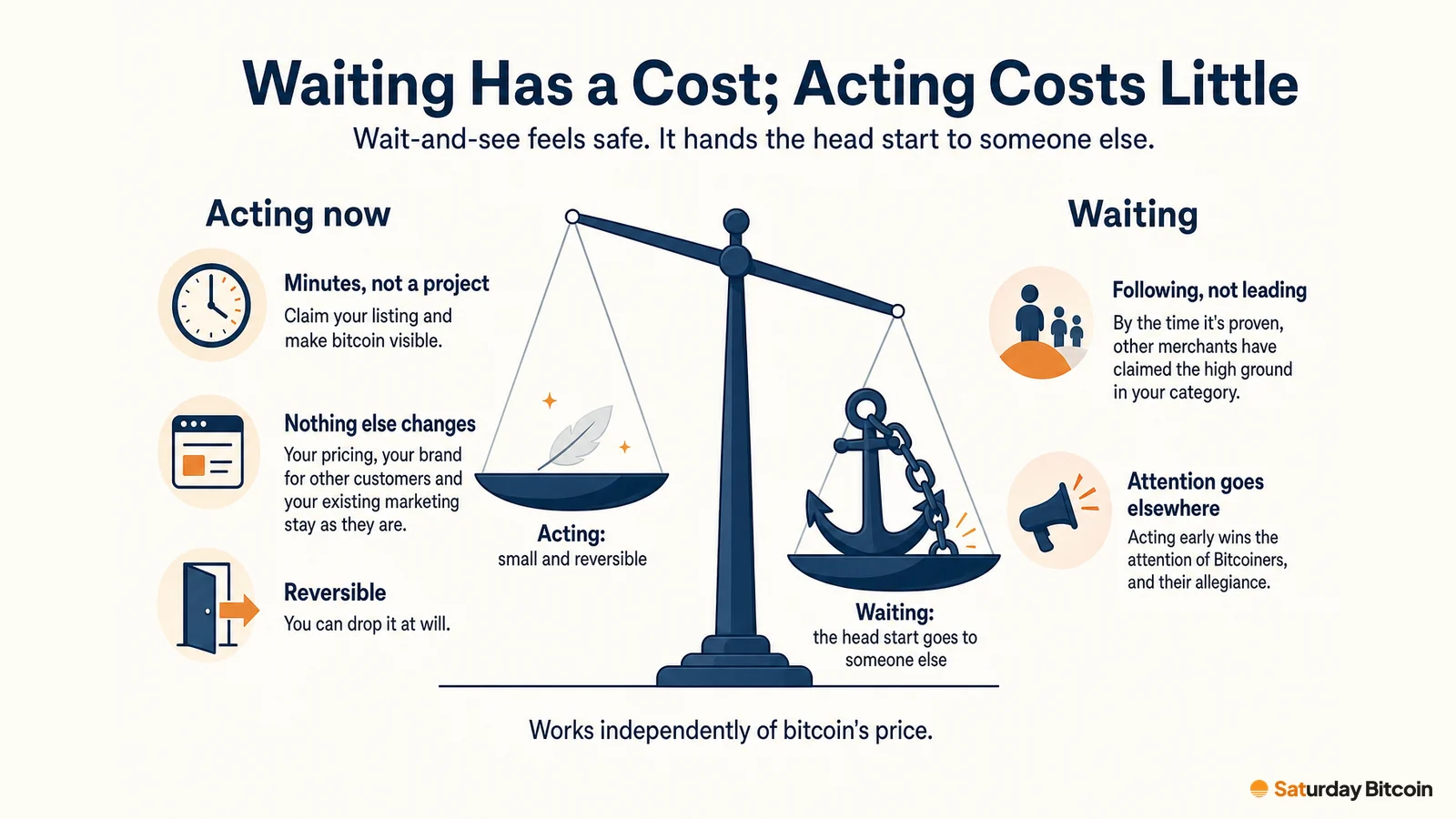
The cost of not acting compounds. Customers go to the competitor who moved first. Recognition builds around someone else. A competitor gets the head start in your category.
We walked through the four scenarios (act or wait, competitor moves or doesn’t) in First Visible Wins. The short version: if you act and it’s quiet, you’ve spent a few minutes. If you wait and a competitor moves, you start behind them in your category.
The upside comes in two layers. The first is customers now. The second, which builds over time, is your position in the category. Acting costs minutes. Waiting cedes the head start. Acting is free, reversible, low effort, with real upside.
For the CFO: preparedness, not speculation
For a CFO, general counsel or board member, the question isn’t “what could we gain?” It’s “what’s the risk-adjusted cost of each option?” Framed that way, acting is preparedness, not speculation. A prudent executive in 2005 made sure the company could sell online. That wasn’t because the outcome was certain. Being wrong about not having it would cost far more than having it and not needing it.
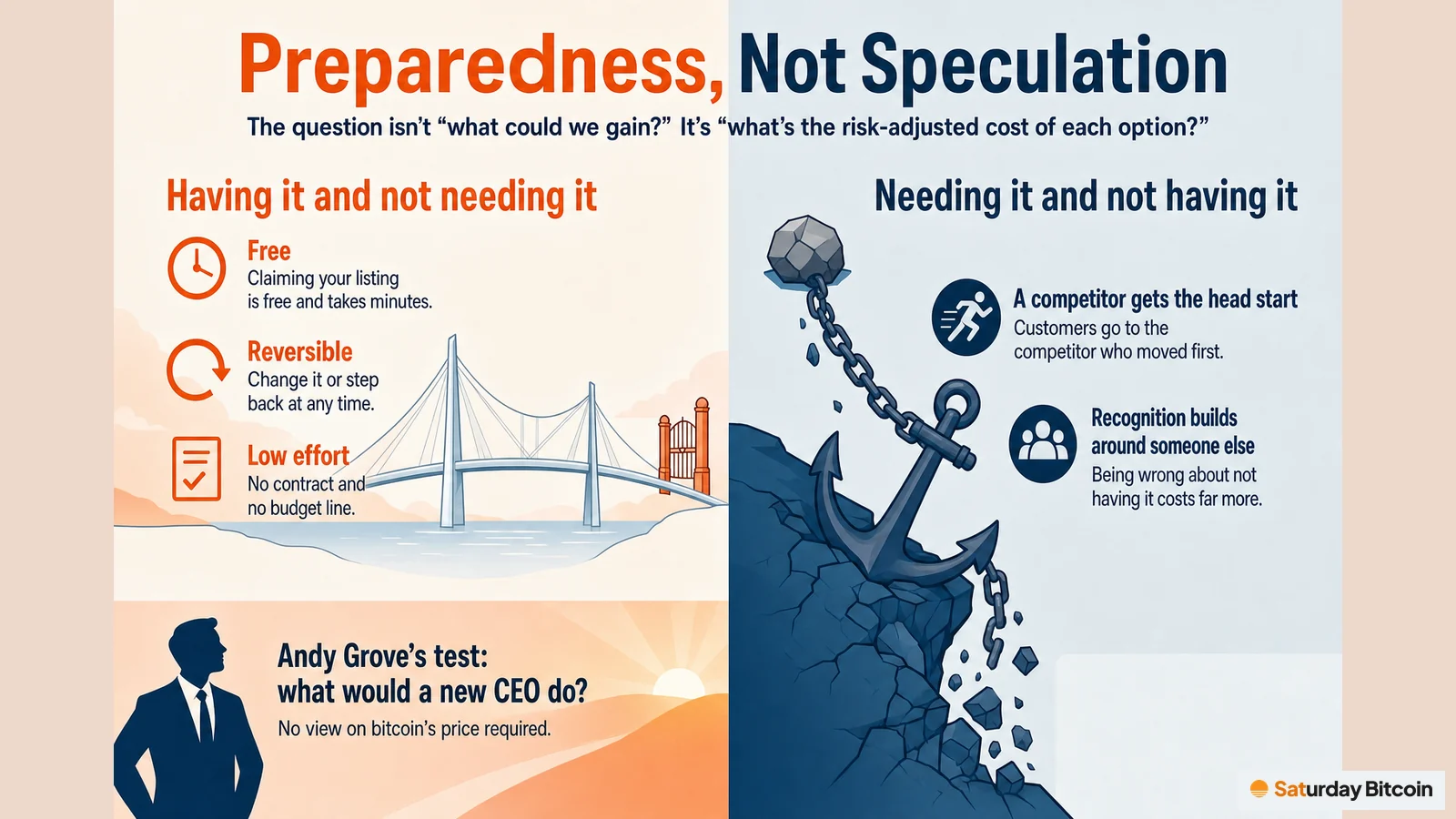
You don’t have to hold a view on bitcoin’s price. The customer segment is real either way, and the merchant bitcoin strategy doesn’t depend on where the price goes.
Try Andy Grove’s test from Intel: what would a new CEO do? A new executive with no stake in “wait and see” wouldn’t hesitate to take a free, reversible, low-effort step toward a segment a competitor may already be courting.
An honest limit
Being discovered doesn’t guarantee volume. The committed segment is small next to the mass market. Many Bitcoiners still pay by card, out of habit, for card rewards, because of tax friction, or to support you on principle. That customer still counts. When they do pay in bitcoin, it happens on your bitcoin channel: lower processing costs than cards (which average about 2.3% + $0.25 online), final settlement and no chargebacks, and you decide refunds. Saturday Bitcoin is a directory, not a payment processor, so we can’t see your purchases. And your product and service still have to be right. Bitcoiners are loyal to merchants who welcome them, but they aren’t loyal to bad experiences.
Your move
Some Bitcoiners in your category are looking for a merchant right now. Claim your free listing at saturdaybitcoin.com/business. It takes minutes, and it’s free, reversible, low effort, with real upside. Category consolidation is underway.